Dashcams 101 & Dangerous Intersections: The Ultimate Guide to Capturing Evidence and Advocating for Safer Streets
The modern roadway is a highly complex, rapidly evolving ecosystem where human behavior, vehicle technology, and legacy civil engineering intersect on a daily basis. For the everyday commuter navigating rush-hour congestion, the neighborhood watch lead monitoring local traffic behaviors, or the protective parent driving their children to school, the streets can often feel like a landscape of unpredictable risks. Every day, millions of drivers traverse environments that were originally designed for different eras, facing compounding dangers from high-speed arterials, distracted driving, and increasingly complex junction geometries.
In this contemporary landscape, automotive safety is no longer confined to the traditional passive measures of seatbelts, crumple zones, and airbags. It has evolved into a highly proactive, data-driven discipline that relies heavily on digital evidence collection and coordinated community advocacy. We are witnessing a paradigm shift in how we approach traffic safety, moving from a model of post-accident reaction to one of technological preparation and infrastructural accountability.
This comprehensive research report examines the two most critical pillars of modern road safety and accident mitigation. The first pillar focuses on internal vehicle technology, specifically the optimal deployment, placement, and technical configuration of dashboard cameras (dashcams) to capture indisputable, high-fidelity forensic evidence. The second pillar addresses external infrastructure, analyzing the ten most dangerous intersection design patterns in the United States and outlining the low-cost, high-impact engineering countermeasures that communities can successfully champion to save lives. Finally, the analysis explores the emerging concept of "Human Media"—platforms that bridge the gap between driver-to-driver communication and community reporting to redefine neighborhood security and drastically reduce law enforcement response times.
Part I: The Silent Witness – Advanced Dashcam Deployment and Evidence Capture
The proliferation of dashboard cameras has fundamentally altered the landscape of automotive liability, insurance claims processing, and forensic crash reconstruction. No longer viewed as a niche gadget for extreme driving environments, the modern dashcam serves as an objective, unblinking, time-stamped observer that directly mitigates the inherent unreliability of human memory, the emotional bias of involved parties, and the frequently conflicting accounts of eyewitness testimony.
The Statistical Impact of Video Evidence on Liability and Justice
The integration of video evidence into post-incident analysis yields profound, mathematically measurable benefits for drivers, insurance carriers, and law enforcement agencies. When a collision occurs, the immediate aftermath is typically chaotic. Adrenalline runs high, and drivers who caused an accident rarely volunteer immediate admissions of guilt. In these scenarios, the presence of a dashcam completely neutralizes "he-said, she-said" stalemates and supports the growing movement toward smart, documented crash response by bystanders and victims.
Industry data consistently indicates that insurance claims supported by clear, continuous dashcam footage are resolved approximately 35% to 50% faster than claims relying solely on verbal accounts, physical damage assessments, and standard police reports. Furthermore, statistical analyses reveal that drivers utilizing dashcams are roughly 40% more likely to have disputed claims settled favorably in their direction. This is largely because video footage exposes the mechanical reality of the event: exact vehicle positions, braking patterns, lane discipline, and the state of traffic signals at the moment of impact. Video evidence is also the primary tool used by commercial fleets and private drivers to expose fraudulent "crash-for-cash" schemes, such as swoop-and-squat maneuvers, where fraudsters intentionally cause a rear-end collision to extort insurance payouts.
In the context of severe incidents, particularly hit-and-run collisions, the value of video evidence scales exponentially. Hit-and-run crashes represent a massive crisis on American roadways, occurring approximately every 43 seconds in the United States. In 2016 alone, hit-and-run crashes resulted in 2,049 fatalities, a number that has been steadily increasing over the last decade. In cases involving severe property damage, bodily injury, or death, a dashcam's ability to capture a fleeing vehicle's make, model, color, and most importantly, its license plate, serves as the primary catalyst for law enforcement investigations. Having this visual data immediately available dramatically reduces the timeline for suspect identification, providing police with actionable leads within hours rather than weeks. In the highly specialized field of forensic pathology, continuous video recording from dashcams has even proven crucial during death scene investigations (DSI), helping medical examiners definitively differentiate between an accidental pedestrian strike and an intentional, suicidal act by observing the pedestrian's premeditated movements prior to impact.
The Art and Science of Optimal Dashcam Placement
Purchasing a high-end, 4K dashcam is only the first step in securing your vehicle; improper physical installation can render the most expensive device legally problematic and operationally useless. Placement requires a delicate balance: the camera must possess an unobstructed, comprehensive view of the roadway, yet it must be installed in strict adherence to state windshield obstruction laws to avoid traffic citations.
Front-Facing Camera Positioning and Geometry
The universal consensus among professional installers, safety advocates, and automotive engineers dictates that the optimal location for a primary, front-facing dashcam is high up on the front windshield, centered horizontally, and tucked directly behind the rearview mirror. This specific geometric placement achieves several critical operational objectives that maximize the quality of the collected evidence:
Field of View Optimization and Distraction Mitigation: Placing the camera body behind the rearview mirror provides a perfectly balanced, wide-angle perspective of the road ahead, capturing both the immediate lane and adjacent traffic. Crucially, this placement hides the device's screen and blinking operational LEDs from the driver's direct line of sight, preventing dangerous visual distractions, particularly during night driving when overall visibility and driver focus are already compromised.
Wiper Sweep Integration: A common, fatal mistake in dashcam installation is placing the lens too high or too far to the passenger side, placing it outside the physical reach of the windshield wipers. In the event of a crash during a rainstorm, snowstorm, or when the glass is obscured by highway grime, a camera mounted outside the wiper sweep will only record an illegible, blurred smear. The lens must sit within the area actively cleared by the wiper blades to guarantee clear footage in adverse weather.
The 60/40 Exposure Rule: The vertical angle of the camera lens is just as important as its physical location. The lens must be tilted to capture a precise ratio: approximately 60% road and 40% sky. Angling the lens too high upward forces the camera's internal exposure sensor to constantly adjust for the bright glare of the sky. Consequently, the camera will severely underexpose the lower portion of the frame, turning the road, surrounding vehicles, and vital license plates into dark, illegible silhouettes. Positioning the lens to favor the road ensures balanced, highly detailed exposure of ground-level hazards.
Rear-Facing Camera and Cabin Configurations
For drivers seeking comprehensive protection, dual-channel systems featuring a secondary rear-facing camera are highly recommended. The rear camera should be mounted at the top center of the rear windshield, angled slightly downward to capture the flow of following traffic and document the moments immediately preceding a rear-end collision. For vehicles equipped with heavily tinted rear windows or privacy glass, ensuring the camera lens sits flush against the glass surface can help mitigate internal glare and reflection. In cases where a vehicle has an opaque rear enclosure (such as a cargo van or box truck), external, weather-proof cameras mounted near the license plate are required. For rideshare drivers or protective parents wishing to monitor teenage driving habits, a three-channel system that includes an interior cabin-facing camera equipped with infrared (IR) night vision provides total situational awareness and pairs well with structured near-miss review and coaching after close calls.
Critical Cable Management and Airbag Safety
While dangling power cables are an obvious aesthetic nuisance and a mild distraction, improper cable routing poses a severe, potentially lethal safety hazard in modern vehicles. Wires routed hastily or lazily straight down the A-pillar (the structural frame on either side of the windshield) directly cross the deployment path of modern side-curtain airbags. In the violent event of a collision, a deploying airbag expands with explosive force. If a dashcam cable rests over the airbag module, the deployment can turn the taut cable into a dangerous projectile inside the cabin, or it can instantly sever the dashcam's power supply precisely at the moment the impact needs to be recorded. To ensure safety and reliability, cables must be meticulously routed along the edge of the roof headliner, tucked safely behind the A-pillar weatherstripping, and secured behind all airbag deployment zones down to the fuse box or power outlet.
Navigating State-by-State Legal Restrictions
Legislation governing dashcam usage varies significantly by jurisdiction, and ignorance of the law is not a valid defense if footage is challenged in court. While video-only recording in public spaces is universally recognized as legal across all 50 states, windshield obstruction laws differ wildly. For example, the state of Alabama expressly prohibits suction-cup windshield mounts entirely, requiring that devices be mounted directly to the dashboard to preserve the driver's unhindered field of vision.
Furthermore, audio recording invokes complex wiretapping statutes. In "two-party consent" or "all-party consent" states (such as California, Florida, Illinois, and several others), recording audio within the enclosed, private space of a vehicle cabin requires the explicit, informed consent of all passengers present. Failure to disable the microphone or obtain recorded consent in these jurisdictions can not only result in criminal penalties but can render the entire video recording completely inadmissible as evidence in civil litigation or insurance disputes.
Part II: Configuring for Clarity – Technical Settings that Secure Convictions
Owning a high-end dashcam is irrelevant if the internal software settings are not aggressively optimized for the harsh realities of the road. The ability to successfully identify a fleeing hit-and-run vehicle or read a blurred street sign in a split-second frame hinges entirely on technical configuration. Default factory settings are frequently geared toward saving SD card space rather than maximizing forensic detail, leaving drivers with useless, grainy footage after a severe, high-speed, or low-light incident. These same configuration choices can also affect how well your camera captures common danger patterns like near-misses that never get reported but signal serious risk.
The Triumvirate of Quality: Resolution, Frame Rate, and Bitrate
Video quality is not determined by a single metric, but rather a complex interplay between resolution, frame rate, and bitrate. Understanding these three pillars is essential for setting up a dashcam that functions as a reliable forensic tool.
Resolution: The Pixel Density Imperative
Resolution dictates the raw number of pixels captured in each individual frame of video. While 1080p (Full HD) was historically the industry standard, it is now widely considered the absolute bare minimum for modern driving environments. Today, 4K Ultra HD (2160p) is the benchmark for superior clarity and evidence collection. A 4K image contains precisely four times the number of pixels as a standard 1080p image. This massive increase in pixel density is paramount during post-accident analysis. When an investigator or insurance adjuster pauses a video and digitally zooms in on a distant, fleeting license plate, a 1080p image will quickly degenerate into illegible, blocky pixels. In contrast, a 4K resolution preserves the fine geometric details of alphanumeric characters, allowing for positive identification even at considerable distances.
Frame Rate (FPS): Conquering Motion Blur
Frame rate, measured in frames per second (FPS), dictates how many individual still images the camera captures every second to create the illusion of motion. Standard recording typically occurs at 30 FPS. However, traffic accidents are defined by extreme kinetic energy and rapid movement. Consider the physics of two vehicles passing each other in opposite directions on a standard road, each traveling at 50 mph. The combined closing speed of those vehicles is 100 mph. At 30 FPS, the camera may only capture one or two frames of the passing car, resulting in a smeared, stretched blur caused by motion blur. By configuring the dashcam to record at 60 FPS, the camera doubles the number of still frames captured per second, significantly reducing motion blur and producing smooth, crisp images where fast-moving details remain locked in sharp focus.
Bitrate: The Unsung Hero of Video Compression
Even with 4K resolution and 60 FPS, footage can appear awful if the bitrate is too low. Bitrate determines exactly how much digital data is stored per second of video. Dashcams must compress video files heavily to fit hours of driving onto a tiny microSD card. If a camera uses high compression (a low bitrate) to save space, the video will suffer from heavy compression artifacts—meaning fast-moving scenes like trees passing by or complex roadway textures will turn into muddy, blocky, pixelated messes, completely destroying fine details like license plates. For high-quality 4K forensic recording, a constant bitrate (CBR) of 15,000 to 20,000 kbps is highly recommended to preserve the integrity of the data.
| Recommended Resolution | Minimum Frame Rate | Recommended Bitrate (kbps) | Primary Use Case and Forensic Value |
|---|---|---|---|
| 1080p (Full HD) | 60 fps | 6,000 – 9,000 | General daily driving; adequate for close-range incidents and slower urban traffic. |
| 1440p (2K HD) | 30 fps / 60 fps | 9,000 – 12,000 | Enhanced overall clarity; provides a good balance of visual detail and SD card storage efficiency. |
| 2160p (4K Ultra HD) | 30 fps (or 60 if supported) | 15,000 – 20,000 | Professional-grade evidence collection; absolutely essential for digital zooming and low-light plate capture. |
Advanced Illumination Processing: WDR and HDR
The majority of severe accidents and pedestrian fatalities occur in dark or low-light conditions. Driving at night presents extreme challenges for camera sensors. The environment is generally pitch black, punctuated by the blinding glare of oncoming LED headlights, streetlamps, and reflective surfaces. License plates, by design, are highly retroreflective. When a vehicle's headlights strike a license plate at night, a standard camera sensor will massively overexpose the image, rendering the plate as a glowing, featureless white rectangle.
To combat this, premium dashcams employ High Dynamic Range (HDR) and Wide Dynamic Range (WDR) technologies, paired with advanced hardware sensors like the Sony STARVIS line. These technologies work by rapidly capturing multiple alternating frames at different exposure levels—one underexposed to capture the bright highlights (the license plate), and one overexposed to capture the dark shadows (the surrounding street). The processor instantly merges these frames, balancing the extreme brights and deep shadows to produce a perfectly exposed image where reflective alphanumeric characters remain crisp and legible against the dark background.
Essential Evidence Preservation Settings
To guarantee that crucial footage is systematically protected and not accidentally lost, specific operational protocols must be actively engaged within the camera's menu:
Loop Recording Intervals: Dashcams record continuously, overwriting the oldest footage when the memory card is full. This loop recording should be set to manageable intervals of 1 to 3 minutes. Smaller file sizes are significantly easier to lock, download to a smartphone via Wi-Fi, and transmit to police or insurance web portals without the connection timing out or the file size exceeding attachment limits.
G-Sensor Calibration: The internal accelerometer (G-Sensor) detects sudden shifts in kinetic energy (impacts, heavy braking, swerving) and automatically tags and locks the current video file in a protected folder, preventing the loop recording function from ever overwriting it. However, this sensitivity must be carefully calibrated to the specific suspension of your vehicle. If set too high on a stiff-riding car, simply driving over standard potholes or railroad tracks will trigger the sensor, rapidly filling the protected memory partition with useless clips and leaving no room for actual collision data when it is desperately needed.
Part III: The Anatomy of Danger – The 10 Most Dangerous Intersection Patterns
While a properly configured dashcam flawlessly documents the harsh reality of a collision, it is the underlying civil engineering and infrastructural design that largely dictates the mathematical probability of that collision occurring in the first place. Intersections represent the most intense, concentrated points of vehicular, pedestrian, and cyclist conflict in any municipal grid. According to data from the Federal Highway Administration (FHWA), over 50% of all combined fatal and injury crashes in the United States occur at or immediately near intersections.
A rigorous analysis of national crash data—including heavily scrutinized hazard zones like California's Orange County, the congested corridors of Los Angeles, and the rapidly expanding, high-speed arterials of the American South and Southwest—reveals consistent, systemic, and deadly flaws in legacy intersection design.
The traditional approach to mitigating these dangers relied almost exclusively on modifying human behavior through endless public education campaigns or punitive police enforcement. However, the modern "Safe System Approach"—the core philosophy driving the national Vision Zero initiative—posits that human error, distraction, and misjudgment are inevitable biological realities. Therefore, the infrastructure itself must be fundamentally designed to accommodate those human errors without resulting in fatal transfers of kinetic energy.
Based on crash histories, engineering studies, and fatality reports, safety advocates have identified the 10 most inherently dangerous intersection patterns currently dominating American roadways. Many of these also appear repeatedly in broader research into dangerous intersections and extreme driving conditions.

1. The Multi-Lane Urban Arterial (The "Boulevard of Death")
Wide, multi-lane arterials, originally designed primarily for rapid, high-volume vehicle throughput rather than community connectivity, represent the absolute deadliest environment for pedestrians and perpendicular cross-traffic. Locations such as Roosevelt Boulevard in Philadelphia, PA (which records upwards of 75 severe accidents annually at specific nodes) and the Pacific Coast Highway (PCH) running through Huntington Beach, CA, epitomize this threat. These massive intersections routinely require vulnerable road users to traverse six to eight lanes of high-speed traffic, often exceeding 40 mph. The sheer crossing distance means pedestrians are exposed in the conflict zone for an extended duration, leaving almost zero margin for error if a driver runs a red light or fails to yield.
2. The Skewed or Diagonal Intersection
Intersections that do not meet at standard, perpendicular 90-degree angles create profound vision and geometric complications. When roads intersect at skew angles greater than 75 degrees, it fundamentally breaks a driver's line of sight. Drivers are forced to crane their necks unnaturally to look over their shoulders to check for oncoming high-speed traffic—a physical maneuver that becomes increasingly difficult, painful, and prone to failure for aging driver populations with reduced cervical mobility. Furthermore, the skewed, elongated geometry physically increases the distance and the total time required for a vehicle or a pedestrian to completely clear the intersection, drastically prolonging their window of exposure to cross-traffic.
3. The Unprotected Left-Turn Conflict Zone
Signalized intersections that permit left turns on a solid green light (requiring the driver to yield to oncoming traffic) are prime locations for catastrophic, high-impact T-bone (angle) crashes and severe pedestrian strikes. Drivers waiting in the middle of the intersection frequently experience psychological "gap misjudgment." Anxious to clear the intersection before the light turns red, they attempt to violently accelerate through a brief, perceived opening in oncoming traffic. In doing so, their cognitive focus and visual tracking are entirely consumed by the oncoming cars, completely blinding them to the presence of pedestrians or cyclists who concurrently possess the legal right-of-way in the exact crosswalk the driver is aggressively turning into.
4. The High-Speed Rural Unsignalized Crossing
It is a statistical reality that approximately two-thirds of all intersection fatalities occur at unsignalized, stop-controlled intersections, and these tragedies are heavily weighted toward rural environments. At these specific locations, a minor, low-volume road controlled by a simple stop sign intersects with a high-speed, two-lane rural state highway. Catastrophic side-impact crashes typically occur because the stopped driver mathematically misjudges the approach speed of the highway vehicles (which may be traveling at 60 mph or more). Additionally, poor highway geometry—such as approaching curves, blind crests, or overgrown vegetation—severely limits the physical sight distance necessary for the stopped driver to perceive the cross-traffic in time to make a safe crossing decision.
5. The Wide-Radius Slip Lane
Slip lanes (or channelized right turns) are explicitly designed to allow vehicles to make right-hand turns without stopping, prioritizing the uninterrupted flow of vehicle traffic over the safety of pedestrians. When these lanes feature wide, sweeping, gentle radii, they psychologically encourage drivers to maintain speeds of 20 to 30 mph completely through the turn. Executing this high-speed, sweeping maneuver forces the driver to look continuously over their left shoulder to spot a merging gap in the cross-traffic. Consequently, the driver's attention is entirely diverted away from the crosswalk that sits directly in front of them on their right side, leading to high-speed pedestrian impacts.
6. The Obstructed Sightline (Lack of Daylighting)
In dense, gridded urban environments, municipalities frequently allow on-street parking to extend too close to the corner of an intersection, creating severe, deadly blind spots. When large SUVs, opaque delivery box trucks, or commercial vans park right up to the painted crosswalk line, approaching drivers simply cannot see pedestrians stepping off the curb until they are already physically in the travel lane. Conversely, pedestrians, particularly children or those in wheelchairs, cannot see approaching vehicles without stepping out from behind the parked car and directly into the danger zone. This lack of mutual visibility is a primary driver of urban pedestrian fatalities and is a major focus of modern pedestrian and cyclist safety strategies.
7. The Complex Freeway Interchange Transition
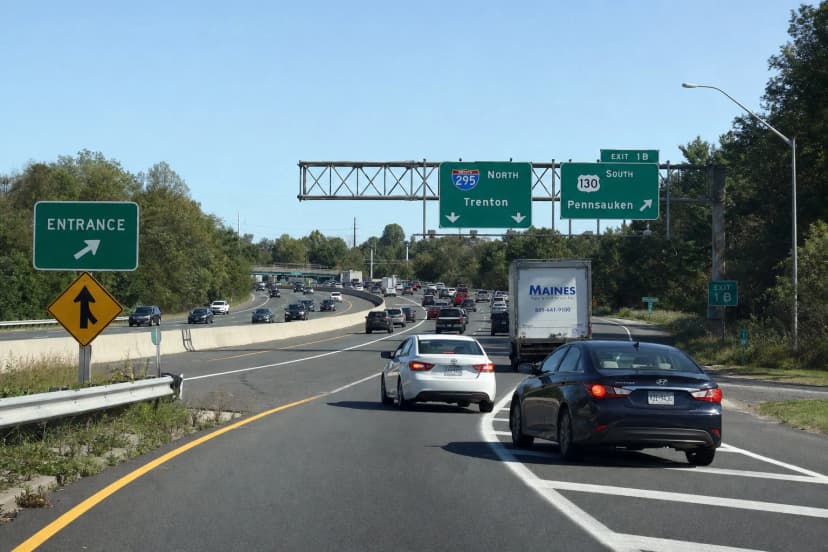
Intersections positioned immediately at the terminus of a major freeway off-ramp represent a highly volatile mixing zone. These areas force high-speed, decelerating highway traffic to suddenly merge with local, slow-moving, stop-and-go urban surface traffic.
To illustrate the localized severity of these specific design flaws, we can examine recent crash data from Orange County, California—a region defined by massive freeway interconnectivity and heavy arterial volume. Data sourced from the California Statewide Integrated Traffic Records System (SWITRS) reveals how these freeway transitions and wide, complex arterials dominate the list of the region's deadliest hotspots. This is the same environment where community-led safety hubs are beginning to push back using local data and tools.
| Rank | Intersection | City | Reported Accidents | Reported Injuries | Key Risk Factor |
|---|---|---|---|---|---|
| 1 | Newport Blvd & Victoria St | Costa Mesa | N/A (Ranked #1) | N/A | Freeway transition (SR-55 terminus) |
| 2 | Harbor Blvd & Orangethorpe Ave | Fullerton | 60 | 82 | Complex intersection |
| 3 | Edinger Ave & Beach Blvd | Huntington Beach | 55 | 89 | High traffic volume |
| 4 | Harbor Blvd & La Palma Ave | Anaheim | 55 | 79 | 55+ crashes annually |
| 5 | Beach Blvd & Ball Rd | Anaheim | 53 | 84 | Pedestrian hazards |
Table: High-Risk Conflict Zones: Orange County's Most Dangerous Intersections (2024-2025 Data). Note that Newport Blvd & Victoria St consistently ranks as the absolute most dangerous due to the confusing, high-speed transition from the SR-55 freeway directly into surface street cross-traffic.
8. The Poorly Lit Nighttime Junction
The presence and quality of artificial lighting profoundly impact intersection safety. National statistics are staggering, revealing that over 76% of all pedestrian fatalities occur in dark conditions. Intersections equipped with only a single, dim overhead luminaire fail to provide the necessary visual contrast for drivers to identify dark-clad pedestrians in crosswalks, navigate complex turning movements, or perceive median islands. The degradation of visual acuity at night, combined with insufficient lighting infrastructure, turns otherwise standard intersections into lethal traps.
9. The "Stale Green" Dilemma Zone
Long, straight arterial corridors with infrequent, widely spaced traffic signals encourage habitual speeding. When drivers approach an intersection at 50 mph and the light suddenly turns yellow, they enter what traffic engineers call the "dilemma zone." This is the mathematical and physical space where a driver calculates that it is physically impossible to brake safely before the stop line, but maintaining speed risks running the red light if the cycle is short. This split-second panic decision frequently results in devastating, high-speed, right-angle (T-bone) crashes when the opposing traffic gets the green light and proceeds into the intersection simultaneously.
10. The Unmarked Crosswalk in Commercial Corridors
In sprawling suburban environments and "stroads" (streets functioning as high-speed roads), public transit bus stops, large apartment complexes, and commercial strip mall entrances are frequently placed at intersections entirely lacking painted crosswalks, dedicated pedestrian signals, or raised refuge islands. Vulnerable road users—often low-income workers relying on transit—are forced to play a deadly game of Frogger, navigating across multiple lanes of fast-moving traffic without any structural protection or visual warning provided to approaching drivers.
Part IV: Empowering Communities – Low-Cost, High-Impact Engineering Fixes
Historically, when a community identified a dangerous intersection, the municipal response was often paralyzing. Major geometric reconstructions, land acquisitions for road widening, or the installation of entirely new, mast-arm traffic signal systems can cost upwards of $600,000 per intersection and take anywhere from two to five years of planning and construction to execute.
However, under the modern Vision Zero framework, safety advocates and local transportation departments are increasingly deploying "quick-build," rapid, low-cost countermeasures. These physical and procedural interventions typically range in cost from a mere 1,000 to 50,000, yet they fundamentally alter driver psychology and physical traffic flow, drastically reducing fatal crash rates almost overnight. Communities must understand these tools to effectively advocate for their implementation and to complement everyday protective driving strategies like smart merging and conflict-free lane changes.

1. Intersection Daylighting: The Power of Visibility
"Daylighting" is the simple, powerful practice of removing visual obstructions—primarily illegally or legally parked vehicles—from the curb space immediately adjacent to crosswalks. By clearing the last 20 to 30 feet of curb before an intersection, both drivers and pedestrians gain vastly improved, unobstructed sightlines.
Implementation: Rather than relying on easily ignored red painted curbs, proactive cities utilize "hardened daylighting." This involves installing physical infrastructure like white flexible delineator posts (flex posts), heavy steel bike corrals, or large concrete planters to physically block vehicles from parking in the visual clearance zone.
Cost and Impact: Daylighting is remarkably inexpensive and fast to deploy. Using flex posts at roughly $40 each, an entire four-way intersection can be effectively daylit for between 160 and 960, plus the minimal cost of municipal paint and labor. The FHWA notes that physically restricting parking near intersections can yield an immediate 30% reduction in pedestrian crashes.
2. Leading Pedestrian Intervals (LPI): The Seven-Second Lifesaver
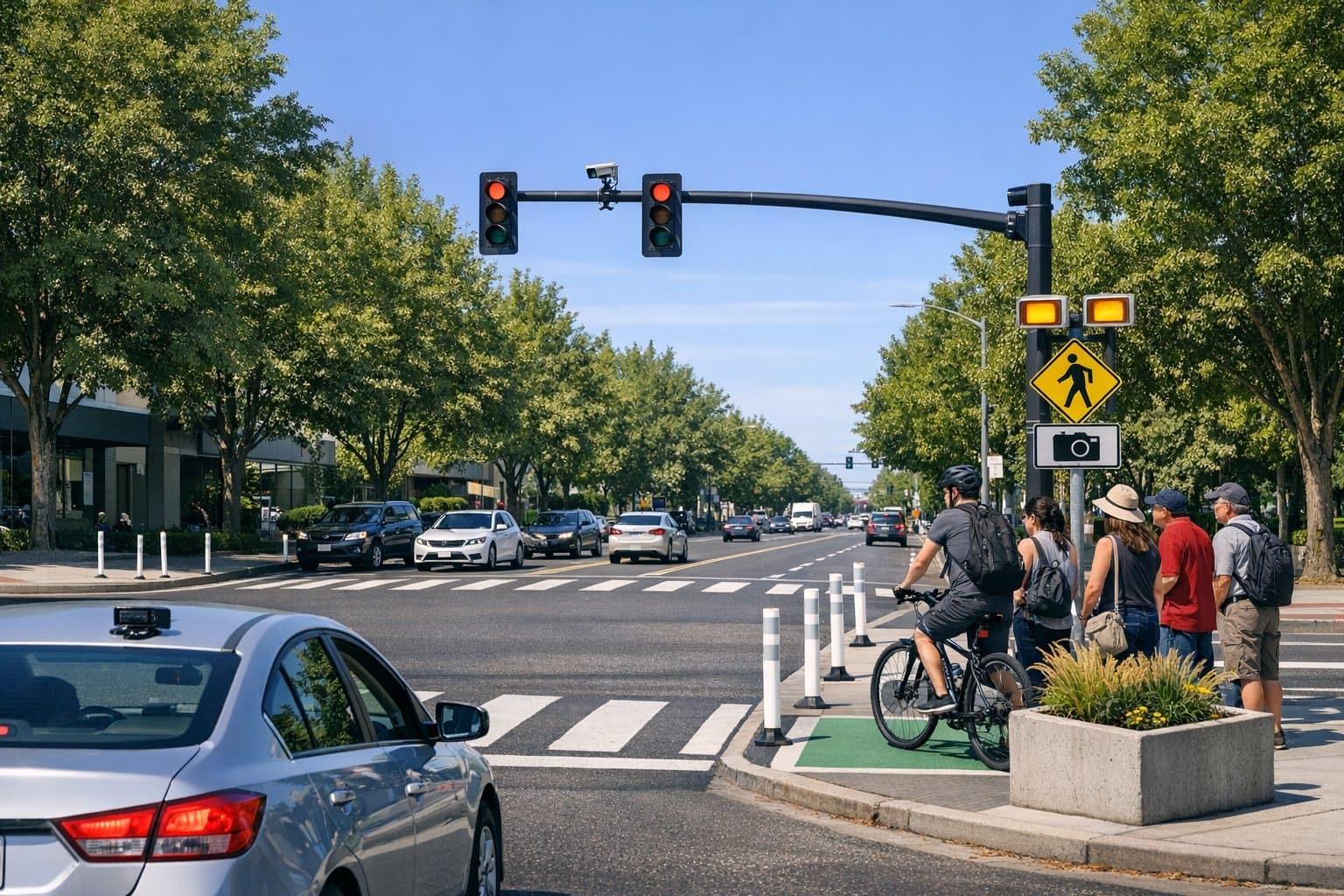
A Leading Pedestrian Interval (LPI) is a software solution that requires no concrete or asphalt. It involves a simple reprogramming of the existing traffic signal control cabinet. An LPI provides pedestrians with a 3- to 7-second head start to enter the crosswalk with a "Walk" signal before the concurrent, parallel vehicle traffic is given a green light.
Mechanism of Action: This brief head start allows pedestrians to leave the curb and establish their physical presence squarely in the center of the crosswalk. This moves them completely out of the turning vehicle's dangerous A-pillar blind spot and asserts their right-of-way, forcing turning drivers to yield.
Cost and Impact: Because it requires absolutely no new physical infrastructure, the cost of implementing an LPI is practically negligible (often just the labor hours of a traffic engineer). Extensive scientific studies, including a massive analysis of over 6,000 New York City intersections, demonstrate that LPIs reduce total vehicle-pedestrian crashes by a staggering 58.7%, making it arguably the single most cost-effective safety treatment available to modern cities.
3. Hardened Centerlines and Turn Wedges: Slowing the Swerve
As detailed earlier, left-turning vehicles striking pedestrians in the crosswalk is a persistent hazard. Drivers aggressively "cut the corner" diagonally across the intersection, allowing them to maintain lethal speeds through the turn. Centerline hardening puts a physical end to this behavior. It utilizes modular, bolt-down rubber curbs and highly visible bollards installed directly on the double-yellow centerline, extending slightly into the middle of the intersection.
- Mechanism of Action: The physical rubber barrier forces the driver to navigate deeper into the center of the intersection before initiating their turn, forcing them to make a much slower, sharper, right-angled turn rather than a sweeping diagonal swoop.
Cost and Impact: Installed in an afternoon for a few thousand dollars using durable, recycled rubber materials, hardened centerlines have been associated with a massive 70.5% reduction in near-miss conflicts between left-turning vehicles and pedestrians. Furthermore, they drastically reduce the mathematical odds of a vehicle exceeding a survivable 15 mph during the turn.
4. Rectangular Rapid Flashing Beacons (RRFBs): Commanding Attention
For unsignalized mid-block crossings, trails, or suburban commercial corridors, traditional painted crosswalks are essentially invisible to distracted motorists. RRFBs are push-button activated, high-intensity LED beacon systems mounted on poles adjacent to the crosswalk. They utilize a highly irregular, stuttering flash pattern (specifically modeled after the strobe patterns of police emergency vehicles) to cut through visual noise and aggressively command driver attention.
Cost and Impact: While slightly more capital-intensive than a bucket of paint or a row of flex posts (systems typically range from $10,000 to $25,000 depending on whether they utilize solar panels or require hardwired trenching), RRFBs are exceptionally effective. Research indicates they can yield motorist compliance and stopping rates as high as 98%, and overall, they lower total pedestrian crashes by an impressive 47%.
5. Rural Stop-Control Enhancements: Waking Up the Highway
For the incredibly dangerous, high-speed rural intersections mentioned earlier, the systematic application of basic, low-tech signing and marking improvements provides immense, lifesaving value.
Mechanism of Action: The goal is to aggressively alert a fatigued, "highway-hypnotized," or distracted driver that an intersection is approaching long before they reach the actual stop line. Interventions include installing oversized, highly retroreflective "Stop Ahead" warning signs, doubling the stop signs (placing them on both the left and right sides of the road for maximum visibility), and milling transverse rumble strips into the asphalt on the approach to provide a loud, tactile physical vibration.
Cost and Impact: These comprehensive rural enhancement packages generally cost between a highly affordable 3,000 and 10,000 per intersection. When deployed systemically, they are proven to reduce fatal angle crashes related to drivers blowing through stop signs by approximately 30%.
Part V: The Intersection of Tech and Advocacy – Building a "Human Media" Network
The ultimate, systemic goal of modern road safety is bridging the gap between passive evidence collection (dashcams) and active community intervention (infrastructure advocacy). While high-resolution dashcams reliably record the raw data, and municipal traffic engineers possess the technical knowledge to implement the low-cost fixes, a vital missing link remains: mobilizing the community to hold dangerous drivers accountable in real-time and demanding infrastructural changes based on hyper-local, undeniable video evidence. This is where safe reporting of dangerous drivers and intersection chaos becomes part of everyday driving, not just an afterthought.
From Passive Recording to Proactive Safety: The Human Media™ Shift
Traditional social media algorithms thrive on abstract complaints, isolated outrage, and unverified neighborhood gossip. However, a revolutionary emerging concept known as "Human Media™" seeks to completely repurpose our digital connectivity toward real-world, tangible impact. This philosophy fundamentally transforms the isolated, individual dashcam user into an active node within a much broader, highly responsive community watch network.
Platforms dedicated to driver-to-driver communication, such as Carszy, bypass traditional social networks by leveraging the one unique, public identifier that every single vehicle on the road shares: the license plate.
Secure License Plate Messaging: The Preemptive Strike
Consider the incredibly common, yet highly dangerous highway hazard of a vehicle driving at night with inactive taillights, or a family SUV cruising down the interstate with a tire severely underinflated and on the verge of a blowout. Historically, surrounding drivers had absolutely no safe, non-aggressive mechanism to alert that driver to their peril. Honking or flashing high-beams is frequently misinterpreted as road rage and can escalate tense situations that are better handled with calm, evidence-based approaches to spotting and managing reckless behavior.
License Plate Messaging completely changes this dynamic. It allows a concerned driver to securely and anonymously text a vital alert using only the offending vehicle's license plate number. This functionality creates a localized ecosystem of preemptive safety—allowing a community to warn a driver of a mechanical failure, an open gas cap, or critically, a dog locked in a hot car, effectively intervening before a tragic incident or accident even occurs.
Mobilizing with VOIS™ (Vehicle of Interest Search)
When severe, criminal incidents like hit-and-runs, amber alerts, or human trafficking abductions occur, law enforcement response times and overall case resolution rates are heavily, almost exclusively dependent on the rapid collection of visual evidence and vehicle tracking. A localized, interconnected dashcam network acts as a massive force multiplier for public safety.
If a reckless, impaired driver causes a devastating crash at a known dangerous intersection and immediately flees the scene, a single victim's dashcam might only capture a partial license plate or a vague vehicle description due to the closing speed. Through sophisticated community alert systems like VOIS™ (Vehicle of Interest Search), community members and victims can instantly broadcast these partial details to a massive network of local, tech-forward drivers.
Other users in the vicinity can then review their own dashcam loops from that specific timeframe and geographic location. By crowdsourcing the missing puzzle pieces—perhaps a driver three blocks away captured the fleeing vehicle clearly at a red light—the community provides law enforcement with a complete evidentiary package, drastically compressing investigation timelines from months into mere hours.
Data-Driven Community Advocacy
Finally, community watch leads, school board members, and safety-conscious parents no longer need to rely on easily dismissed anecdotal complaints when petitioning stubborn city councils for traffic calming measures. By aggressively aggregating geo-tagged dashcam footage of terrifying near-misses, habitual red-light running, and dangerous pedestrian conflicts at specific, known intersections, neighborhoods can present irrefutable, data-driven visual dossiers to local transportation departments. This undeniable visual evidence provides the exact, urgent justification required by bureaucrats to instantly unlock funding for the low-cost, high-impact fixes—like daylighting and LPIs—that save lives, especially around school zones where children are most exposed.
Conclusion: The Architecture of Accountability
Achieving the ultimate goal of zero traffic fatalities requires a comprehensive, multifaceted approach that addresses both the complex machinery we operate and the unforgiving environments we traverse.
Within the cabin of the vehicle, deploying a high-resolution, 4K dashcam is unequivocally the single most effective action a driver can take to proactively protect themselves from liability disputes, insurance fraud, and the devastating financial aftermath of hit-and-run incidents. Ensuring the camera is placed correctly behind the rearview mirror within the wiper sweep, wired safely away from side-curtain airbags, and meticulously set to capture high-bitrate, 60 FPS video guarantees that the device serves as an unimpeachable, silent witness to the truth.
Outside the vehicle, recognizing the inherent, systemic flaws in legacy road design—from wide, high-speed multi-lane arterials to visually obstructed corners—must shift the civic conversation away from endlessly blaming victims and toward rapidly engineering physical solutions. Communities now possess the data and the tools to relentlessly advocate for proven, incredibly inexpensive interventions like intersection daylighting, leading pedestrian intervals, and hardened rubber centerlines. These simple geometric changes collectively neutralize the deadliest elements of traffic physics and align with a broader shift toward community-led, tech-enabled road safety.
Ultimately, safety is not an individual luxury; it is a shared, communal responsibility. By combining the undeniable, high-definition proof of modern dashcam technology with the proactive, protective communication of Human Media networks, everyday drivers have the power to transform our roadways from isolated, dangerous corridors into connected, deeply accountable communities.
Equip your vehicle. Ensure your dashcam is optimized for the dark roads ahead. Advocate passionately for smarter, slower intersections in your neighborhood. And to take the next step in community protection, download the app to stay connected at carszy.com, turning every commute into an opportunity to watch out for one another.