Surviving the Elements: A Comprehensive Hub for Driving in Extreme Weather and Navigating Dangerous Intersections
The modern roadway represents a complex, highly dynamic ecosystem where human behavior, infrastructure design, and atmospheric conditions continuously intersect. Every year, the United States witnesses an average of 5.89 million vehicle crashes, an astonishing figure that highlights the inherent risks of vehicular travel. While factors such as human distraction and excessive speed command significant attention in public safety campaigns, environmental variables and roadway geometry play a monumental, often underestimated role in traffic safety. Approximately 21 percent of all motor vehicle collisions are directly weather-related, resulting in nearly 5,000 fatalities and over 418,000 injuries annually. Simultaneously, intersections—planned points of conflict where divergent traffic streams cross paths—account for roughly 40 percent of all crashes and over 20 percent of fatal collisions nationwide.
When extreme weather conditions overlap with inherently dangerous intersection designs, the risk to everyday drivers, protective parents, commuters, and vulnerable pedestrians multiplies quickly. Truly understanding these risks means going beyond basic driver's education and digging into the real-world mechanics of weather, human behavior, and urban planning.
This comprehensive research report serves as a centralized, expert-level hub for understanding the multifaceted hazards of modern driving. It dissects the meteorological mechanics of rain, fog, extreme heat, wildfire smoke, and flooding, detailing how each element compromises vehicle physics and driver cognition. Furthermore, this report identifies the ten most dangerous intersection patterns recognized by safety engineers and outlines low-cost, high-impact interventions that community advocates and neighborhood watch leads can champion. Finally, the analysis explores how emerging technologies, specifically driver-to-driver communication and real-time community reporting platforms, are revolutionizing roadway safety by shifting the paradigm from reactive emergency response to proactive, community-driven accident prevention. For a deeper look at how community tools can reshape street safety, see how community-led tech interventions are transforming road safety in 2026.
Part I: The Atmospheric Adversaries: Decoding Weather-Related Driving Risks
Weather conditions drastically alter the operational limits of both the vehicle and the human operator. Precipitation, thermal extremes, and atmospheric particulates affect tire traction, visibility, cognitive processing, and traffic flow. The National Highway Traffic Safety Administration (NHTSA) and the Federal Highway Administration (FHWA) have compiled decades of data showing exactly how and when the elements turn deadly.
The following sections provide an in-depth breakdown of the five primary weather hazards, the statistical realities of their impact, and the critical vehicle and behavioral adjustments required for survival. This section acts as a master hub, summarizing the top risks for each condition.

1. Rain and Wet Pavement: The Ubiquitous Hazard
Despite the widespread and routine nature of rain, it remains the most lethal atmospheric condition for motorists across the nation. Human psychology often normalizes rain, so many drivers do not show the same caution they would during a blizzard or tornado. However, crash data paints a very different, more sobering picture.
| Weather / Road Condition | Annual Average Crashes | Annual Average Injuries | Annual Average Fatalities | Share of Weather Crashes |
|---|---|---|---|---|
| Wet Pavement | ~981,000 | ~435,000 | ~4,500 | 70% - 75% |
| Rainfall (Active) | 573,784 | 228,196 | 2,732 | 46% - 47% |
| Snow/Sleet | 219,942 | 34,206 | 407 | 18% |
| Fog/Low Visibility | 32,871 | 11,292 | 407 - 488 | 3% - 4% |
Data aggregated from the Federal Highway Administration (FHWA) and National Highway Traffic Safety Administration (NHTSA). Note: Conditions often overlap (for example, active rain on already wet pavement).
The Mechanics of the Threat Rain fundamentally alters the friction between the vehicle's tires and the asphalt. During prolonged dry spells—a very common pattern in regions like Southern California, Arizona, and Texas—engine oil, grease, brake dust, and other fluids build up on the road surface. When the first rain of the season hits, these hydrophobic substances mix with the water to create an exceptionally slick, emulsified film. This is why the first hour of a rainstorm is often far more dangerous than later hours, before the grime is washed toward the shoulders. For more ways to respond after scary close calls in wet or changing weather, drivers can follow an evidence-based near-miss collision action plan.
As water pools on the roadway, vehicles also become highly susceptible to hydroplaning (or aquaplaning). Hydroplaning occurs when the volume of water encountered by a tire exceeds the tread's ability to move that water out of the way. Once that threshold is passed, the tire is lifted off the asphalt and rides on a thin film of water instead. Steering and braking grip disappear almost instantly, turning the driver into a passenger.
Required Adjustments for Commuters
-
Speed Reduction: Hydroplaning can begin at speeds as low as 35 mph on roads with heavy pooling. As a simple physics rule of thumb, vehicle speed should be reduced by at least one-third on wet roadways.
-
Following Distance Modification: Braking distance increases significantly on wet asphalt because friction is lower. Following distances should be doubled or even tripled to allow enough perception-reaction time and mechanical stopping distance. Wet brakes need more time and space to work properly.
-
Deactivation of Cruise Control: Using cruise control on wet surfaces is a serious error. If the vehicle starts to hydroplane, the cruise system may sense a drop in wheel speed and try to accelerate, which makes the skid worse and can trigger a spin.
-
Illumination Laws: Headlights must be on to improve how visible you are to others. In many states, including California, the law clearly says headlights must be on whenever windshield wipers are in continuous use because of rain or other bad weather.
2. Fog and Low Visibility: The Illusion of Safety
While fog accounts for a smaller overall share of weather-related crashes than rain, the crashes that do occur in fog are far more likely to be deadly. Research from the AAA Foundation for Traffic Safety shows that crashes in fog result in 17.3 fatalities per 1,000 crashes—a staggering 155 percent more deaths per crash than those in clear weather, even after adjusting for other severity factors. Over 38,700 vehicle crashes happen in fog each year, and more than 600 people lose their lives.
The Mechanics of the Threat Fog is essentially a dense cloud of microscopic water droplets sitting near the ground. It creates severe optical hazards by scattering light, which slashes contrast and visibility. Even more dangerous, fog causes “spatial disorientation” in the human brain. Without clear background reference points, we struggle to judge speed and distance accurately.
Drivers in fog often travel much faster than they realize, falling into a psychological trap known as “speed adaptation.” Because the normal visual cues along the roadside are blurred or hidden, the sensation of speed is muted. When a hazard—like a stopped vehicle or a suddenly appearing intersection—finally emerges from the mist, the driver is usually going too fast to stop within their limited line of sight. This human limitation is a key reason we see massive, multi-vehicle pileups on highways during fog events. If you’re forced to pull over after a fog-related crash or breakdown, knowing how to respond safely as a bystander can be the difference between life and death, which is why a dedicated bystander crash-response playbook is so valuable.
Required Adjustments for Commuters
-
Strict Optical Management: High-beam headlights must never be used in fog. The bright light reflects off the tiny droplets straight back into the driver’s eyes, creating a blinding white wall. Low-beam headlights and dedicated fog lights (mounted lower to the ground to light the pavement under the densest layer of fog) are the only safe choice.
-
Pavement Tracking Techniques: In near-zero visibility, drivers should use the right edge of the road or the painted right-side lane markings as their guide. Staring at the center line alone increases the risk of drifting into oncoming traffic.
-
Acoustic Awareness: Turn off the radio, reduce cabin noise, and consider slightly lowering a window at intersections. Listening for approaching vehicles you cannot yet see can give you a crucial early warning.
3. Extreme Heat: The Invisible Infrastructure and Mechanical Stressor
Extreme heat is rarely talked about in the same dramatic way as blizzards or hurricanes, yet climate data shows it causes more reported deaths in the United States each year than any other weather hazard. For motorists, extreme heat silently stresses both the vehicle’s hardware and the human body.
The Mechanics of the Threat Asphalt absorbs and traps solar radiation. Road surface temperatures can easily climb above 140°F (60°C) when the air temperature is “only” 100°F (38°C). This intense surface heat speeds up the breakdown of rubber compounds in tires. At the same time, the air inside the tire expands as temperatures rise. Underinflated, overloaded, or very worn tires are then much more likely to suffer catastrophic blowouts at highway speeds. Commercial truck tire blowouts can send debris flying into adjacent lanes, forcing nearby drivers into sudden, dangerous maneuvers.
High ambient temperatures also strain engine cooling systems, leading to overheating, sudden engine failure, and vehicles stalling in live traffic or on narrow shoulders. That creates a secondary hazard: many disabled vehicles sitting in risky, high-speed environments.
Inside the cabin, the greenhouse effect can push temperatures to deadly levels in minutes. Summer is especially dangerous for children and pets left unattended in parked cars. A child’s body temperature rises three to five times faster than an adult’s. Even when it feels mild outside—around 60°F—the inside of a vehicle parked in direct sun can climb to lethal levels. To understand how technology, law, and community alerts are starting to tackle this problem, explore how invisible guardians are preventing child and pet heatstroke in vehicles.
Required Adjustments for Commuters
-
Cold Tire Pressure Verification: Check tire pressure when tires are “cold” (first thing in the morning, before driving) for an accurate reading. Proper inflation limits sidewall flex, reduces internal heat buildup, and helps prevent blowouts.
-
Cooling System Maintenance: Inspect radiator hoses, which wear out faster in summer heat, for bulges or cracks. Flush and refill engine coolant with the proper 50/50 antifreeze and water mix, following manufacturer guidelines, so the system can handle high temperatures.
-
Cabin Thermal Management: Have the A/C system and cabin air filter checked. Using the “recirculate” mode helps the cabin cool faster by re-cooling interior air instead of constantly pulling in 100-degree outside air.
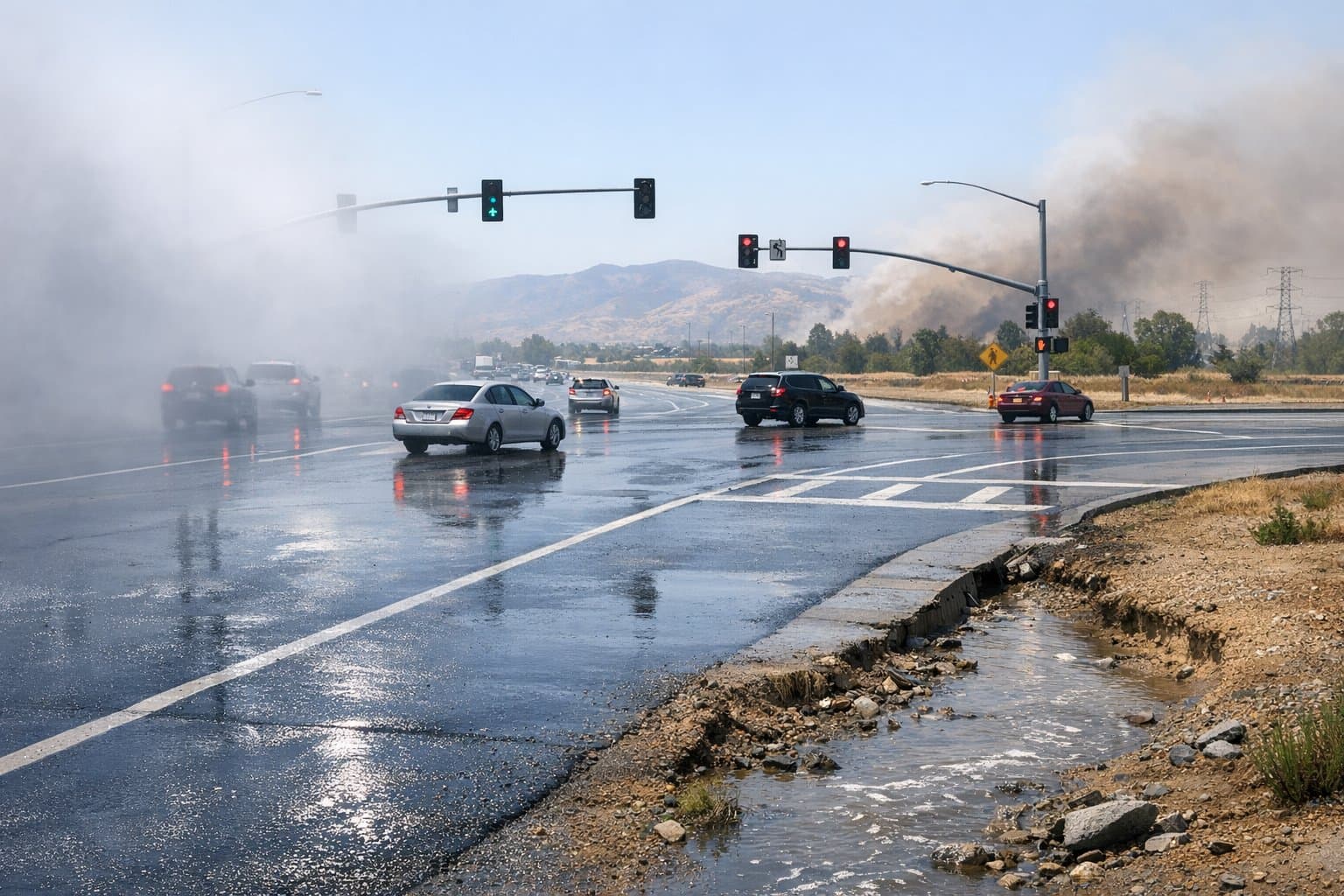
4. Wildfire Smoke and Ash: The Modern Ecological Hazard
Driven by shifting climate patterns, long droughts, and decades of fire suppression policies, wildfires have grown more frequent, longer-lasting, and more intense, especially in the Western United States. The resulting smoke plumes create a complex driving hazard that combines the low visibility of dense fog with the health threats of toxic pollution.
The Mechanics of the Threat Wildfire smoke is a dangerous mix of toxic gases and fine particulate matter (PM2.5). These tiny particles are small enough to pass deep into the lungs, slip into the bloodstream, and trigger respiratory crises. They worsen asthma and COPD and raise the risk of heart attacks and strokes. A striking study in Science Advances estimated that wildfire smoke contributed to more than 52,000 premature deaths in California alone over a ten-year window.
For motorists, driving through active fire zones or thick smoke presents immediate, extreme dangers. Visibility can drop to almost nothing, blocked by smoke and falling ash. Ash coats windshields and, if wiped dry, can permanently scratch the glass. Modern wildfires burning through the wildland-urban interface also consume plastics, building materials, and vehicles, releasing far more toxic chemicals than ordinary wood smoke. During panicked evacuations, heavy traffic often grinds to a halt, trapping drivers in super-heated, low-oxygen environments where engines can stall and air filters clog.
Required Adjustments for Commuters
-
Total Cabin Isolation: Keep windows closed and exterior vents shut. Set the HVAC system to “recirculate” so you are not constantly drawing in toxic outside air or carbon monoxide. Briefly switch to fresh air only once every hour to vent exhaled carbon dioxide, then return to recirculation.
-
Ash Management: Never run wipers over a dry, ash-covered windshield. Ash acts like sandpaper. First, soak the glass with plenty of washer fluid, then wipe to reduce scratching.
-
Combustion Prevention: Never drive through or park on dry grass or tall weeds during high fire-risk periods. Under the car, parts like the catalytic converter and exhaust system routinely exceed 1,000°F and can easily ignite dry vegetation.
5. Flooding: Hydrologic Force and Infrastructure Failure
Inland flooding, flash floods, and atmospheric rivers can all overwhelm road networks with little warning. Flooding shrinks usable roadway space, hides lane markings, and can weaken or destroy the pavement and base layers hidden under the water.
The Mechanics of the Threat The main danger of floodwaters is that people are not good at judging how powerful moving water really is. Water weighs about 62.4 pounds per cubic foot. The National Weather Service and the CDC warn that just 12 inches of fast-moving water can sweep away many passenger cars, and only two feet can move large pickup trucks and SUVs.
Murky floodwater can conceal washed-out sections of road, open manholes, or large debris. Trying to “push through” a flooded street can also cause hydrolock, a catastrophic failure where water is sucked into the engine’s air intake. This can destroy the engine instantly and leave the vehicle stranded as water rises.
Required Adjustments for Commuters
-
Turn Around, Don't Drown: The number-one rule for floods is simple: never drive into standing or moving water covering a road, no matter how shallow it looks or how large your vehicle is.
-
Route Deviation: Look for alternate routes early and monitor local emergency alerts or navigation tools for real-time road closures and flood warnings.
Part II: The Architecture of Danger: The 10 Most Dangerous Intersection Patterns
While severe weather raises the odds of a crash, the underlying geometry of the road network shapes where those crashes are most likely to happen. Intersections are the most complex environments a driver will ever face. They force the brain to track multiple vehicles moving at different speeds, pedestrians, blind spots, and changing signals—all at once.
According to the Federal Highway Administration, more than 50 percent of the combined total of fatal and injury crashes occur at or near intersections.
To understand where communities are most at risk, safety engineers, the National Highway Traffic Safety Administration (NHTSA), and metropolitan planning organizations use complex crash algorithms—factoring in crash frequency, injury severity, and collision type—to rank dangerous intersections.
A detailed analysis of high-risk hotspots nationwide—from the sprawling grids of Phoenix and Orange County to the dense corridors of Philadelphia and New Jersey—reveals ten repeating intersection patterns that consistently generate severe collisions. Many of these same patterns also appear where pedestrians and cyclists are most at risk, as explored in depth in this human-centric guide to pedestrian and cyclist safety.
Top Crash Hotspots: A Regional Snapshot
To see how this plays out on real streets, it helps to look at data from some of the country’s most dangerous intersections. These locations share the geometric flaws described below.
| Intersection Location | City / State | Fatal Crashes (2025 Data) | Key Risk Factors Noted |
|---|---|---|---|
| Lalor Street & SR-129 | Trenton, NJ | 7 | Heavy traffic, poor visibility, complex layout |
| Route 7 & Hickory Road | Niskayuna, NY | 5 | Pedestrian danger, lack of signals |
| Newport Blvd & Victoria St | Costa Mesa, CA | Highest in Orange County | Highway transition to surface streets, high speeds |
| Flamingo Road & S. Decatur Blvd | Las Vegas, NV | 4 | Tourist congestion, massive road spans |
| 99th Ave & Lower Buckeye Rd | Phoenix, AZ | 411 total crashes (multi-year) | Industrial/commuter mixing, high volume |
| I-70 & Jennings Station Road | St. Louis, MO | 3 | High-speed merging issues |
Data aggregated from state DOTs, MAG, and NHTSA FARS reporting.
1. The Severe Skewed Angle Intersection
Traditional, safer intersections meet at 90-degree right angles. When roads intersect at very sharp or very shallow angles (greater than 75 degrees or less than 60 degrees), the environment quickly becomes hazardous.
-
The Hazard: Skewed angles force drivers to crane their necks and twist their bodies to look for oncoming traffic, which shrinks the “vision triangle.” These angles also increase the distance and time a turning car or crossing pedestrian spends inside the conflict zone. Older drivers, who may have reduced neck and spine mobility, are especially vulnerable to angle crashes at these skewed intersections because they literally cannot turn far enough to see approaching threats.
2. High-Speed Rural-to-Urban Transition Zones
As suburbs expand, once-quiet rural highways are swallowed by busy residential grids, but the street design often doesn’t change fast enough.
-
The Hazard: These intersections usually keep high posted speed limits (55 mph or more) even as they begin to intersect with dense commercial or residential streets. Drivers cruising at highway speeds experience speed adaptation and often fail to slow down enough when approaching the intersection. Misjudging the speed of a vehicle barreling toward you at 60 mph can lead to devastating, high-energy T-bone crashes.
3. Wide Multi-Lane Arterials with Long Signal Cycles
Huge intersections with six to eight lanes of traffic (common in Sunbelt states like Arizona, Texas, and Florida) are built to move lots of cars, not to keep everyone safe.
-
The Hazard: The sheer width of these intersections creates a large exposure zone. Long signal cycles test drivers’ patience and tempt them to race the yellow. When someone runs a red across an eight-lane arterial, the resulting side-impact crash usually happens at high speed. Pedestrians often cannot cross all lanes in a single cycle and may end up standing in the middle on small, unprotected islands.
4. Permissive Left Turns Across Multiple Lanes
A “permissive” left turn happens when a driver turns left on a solid green and must yield to oncoming traffic, rather than waiting for a dedicated green arrow.
-
The Hazard: When a driver must judge the speed and distance of oncoming traffic across three or four lanes, the brain often gets the gap wrong. This leads to “Left Turn Across Path” (LTAP) collisions, which safety engineers recognize as one of the most common and deadly crash types in busy urban corridors. These same left-turn patterns are a major factor in many road rage and reckless driving incidents at intersections, especially when stress and impatience are already high.
5. Visual Clutter and Blind Driveways (The Halo Effect)
Many dangerous intersections are ringed by gas stations, strip malls, and fast-food drive-thrus packed tightly onto the corners.
-
The Hazard: Poor zoning and site design create chaotic merging zones just a few feet from the main traffic light. Drivers face billboards, bright signs, people walking, and cars turning in and out of driveways all at once. When a motorist focuses only on a changing traffic signal, they may rear-end a vehicle that suddenly brakes to turn into a driveway that seemed to “come out of nowhere.”
6. The Unsignalized Minor Road Crossing a Major Artery
Often found where quiet neighborhood streets meet busy main roads, these intersections have a stop sign on the minor road, while the major road traffic keeps flowing at speed.
-
The Hazard: Drivers on the minor road must judge small gaps in fast, heavy cross-traffic. Mistakes lead to severe angle crashes. The FHWA notes that unsignalized intersections are actually the most common intersection type in the U.S., and failures to yield the right-of-way are a leading cause of deaths.
7. Highway Off-Ramps Terminating at Surface Streets
Interchanges where high-speed interstate ramps end directly at surface-level traffic lights are notoriously risky, like the Hampton Avenue and I-44 interchange in St. Louis or complex SR-55 transitions in Costa Mesa.
-
The Hazard: Drivers exiting a highway experience “velocity blindness.” After an hour at 75 mph, 45 mph feels painfully slow, so they often approach the surface street intersection faster than they realize. That leads to hard rear-end crashes and red-light running. Complex weaving or lane changes just before the light add more instability right where drivers should be focused on slowing down.
8. Intersections Lacking Pedestrian Refuge and Visibility
Intersections near schools, bus stops, or shopping areas that are not designed with people on foot in mind are especially dangerous for those walking or using mobility devices.
-
The Hazard: Wide turning radii at the corners let vehicles take right turns at higher speeds, sweeping directly into the crosswalk. Without “daylighting” (clearing parked cars near the corner), turning drivers cannot see people stepping off the curb until it is almost too late. Without raised median islands, pedestrians are fully exposed to moving traffic for the entire time they are in the street.
9. Topographic Blind Spots: Crests and Curves
Some intersections sit just beyond a hill crest or are tucked around a sharp bend.
-
The Hazard: Local hills and curves physically block a driver’s view. Motorists coming over a crest may suddenly find stopped traffic at a red light with almost no time to react, which practically guarantees a high-speed rear-end collision. At night, poor lighting and tricky geometry make it even harder to judge safe gaps for turning.
10. The Complex "Offset" or Multi-Leg Intersection
These are locations where five or more roads converge, or where opposite legs of the intersection do not line up straight across from each other.
-
The Hazard: This geometry is confusing to most drivers. It is hard to tell who has the right-of-way, lane alignments feel uncertain, and turn paths overlap. Confusion leads to hesitation, sudden stops, and a high rate of sideswipes and angle crashes.
Part III: Blueprint for Survival: Low-Cost Fixes Communities Can Advocate For
For years, fixing dangerous intersections was seen as something that required tens of millions of dollars, major land takings, and decades-long construction to add overpasses or complex signals. But the modern traffic safety movement—led by groups like the National Association of City Transportation Officials (NACTO) and the global Vision Zero framework—has shown that targeted, low-cost changes can drastically cut crashes and save lives.
The core philosophy of Vision Zero is the “Safe System” approach. This approach starts from a simple truth: people will make mistakes behind the wheel. Instead of relying only on education campaigns or police enforcement, the physical street must be engineered so that when mistakes do happen, the crash forces are not deadly to the human body.
Neighborhood watch groups, safety-focused parents, and local advocates do not have to wait for a huge federal infrastructure bill. They can organize today and press city planners to roll out the following quick, high-impact fixes. Many of these inexpensive tools are the same ones featured in step-by-step guides to reclaiming chaotic intersections and reporting dangerous drivers.

1. Daylighting Intersections One of the cheapest and most effective tools any city can use is “daylighting.” This means removing parked cars within about 20 to 30 feet of an intersection. When parking is banned near corners, sight lines open up. Drivers approaching the intersection can clearly see people waiting to cross, and drivers pulling out from side streets have a much better view of oncoming traffic.
2. Painted Curb Extensions (Bulb-Outs) Instead of pouring expensive concrete to rebuild corners, cities can use bright paint and flexible bollards to create curb extensions. These narrow the roadway visually and physically at the intersection. The benefits are clear: pedestrians have a shorter distance to cross, so they spend less time exposed to moving traffic, and drivers must make tighter, slower turns, which greatly reduces the risk of high-speed “right hook” collisions with cyclists and people on foot.
3. High-Friction Surface Treatments (HFST) Intersections see constant braking and accelerating. Over time, this polishes the asphalt, making it slick even when dry. Applying a thin layer of durable, high-friction material to intersection approaches can sharply cut braking distances. An FHWA study in South Carolina found that adding HFST to rural stop-controlled intersections, at an average cost of just $6,000 per site, cut fatal and injury crashes by 10 percent and delivered about an 8:1 return on investment.
4. Retroreflective Signal Backplates A simple fix for signalized intersections is adding a yellow retroreflective border around the black backplate behind each traffic light. This low-cost upgrade—often under $100 per signal—makes the lights far more visible at night, during storms, and when the sun is low and glaring. That improved visibility gives drivers a few extra seconds to notice and respond, which can be the difference between a near-miss and a crash.
5. Leading Pedestrian Intervals (LPI) An LPI is purely a signal-timing change—no construction needed. It gives people walking a three to seven-second head start to enter the crosswalk before cars moving in the same direction get a green light. This brief head start places pedestrians clearly in the turning driver’s field of vision and has been shown to sharply reduce turning conflicts and “I didn’t see them” crashes. Pairing LPIs with better lighting and driver alerts makes them even more effective, especially at night or in bad weather, as explored in strategies for cutting nighttime driving risk with visibility and tech.
6. Mini-Roundabouts and Traffic Circles For stubborn neighborhood intersections controlled only by stop signs, installing a mini-roundabout using temporary materials, planters, or paint forces all traffic to slow down and navigate around a central island. This design eliminates high-speed, right-angle T-bone crashes and replaces them with lower-speed merging conflicts that are far less likely to cause serious injury.
Part IV: The Frontier of Safety: Connected Communities and Real-Time Accountability
While weather and bad design create the physical risks on our roads, the speed at which a community can detect, share, and respond to those risks often determines how severe the outcome will be.
For decades, traffic incident management followed a reactive pattern. A crash would happen, someone eventually called 911, dispatch gathered details, and then emergency medical services fought through traffic to reach the scene.
The research is blunt: in traffic trauma, time is everything. Studies show that when police and EMS arrive within 5 minutes, the chance of making an arrest in a related crime—such as a hit-and-run—is about 60 percent. When response time stretches past 5 minutes, that chance drops to around 20 percent. In rural areas, average “Detection and Response Time” (DRT) has historically been much worse, though modern technology has helped reduce average rural DRT from about 26.5 minutes to 22.1 minutes over recent decades.
The Danger of Distraction vs. The Power of Connection
Today, technology inside the vehicle can be both a major risk and a powerful safety tool. The NHTSA reports that distracted driving claimed 3,275 lives in 2023 alone. Sending or reading a text takes a driver’s eyes off the road for about 5 seconds. At 55 mph, that is like driving the length of a football field with your eyes closed. The National Safety Council estimates that cell phone use while driving is a factor in 1.6 million crashes each year.
But when technology is used for proactive intelligence instead of distraction, it becomes one of our strongest defenses. Studies of crowdsourced traffic apps show that community-reported data can detect crashes much faster than traditional highway patrol methods, which speeds up EMS dispatch and can save lives. Community reporting of near-miss events—even when a collision never actually happens—also helps agencies see patterns of danger before tragedy strikes, which is the core idea behind near-miss reporting and Sentiment Heatmaps for hidden risks.
In-cab digital alerts and connected vehicle tech have also been shown to change driver behavior in real time. Data from over 40,000 digital alert interactions revealed that drivers who received a heads-up about an upcoming hazard slowed down by an average of 17 percent, easing off the gas instead of slamming on the brakes at the last second.
Human Media™ and the Carszy Ecosystem
This connected, proactive approach is exactly where platforms like Carszy are pushing roadway safety. Instead of treating drivers as passive content consumers, the idea behind Human Media™ is to help people generate real-world, local impact that keeps neighbors safer.
By using license plates as unique, secure identifiers, driver-to-driver communication fills the critical awareness gap that traditional emergency services cannot cover alone.
-
Preventative Alerts via License Plate Messaging: Picture a driver in heavy rain or thick fog with no working taillights, or a car on a summer freeway with a visibly underinflated tire about to fail. Through Carszy, nearby motorists can send an instant, secure alert using only the license plate number. This tiny interaction can defuse a high-speed hazard before it ever becomes a crash, turning everyday drivers into active guardians of their corridors and school zones—similar to the community approach laid out in guides for protecting kids in school zones and dangerous intersections.
-
Community Mobilization and VOIS™: In the chaotic moments after a hit-and-run at one of the high-risk intersections described earlier, or during smoky wildfire evacuations, the VOIS™ (Vehicle of Interest Search) system taps into the collective observations of the community. This crowdsourced alert network helps quickly locate vehicles tied to critical incidents—such as abductions, trafficking, or serious crashes. By turning thousands of regular drivers into extra sets of eyes, VOIS™ shrinks the time gap that law enforcement often faces and can dramatically increase the odds of a fast, safe resolution.
-
Privacy and Accountability: This power is paired with strong safeguards. Using US-based servers and strict privacy controls, the platform enables real-time community reporting of dangerous driving and roadway hazards without turning into a surveillance tool. The goal is collective accountability, not voyeurism.
Ultimately, reducing the dangers of extreme weather and flawed roadway design takes more than simply telling people to “drive carefully.” It calls for a connected, alert, and empowered community. By learning the science behind these hazards, organizing for low-cost engineering fixes, and using modern tools to spot and report risk in real time, everyday people can help break what once felt like the “inevitable” cycle of traffic deaths. Local examples, like how Orange County residents are using connected reporting and events to build an OC road safety hub with the Carszy app, show what is possible when communities lean in together.
Safety-conscious parents, neighborhood watch advocates, and everyday commuters who want to take an active role in protecting their streets are encouraged to download the application at carszy.com to join a growing network dedicated to real-time awareness, accountability, and survival on the road.