School Zone Safety & The 10 Most Dangerous Intersections: A Modern Driver’s Guide to Protecting Our Streets
The daily commute has undergone a profound transformation over the last decade. The modern transportation ecosystem is characterized by an increasing presence of electric vehicles (EVs) capable of whisper-quiet operation and instant acceleration, a dramatic shift in driver psychology, and a nationwide infrastructure network that frequently struggles to accommodate modern traffic volumes safely. Furthermore, society is sharing the road with a population exhibiting elevated levels of stress and distraction; recent data indicates that nearly half of all Americans (49%) believe drivers in their local areas are operating vehicles more dangerously now than before the global pandemic.
This perception is heavily supported by empirical data. While advancements in automotive engineering have managed to reduce the rates and frequencies of motor-vehicle occupant deaths over time, the same protections have not translated to vulnerable road users outside of the vehicle.
The nation is currently grappling with a severe pedestrian safety crisis.
In 2022, the number of pedestrians struck and killed by vehicles reached a staggering 40-year high of 7,522 fatalities, representing an astonishing 75% increase in such deaths since 2010. To put this into perspective, this equates to an average of more than 20 pedestrians losing their lives every single day. Certain metropolitan areas have seen astronomical spikes in these tragedies. For instance, Memphis, Tennessee, has witnessed its pedestrian fatality rate nearly triple over a decade, reaching 5.14 deaths per 100,000 people. These statistics are not mere anomalies; they are the predictable outcomes of a transportation network that is often “dangerous by design,” prioritizing the rapid movement of vehicular traffic at the direct expense of human safety.
When this multi-ton, highly distracted kinetic energy is funneled into the concentrated, chaotic environment of a local school zone—an area populated by unpredictable children, rushed commuters, and complex pickup lines—the risk profile becomes exceedingly critical. The National Center for Education Statistics (NCES) reports that 38% of school leaders identify traffic patterns around their campuses as a direct and ongoing threat to the physical safety of their students. Despite the presence of flashing warning beacons, reduced speed limits, and community awareness campaigns, motorists continually fail to adjust their driving habits to meet the demands of these vulnerable spaces.
This exhaustive research report aims to bridge the critical gap between urban planning theory, modern driving behaviors, and cutting-edge community technology. The analysis will dissect the three riskiest operational moments within school zones, deconstruct the architectural anatomy of the ten most dangerous intersection patterns in the United States, and provide an actionable, low-cost infrastructure playbook designed for community watch advocates and protective parents. Finally, the report will explore the vital role of decentralized, peer-to-peer technology—specifically the shift toward “Human Media™”—in mobilizing communities to protect their own streets in real time, thereby reducing reliance on overburdened law enforcement resources. For an even deeper look at how neighborhoods are starting to lead this shift, see how Orange County built an OC road safety hub using the Carszy app to power its local efforts.
Part 1: School Zone Safety: The 3 Most Common Risk Moments and How to Avoid Them
School zones are fundamentally designed to be slow, predictable, and highly regulated environments. However, the practical reality of these spaces often involves frantic vehicle maneuvering, widespread non-compliance with traffic control devices, and unpredictable pedestrian movements. To effectively mitigate these hazards, safety engineers and modern drivers must understand the distinct psychological and mechanical factors defining the three most dangerous operational periods within a school zone.
1. The After-School Apex: Dismissal (3:00 PM – 4:00 PM)
Empirical traffic and crash data consistently point to the afternoon dismissal period as the single most dangerous time for students navigating the school zone and its immediate surrounding neighborhoods. According to the American Automobile Association (AAA) and the National Highway Traffic Safety Administration (NHTSA), the hour between 3:00 PM and 3:59 PM accounts for more school-age pedestrian fatalities caused by motorists than any other time of day.
The elevated risk profile during dismissal is generated by a confluence of environmental saturation and severe behavioral distraction. Unlike the morning arrival period—which tends to be somewhat staggered as parents drop children off at varying intervals before the final bell—dismissal represents a mass, simultaneous exodus. Hundreds of students exit the educational facility concurrently, instantly flooding adjacent sidewalks, crosswalks, and high-risk mid-block areas.
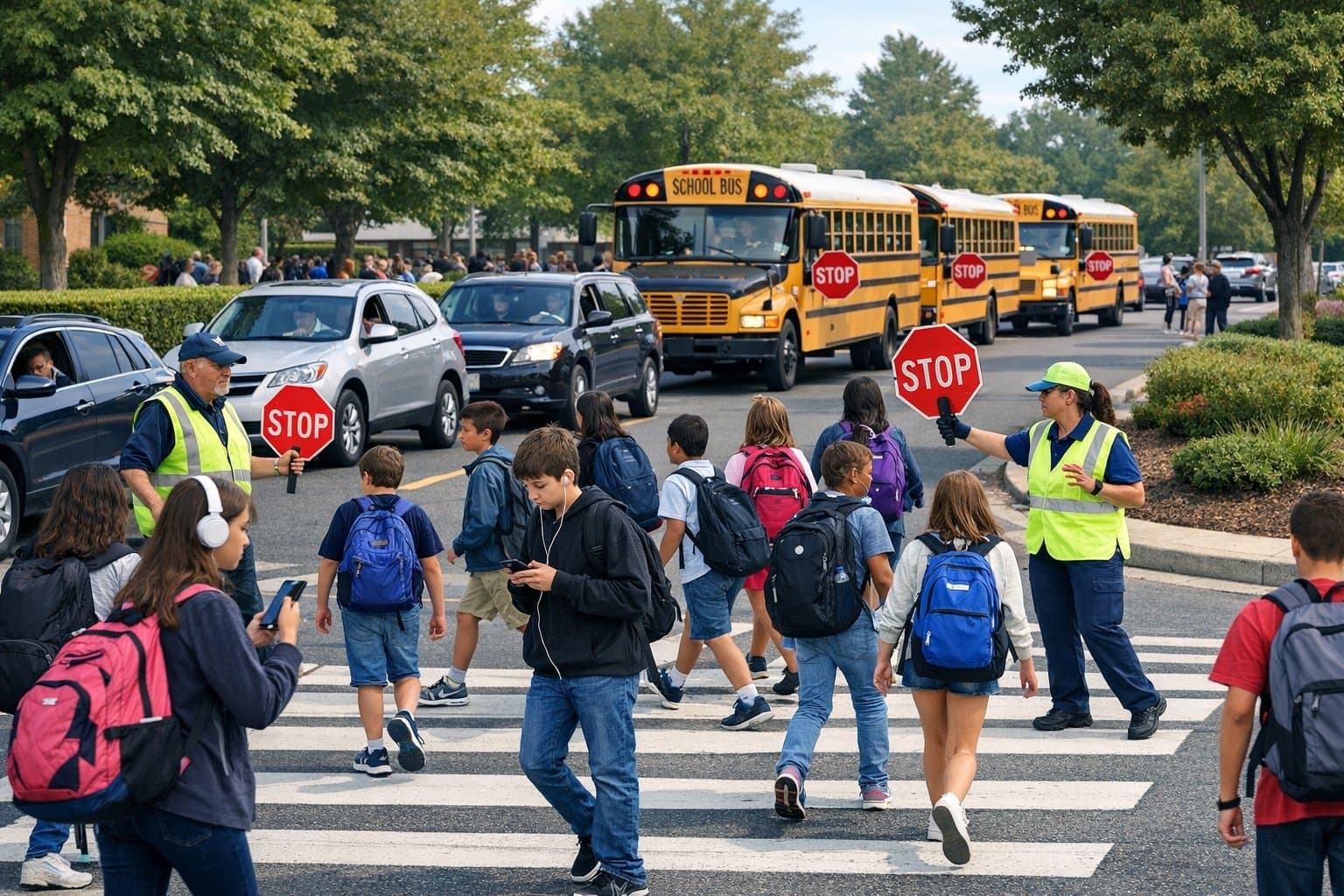
A massive observational study conducted by Safe Kids Worldwide, tracking the street-crossing behaviors of over 39,000 middle and high school students, revealed alarming trends. The study observed that 17% of middle school students and 27% of high school students actively crossed streets while distracted by mobile devices. The nature of this distraction fundamentally degrades situational awareness: 44% of the distracted teenagers were wearing headphones (eliminating crucial auditory cues of approaching vehicles), 31% were actively texting, and 18% were talking on the phone. When a highly distracted pedestrian population interacts with impatient drivers attempting to exit the school zone, the margin for error effectively drops to zero. These same distraction patterns also show up in close calls and “almost” incidents on regular streets; understanding those near misses is the focus of our guide to where near misses hide on our roads.
2. The Morning Rush: Arrival (7:00 AM – 9:00 AM)
If the afternoon dismissal is defined by overwhelming pedestrian volume and distraction, the morning arrival period is defined by vehicular density and driver panic. Crash data spanning a ten-year period from 2014 to 2023 reveals that the 7:00 AM to 7:59 AM window is the second deadliest hour for school-age pedestrians.
During the morning rush, the primary risks stem from driver impatience and egregious rule-breaking. Traffic safety engineers frequently observe a pervasive culture of the “rolling stop,” where drivers fail to bring their vehicles to a complete halt at stop signs, prioritizing momentum over safety. Additionally, the morning commute introduces a high density of stressed parents navigating complex, tightly packed drop-off loops. A common, highly dangerous habit observed by law enforcement is the practice of double-parking or stopping to let children out on the opposite side of the street, forcing young pedestrians to navigate through active lanes of moving traffic to reach the campus.
Furthermore, the morning arrival period heavily involves school bus operations. Statistics clearly show that the area extending ten feet around a school bus is the ultimate “danger zone” for children, yet impatient motorists continually violate stop-arm laws. In all fifty states, it is illegal to pass a school bus that has its red lights flashing and stop arm extended, yet driver compliance remains a massive issue. Startlingly, nearly one-fifth (19%) of all school-age pedestrians killed in school-transportation-related crashes are struck by other vehicles that are simply traveling straight past a stopped or slowing bus. Knowing how to calmly spot and respond to reckless behavior in this environment is essential; our framework for understanding road rage, recklessness, and insurance can help you recognize danger before it escalates.
3. The Crosswalk Conflict: Mid-Block and Uncontrolled Crossings
The third critical risk moment occurs at the actual point of crossing, particularly at uncontrolled intersection legs or mid-block locations. While traditional intersections often feature traffic lights to dictate the right-of-way, many school zones rely heavily on marked crosswalks and the presence of adult crossing guards. Unfortunately, a glaring infrastructure gap exists: approximately 59% of public schools lack crossing guards, leaving a massive void in student guidance and driver compliance enforcement.
Even when crossing guards are physically present to assist students, driver behavior can be shockingly reckless. Observational studies conducted during peak arrival and dismissal times have documented numerous instances of vehicles actively speeding around crossing guards or passing them without obeying their direct stop instructions. The risk is further exacerbated when children cross mid-block or outside designated areas. This behavior is significantly more likely to occur when existing crosswalks are poorly marked or entirely absent, a hazardous condition that is disproportionately prevalent in lower-income communities suffering from historical infrastructure underinvestment. Research indicates that when high-visibility enhancements (such as flashing beacons) are absent, driver yielding compliance at crosswalks drops drastically, sometimes plummeting to as low as 18%.
The Modern Playbook: Actionable Driving Habits to Reduce Risk
Understanding the statistical risks of the school zone is only the foundational step; actively modifying behavior behind the wheel is where lives are saved. The automotive landscape has changed, and driving habits must evolve accordingly. The following practices form the essential safety playbook for modern drivers navigating school zones:
- Mastering the Four-Second Rule: The traditional “three-second rule” for following distance is largely obsolete in an era defined by complex touchscreen infotainment systems, heavier vehicle weights, and widespread cognitive distraction. Adopting a strict four-second following distance in and around school zones provides the critical physical space and reaction time required if a distracted teenager unexpectedly steps off the curb or a vehicle abruptly stops ahead. Creating this extra buffer also protects you when another driver’s risky move turns into a near miss; if you’ve recently had an “almost crashed” moment, follow the steps in our 5-step near-miss action plan to document it and learn from it.
- Implementing “Phone-Down Before Key-In”: Hands-free operation is not risk-free operation. In highly volatile environments like active school zones, a driver’s visual and cognitive attention must be absolute. The most effective habit is to set GPS navigation, adjust audio settings, and completely stow the mobile device before shifting the vehicle into drive.
- Adapting to Electric Vehicle (EV) Dynamics: Drivers operating electric vehicles must actively compensate for the unique mechanical traits of the technology. EVs lack traditional internal combustion engine noise, meaning distracted, headphone-wearing pedestrians will not hear the vehicle approaching. Furthermore, the instant torque delivery of an EV can lead to unintentional speeding in tight, speed-restricted zones. Drivers must utilize one-pedal regenerative braking deliberately and maintain a hyper-vigilant visual scan of the surroundings.
- Respecting the “Bus Bubble”: Drivers must never pass a stopped school bus from behind or from the opposite direction on an undivided road. It is imperative to stop far enough back to give children a wide, ten-foot spatial buffer to enter or exit the bus safely.
- Eliminating the Rolling Stop: Drivers must come to a complete, absolute stop at all stop signs and crosswalk lines. A rolling stop in a school zone severely compromises a driver’s ability to scan for small, fast-moving pedestrians and represents an unacceptable gamble with community safety.
Part 2: The 10 Most Dangerous Intersection Patterns

While school zones represent a concentrated, time-specific danger, intersections represent the constant, baseline threat of the daily commute. Intersections are complex environments where dozens of high-speed decisions, conflicting vehicle trajectories, and vulnerable road users collide in fractions of a second. Nationally, intersections account for a disproportionate volume of fatal and serious injury crashes. In Michigan alone, approximately 30% of all fatal motor vehicle accidents occur at intersections.
By rigorously analyzing crash data from high-risk metropolitan areas—including Phoenix, Arizona (which routinely dominates regional danger lists), Springfield, Missouri, and extensive multi-state southern corridors—traffic safety engineers have successfully identified the specific design patterns that consistently lead to collisions. Between 2019 and 2023, over 100 fatal crashes occurred at just the top intersections across ten southern states, underscoring systemic engineering failures.
The following details the ten most dangerous intersection patterns that everyday drivers, commuters, and community watch advocates must learn to identify and navigate with extreme caution.
1. The High-Speed “Stroad” Arterial
A “stroad” is a dangerous infrastructure hybrid: a thoroughfare designed with the high speeds, multiple lanes, and wide geometry of a road, but featuring the complex commercial driveways, pedestrian traffic, and frequent stops of a street.
- The Danger: The intersection of 67th Avenue and McDowell Road in Phoenix, which recorded an astounding 251 crashes over a five-year period, is a prime example of this deadly pattern. These intersections feature wide, forgiving lanes that psychologically invite drivers to exceed the speed limit, combined with incredibly heavy retail and commuter turning traffic.
- The Result: The environment produces high-energy side-impact collisions and severe pedestrian fatalities, as drivers traveling 45 miles per hour or faster simply cannot react in time to vehicles entering the roadway from densely packed commercial parking lots.
2. The Unprotected Left Turn
Traffic analysis universally confirms that left-hand turns are inherently riskier than right-hand turns. In fact, statistical studies indicate that left turns are up to 55 times more dangerous than right turns, accounting for roughly 20% of all car accidents.
- The Danger: Unprotected left turns require a driver to accurately judge the speed, distance, and trajectory of oncoming traffic across multiple lanes, while simultaneously scanning for pedestrians actively using the crosswalk. Drivers naturally suffer from depth perception failures when judging high-speed oncoming vehicles. Furthermore, the modern vehicle’s A-pillar often creates a significant blind spot exactly where a pedestrian might be initiating a crossing.
- The Result: This maneuver frequently results in T-bone (side-impact) collisions and head-on crashes, which are statistically the deadliest types of motor vehicle accidents. The risk is so pronounced that many major commercial fleets utilize routing software to eliminate left turns entirely whenever possible.
3. Skewed or Angled Intersections
Not all intersections meet at a perfect, orthogonal 90-degree angle. Skewed intersections occur when roadways intersect diagonally, forcing drivers to look over their shoulders at unnatural, strained angles to check for cross-traffic.
- The Danger: Older drivers, or those with limited neck and spinal mobility, are particularly vulnerable at these locations. The skewed geometry drastically increases the vehicle’s structural blind spots for right-turning vehicles.
- The Result: Drivers mistakenly pull out into oncoming traffic because the intersection’s geometry physically prevented them from seeing approaching vehicles clearly, leading to severe angle collisions.
4. Multi-Lane Uncontrolled Pedestrian Crossings (The “Multiple Threat”)
This pattern involves a marked pedestrian crosswalk spanning three or more lanes of unidirectional traffic without the protection of a dedicated red light or a physical refuge island in the median.
- The Danger: This design creates the deadly “multiple threat” scenario. A driver in the right-hand lane observes a pedestrian and stops to allow them to cross. However, the mass of the stopped vehicle visually blocks the pedestrian from the view of the driver rapidly approaching in the adjacent left-hand lane.
- The Result: The left-lane driver, entirely unaware of the crossing pedestrian, maintains their speed and strikes the individual as they step out from in front of the stopped vehicle. This specific scenario is a primary driver of urban pedestrian fatalities.
5. High-Speed Slip Lanes
A slip lane is a dedicated right-turn lane physically separated from the main intersection by a small concrete triangle (often called a “pork chop” island), designed specifically to allow vehicles to turn right without stopping at the main traffic signal.
- The Danger: Slip lanes fundamentally prioritize vehicle throughput and speed over human life. They encourage drivers to look over their left shoulder to identify a gap in cross-traffic while simultaneously accelerating and turning their vehicle to the right—which is exactly where a pedestrian is attempting to utilize the crosswalk.
- The Result: Pedestrians are frequently struck by accelerating drivers whose visual attention was focused entirely in the opposite direction.
6. Confusing Lane Configurations and Asymmetrical Merges
Intersections characterized by multiple dedicated turn lanes, lanes that suddenly and unexpectedly become “turn only,” or short, aggressive merging zones heavily tax driver cognition and decision-making capabilities.
- The Danger: At notorious locations like Route 9 and Hammond Pond Parkway in Massachusetts, drivers frequently realize they are in the incorrect lane at the last possible second. This realization prompts erratic, unpredictable, and highly aggressive evasive maneuvers.
- The Result: These zones see exceptionally high rates of sideswipe crashes, rear-end collisions resulting from sudden braking, and escalating road rage incidents stemming from perceived cut-offs. If you’re caught in one of these tense moments, knowing how to safely respond and report what you see is key; use the strategies in our piece on how to report dangerous drivers and reclaim your intersection.
7. Poorly Lit and Nighttime Blind Spots
Crashes that occur during hours of darkness are exponentially more severe than daylight crashes. An intersection equipped with only a single overhead luminaire—or none at all—severely degrades a driver’s ability to navigate turning movements or identify pedestrians.
- The Danger: The human eye struggles significantly with contrast in low-light environments. A pedestrian wearing dark clothing at an unlit intersection is practically invisible until the approaching vehicle is within fifty feet, leaving zero time for evasive action. Drivers also underestimate how much their own headlights, cabin screens, and fatigue affect night vision; mastering a safer setup can dramatically change outcomes, as outlined in our guide to 10 immediate ways to cut night driving risk.
- The Result: Research demonstrates a tangible 2.9% reduction in the night-to-day crash ratio for every single 1-lux increase in minimum illuminance at an intersection box. Failing to adequately light these zones is a direct failure of municipal infrastructure.
8. Short Signal Cycles and The “Yellow Light Trap”
Long, wide intersections require adequate time for a vehicle to completely clear the intersection “box.” When municipalities program exceptionally short yellow lights to artificially improve overall traffic flow, they create a deadly behavioral trap.
- The Danger: Approaching drivers face a split-second dilemma zone: slam on the brakes and risk a high-speed rear-end collision, or accelerate rapidly to beat the light and risk a devastating T-bone crash with cross-traffic.
- The Result: These intersections exhibit high frequencies of red-light running and severe angle collisions, driven entirely by poor signal timing.
9. Habitual Speeding Corridors & Transition Zones
A transition zone is an area where a high-speed highway, rural route, or tollway suddenly enters a densely populated residential or commercial area.
- The Danger: Drivers entering these zones suffer from “speed adaptation”—a psychological phenomenon where, after driving 65 miles per hour for twenty minutes, 45 miles per hour feels incredibly slow. Consequently, they fail to adjust their speed adequately when approaching the first few intersections of the new, lower-speed zone.
- The Result: This results in high-velocity rear-end collisions at the first encountered traffic light and an inability to brake for pedestrians stepping into crosswalks.
10. High-Density Commercial Driveways Near Intersections
When gas stations, fast-food restaurants, and busy strip malls place their primary entry and exit driveways within a few dozen feet of a major signalized intersection, they create an overwhelming density of vehicular “conflict points.”
- The Danger: A driver attempting to navigate the main intersection must simultaneously track vehicles turning left, vehicles stopping for a red light, pedestrians in the crosswalk, and individuals abruptly braking to turn right into a commercial lot.
- The Result: This intense cognitive overload routinely leads to a failure to yield the right-of-way, causing localized fender-benders, sideswipes, and pedestrian strikes.
| Real-World Examples: Notorious Intersections & Primary Risks |
|---|
67th Avenue & McDowell Road (Phoenix, AZ) Risk: Wide lanes inviting dangerous speeds, long signal cycles pushing drivers to gamble on late yellows, resulting in severe side-impact collisions. This location recorded 251 crashes over a five-year study period. |
Route 9 & Hammond Pond Pkwy (Massachusetts) Risk: Highly confusing lane configurations, complex speed merging issues, and dense pedestrian traffic leading to crosswalk dangers. |
Beach Blvd & Chapman Ave (Orange County, CA) Risk: Immense traffic volume meeting complex pedestrian crosswalks, resulting in frequent red-light running and pedestrian hazards. |
Kansas Expressway & Sunshine Street (Springfield, MO) Risk: Massive speed transitions from highway environments to city streets, causing highly predictable rear-end collisions and left-turn failures. |
Part 3: Low-Cost Fixes Communities Can Advocate For
Recognizing dangerous intersection patterns is empowering, but accepting them as permanent, unchangeable fixtures of the neighborhood is unacceptable. Across the country, progressive safety engineers and urban planners are abandoning outdated models that prioritize maximum vehicle speed and throughput. Instead, they are adopting the Safe System Approach.
The Safe System Approach fundamentally accepts that human road users will inevitably make mistakes. Therefore, the transportation system—comprising safe roads, safe speeds, safe vehicles, and post-crash care—must be designed and managed so that these inevitable human errors do not result in death or serious injury. As kinetic energy increases, the probability and severity of a crash increase exponentially; the Safe System Approach aims to reduce impact forces to levels that are physically tolerable for the human body to sustain.
Fortunately, local communities do not need to wait for multi-million-dollar, decade-long infrastructure overhauls to see improvements. There is a heavily researched, proven menu of low-cost, high-impact “Traffic Calming” engineering fixes that neighborhood watch leads, concerned parents, and citizen advocates can successfully lobby their city councils to implement.
The Traffic Calming Engineering Playbook

1. Speed Feedback Displays (Radar Speed Signs)
- Mechanism: These are highly visible digital signs that utilize radar to read and display an approaching driver’s speed in real time.
- The Safety Impact: Radar signs provide an immediate psychological “nudge,” interrupting the driver’s speed adaptation. Studies show they reliably reduce vehicle speeds by 10% to 20%, particularly in habitual speeding corridors and active school zones. Furthermore, advanced models collect anonymized traffic data, providing communities with hard evidence to prove to local authorities that a systemic speeding problem exists.
- Implementation Cost: Low.
2. Rectangular Rapid Flashing Beacons (RRFBs)
- Mechanism: RRFBs are high-intensity, push-button-activated LED flashing lights installed directly at the crossing point of mid-block crosswalks.
- The Safety Impact: RRFBs are incredibly effective at curing the deadly “multiple threat” crash scenario. The Federal Highway Administration (FHWA) has found that installing RRFBs can increase driver yielding rates from a dismal 18% up to over 80%, even on wide, multi-lane roads.
- Implementation Cost: Low to Medium.
3. Intersection Daylighting & Curb Extensions
- Mechanism: “Daylighting” is the practice of removing parked vehicles from the immediate 20 to 30 feet surrounding an intersection, often replacing the space with high-visibility paint, flexible bollards, or physical curb extensions (also known as bulb-outs).
- The Safety Impact: Daylighting drastically improves critical sightlines. Children stepping into the crosswalk are no longer hidden behind large, parked SUVs. Curb extensions also physically narrow the roadway, significantly shortening the distance the pedestrian is exposed to live traffic and forcing turning vehicles to slow down to navigate the physically tighter turning radius. While daylighting is highly effective, it must be implemented correctly; poorly executed daylighting without physical barriers on high-speed truck routes can sometimes inadvertently increase speeds due to the perceived widening of the intersection.
- Implementation Cost: Very Low (if utilizing paint and plastic delineator posts).
4. Speed Humps, Tables, and Raised Crosswalks
- Mechanism: These are engineered vertical deflection devices. Unlike the harsh, jarring speed bumps found in private parking lots, speed humps and tables are elongated, gently sloped mounds of asphalt that allow vehicles to pass comfortably at a specific, safe design speed (e.g., 20 mph) but cause noticeable discomfort if traversed faster. A raised crosswalk simply elevates the entire pedestrian path so it is flush with the adjoining sidewalks.
- The Safety Impact: Vertical deflection is self-enforcing. A distracted or aggressive driver cannot simply ignore a physical mound of asphalt in the roadway the way they can ignore a painted speed limit sign. Raised crosswalks also dramatically improve ADA accessibility for students utilizing wheelchairs or mobility devices.
- Implementation Cost: Medium.
5. Pedestrian Hybrid Beacons (PHBs / HAWK Signals)
- Mechanism: A PHB is an overhead, pedestrian-activated signal specifically designed to facilitate uncontrolled mid-block crossings. It rests entirely dark until activated by a pedestrian, at which point it initiates a flashing yellow sequence before transitioning to a solid red light, legally requiring all motorists to come to a complete stop.
- The Safety Impact: PHBs provide an excellent, highly visible solution for locations where traffic volumes do not meet the strict engineering warrants required for a full traditional traffic light, but where pedestrian safety is severely compromised.
- Implementation Cost: Medium to High (though significantly less expensive than a full traffic signal installation).
| Countermeasure / Intervention | Target Risk Addressed | Estimated Crash Modification Factor (CMF)* | Relative Cost Range |
|---|---|---|---|
| Transverse Rumble Strips | Driver inattention at stop signs | Reduces crashes by ~28% (CMF 0.72) | Very Low (<1,000 to 10k) |
| “Stop Ahead” Pavement Markings | Late recognition of stop locations | Reduces crashes by ~15% (CMF 0.85) | Very Low (<$1,000) |
| Improved Intersection Lighting | Nighttime blind spots & pedestrian strikes | Reduces night crashes by up to 50% | Medium (5,000 - 15,000) |
| Rectangular Rapid Flashing Beacons (RRFBs) | Poor driver yielding at mid-block | Yielding compliance increases from 18% to over 80% | Medium |
| Raised Crosswalks (Vertical Deflection) | Habitual speeding in school zones / ADA access limitations | High physical speed reduction; self-enforcing design | Medium |
| * Note: A Crash Modification Factor (CMF) below 1.0 indicates a statistically expected reduction in crashes (e.g., a CMF of 0.85 indicates a 15% reduction). |
How to Advocate: The Citizen’s Action Plan
Vital safety infrastructure does not simply materialize; it requires organized, persistent, and data-driven community advocacy. If a neighborhood is plagued by cut-through speeders or a notoriously dangerous school crossing, residents should follow this proven municipal playbook:
- Document the Data (Request Action): The first step is to formally submit a Transportation Action Request (TAR) to the city’s Public Works or Transportation department. It is critical to frame the request strictly around safety impacts, not merely convenience. Asserting that “cars go fast” is insufficient. Advocates must utilize available local crash data, police reports, or crowdsourced analytics to document specific times of day, vehicular volumes, and near-miss incidents. Modern tools, including AI dashcams and community reporting apps, can help capture this evidence; for example, our deep dive into the future of AI dashcams and community safety explains how video can support safer streets.
- Form a Neighborhood Working Group: Municipalities heavily prioritize organized voices over individual complaints. Citizens should initiate a Neighborhood Traffic and Safety Education program. This grassroots effort can include distributing informational flyers, hosting local meetings, and deploying brightly colored “Drive Like You Live Here” yard signs to build visual consensus.
- Execute the “50% + 1” Petition: Most formal municipal frameworks (such as the Neighborhood Traffic Management Programs utilized in cities like El Paso, Texas, or DeSoto, Texas) require tangible proof of community buy-in before they will allocate funding or alter the roadway. Generally, advocates will need to canvas their neighbors and secure a formal petition signed by at least 50% of the affected households (and often 100% of the households immediately abutting the proposed traffic calming device).
- Leverage Federal Funding Avenues: When local city councils claim they lack the necessary budget for infrastructure improvements, advocates must point them toward the Safe Streets and Roads for All (SS4A) grant program. Funded heavily by the Bipartisan Infrastructure Law, this program offers billions of dollars specifically earmarked for local communities to directly implement quick-build demonstration projects, conduct road safety audits, and install permanent traffic calming measures. Furthermore, states utilize the Safe Routes to School (SRTS) program, which allocates substantial funding to build sidewalks and safe crossings, ensuring that 70% to 90% of funds are directed precisely toward physical engineering projects.
Part 4: The Tech-Forward Approach: “Human Media™” and Community Accountability
While advocating for speed tables, pedestrian hybrid beacons, and intersection daylighting is undeniably vital work, the stark reality of urban planning is that rewriting zoning laws, securing municipal grants, and pouring concrete takes years. As everyday drivers, tech-savvy commuters, and highly protective parents, the public requires dynamic tools that keep communities safe today.
The automotive and tech industries are heavily investing in Vehicle-to-Everything (V2X) and Vehicle-to-Vehicle (V2V) communication systems. These systems allow connected and autonomous vehicles to share sensor data, effectively “seeing through the eyes of others” to detect hazards, hard braking events, or pedestrians before they enter the driver’s line of sight. Advanced simulation studies indicate that V2V systems can drastically improve lane-change safety and allow vehicles to decelerate up to 50 meters earlier when approaching a hazard like a work zone. However, research clearly demonstrates that for collective perception technology to tangibly reduce the risk of serious traffic accidents to a mere “residual risk,” a market penetration of at least 25% to 30% equipped vehicles is absolutely necessary. Widespread adoption of Level 4 autonomous or fully V2X-equipped vehicles remains years, if not decades, away for the average consumer.
Simultaneously, traditional methods of maintaining road safety are under immense strain. Historically, society has relied almost entirely on traditional law enforcement to monitor streets and enforce traffic laws. However, the data reveals a struggling system. Police departments across the nation are facing severe, multi-year staffing shortages. Consequently, 911 dispatch centers must aggressively triage and prioritize calls.
In major metropolitan areas like St. Louis, empirical data shows that while officers prioritize life-threatening “Priority A” emergencies, the average time spent responding to routine, non-life-threatening hazard calls or generalized traffic complaints averages between 22 and 26 minutes. This delay is not due to a lack of effort, but rather a simple lack of available resources. This delay has severe consequences: criminological research indicates that for every 10% increase in police response time, there is a corresponding 5% decrease in the likelihood of incident clearance, as critical witnesses leave the scene and transient evidence dissipates.
Society cannot expect a police patrol vehicle to be stationed at every dangerous stroad intersection or school zone crosswalk. The modern, pragmatic solution lies in bridging the gap between future V2V technology and current law enforcement limitations by empowering the community itself through localized, peer-to-peer technology.
The Shift to “Human Media™” and the Role of Carszy
This philosophy of decentralized, community-driven safety is the operational foundation behind platforms like Carszy. Society is currently witnessing a necessary cultural and technological shift away from traditional “Social Media”—which often prioritizes algorithmic doomscrolling, digital isolation, and divisive content—toward Human Media™. Human Media is fundamentally about utilizing mobile connectivity to create real-world, localized impact, fostering genuine accountability and proactive safety on the pavement right outside the front door. If you want a broader view of this cultural change in driving, our essay on the ‘Driven’ revolution in car culture explains how drivers are becoming daily guardians of their streets.
By utilizing standard vehicle license plates as unique, highly visible public-facing identifiers, Carszy securely connects the individuals sharing the road, transforming a chaotic sea of anonymous metal boxes back into a cohesive neighborhood of human beings.
1. License Plate Messaging: De-escalation over Road Rage
Consider the daily friction of the modern commute: observing a driver who has unknowingly left a coffee cup on their vehicle’s roof, a motorist driving miles down a dark highway with their headlights completely off, or the deeply alarming sight of a pet left panting in a hot car outside a commercial strip mall. Previously, a concerned citizen’s options were severely limited to aggressive honking, dangerous vehicular maneuvering to roll down a window and shout, or calling a heavily burdened 911 dispatch center for a non-emergency situation.
License Plate Messaging alters this dynamic entirely. The platform grants users the ability to securely text or call another driver utilizing only their license plate number. Sending a quick, anonymous alert—such as, “Hey, your passenger-side taillight is out,” or “Your rear tire appears dangerously low”—replaces the anxiety, hostility, and danger of traditional road rage with proactive, peer-to-peer courtesy. It functions as a digital tap on the shoulder that instantly makes the roadway safer for all occupants, mirroring the hazard alerts promised by future V2V technologies but utilizing the smartphones drivers already possess. This same kind of quick, calm outreach can be life-saving when you see aggressive behavior spiraling into road rage; for more structured guidance, see our step-by-step advice on how to report road rage safely and effectively.
2. VOIS™ (Vehicle of Interest Search): Real-Time Community Mobilization
While License Plate Messaging handles the daily friction and courtesy of the road, the platform’s VOIS™ (Vehicle of Interest Search) feature tackles critical community security. Hit-and-run crashes have become an escalating, deadly epidemic across the nation. Recent federal data indicates that an average of 682,000 hit-and-run crashes occur annually, with numbers climbing well over 737,100 in recent years. Traditional countermeasures—such as post-crash education or installing passive dashcams—frequently fail to capture fleeing drivers once they rapidly depart the immediate scene, and law enforcement simply cannot blanket every intersection.
VOIS™ operates as a massive, community-driven alert network. When a critical incident occurs—an abducted child triggering an AMBER alert, a vehicle suspected of human trafficking, or a devastating hit-and-run at a notorious skewed intersection—the platform instantly mobilizes the local community network. Instead of waiting hours for a grainy, delayed security camera photograph to make the 6:00 PM evening news, thousands of local drivers, neighborhood watch leads, and active pedestrians are instantly empowered with the vehicle’s description and plate data.
This localized crowdsourcing effectively reduces the critical time gap between an incident occurring and the community responding. By allowing citizens to spot and report the vehicle of interest safely, it acts as an immense force multiplier for local law enforcement, significantly reducing effective response times and drastically improving the odds of clearance.
Crucially, this entire ecosystem operates with an uncompromising focus on user privacy. Utilizing secure, US-based servers, the platform ensures that personal identities, phone numbers, and private data remain strictly protected behind the license plate interface. The technology is not designed for invasive tracking; it is engineered explicitly for rapid, accountable alerting. In many serious crashes, the moments right after impact are when bystanders matter most; if you ever witness a collision, our bystander playbook on what to do if you witness a crash walks you through safe documenting, calling for help, and using tools like VOIS™ to assist.
Conclusion
The geometric designs of modern intersections may be fundamentally flawed, and the physics of heavy, fast-moving vehicles may be highly unforgiving, but the safety of local streets ultimately remains within the grasp of the community.
Protecting vital school zones requires an immediate, personal commitment to behavioral change. By strictly adhering to the four-second following rule, actively eliminating digital and cognitive distractions before shifting the vehicle into gear, and fully understanding the unique, chaotic dangers of the 3:00 PM dismissal hour, drivers can instantly and measurably reduce the risk to the most vulnerable pedestrians.
Simultaneously, communities must firmly reject the normalization of dangerous, outdated infrastructure. By learning to identify high-risk stroads, demanding the elimination of unprotected left turns, and utilizing the municipal playbook to lobby local governments for low-cost, highly effective traffic calming measures like Rectangular Rapid Flashing Beacons and intersection daylighting, citizens can permanently alter the physical landscape of their neighborhoods for the better.
However, society does not have to wait for the concrete to dry or for autonomous vehicles to achieve total market penetration to start saving lives. By actively embracing the principles of Human Media and leveraging secure, driver-to-driver communication, the public can actively look out for one another, organically deter reckless behavior through peer accountability, and mobilize instantly when a crisis strikes. These same tools also help capture and learn from the “almost” moments that never make it into official statistics; when you log and share near misses, you feed the kind of community data described in our explainer on the hidden world of near-miss reporting and heatmaps.
Road safety is not merely a bureaucratic policy; it is a shared, daily practice that demands active participation. To take immediate action, everyday drivers, safety-conscious parents, and community watch advocates are encouraged to download the app to stay connected at carszy.com.