Safe Night Driving: 10 Things That Reduce Risk Immediately
By the Automotive Safety & Tech Desk
Introduction: The Asymmetry of Risk
The modern automobile stands as a testament to over a century of engineering refinement. We have encircled the driver in a fortress of high-strength steel, cushioned them with airbags, and surrounded them with an array of sensors—radar, lidar, ultrasonic, and optical—that promise to perceive the world with superhuman acuity. Yet, despite these monumental technological leaps, the driving environment remains fundamentally bifurcated by the rotation of the Earth. There is the day, and then there is the night.
The statistics describing this bifurcation are stark, unyielding, and largely ignored by the average motorist until the moment of crisis. While only approximately 25% of all vehicular travel occurs during the hours of darkness, nearly 50% of all traffic fatalities take place in this window. The National Highway Traffic Safety Administration (NHTSA) data consistently reveals a terrifying multiplier: the passenger vehicle occupant fatality rate at nighttime is approximately three times higher than the daytime rate. This is not a marginal increase in risk; it is a fundamental shift in the safety paradigm.
Why does this asymmetry exist? It is easy to point to the obvious reduction in visibility, but the true answer is a complex convergence of compromised biology, immutable physics, and social isolation. We are driving machines designed for 24-hour operation using biological sensors—our eyes—that evolved for foraging under the sun. When we force this diurnal biology to operate at 70 miles per hour in a low-luminance environment, we enter a state of physiological deficit. We rely on mesopic vision, a hybrid state of sight where depth perception flattens, contrast sensitivity plummets, and color recognition fades. Simultaneously, we face the physics of "overdriving," where our velocity outstrips the reach of our photons.
Furthermore, night driving strips away the social cues that regulate human behavior. In the dark, a car is just a set of headlights and taillights; the human within is invisible. This anonymity breeds a specific type of hostility and detachment, exacerbating risks like road rage and aggressive maneuvering. This is where the emerging philosophy of Human Media—the integration of identity and communication into the driving experience—becomes critical. Concepts like License Plate Messaging (LPM) and Vehicle Ownership Identity Systems (VOIS), championed by forward-thinking platforms like Carszy, suggest that the solution to night driving risk is not just brighter lights, but better connection.
This report is not a cursory list of "dos and don'ts." It is a comprehensive operational protocol for the night pilot. We will dismantle the "yellow glasses" myth with clinical data, dissect the chemistry of polycarbonate oxidation that dims your lights, and provide a technical roadmap for the "Dark Cockpit." We will explore how to leverage the digital layer of modern motoring to reduce the isolation of the dark. This is a guide to neutralizing the invisible dangers of the night through physics, biology, and technology, and to plug into newer, community-led safety tools that are reshaping how we drive.
Part I: The Photometric Equation – Light, Speed, and Physics
To survive the night, one must first respect the math of it. The primary cause of nighttime collisions is not necessarily "not seeing" an object, but rather seeing it too late to obey the laws of physics.
Tip 1: The Envelope Strategy – Managing Photometric Stopping Distance
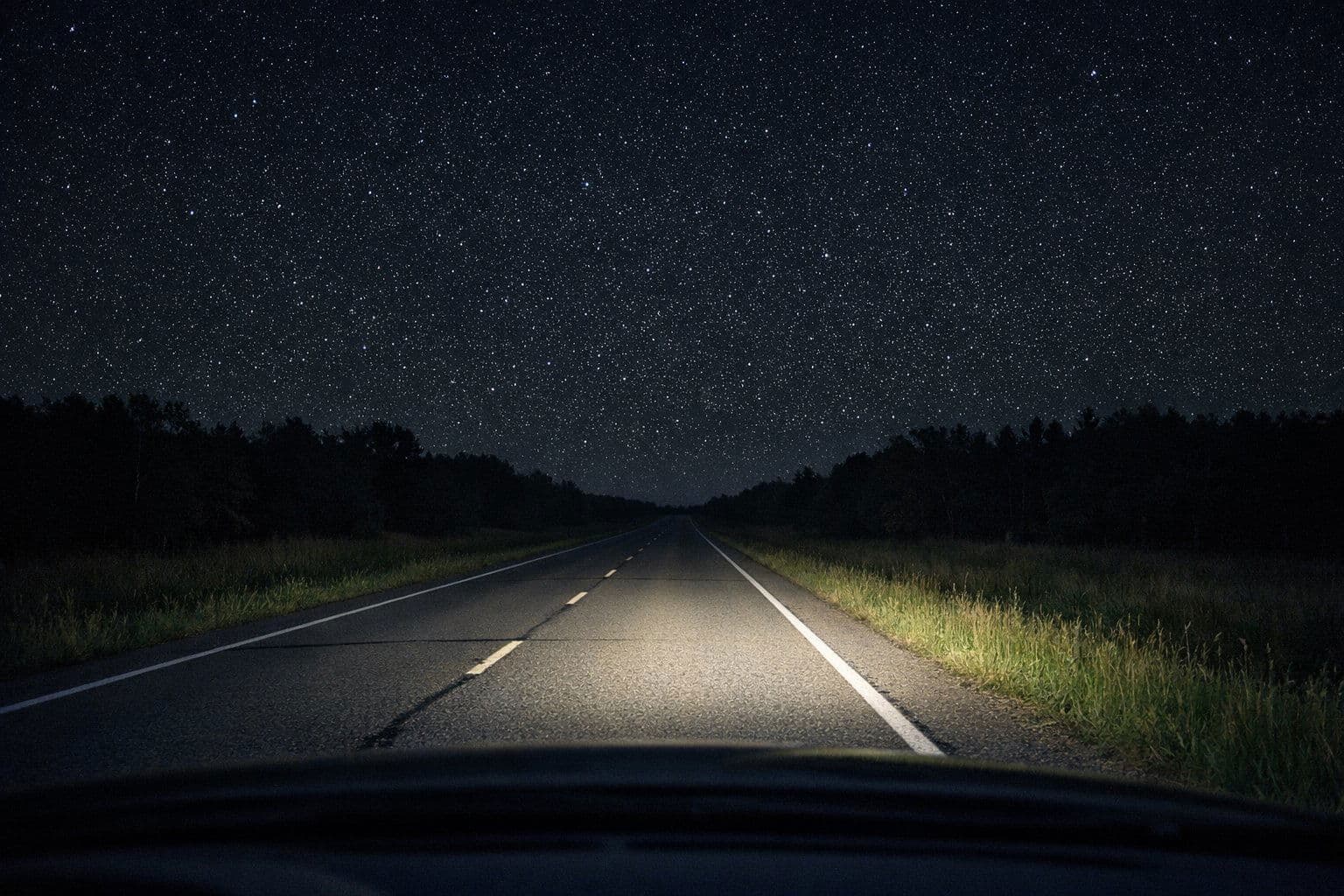
The most fundamental error committed by drivers at night is "overdriving the headlights." This is a physics problem that occurs when your vehicle’s total stopping distance exceeds the illuminated range of your headlights. It is a trap that is remarkably easy to fall into because modern vehicles feel stable and quiet at high speeds, masking the reality that the driver is effectively moving blind into a void.
The Data of Deficit
Let us examine the numbers. Standard halogen low-beam headlights—which remain common on the majority of vehicles on the road—typically illuminate the road surface for a distance of approximately 150 to 200 feet ahead. High-intensity discharge (HID) or LED units may extend this slightly, but the regulatory cutoffs designed to prevent glare limit their low-beam reach significantly.
Contrast this with the physics of stopping. A vehicle traveling at 60 mph is moving at 88 feet per second. To bring that vehicle to a halt involves three distinct phases:
- Perception Time: The time it takes for the photon to hit the retina, the signal to travel to the visual cortex, and the brain to identify "obstacle." (Approx. 0.75 to 1.5 seconds).
- Reaction Time: The time it takes for the brain to command the foot to lift off the accelerator and depress the brake pedal. (Approx. 0.75 seconds).
- Braking Distance: The physical distance required for the friction of the brakes and tires to dissipate the vehicle's kinetic energy.
At 60 mph, the distance covered during the perception and reaction phase alone (1.5 seconds total) is roughly 132 feet. The physical braking distance on dry pavement is often another 120 to 140 feet. The total stopping distance, therefore, sits between 250 and 300 feet under ideal conditions.
The math reveals a terrifying deficit. If your low beams only show you 150 feet of road, and you need 300 feet to stop, you are driving with a 150-foot blind zone. If a deer, a stalled vehicle, or a pedestrian in dark clothing appears at the extreme edge of your light, you will strike them at speed before you can stop. You are committed to a collision that hasn't happened yet.
The Actionable Protocol
To mitigate this, drivers must adopt the "Envelope Strategy." You must consciously adjust your speed so that your stopping distance fits inside your visibility envelope. This same mindset underpins many modern software-defined vehicle safety systems, which constantly balance speed, grip, and available visibility.
- On unlit rural roads: This often means driving below the posted speed limit when forced to use low beams due to oncoming traffic.
- High Beam Discipline: High beams are not a luxury; they are a safety necessity. They extend visibility to 350-500 feet, which is the only way to safely drive at highway speeds (60+ mph) at night. However, they must be used with strict discipline to avoid blinding others—dimming within 500 feet of an oncoming car and 300 feet of a leading car.
- The Cornering Paradox: Headlights generally point straight. When you enter a curve at night, your lights illuminate the trees on the outside of the turn, not the lane you are steering into. You are turning into a black void. The protocol is to decelerate before the curve, entering at a speed that allows you to stop within the shortened sightline, and accelerating only as the headlights swing around to reveal the exit.
Tip 2: Optical Restoration – The Chemistry of Clarity
We often assume that if our headlights turn on, they are working. This is a dangerous fallacy. The performance of a headlight is heavily dictated by the condition of the lens through which the light passes.

The Polycarbonate Degradation
Modern headlight lenses are manufactured from polycarbonate, a robust thermoplastic that is resistant to impact but highly susceptible to ultraviolet (UV) radiation. To protect the plastic, manufacturers apply a hard coat UV inhibitor at the factory. However, over years of exposure to the sun, road salts, and harsh detergents, this coating degrades. The underlying polycarbonate then oxidizes, turning a cloudy, opaque yellow.
This "hazing" is not merely cosmetic; it is an optical disaster.
- Lumen Reduction: Heavily oxidized lenses can block up to 80% of the light output. You may have high-performance bulbs, but if they are shining through a yellow filter, you are effectively using candles.
- Beam Scatter: The most insidious effect is diffraction. A clear lens focuses light into a tight, controlled beam. A cloudy lens acts as a diffuser, scattering light in all directions. This reduces down-road visibility and, critically, throws glare upward into the eyes of oncoming drivers and into fog or rain, blinding the driver with backscatter.
The Restoration Protocol
Wiping the lens with a cloth does nothing. The damaged plastic must be physically removed.
- Step 1: Abrasion. The oxidized layer is dead plastic. It must be sanded off. A wet-sanding process, starting with 600 or 1000 grit paper and moving progressively to 3000 grit, is required to strip the yellow haze and smooth the surface.
- Step 2: Polishing. Once the heavy oxidation is removed, a polishing compound is used to restore optical transparency, turning the frosted look into glass-like clarity.
- Step 3: Sealing (The Critical Missed Step). Once you have sanded and polished, you have exposed raw, unprotected polycarbonate. Without a new UV sealant or clear coat, the lenses will yellow again within months, often worse than before. A ceramic coating or a dedicated headlight clear coat spray must be applied to lock in the clarity.
By treating headlight maintenance as a critical safety ritual—akin to checking tire pressure—drivers can immediately reclaim hundreds of feet of visibility and better support the advanced driver-assist and AI dashcam systems many newer cars now rely on.
Tip 3: Geometric Calibration – The Art of Aiming
A clear, bright headlight is useless if it is pointed at the treetops or the bumper of the car in front of you. Headlight aim is often disturbed by suspension settling, minor fender benders, or even changing a bulb incorrectly.
The Cutoff Line
Low-beam headlights are engineered with a distinct "cutoff"—a sharp line above which very little light is projected. This is to protect oncoming drivers.
- Too Low: If the cutoff is aimed too low, your 200-foot visibility shrinks to 50, forcing you to look at the ground directly in front of the hood.
- Too High: You blind everyone else, triggering "glare wars" where opposing drivers flash their high beams at you, reducing everyone’s safety.
The Calibration Protocol
Every driver should perform an aim check annually. This kind of home calibration pairs nicely with broader, community-led safety interventions that focus on fixing risks before they turn into crashes.
- The Setup: Find a flat surface with a vertical wall. Park the vehicle exactly 25 feet away from the wall, on level ground.
- The Measurement: Measure the height from the ground to the center of the headlight bulb on the vehicle. Mark this height on the wall with tape.
- The Adjustment: Turn on the low beams. The top edge of the distinct bright area (the cutoff) should fall roughly 2 inches below the tape mark. This slight downward angle ensures the light hits the road surface far ahead without rising into the eyes of oncoming traffic.
- Lateral Bias: The beams should also favor the right side (in right-hand traffic countries). They should illuminate the shoulder, where pedestrians and road signs reside, while keeping the left side of the beam tighter to avoid dazzling oncoming lanes.
Part II: The Biology of the Night Pilot
We cannot upgrade the human eye, but we can optimize the environment in which it operates. Understanding the limitations of our visual system is the key to Tip 4 and Tip 5.
Tip 4: The "Dark Cockpit" – Maximizing Mesopic Sensitivity
The human eye is an aperture system. The iris controls the pupil, expanding it (dilation) in low light to gather more photons and contracting it (constriction) in bright light to protect the retina.
The Contrast Trap
The problem with modern vehicle interiors is "light pollution." Digital instrument clusters, massive infotainment touchscreens, and ambient mood lighting create a high-luminance environment inside the cabin.
When a driver looks at a bright white speedometer or a glowing navigation map, their pupils constrict. This happens almost instantly. However, when they look back up at the dark road, the process of re-dilation is slow, taking several seconds or minutes to reach full sensitivity.
By driving with a bright dashboard, you are effectively forcing your eyes to remain in a "daytime" setting while trying to peer into the night. You lose sensitivity to the faint contrast of a deer standing on the shoulder or a pedestrian in grey clothing. This is the "Contrast Trap."
The Dark Cockpit Protocol
To counter this, we must adopt a strategy used by pilots: the Dark Cockpit.
- Rheostat Discipline: Locate the dashboard dimmer switch (rheostat). Turn the brightness down to the absolute minimum level where the gauges are still legible. You will be surprised at how dim this can be while still remaining readable.
- Screen Management: Most modern infotainment systems have a "Display Off" or "Night Mode" feature. Use it. A 12-inch glowing rectangle in your peripheral vision is a major source of veiling glare and pupil constriction.
- Cabin Hygiene: Ensure no interior map lights are left on. Even a small overhead light creates reflections on the inside of the windshield that can mask external hazards.
These cockpit habits work even better when combined with connected safety tools—like hyper-local road safety alerts in apps such as Carszy—that reduce surprise hazards before you even see them.
Tip 5: Active Scanning – Overcoming the "Moth Effect"
In the dark, the human eye is drawn to light. It is a biological reflex. When an oncoming car approaches, our gaze naturally wants to lock onto its headlights. This is dangerous for two reasons.
- Flash Blindness: Staring at high-intensity LEDs can bleach the rhodopsin (visual purple) in your rod cells, leaving you with a blind spot that persists for several seconds after the car passes.
- Target Fixation (The Moth Effect): Drivers have a subconscious tendency to steer where they look. If you stare at the oncoming headlights, you may subtly drift toward the center line—and into a collision.
The Saccadic Solution
To break this reflex, you must train your eyes to perform specific maneuvers.
- The Right-Side Anchor: When facing oncoming glare, deliberately shift your focus to the white fog line on the right edge of the road. Use this high-contrast line to guide your steering. Your peripheral vision will still track the oncoming vehicle, but your foveal (central) vision is protected from the direct glare.
- The Block Scan: Do not stare at a fixed point in the darkness. Under scotopic (low light) conditions, staring can cause images to fade from the retina due to a phenomenon called Troxler’s Fading. Keep your eyes moving. Scan the distance, check the mirrors, scan the instruments, and return to the distance. This "saccadic" movement keeps the retina refreshed and increases the likelihood of detecting motion in the periphery.
Part III: The Optics of Glare
Glare is not just about what hits your eyes; it is about what happens to that light before it gets there.
Tip 6: Cleaning the Inside Glass – The Invisible Film
Drivers obsess over washing the exterior of their cars, but the most dangerous optical distortion often comes from inside the cabin.
Modern car interiors are composed of plastics, vinyls, and synthetic leathers. These materials release chemical vapors over time, especially in heat—a process known as "off-gassing." These vapors condense on the coolest surface they can find: the inside of the windshield.
Veiling Glare
This creates a thin, oily, often invisible film. During the day, you might not notice it. But at night, when a streetlight or oncoming headlight hits the glass, this film acts as a diffraction grating. It smears the light, creating a "halo" or "starburst" effect that veils the entire road scene in a milky haze. This is "veiling glare," and it drastically reduces contrast sensitivity.
The Clarity Protocol
Cleaning this film requires more than a casual wipe.
- Solvent Selection: Standard blue glass cleaners often smear this oily film rather than removing it. A mixture of isopropyl alcohol and water (50/50) or a dedicated automotive glass stripper is recommended to cut through the plasticizer residue.
- Mechanical Agitation: Use a clean microfiber towel to scrub the glass.
- The Dry Buff: The secret to streak-free night vision is to follow the wet wipe immediately with a dry microfiber towel, buffing the glass until there is zero resistance. Any remaining streak will flare up like a neon sign when hit by oncoming lights.
Tip 7: The "Yellow Lens" Myth – What Not to Wear
In the quest for better night vision, many drivers turn to yellow-tinted "night driving glasses." Marketing often claims these glasses reduce glare and improve contrast. It is critical to address this with scientific rigor: This is a dangerous myth.
The Science of Filtration
Yellow lenses work by filtering out blue light. While this may subjectively make the scene feel "warmer" or less harsh, the physics are undeniable: any filter placed in front of the eye reduces the total amount of light reaching the retina. At night, your visual system is already starving for photons. Reducing light input further—even by a small percentage—is detrimental to visual acuity.
The Evidence
Studies by the Sunglass Association of America, the American Academy of Ophthalmology, and various research bodies have consistently found that yellow lenses do not improve detection rates of pedestrians or hazards. In fact, they often worsen performance. A study involving night-driving simulations showed that older drivers were significantly slower to respond to pedestrians when wearing yellow lenses compared to clear ones.
The Recommendation
If you wear prescription glasses, the only valid upgrade for night driving is a high-quality Anti-Reflective (AR) coating. This clear coating allows more light to pass through the lens (increasing transmission to ~99%) and eliminates the internal reflections (ghost images) that can be distracting at night. If you do not need prescription glasses, the best eyewear for night driving is no eyewear at all.
Think of this the same way you’d think about trusting evidence-based safety tech for kids and pets in hot cars: if the science says it does not help—or even makes things worse—it does not belong in your routine.
Part IV: The Human Element and Digital Connection
Night driving is not just a visual challenge; it is a social and behavioral one. The darkness acts as a cloak of anonymity, stripping away the human connection between drivers. This isolation breeds danger—from aggressive "road rage" to the helpless feeling of being stranded. This is where the concept of Human Media becomes a vital safety tool.
Tip 8: Human Media – Leveraging the Connected Community
"Human Media" is a concept that goes beyond social networking; it is about using technology to facilitate authentic human-to-human interaction and helpfulness. In the automotive context, companies like Carszy are pioneering the idea that a car should not be an anonymous metal box, but a node in a communicative, cooperative network.
The Failure of Anonymity
Much of the aggression we see at night—tailgating, high-beaming, cutting off—stems from de-individuation. We do not see a person; we see a "car." We cannot communicate "I'm sorry, I didn't see you," or "Your trunk is open," or "There is ice ahead." We are mute.
The Solution: VOIS and LPM
To reduce risk, we must embrace tools that restore communication and accountability.
- Vehicle Ownership Identity Systems (VOIS): This framework envisions linking a vehicle to a secure digital identity. It allows a car to be "known" in a privacy-compliant way. When a driver knows they are accountable—that their vehicle has a digital fingerprint—behavioral psychology suggests they are less likely to engage in aggressive, anonymous acts of road rage.
- License Plate Messaging (LPM): This is the practical application of Human Media. Imagine being able to safely send a pre-set message to the car ahead: "Your brake lights are out." Currently, we can only flash our lights, which is often misinterpreted as aggression. LPM platforms allow for this benevolent exchange of safety information.
Immediate Application
While universal LPM is still evolving, drivers can engage in Human Media now by participating in community-based navigation apps (like Waze). Reporting a pothole, a car on the shoulder, or fog is an act of Human Media. It is one human extending their senses to help another human they will never meet. By actively participating in this "crowdsourced safety layer," you reduce risk for everyone on the road.
Carszy extends this idea further with the Driven model of car culture, turning ordinary drivers into active guardians of their local streets, especially when visibility and stress are at their worst.
Tip 9: De-escalation – Managing the Emotional Climate
The darkness amplifies fear. When a driver is tailgated at night, the blinding glare in the rearview mirror triggers a primal "fight or flight" stress response. This can lead to brake-checking or aggressive blocking—behaviors that are fatal at highway speeds.
The BGE Mirror Setting
One immediate technical fix for road rage provocation is the Blind Spot and Glare Elimination (BGE) mirror setting.
Most drivers set their side mirrors so they can see the side of their own car. This is incorrect. It creates massive blind spots and, crucially, it reflects the headlights of the car behind you directly into your eyes.
- The Adjustment: Lean your head against the driver’s side window and adjust the mirror until you just lose sight of your own car. Do the same for the passenger side (lean to the center console).
- The Result: You have now pushed the viewing angle outward. This eliminates the blind spot (you don't need to look over your shoulder as much) and, vitally, it directs the reflected light of a tailgater away from your eyes.
Behavioral De-escalation
If you encounter an aggressive driver:
- Assume Benign Intent: That car flashing its lights might not be aggressive; they might be hitting a bump, or alerting you to a hazard.
- Disengage: Do not make eye contact. Do not gesture. Move over. In the dark, you cannot assess the threat level of the other driver. Distance is the only defense.
This calmer, more intentional approach to conflict on the road aligns with modern guidance on reporting and handling road rage safely, where your goal is always to lower the temperature, not "win" the encounter.
Part V: Physiological Maintenance – The Biological Engine
The most critical component of the car is not the engine, but the driver. At night, the driver is fighting their own biology.
Tip 10: Respecting the Circadian Dip
The human body operates on a circadian rhythm that hard-wires us for sleep during the night. No amount of willpower can fully override this.
Data shows a massive spike in crash risk between midnight and 6:00 a.m., and specifically between 2:00 a.m. and 4:00 a.m. This is the "circadian nadir"—the lowest point of alertness.
Microsleeps
The danger is "microsleep"—a brief, uncontrollable episode where the brain shuts down for 2 to 30 seconds. The eyes may remain open, but the brain is offline. At 60 mph, a 3-second microsleep means the car travels the length of a football field without a pilot.
The Mitigation Strategy
You cannot bargain with biology, but you can work with it.
- The Power Nap: If you feel the signs of fatigue (yawning, drifting, heavy eyelids), caffeine is a slow fix. The only immediate remedy is a nap. Pull over to a safe, well-lit area. Sleep for 15-20 minutes. This is enough to dissipate "sleep pressure" (adenosine buildup) without entering deep sleep (inertia).
- Hydration & Environment: Dehydration mimics fatigue. Drink water. Keep the cabin cool; warm air induces drowsiness.
- Strategic Stops: On long night drives, plan stops every 2 hours or 100 miles to walk around and reactivate your metabolism.
Smart communities are starting to weave these human limits into their planning, using local alert hubs and events to remind drivers when and where fatigue-related risk is highest.

Summary of Key Data Points
To synthesize the wealth of information presented, the following table breaks down the 10 tips by the mechanism of risk they address.
| Tip Category | The Action | The Scientific Mechanism | Expected Benefit |
|---|---|---|---|
| Physics | 1. The Envelope Strategy | Adjust speed to match stopping distance to headlight range. | Prevents "driving blind" and inevitable collisions. |
| Physics | 2. Optical Restoration | Remove oxidation from polycarbonate lenses. | Restores up to 80% of lost light; reduces beam scatter. |
| Physics | 3. Geometric Aiming | Calibrate cutoff line to -2 inches at 25 feet. | Maximizes down-road visibility without blinding others. |
| Biology | 4. The Dark Cockpit | Dim dashboard lights to minimum legibility. | Prevents pupil constriction; maximizes mesopic sensitivity. |
| Biology | 5. Active Scanning | Shift gaze to the right fog line; keep eyes moving. | Counters "Moth Effect" and Troxler’s Fading. |
| Optics | 6. Clean Inside Glass | Remove plasticizer off-gassing film. | Eliminates "veiling glare" and starbursts from lights. |
| Optics | 7. Clear Lenses Only | Avoid yellow-tinted glasses. | Maximizes light transmission (photons) to the retina. |
| Social | 8. Human Media | Use apps/systems to share hazard data (VOIS/LPM). | Breaks anonymity; leverages community intelligence. |
| Social | 9. BGE Mirror Setting | Push mirrors out to eliminate blind spots. | Reduces glare from tailgaters; lowers stress. |
| Biology | 10. Circadian Respect | Nap when tired; avoid 2am-4am driving. | Counters biological sleep pressure and microsleeps. |
FAQ: Common Night Driving Questions
Q: Do yellow "night driving glasses" actually help?
A: No. Despite aggressive marketing, yellow lenses filter out blue light, which reduces the total amount of light entering your eye. At night, your eyes need every photon they can get. Studies confirm they do not improve hazard detection and may actually impair it. The only helpful coating is a clear Anti-Reflective (AR) coating.
Q: Why do LED headlights from oncoming cars seem so blinding?
A: LED headlights often have a "blue-rich" spectrum. The human eye in its night-adapted state (mesopic vision) is particularly sensitive to blue light, perceiving it as brighter and more glaring than yellow-toned halogen light of the same intensity. Additionally, the small surface area of LEDs creates high "luminance intensity" (pinpoint brightness), which is harder for the eye to process than a larger light source.
Q: What is the single best upgrade I can make for night driving?
A: Before buying brighter bulbs, restore your headlight lenses. If they are cloudy, you are wasting whatever light your bulbs produce. A 20 restoration kit is often more effective than 100 bulbs put into a dirty housing.
Q: How does Carszy's VOIS help me drive safely at night?
A: VOIS (Vehicle Ownership Identity System) creates a layer of accountability and connection. While the technology is still maturing, the principle is that a connected driver—one who can receive alerts about their taillights being out or hazards ahead—is a safer driver. It moves us from a system of isolated, anonymous actors to a cooperative safety network. As VOIS evolves alongside tools like UWB-based anti-theft and recovery networks, your car becomes harder to steal and easier to protect, even in the shadows.
Q: Can community safety apps really make a difference after dark?
A: Yes. When drivers share real-time information about hazards, near-misses, stalled vehicles, wildlife crossings, and even aggressive drivers, it creates a safety net that stretches beyond your headlights. Systems that combine AI dashcams and Human Media-style reporting can flag risky spots long before they show up in official statistics.
Conclusion
The night is unforgiving, but it is not unmanageable. The risks of driving after dark are born from the collision of high-speed physics with stone-age biology, exacerbated by social isolation. We cannot change our biology, and we cannot change the speed of light. However, we can adapt our machines and our behaviors.
By maintaining our optical systems with rigor, respecting the limits of our vision, managing the light environment inside the cockpit, and embracing the emerging digital layer of Human Media, we can reclaim safety from the darkness. The key is to stop treating night driving as "driving, but darker," and start treating it as a distinct discipline requiring its own set of tools, protocols, and mindset.
As connected-car tech, software-defined safety features, and community-first road safety models continue to mature, every driver has a bigger role to play in making nighttime roads less hostile and more humane. Drive connected, drive clear, and drive safe.