The Sentinel and the Signal: A Comprehensive Analysis of Automotive Counter-Surveillance, Relay Attacks, and the Rise of Crowdsourced Security Architectures
Executive Summary
The automotive ecosystem in 2026 stands at a critical juncture, defined by a paradox of innovation. On one hand, vehicles have never been more advanced, integrated with biometrics, connectivity, and autonomous capabilities that promise unparalleled convenience. On the other, this very digitization has expanded the attack surface, ushering in a "golden era" of electronic vehicle theft.
The mechanical lock-and-key paradigm has been almost entirely supplanted by Passive Keyless Entry and Start (PKES) systems, a transition that has inadvertently democratized high-end theft through the proliferation of the "Relay Attack." This technique, which bridges the physical distance between a key fob and a vehicle via radio frequency amplification, allows criminals to steal luxury assets in seconds without force or forensic trace.
However, as the threat landscape evolves, so too does the response. The traditional reliance on state-level enforcement—police patrols and centralized dispatch—is buckling under the weight of resource constraints and prioritizing violent crime over property loss. This "security gap" has catalyzed the emergence of a new paradigm: Community Counter-Surveillance. Technologies such as Carszy’s Vehicle of Interest Search (VOIS™) are operationalizing the concept of the "human sensor grid," transforming the ubiquitous smartphone and the legally mandated license plate into a decentralized recovery network.

This report offers an exhaustive examination of these converging forces. We analyze the granular mechanics of relay attacks in the 2024–2025 landscape, evaluating the efficacy of defensive measures ranging from Faraday isolation to Ultra-Wideband (UWB) protocols. For a broader look at how software-defined vehicles and connected systems reshape neighborhood safety, see how software-defined vehicles transform road safety in 2026. Furthermore, we dissect the operational architecture of crowdsourced security platforms, assessing their potential to bridge the gap between theft and recovery in an era where the "Golden Hour" of response time is increasingly outside the reach of traditional law enforcement.
1. The Evolution of Automotive Theft: From Mechanics to Electronics
To fully grasp the necessity of modern counter-surveillance tools, one must first appreciate the seismic shift in the methodology of vehicle theft. For most of the 20th century, stealing a car was a mechanical challenge. It required physical interaction with the lock cylinder, the steering column, or the ignition wiring. The "hot-wire" was the emblem of the era. This changed in the 1990s with the introduction of the immobilizer, a transponder-based system that required a digital handshake between the key and the engine control unit (ECU). Mechanical theft plummeted, and for a brief period, the car was secure.
1.1 The Convenience Trap: Remote Keyless Entry (RKE) and PKES
The demand for friction-less user experiences drove manufacturers to move beyond simple RKE (pressing a button to unlock) to Passive Keyless Entry and Start (PKES). In a PKES system, the driver need never touch the key. The vehicle acts as a constant beacon, periodically broadcasting a low-frequency (LF) "wake-up" signal. When a legitimate key fob enters this field (typically within 1–2 meters), it wakes up and responds with a Ultra-High Frequency (UHF) signal containing an encrypted authorization code. If the code is valid, the door unlocks. A similar handshake occurs to start the engine.
This system relies on a critical, often flawed, assumption: Proximity implies Possession. The system assumes that if it receives a valid response, the key must be physically close. It does not natively measure distance; it measures signal validity. This vulnerability is the foundational crack into which the relay attack drives its wedge and is at the heart of the future of dashcams, AI, and community safety, where in-vehicle sensors and cameras help document suspicious access attempts.
1.2 The Proliferation of Electronic Compromise
By 2024 and 2025, the theft landscape had bifurcated. On the lower end, mechanical exploits (such as those affecting older Kia and Hyundai models without immobilizers) persisted but began to decline as software patches and fleet attrition took effect. On the high end, however, electronic compromise became the dominant vector. Research indicates that in the UK, a bellwether for global theft trends, relay attacks now account for over 50% of all stolen vehicles, with some insurers citing figures as high as 70% for keyless models. The United States has seen a similar trajectory, with high-value targets like the Tesla Model 3 and Model Y becoming susceptible to Bluetooth Low Energy (BLE) variants of the attack.
2. The Relay Attack: A Technical and Operational Autopsy
The relay attack is not hacking in the Hollywood sense. It does not involve cracking encryption codes or brute-forcing passwords. Instead, it is a physical layer attack that extends the communication range of the intended signals. It is a "Man-in-the-Middle" attack where the "Man" is a pair of radio transceivers acting as a long-range wire.
2.1 The Two-Man Topology
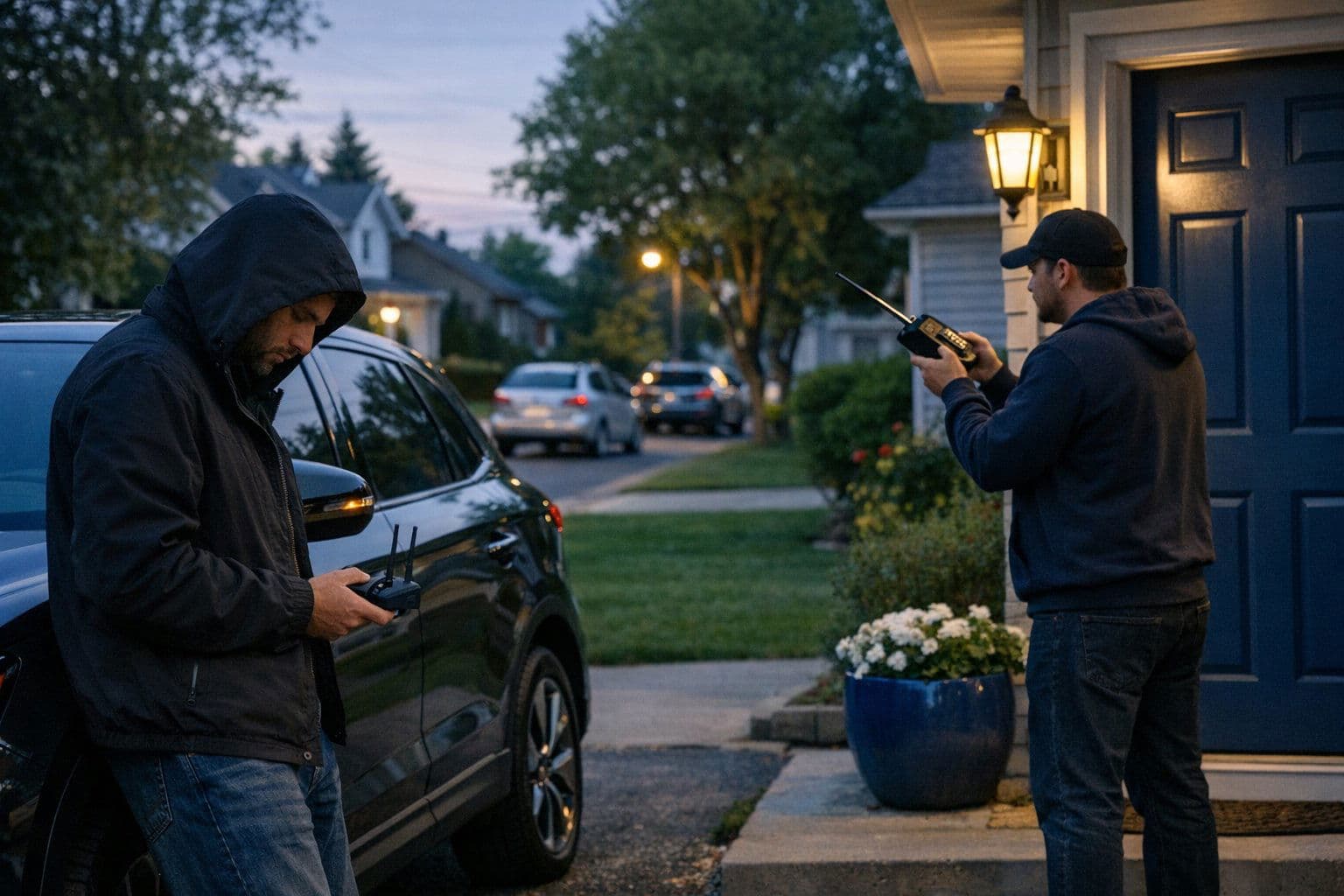
The classic relay attack is executed by an organized pair of thieves, often referred to as the "Scanner" and the "Receiver."
The Receiver (Car Side): Thief A stands next to the locked vehicle. They hold a device that mimics the car’s LF wake-up signal (125 kHz).
The Scanner (House Side): Thief B approaches the victim’s home, scanning the front door, windows, or garage walls. They hold a device containing a sensitive LF antenna and a high-speed relay transmitter.
The Bridge: When Thief A triggers the car's entry system, the car broadcasts a challenge. Thief A's device captures this, converts it to a higher frequency (often 2.4 GHz or proprietary bands to maximize range and speed), and shoots it to Thief B's device.
The Handshake: Thief B's device down-converts the signal back to 125 kHz and broadcasts it to the house. The key fob, sitting in a bowl by the door or in a purse in the hallway, receives this signal. Believing the car is nearby, it wakes up and transmits the UHF unlock response (315 MHz in the US, 433 MHz in Europe).
The Unlock: This valid UHF response is captured by Thief B, relayed back to Thief A, and broadcast to the car. The car unlocks. The process is repeated to start the engine.
2.2 Frequency Bands and the BLE Shift
The efficacy of the attack depends on the frequencies used.
- 125 kHz (LF): Used for the "wake-up" call. LF waves have excellent wall penetration capabilities but limited range, which is why the "Scanner" thief must be physically close to the house walls.
- 315 MHz / 433 MHz (UHF): Used for the key's response. These signals carry the encrypted rolling codes. Crucially, the relay device does not need to decrypt these codes; it simply repeats them.
- 2.4 GHz (Bluetooth Low Energy): Modern vehicles, particularly Tesla (Model 3/Y) and those using "Phone-as-a-Key," utilize BLE. While BLE allows for more granular distance estimation than older RF, it is still susceptible to relay attacks if the latency is managed correctly. Attackers use commodity hardware to bridge the BLE connection between the phone (in the bedroom) and the car (in the driveway).
2.3 The Economics of Theft
The barrier to entry for this sophisticated attack has collapsed. In the early 2010s, building a relay setup required significant engineering expertise and thousands of dollars in software-defined radios (SDRs). By 2026, the market is flooded with pre-configured "black box" devices.
- Budget Tier ($300–$600): Basic repeaters capable of attacking older LF/UHF systems.
- Professional Tier ($500–$1,500): Devices with higher gain antennas, capable of penetrating thicker walls and bridging greater distances between the two thieves.
- Premium/Industrial Tier ($3,000+): Advanced units capable of attacking newer encryption protocols and wider frequency bands.
This commoditization has industrialized theft. Organized gangs can now equip "foot soldiers" with these devices, allowing them to sweep entire neighborhoods in a single night. The "Scanner" simply walks up to every front door; if the device lights up, they have a match. As these tools become cheaper and more powerful, they intersect with a broader shift in mobility culture described in Drive Real and the 'Driven' revolution in car culture, where everyday drivers become more alert, informed participants in safety.
3. The Institutional Void: Why Police Can't Save Your Car
In the face of this mechanized, high-speed theft, the traditional apparatus of law enforcement has struggled to keep pace. The structural limitations of modern policing have created a "security gap" that private counter-surveillance is attempting to fill.
3.1 The Response Time Crisis
Response time—the interval between a 911 call and officer arrival—is the critical metric in property recovery. However, in major metropolitan areas, this metric is degrading.
- Prioritization: Police departments, facing staffing shortages, rigorously triage calls. Violent crimes (Code 3) take precedence. Auto theft, unless in progress or involving a carjacking, is often downgraded to a lower priority (Code 1 or 2). In cities like Nashville and New Orleans, response times for non-emergency calls can stretch into hours, or result in no physical response at all, with victims directed to file reports online or via telephone.
- The Data: In Salt Lake City, analysis of Computer-Aided Dispatch (CAD) data from 2016 to 2021 revealed a clear trend of increasing response times correlating with staffing fluctuations. When response times increase, the deterrence factor decreases, and the "clearance rate" (the percentage of crimes solved) drops.
3.2 The "Golden Hour" and the Cooling Off Period
The NICB emphasizes that the first 24 hours are critical. Passenger vehicles reported stolen in the first 24 hours had a 34% same-day recovery rate in 2023. However, thieves have adapted to this window.
- The Cool Down: Sophisticated thieves rarely drive a stolen vehicle directly to a chop shop or export container immediately. Instead, they park it in a public place—a quiet residential street, an apartment complex lot, or a hospital garage—for 24 to 48 hours. This "cooling off" period is designed to see if the car has a hidden aftermarket GPS tracker. If the car is still there after two days, it is deemed "clean" and moved.
- The Blind Spot: Police patrols cannot possibly scan every side street for "cooling" vehicles. This operational blind spot is where the stolen vehicle sits, vulnerable only to chance discovery—or to a distributed network of observers.
For many drivers, this same window is when emotions run highest and reactions can turn risky. Knowing how to safely document and share what you see, especially when aggressive behavior is involved, is covered in this guide on reporting road rage effectively, which complements the recovery strategies discussed here.
4. Defensive Architectures I: The Hardened Asset
The primary line of defense against relay attacks involves hardening the asset itself—either by physically isolating the key or by upgrading the communication protocols.
4.1 The Physics of Isolation: Faraday Cages
The most accessible countermeasure is the Faraday pouch (or cage). Its operating principle is grounded in electrostatic shielding. By enclosing the key fob in a mesh of conductive material (copper, nickel, or silver), the pouch redistributes external electromagnetic fields around its exterior, canceling the field within the interior volume.
4.1.1 Efficacy and Failure Modes
When functioning correctly, a Faraday pouch creates a "quiet zone" of over 80dB attenuation, rendering the key invisible to the relay scanner. However, the market is saturated with varying qualities.
- Mesh Degradation: The conductive fabric is prone to fatigue. Repeated opening and closing causes microscopic cracks in the metal coating. These micro-tears can eventually act as slot antennas, allowing RF leakage.
- Frequency Specificity: A pouch designed to block 2.4 GHz (Wi-Fi/Bluetooth) signals might be less effective at the 125 kHz magnetic fields used for the car's wake-up signal, or vice versa. The most effective pouches use dual-layer construction to handle both high and low-frequency bands.
- The Human Factor: Ultimately, the Faraday pouch is a passive tool that requires active compliance. If the driver forgets to pouch the key once, the protection is void.
4.2 The Protocol Solution: Ultra-Wideband (UWB)
The definitive technological cure for the relay attack is the shift from Signal Strength (RSSI) to Time-of-Flight (ToF) measurement, facilitated by Ultra-Wideband (UWB) technology.
4.2.1 The Speed of Light Constraint
Traditional PKE systems estimate distance by how "loud" the signal is. A relay attack simply makes a distant signal sound "loud" by amplifying it. UWB, however, uses the speed of light (c ≈ 3 × 10⁸ m/s) as a constant.
- Pulse Measurement: The car sends a UWB pulse to the key. The key processes it and sends a pulse back.
- Time of Flight: The car measures the exact round-trip time. Distance = Time × Speed of Light / 2.
- Defeating the Relay: A relay attack inherently introduces latency. The signal must be received, processed, amplified, and re-transmitted by the thief's equipment. Even a processing delay of a few nanoseconds is detectable by the UWB system. If the response takes too long, the car knows the key is far away, even if the signal is strong. It rejects the unlock request.
4.2.2 Adoption and the Digital Key 3.0
As of 2025/2026, UWB is becoming standard in the "Digital Key 3.0" specification championed by the Car Connectivity Consortium.
- Secure Models: BMW (all models 2021+), Genesis (2023+), Hyundai (Ioniq 5/6/9), Kia (EV9, EV3), and the refreshed Tesla Model 3/Y (Highland/Juniper) utilize UWB. These vehicles are theoretically immune to standard relay attacks.
- Vulnerable Fleet: The vast majority of cars on the road—including pre-2023 luxury vehicles and entry-level models like the Kia Niro or Seltos—still rely on legacy NFC or RF, leaving them exposed.
| Manufacturer | Models with UWB/Digital Key Support (2025+) | Vulnerability Status |
|---|---|---|
| BMW | All models (2021+) | Secure (UWB Active) |
| Tesla | Model 3/Y (Highland/Juniper refresh) | Secure (If UWB enabled) |
| Tesla | Older Model 3/Y | Vulnerable (BLE Relay) |
| Kia | EV9, EV3, Carnival (2025) | Secure (UWB Active) |
| Kia | Niro, Seltos, Older Telluride | Vulnerable (NFC/LF only) |
| Hyundai | Ioniq 5/6/9, Santa Fe (2024+) | Secure (UWB Active) |
| Rivian | R1S, R1T (Gen 2) | Secure (UWB Active) |
Table 4.1: Security status of major vehicle platforms as of Q1 2026. Note the distinction between "Secure" models using UWB and "Vulnerable" models relying on legacy RF or BLE. The broader shift toward smarter, connected vehicles is also part of a larger, community-led safety movement explored in this 2026 road safety shift overview, where neighborhoods, not only automakers, drive change.
5. Defensive Architectures II: The Distributed Network (Carszy & VOIS™)
While UWB secures future vehicles, the current fleet requires a different approach. If the physical asset cannot be fully hardened, the environment must be monitored. This is the domain of Community Counter-Surveillance, and specifically, the operational model of Carszy.
5.1 The Philosophy of "Human Media"
Carszy distinguishes itself from traditional social media by anchoring interaction not to a user profile, but to a physical object: the vehicle.
- License Plate as Handle: In the Carszy ecosystem, the license plate is the unique identifier. This removes the anonymity of the road. A driver does not need to know who is driving the car in front of them to interact; they only need to see the plate.
- Contextual Interaction: The "Human Media" section allows for pro-social interaction (sharing photos of unique cars, "nice rims," "your dog is cute") and safety reporting ("your brake light is out," "you are driving recklessly"). This builds a user base that is habitually scanning license plates, creating a latent "sensor grid."

This "human media" model is already being applied in real communities, like Orange County’s emerging OC Road Safety Hub powered by the Carszy app, where events, ambassadors, and local agencies work together to turn everyday drivers into active sensors on the street.
5.2 VOIS™: Weaponizing the Cooling Off Period
The Vehicle of Interest Search (VOIS™) feature transforms this social grid into a security apparatus. It effectively crowdsources the function of an Automatic License Plate Reader (ALPR) network, but with mobility and coverage that fixed cameras cannot match.
5.2.1 The Recovery Workflow
The VOIS™ system operates on a specific workflow designed to outpace the thief's timeline:
- The Incident: A vehicle is stolen (e.g., via relay attack) from a driveway at 3:00 AM.
- The Void: The owner calls the police. A report is filed, but no officer is dispatched immediately. The data enters the NCIC (National Crime Information Center) database, which can take hours to propagate to patrol cars.
- The VOIS Alert: Simultaneously, the owner generates a VOIS™ alert on the Carszy app. This includes the vehicle's photo, plate number, and last known location.
- Community Mobilization: The alert is pushed to Carszy users in the surrounding geofence. This includes gig workers (Uber/Lyft/DoorDash drivers) who are already patrolling the streets.
- The Scan: The thief parks the car in a "cool down" spot—a quiet cul-de-sac or apartment complex lot—to check for trackers. A Carszy user, delivering food to that complex, spots the vehicle. They verify the plate in the app.
- The Match: The user reports the sighting. The owner receives an instant notification with GPS coordinates.
- Recovery: The owner can now update law enforcement with a precise, real-time location, significantly increasing the priority of the call and the likelihood of recovery before the car is stripped or exported.
This workflow compresses the discovery time from days (waiting for a patrol car to luckily drive by) to hours (leveraging thousands of eyes). It sits within a wider pattern of "driven" communities, where safety-first, community-led platforms turn drivers into active guardians of local streets rather than passive victims of crime.
5.3 Comparative Analysis: VOIS™ vs. The Ecosystem
Carszy sits in a unique niche compared to other community tools.
- vs. Nextdoor: Nextdoor is text-based and static. It relies on "suspicious person" posts which are often subjective and delayed. Carszy is object-oriented and mobile.
- vs. Citizen: Citizen focuses on 911 feed data and safety incidents (fires, shootings). It informs users to avoid danger. Carszy mobilizes users to find assets.
- vs. FLOCK Safety: FLOCK cameras are powerful but fixed. They cover main intersections. They cannot see into the private "cool down" spots where thieves hide cars. Carszy’s human sensors can.
| Feature | Carszy VOIS™ | Citizen App | Nextdoor | FLOCK Safety (LPR) |
|---|---|---|---|---|
| Primary Sensor | Human Eyes | User Reports / 911 Feed | User Posts | AI Cameras |
| Identifier | License Plate | Location/Incident Type | Neighborhood | License Plate |
| Response Speed | Real-time (Alert based) | Real-time (Incident based) | Slow (Hours/Days) | Instant (Automated) |
| Coverage | Mobile / Ubiquitous | Mobile | Residential Zones | Fixed Intersections |
| Privacy Risk | Moderate (Stalking potential) | Moderate (Fear mongering) | Low (Gossip) | High (Mass Surveillance) |
| Cost to User | Free | Free / Premium | Free | Taxpayer Funded |
Table 5.1: Comparative matrix of community security tools. Carszy occupies a unique niche by using the license plate as the primary key for interaction, bridging the gap between social networks and hard LPR data. As communities experiment with these tools, they echo a broader civic-tech trend: community-led road safety interventions that push beyond purely reactive policing.
6. Case Studies and Statistical Validation
The efficacy of community-based recovery is supported by emerging data from various jurisdictions.
- Portland, Oregon: A collaboration between the Portland Police Bureau and a Facebook-based crowdsourcing group "PDX Stolen Cars" (a rudimentary analog to Carszy) resulted in the recovery of 56 stolen vehicles. The police acknowledged that the community group assisted in 22 distinct Stolen Vehicle Operations, proving that "eyes on the ground" directly translates to recovery statistics.
- Colorado: Despite having high theft rates, Colorado has maintained recovery rates surpassing the national average (hovering around 86–90%), attributed partly to robust public awareness and community reporting mechanisms.
- The Revenue of Recovery: For commercial telematics providers, integrating theft recovery features (similar to the logic of VOIS) has shown tangible economic benefits, with one case study citing a 19% revenue boost and an average recovery time of just 26 minutes when real-time tracking is engaged.
These examples validate the core thesis of Carszy: that a mobilized community, equipped with the right data, acts as a force multiplier for law enforcement. In practice, that looks like a living "road safety hub" in each city, much like the Orange County playbook for community-led road safety, which blends alerts, events, and partnerships into a coherent local strategy.
7. The Sociological and Legal Dimensions of Citizen Policing
The rise of platforms like VOIS™ is not without friction. It represents a shift in the social contract of policing, moving from a state monopoly on surveillance to a distributed, peer-to-peer model.
7.1 The Privacy Paradox and "Stealth Plates"
As LPR technology (both institutional like FLOCK and social like Carszy) becomes ubiquitous, a counter-culture of "anti-surveillance" is emerging among drivers.
- Stealth Tech: Drivers are increasingly employing "stealth plates"—LCD covers, reflective vinyl, or mechanical flippers—to defeat cameras. While often illegal ("no plate, no case" is the mantra of evasion), this reflects a growing anxiety about being constantly tracked.
- The Stalking Risk: Carszy’s model of allowing users to message license plates carries inherent risks of harassment or road rage escalation. The platform mitigates this by focusing alerts on crimes (abductions, thefts) and maintaining strict data privacy protocols (US-based servers, no data selling). However, the potential for misuse—tracking an ex-partner, for example—remains a critical challenge for all LPR-adjacent technologies.
7.2 Vigilance vs. Vigilantism
There is a fine line between reporting a stolen car and intervening. Law enforcement agencies warn against citizens engaging thieves directly. The success of platforms like Carszy depends on their ability to act as information brokers rather than enforcement agencies. The "Portland Model" shows the ideal balance: the community locates, the police interdict.
Similar balance is needed in other road-safety scenarios, from near-miss reports to aggressive driving. The emerging toolkit of AI dashcams as co-pilots, legal witnesses, and neighbors shows how technology can support responsible vigilance without sliding into personal confrontation.
8. Future Outlook: The Convergence of Tech and Community
As we look toward the latter half of the decade, the automotive security landscape will be defined by the convergence of hardware hardening and social software.
8.1 The End of the Relay?
The universal adoption of UWB Digital Keys will eventually close the door on the relay attack. However, with the average age of vehicles on US roads exceeding 12 years, the legacy fleet of RF-based cars will remain vulnerable well into the 2030s. This ensures that relay attacks will not disappear; they will simply migrate down-market to older used vehicles.
8.2 The "Social Security" Grid
We can anticipate a deeper integration of tools like VOIS™ into the vehicle's own OS. Future infotainment systems may natively broadcast "BOLO" (Be On The Look Out) alerts to other drivers in the vicinity. If a car is stolen, it could theoretically alert every Tesla or connected Ford within a 5-mile radius to scan for its plate or digital signature.
In parallel, cities and neighborhoods are likely to adopt more structured, tech-enabled approaches to shared vigilance, echoing the "neighborhood is the new DOT" thinking outlined in this analysis of community-led tech interventions. In that model, hyper-local data, human sensors, and connected vehicles mesh into a single, living safety grid.
Conclusion
The security of the modern vehicle is no longer guaranteed by the strength of its locks, but by the strength of its network. The relay attack exposes the fragility of convenience-driven design, exploiting the physics of radio waves to bypass traditional defenses. While UWB technology offers a long-term immunization, the immediate cure lies in the "Human Sensor Grid."
Platforms like Carszy’s VOIS™ demonstrate that in an era of resource-constrained policing, the community itself is the most underutilized asset in crime prevention. By connecting the disconnected—drivers, gig workers, neighbors—into a cohesive recovery network, we create a layer of defense that is as dynamic and distributed as the threat itself. Together with other shifts in car culture and connected mobility, such as the Driven model of authentic, safety-first car culture and the rise of software-defined vehicles as real-time safety nodes, the lesson of 2026 is clear: The ultimate immobilizer is not a microchip, but a mobilized community.