Pedestrian and Cyclist Safety: Uncovering the Visual Illusions Behind the Wheel and Engineering Safer Streets
The sudden rush of adrenaline, the violent slam of the brakes, and the terrified gasp of a driver realizing they nearly ended a life—it is a scenario that unfolds thousands of times a day on our roadways. When the dust settles from a near-miss or a tragic collision involving a pedestrian or a cyclist, the most common phrase uttered by the driver is almost universally the same: "They came out of nowhere."
To the protective parent holding a toddler's hand at a crosswalk, or the commuter cycling home in a designated bike lane, this excuse sounds like a blatant deflection of responsibility. How can a fully grown human being, wearing a bright jacket and walking in broad daylight, simply materialize from thin air? The reality, however, is deeply rooted in the complex intersections of cognitive science, automotive engineering, and municipal urban design. The driver is often not lying; their brain genuinely failed to render the hazard until it was nearly too late.
Modern roads present an environment where human perceptual processing is routinely pushed beyond its evolutionary limits. As traffic fatalities among vulnerable road users remain historically high, understanding exactly why drivers misjudge distance, fail to see obvious hazards, and make catastrophic errors at intersections is paramount. This comprehensive report investigates the cognitive illusions that blind drivers, categorizes the ten most dangerous intersection patterns contributing to the crisis, explores low-cost tactical urbanism fixes that neighborhood watch leads can champion, and outlines behavioral systems and emerging community platforms—such as Carszy—designed to forge a safer, more accountable roadway ecosystem. For a wider look at how local reporting tools and design changes fit together, see how community-led tech interventions are reshaping road safety in 2026.
The Hidden Epidemic: The Statistical Reality of Vulnerable Road User Safety
To understand the urgency of road safety redesign and driver retraining, it is necessary to examine the current statistical landscape. While vehicle occupants have benefited immensely from advanced structural engineering, curtain airbags, and driver-assistance technologies, pedestrians and cyclists remain highly vulnerable to the sheer physics of modern traffic.
Recent Shifts in Traffic Fatalities
The National Highway Traffic Safety Administration (NHTSA) recently released early estimates for 2024, projecting that 39,345 people died in motor vehicle traffic crashes in the United States. This represents a 3.8 percent decrease compared to the 40,901 fatalities reported in 2023, marking the first time since 2020 that annual fatalities fell below the grim 40,000 threshold.
This decline occurred even as Americans drove more. Preliminary data from the Federal Highway Administration (FHWA) shows that vehicle miles traveled (VMT) in 2024 increased by about 1.0 percent, or 32.3 billion miles. The mathematical interplay between increased driving and decreased deaths pushed the fatality rate down to 1.20 fatalities per 100 million VMT, the lowest rate since 2019, though still above the pre-pandemic average of 1.13.
A deeper dive into the first half of 2024 reveals where these safety gains are occurring, and where vulnerabilities persist.
| Safety Subcategory (First Half 2024 vs. 2023) | Estimated Change in Fatalities |
|---|---|
| Out-of-State Travel Crashes | Decreased by 12% |
| Ejected Passenger Fatalities | Decreased by 9% |
| Urban Interstate Crashes | Decreased by 8% |
| Unrestrained Occupants | Decreased by 7% |
| Children Under 10 Years Old | Decreased by 7% |
| Passenger Vehicle Rollovers | Decreased by 6% |
| Speeding-Related Crashes | Decreased by 6% |
| Nighttime Crashes | Decreased by 4% |
| Pedestrian Fatalities | Decreased by 3% |
Data sourced from NHTSA's early estimates for the first half of 2024.
Despite these encouraging macro-level declines, the raw numbers remain staggeringly high, and the burden falls disproportionately on vulnerable road users. In 2024, drivers struck and killed an estimated 7,148 people walking in the United States. While this is a 4.3 percent drop from the previous year, it remains nearly 20 percent higher than 2016 levels. Over the past 25 years, pedestrian deaths have surged by 37 percent, while bicyclist deaths have increased by an alarming 42 percent. For a closer look at where those “almost” crashes happen and how they warn us about future fatalities, explore the hidden world of near misses on our roads.
The Disproportionate Risk and Environmental Factors
Pedestrian safety metrics reveal terrifying disparities when examining the context of these collisions. While walking trips represent only about 10.5 percent of all transportation mode trips reported in the National Household Travel Survey, pedestrians routinely account for 16 to 17 percent of total traffic fatalities.
Environmental factors, specifically lighting, drastically influence these outcomes. A significant 76 percent of pedestrians killed in collisions are struck during dark lighting conditions, with an additional 4 percent struck during dusk or dawn. This is not merely a static statistic; it is a rapidly worsening trend. If you often drive after sunset and want to cut that risk right away, you can combine this data with practical tips from night driving safety guides focused on visibility, fatigue, and headlight use.
Alarmingly, between 2010 and 2019, the number of pedestrian fatalities occurring in the dark increased by 58 percent, compared to a relatively modest 16 percent increase for daylight fatalities. Furthermore, 73 percent of pedestrian fatalities occur at non-intersection locations, highlighting the extreme dangers of mid-block crossings on fast-moving, poorly lit arterials.
The Hit-and-Run Crisis
Further complicating the safety landscape is the rising prevalence of hit-and-run crashes. A hit-and-run occurs when a driver leaves the scene without assisting injured victims, exchanging insurance information, or calling for help. These incidents delay crucial medical care, exponentially increasing the severity of outcomes for vulnerable users and leaving families without closure or financial recourse.
In 2023, there were 2,872 fatalities in traffic crashes involving hit-and-run drivers. The intersection of hit-and-runs and vulnerable road users is particularly devastating: of the 7,314 total pedestrian fatalities recorded that year, a staggering 25 percent (1,818) were involved in hit-and-run crashes. Similarly, 23 percent (274) of the 1,166 pedalcyclist fatalities involved a fleeing driver. Current estimates suggest a hit-and-run crash occurs somewhere in the United States every 43 seconds, creating profound challenges for law enforcement and shattering community trust in the safety of public spaces. If you ever witness one of these crashes, knowing how to stay safe, document evidence, and help first responders is critical—see the bystander crash response playbook for step‑by‑step guidance.
State-by-State Disparities: A Postcode Lottery of Safety
The geographical distribution of these dangers is not uniform. A state's population, licensure rates, traffic laws, infrastructure design, and weather significantly impact localized fatality rates. Analysis of 2023 data reveals drastic variances in danger levels across the country.
| State | Population (2023) | Vehicle Miles Traveled (Millions) | Total Fatalities | Deaths per 100k Population | Deaths per 100M VMT |
|---|---|---|---|---|---|
| Massachusetts | 6,981,974 | 61,000 (est.) | 340 (est.) | 4.9 | 0.56 |
| District of Columbia | 678,972 | 3,481 | 44 | 6.5 | 1.26 |
| Alaska | 733,406 | 5,617 | 60 | 8.2 | 1.07 |
| Connecticut | 3,617,176 | 30,503 | 308 | 8.5 | 1.01 |
| California | 38,965,193 | 316,612 | 4,061 | 10.4 | 1.28 |
| Colorado | 5,877,610 | 54,654 | 720 | 12.2 | 1.32 |
| Delaware | 1,031,890 | 9,718 | 135 | 13.1 | 1.39 |
| Idaho | 1,964,726 | 19,718 | 275 | 14.0 | 1.39 (est.) |
| Georgia | 11,029,227 | 126,339 | 1,615 | 14.6 | 1.28 |
| Florida | 22,610,726 | 239,188 | 3,396 | 15.0 | 1.42 |
| Arizona | 7,431,344 | 75,297 | 1,304 | 17.5 | 1.73 |
| Alabama | 5,108,468 | 72,289 | 974 | 19.1 | 1.35 |
| Arkansas | 3,067,732 | 39,101 | 596 | 19.4 | 1.52 |
| Mississippi | 2,939,690 | 40,000 (est.) | 730 (est.) | 24.9 | 1.79 |
Data sourced from the U.S. Department of Transportation's Fatality Analysis Reporting System (2023) for select early-reporting states.
The vast variance—from 4.9 deaths per 100,000 people in Massachusetts to 24.9 in Mississippi—highlights how infrastructure funding, pedestrian-friendly policy, and localized driver behavior combine to create vastly different safety ecosystems. A tech-savvy driver commuting in Denver faces a fundamentally different risk profile than a protective parent walking a child to school in rural Arkansas. This is where city-level playbooks, like the Orange County road safety hub model, offer a template for organizing neighbors, agencies, and drivers around shared local risk.
Cognitive Blindness: How the Human Brain Misjudges Distance and Motion
When a driver claims they did not see a cyclist until they were spread across their windshield, it is easy to assume they were texting or entirely disengaged. While distracted driving is a massive issue (accounting for 3,275 fatalities in 2023), many collisions occur with drivers whose eyes are pointed straight ahead. The problem lies not with the eye, but with how the brain processes velocity, depth, and spatial continuity. The human visual system, which evolved over millennia to handle walking and running speeds, is hopelessly ill-equipped to process the high-velocity, high-complexity environment of modern vehicular travel. Two specific perceptual failures—the Looming Effect and the Illusion of Absence—explain why attentive drivers routinely fail to see hazards. For everyday “almost” collisions that never show up in crash data, community reporting of near-miss incidents is becoming a crucial early warning system.

The Physics of Perception: The Looming Effect
A leading cause of rear-end collisions and high-speed pedestrian or cyclist impacts is a physiological limitation known as the "looming effect." While the human eye can easily detect that an object in the distance is getting closer, it is incredibly difficult to accurately estimate the rate of closure—how quickly the distance is shrinking—until the objects are alarmingly close.
The "looming threshold" is the specific mathematical point at which the rate of angular expansion of an object on the retina becomes sufficient for the brain's visual system to consciously register that the object is stationary or closing rapidly. This threshold is a measurable, physiological phenomenon grounded in vision science, not subjective guesswork.
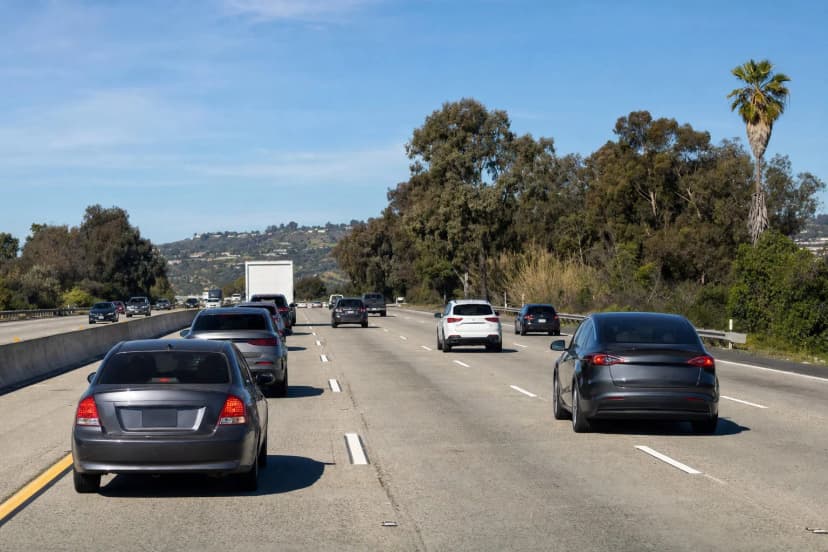
Consider a terrifying real-world highway scenario: A driver traveling at 65 mph approaches an 8-foot-wide vehicle stopped in the lane of travel. Because of the limits of retinal angular expansion, the driver will not be able to accurately estimate the closing speed until they are roughly 195 feet away from the stopped vehicle. At a speed of 65 mph, that distance provides the driver with a mere two seconds to perceive the hazard, cognitively process the danger, move their foot to the brake, and execute an evasive maneuver. For a distracted or slightly fatigued driver, two seconds guarantees an impact.
This delay in perception is drastically exacerbated when encountering vulnerable road users. The looming threshold occurs even later—meaning the hazard is recognized even closer to the point of impact—under specific conditions:
Narrow or Uniform Profiles: A cyclist viewed from behind presents a very narrow vertical silhouette. This generates minimal angular expansion on the driver's retina until the vehicle is practically on top of them. Similarly, a large, uniform profile like the flat, windowless back of a motorcoach delays depth perception because there are no relative reference points to gauge scale.
Lack of Visual Cues: Without flashing lights, distress markers, or high-visibility reflective clothing, the brain lacks the necessary environmental context to calculate speed differentials.
Expectation of Flow: When roadway geometry creates an expectation of uninterrupted movement (such as a long, straight arterial road with a green light ahead), the brain unconsciously filters out anomalies. It delays the cognitive processing of a stopped or slow-moving obstacle because it contradicts the established "schema" of the road.
Lighting and Contrast: Dark conditions completely obliterate depth cues, making it nearly impossible to judge the speed of an unlit cyclist or a pedestrian wearing dark clothing.
It bears emphasis that perception and reaction are not synonymous. Even after a hazard crosses the looming threshold and is perceived, additional time is required for cognitive processing and physical response. Until the looming threshold is crossed, a driver may physically "see" the pedestrian or cyclist without cognitively perceiving them as a hazard requiring action.
The Illusion of Absence: How the Brain Hides Reality
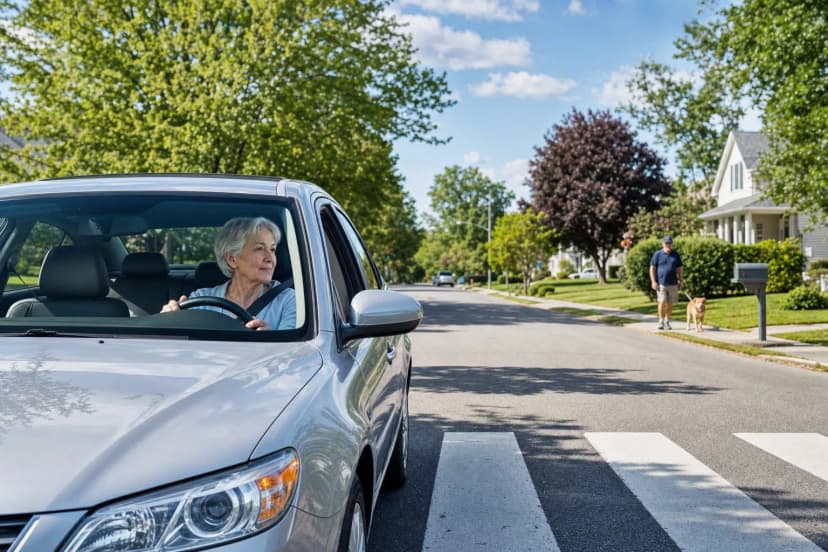
Beyond the inability to judge closing speeds, the physical design of modern vehicles actively triggers optical illusions that render road users totally invisible. The primary culprit is the A-pillar—the heavy structural roof support located on either side of the windshield.
While everyone knows A-pillars create forward-looking blind spots, the danger is not simply that they block vision; it is that they trigger a powerful visual phenomenon known to cognitive psychologists as the "Illusion of Absence".
The Illusion of Absence is a compelling subjective experience where the brain convinces itself that the space behind an occluding object in the foreground is entirely empty. When a driver looks at an A-pillar, their visual system utilizes "amodal completion" and Gestalt principles of good continuation to "fill in" the invisible background. The brain assumes that the smoothly continuing road or background holds no hidden dangers, completely excluding the possibility that a 3D object (like a child crossing the street) exists in that obstructed space.
This illusion is notoriously "cognitively impenetrable". Even if a driver intellectually knows that an A-pillar blind spot exists, their immediate visual experience tells them the area is clear and empty. Drivers inherently trust "what they see with their own eyes" over abstract knowledge. Because the illusion makes the hidden space feel empty, it creates a deadly false sense of security that prevents drivers from taking precautions, such as physically leaning forward to look around the pillar. This resulting "mental blindness" is the root cause of the "Looked-But-Failed-To-See" (LBFTS) or "Sorry-Mate-I-Did-Not-See-You" (SMIDSY) collisions that plague cyclists and pedestrians. Just as objects seem to materialize out of thin air in a magic show, road users seem to appear out of nowhere when they step out of this attentional blind zone.
The danger of A-pillars peaks during situations involving a "constant bearing". If a vehicle is turning at an intersection and a pedestrian is walking across the crosswalk at a specific, complementary speed, the pedestrian can remain perfectly hidden behind the moving A-pillar for the entirety of the turn. They maintain a collision course while remaining entirely invisible to the driver, creating the most adverse visibility conditions in the most dangerous situations.
Experimental testing confirms these terrifying risks. In a controlled study tracking pedestrian trajectory distances during intersection turns, researchers utilized a professional test driver in a sedan and a truck to map exact blind spots. The results were deeply unsettling:
The Sedan: A pedestrian remained completely obscured behind the A-pillar of the sedan for 17.6 meters during a right turn. Furthermore, the sedan exhibited an invisibility rate of 46.1 percent for far-side pedestrians during right turns.
The Truck: For the commercial truck making a left turn, a near-side pedestrian was hidden for a staggering 20.9 meters of trajectory.
The Expanding Blind Zones of Modern Vehicles
The cognitive dangers of A-pillars and the looming effect are currently being magnified by consumer preferences for larger vehicles and a shocking lack of regulatory oversight. A comprehensive study by analysts at the Insurance Institute for Highway Safety (IIHS) revealed that forward visibility in some of America's best-selling vehicles is shrinking at a disturbingly fast rate.
Over the past 25 years, automakers have implemented seemingly simple design changes during the vehicle redesign process that inadvertently increase blind zones and reduce direct visibility. Higher hood heights, designed to project an aggressive stance and accommodate larger engine blocks, make it physically impossible for drivers to see objects—especially children or low-riding cyclists—directly in front of the bumper. Thicker A-pillars, initially thickened to meet rollover safety standards for heavier roofs, obscure vast swaths of the intersection. Finally, massively enlarged side mirrors now obscure motorists' views of the front corners of their vehicles, hiding people who may be walking just beyond them.
The data on specific, wildly popular models illustrates this decay in direct visibility over time:
Honda CR-V: In 1997, drivers of a Honda CR-V could see 68 percent of the area 10 meters in front of their vehicle. By 2022, visibility for that exact same 10-meter area plummeted to just 28 percent.
Toyota Camry: Forward visibility dropped from 61 percent in 2007 to 57 percent in 2023.
Honda Accord: Visibility decreased from 65 percent to 60 percent over a twenty-year period leading up to 2023.
Despite this clear correlation between expanding blind spots and the 37 to 42 percent rise in vulnerable road user fatalities, federal regulators have not stepped in. There is no current federal test that requires automakers to measure or limit the blind zones of their vehicles. While the New Car Assessment Program (NCAP) awards points for high-tech object detection systems, regulators consistently fail to mandate the low-tech, geometric design changes—like shrinking mirrors or sloping hoods—that maximize direct human visibility and save lives. As vehicles become more software-defined, pairing better sight lines with smart sensing is key; new software‑defined vehicle safety tools show how cars themselves can help protect people outside the cabin.
The 10 Most Dangerous Intersection Patterns for Pedestrians and Cyclists
While flawed driver perception and expanding vehicle blind spots are critical components of the safety crisis, the physical geometry of the street is the canvas on which these tragedies occur. Street design dictates how fast cars travel, where conflicts occur, and how visible users are to one another.
The Federal Highway Administration (FHWA) emphasizes the "Safe System" approach to road design. This model relies on managing kinetic energy by engineering features that lower vehicle speeds, physically separate vulnerable road users from heavy machinery, remove conflict points, and reduce the severity of impacts when mistakes inevitably happen.
Intersections that violate these Safe System principles act as deadly funnels. Based on extensive guidance from the National Association of City Transportation Officials (NACTO), municipal traffic engineers, and Vision Zero High Injury Network data from cities across the nation, the following ten intersection patterns routinely rank as the most dangerous and hostile environments for pedestrians and cyclists.

1. The Multi-Lane, Unsignalized Arterial Crossing
Arterial roads are designed primarily for high vehicle throughput, often featuring speed limits between 35 and 50 mph. When pedestrians are forced to cross three or four lanes of unsignalized traffic via a mid-block crosswalk, they face the deadly "multiple threat" scenario. One conscientious driver in the right lane may notice the pedestrian and stop to yield. However, the mass of that stopped vehicle visually occludes the pedestrian from a distracted driver approaching rapidly in the left lane. The pedestrian steps past the yielding car and directly into the path of a high-velocity impact.
2. Skewed and Odd-Angled Intersections
Traditional intersections meet at 90-degree right angles, offering predictable sightlines. However, older cities with diagonal grid overlays or roads following natural topography often feature intersections that meet at sharp, acute angles. These skewed intersections create elongated, confusing crossing distances for pedestrians. More dangerously, drivers navigating these acute angles must look over their shoulders at unnatural, strained angles to spot cyclists in adjacent lanes. This geometry maximizes A-pillar occlusion and increases cognitive load, virtually guaranteeing LBFTS accidents as drivers give up on scanning and blindly trust the flow of traffic.
3. The "Parking to the Corner" Intersection (Zero Daylighting)
In dense urban environments and residential neighborhoods where street parking is highly contested, vehicles are frequently parked directly up to the edge of the painted crosswalk. These parked cars—increasingly tall SUVs and trucks—act as massive, immovable blind spots. A child stepping into the crosswalk remains entirely hidden behind the parked car until the very moment of conflict, completely negating any chance of a driver executing an evasive action. This geometry forces pedestrians to step blindly into live traffic just to see if a car is coming.
4. High-Speed, Sweeping Right-Turn Slip Lanes
Intersections engineered for maximum vehicular efficiency often feature wide, sweeping right-turn "slip lanes" separated from the main intersection by a painted or raised concrete island. The generous turning radius encourages drivers to maintain speeds of 20 to 30 mph through the turn. Because the driver's attention is entirely focused to their left—looking over their shoulder for a gap in oncoming traffic—they become completely blind to the pedestrian crosswalk located directly in front of them to their right. When the driver spots a gap, they accelerate hard, routinely striking pedestrians stepping off the island.
5. Unprotected Multi-Lane Left Turns
When a driver is forced to execute an unprotected left turn across multiple lanes of oncoming, high-speed traffic, their cognitive capacity is entirely consumed by judging vehicle speeds and hunting for a gap. The mental math required is exhausting. When a gap finally appears, the driver accelerates violently through it, completely failing to scan the destination crosswalk where a pedestrian or cyclist may be crossing legally with the walk signal. A-pillar occlusion is also at its absolute worst during this specific maneuver, as the pillar tracks perfectly with the path of the crosswalk.
6. The "Right Hook" Conflict Zone (Shared Bike/Turn Lanes)
Where an unprotected, painted bicycle lane merges with a right-turning vehicle lane, a deadly conflict point known as the "right hook" is created. Drivers frequently pass a cyclist on the approach to the intersection, initiate a right turn, and cut directly across the cyclist's path. This occurs because the cyclist was briefly lost in the vehicle's C-pillar blind spot, or because the driver severely underestimated the cyclist's speed due to the looming effect, assuming they had plenty of time to execute the turn before the bike arrived.
7. Excessively Wide, Heavy-Vehicle Intersections
Intersections situated near industrial zones or major highways are often engineered primarily for the wide turning radii of heavy 18-wheeler semi-trucks. This results in intersections featuring massive, sweeping expanses of asphalt. This sprawling design exponentially increases the time a pedestrian is exposed to live, multi-directional traffic. Elderly pedestrians, children, or those using mobility devices may find themselves stranded in the middle of the intersection when the signal changes, surrounded by impatient drivers revving their engines.
8. Multi-Lane Roads Lacking Pedestrian Refuge Islands
On wide, six-lane roads, crossing the street in a single traffic signal cycle can be impossible for slower walkers. Without a raised concrete median or "refuge island" in the center of the road, pedestrians who run out of time are forced to wait on a painted yellow line separating opposing directions of 45 mph traffic. This leaves them highly vulnerable to sideswipes, aerodynamic drag from large trucks, or distracted drivers drifting slightly out of their lane.
9. The Commercial Driveway Corridor Convergence
Intersections situated in dense commercial zones or "stroads" (a dangerous hybrid of a street and a road) often feature dozens of parking lot driveways for gas stations, fast-food restaurants, and strip malls located just feet from the main traffic light. This density creates chaotic visual noise. Drivers pulling out of these driveways are focused entirely on aggressively merging into the backed-up intersection traffic, routinely rolling their vehicles completely over the sidewalk and striking pedestrians or cyclists in their blind spots as they look the opposite way.
10. Complex Six-Legged Intersections (Traffic Circles and Squares)
When more than two streets converge—creating five, six, or even seven-legged intersections—the resulting environment becomes cognitively overwhelming. Human factors research indicates that as the number of decision points and potential conflict angles increases, a driver's ability to maintain situational awareness degrades rapidly. Cyclists navigating these spaces are often squeezed out or entirely overlooked as drivers frantically scan for heavy machinery and try to decipher confusing, conflicting traffic signals.
Redesigning for Safety: Tactical Urbanism and Low-Cost Fixes
While fully rebuilding a dangerous, six-lane intersection to Safe System standards can cost millions of dollars and take years of bureaucratic planning, communities do not have to wait for major capital projects to save lives. A growing, grassroots movement known as "Tactical Urbanism" empowers neighborhood watch leads, community boards, and local city governments to implement low-cost, short-term interventions that radically alter street geometry and force behavioral change.
Tactical Urbanism (also frequently referred to as DIY Urbanism, Planning-by-Doing, or Urban Prototyping) uses temporary, scalable materials—such as high-friction paint, plastic delineator posts, heavy self-watering planters, and rubber curbs—to test safety improvements and gather real-world data before pouring permanent concrete. These interventions force a Safe System approach on hostile infrastructure, actively managing kinetic energy and prioritizing the visibility of vulnerable users.
The Unmatched Power of Intersection Daylighting
Of all the tactical urbanism strategies available, the single most cost-effective and universally recommended safety fix is "daylighting". Daylighting involves clearing all physical obstructions—specifically parked cars—from the last 20 to 30 feet of curb space leading up to a crosswalk or intersection.
By removing these visual barriers and painting the curb space, daylighting achieves several critical, life-saving goals:
Restoring Mutual Sightlines: Pedestrians standing on the curb become clearly and immediately visible to approaching drivers, and crucially, pedestrians can see oncoming traffic before having to step into the roadway.
Preventing the Illusion of Absence: Removing the solid wall of parked cars prevents the driver's brain from amodally completing an empty street, forcing them to actively register the presence of people on the corner.
Accommodating Larger Emergency Vehicles: Fire engines, ambulances, and garbage trucks can make tighter turns without swinging widely into oncoming lanes or colliding with parked cars.
Daylighting is incredibly inexpensive. Cities like Portland have committed to daylighting hundreds of intersections following pressure from advocacy groups like Oregon Walks and subsequent lawsuits. Utilizing basic signage, paint, and plastic poles at the four corners of an intersection costs an estimated $600 total. In many states, parking within 20 feet of a crosswalk is already illegal by state law; daylighting simply involves physically enforcing and visually reinforcing existing statutes to protect the community.
Bump-Outs, Curb Extensions, and Soft-Hit Posts
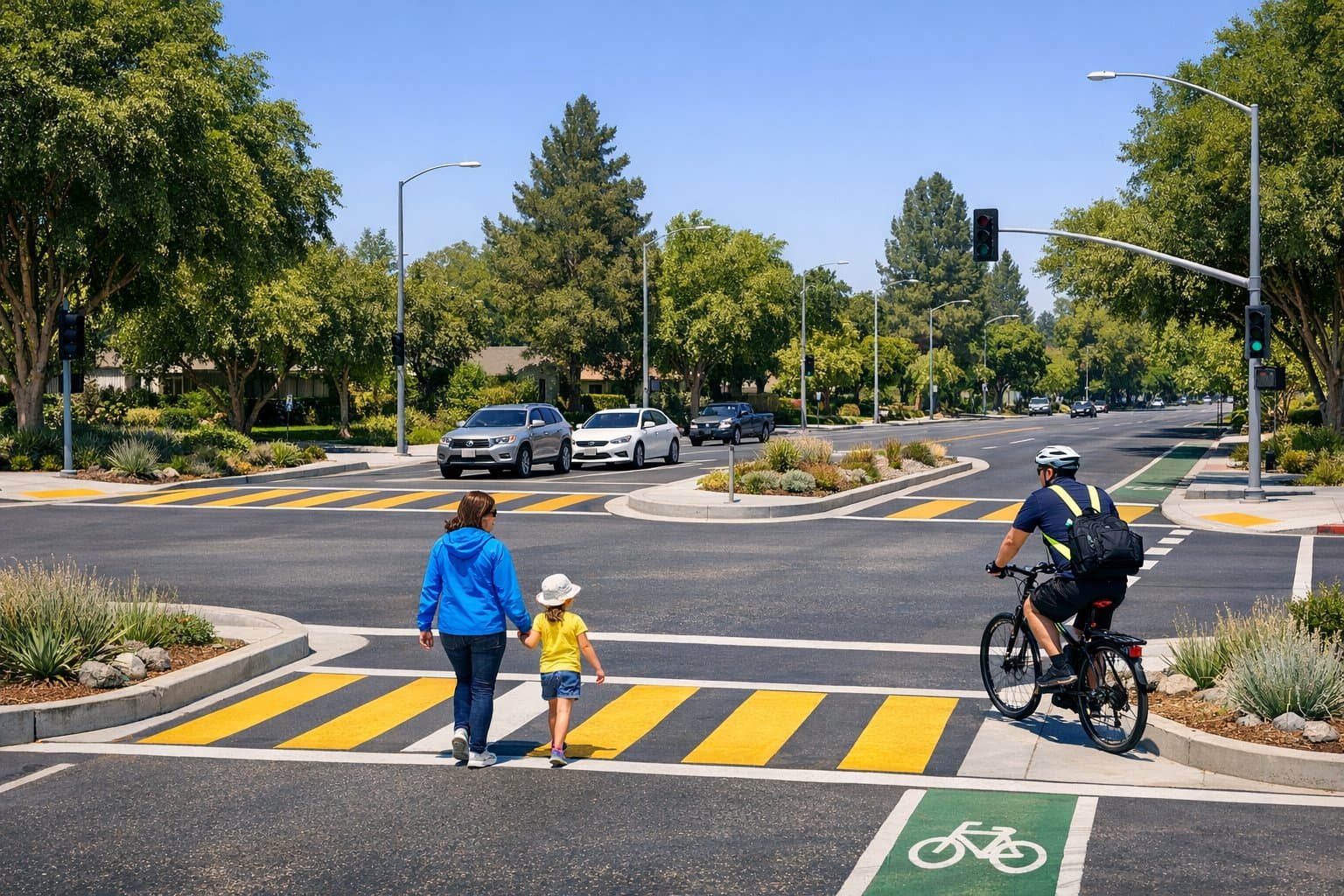
Working in tandem with daylighting, tactical urbanists often install painted bump-outs or curb extensions. Using high-friction surface paint, large planters (which can utilize drought-resistant plants to reduce maintenance), and soft-hit plastic posts, communities can physically extend the pedestrian waiting area out into the roadway, occupying the space where cars used to park.
This physically shortens the distance a pedestrian must cross, massively reducing their exposure time to live traffic. Simultaneously, the visual narrowing of the roadway forces turning vehicles to slow down by tightening their turning radius, directly mitigating the dangers of sweeping slip lanes.
Modifying Signal Phasing: Leading Pedestrian Intervals (LPIs)
While modifying physical infrastructure with paint and planters is vital, changing how traffic signals operate is an equally powerful, low-cost tool. A Leading Pedestrian Interval (LPI) alters the computerized signal phasing to give pedestrians a 3-to-7-second head start before parallel vehicle traffic receives a green light.
By the time the cars begin to move and initiate their turns, the pedestrians are already well established in the middle of the crosswalk. This maximizes their visibility, moves them out of the A-pillar blind spot, and physically prevents aggressive drivers from cutting them off. Combining LPIs with "Hardened Centerlines"—small rubber curbs installed directly at the center line of the intersection—forces left-turning drivers to make slow, square, 90-degree turns rather than cutting dangerously and quickly across the intersection at a shallow angle.
Community Advocacy: From Idea to Asphalt
For neighborhood watch leads or protective parents wishing to implement these fixes, the path from idea to asphalt is becoming increasingly streamlined. Communities can follow established tactical urbanism guides provided by progressive cities like Atlanta, Fayetteville, and Nashville.
The process generally involves:
Identifying the Risk: Consulting local Vision Zero High Injury Network maps to locate corridors where fatal and serious injury crashes are concentrated.
Developing a Site Plan: Gathering community input and utilizing resources like the Tactical Urbanist's Guide to Materials and Design to select appropriate, low-cost interventions (e.g., a pop-up bike lane, a painted pedestrian plaza, or a daylighted corner).
Applying for Permits: Securing right-of-way, lane closure, or special event permits from the municipal transportation department for a short-term demonstration project.
Observation and Permanence: Collecting data on crash reductions and improved pedestrian comfort during the pilot to advocate for municipal funding to pour permanent concrete.
Rewiring Driver Habits: Rules for Safe Passing, Turning, and Scanning
Tactical urbanism and infrastructure improvements are essential long-term solutions, but they require immense time, bureaucratic navigation, and sustained funding. In the immediate present, infrastructure improvements must be paired with fundamental changes in driver behavior. Understanding the cognitive illusions of driving is completely useless if motorists do not actively employ strategies to counteract them. Safety researchers and human factors engineers advocate for specific, trainable behaviors focused heavily on space management and active visual scanning.
The Four Levels of Driver Scanning Activity
Research conducted by the Human Factors Research Laboratory analyzed how drivers approach intersections and categorized their visual scanning behavior into four distinct levels. The researchers correlated these scanning levels directly with target acquisition (seeing the hazard) and accident avoidance.
| Scanning Activity Level | Description of Driver Behavior | Impact on Target Acquisition and Collision Risk |
|---|---|---|
| Level 1 (Eyes Fixed) | The driver stares straight ahead with rigid "tunnel vision," failing to move their eyes or head. | Accounts for roughly 6.3% of scanning; highly inactive and dangerous. |
| Level 2 (Eyes Only) | The driver darts their eyes to scan, but keeps their head perfectly still and locked forward. | Highest incident rate (almost 44%). Drivers falsely believe they are scanning, but peripheral vision remains blocked by A-pillars. |
| Level 3 (Head and Eye Movement) | The driver actively moves both their eyes and their head, physically looking around structural obstructions in the vehicle. | Target acquisition increases significantly; collision rates drop drastically as amodal completion is broken. |
| Level 4 (Proactive/Anticipatory) | The driver uses aggressive head and eye movements to systematically scan specific risk zones based on environmental cues. | Yields the highest target acquisition and lowest collision rates. The driver actively expects hazards. |
Based on Human Factors Research Laboratory simulator data on A-pillar induced blind spots.
To defeat the A-pillar blind spot and the deadly Illusion of Absence, drivers must be explicitly trained to abandon Level 1 and Level 2 scanning. Employing Level 3 or 4 scanning involves a physical, exaggerated "bob and weave" motion of the head when approaching a crosswalk or executing a turn. By physically moving the head laterally, the driver forces the brain to gather visual data from multiple angles, looking around the thick A-pillar, thereby breaking the amodal completion cycle and revealing the hidden pedestrian. This type of proactive scanning also helps drivers spot escalating road rage and reckless behavior early, before it turns into a crash.
Navigating Safe Passing Distance Laws
When overtaking vulnerable road users on open roads or arterials, drivers must actively counteract the looming effect by providing substantial physical clearance. Recognizing this physiological limitation, the vast majority of U.S. states have enacted specific legislation defining safe passing parameters to protect cyclists.
The purpose of bicyclist passing laws is to legally define a minimum clearance space, shifting the burden of safety and spatial awareness onto the operator of the heavier, faster vehicle. As of late 2021, 35 states and the District of Columbia have enacted laws requiring drivers to leave a minimum of three feet of space when passing cyclists.
However, legislation varies significantly across jurisdictions, and everyday drivers must understand the nuances of these rules:
| State / Jurisdiction | Legal Requirement for Passing Cyclists | Key Nuances and Provisions |
|---|---|---|
| California | 3-Foot Minimum | Contains a provision allowing passes with less clearance if "reasonable and prudent" (e.g., tight mountain roads at low speeds), provided it does not endanger the cyclist. |
| New Jersey | 4-Foot Minimum / Move Over | Drivers must move over a full lane if available. On single lanes, a 4-foot buffer is required. If 4 feet is impossible, the driver must slow to 25 mph and prepare to stop. |
| Maine | 3-Foot Minimum / Centerline Cross | Specifically allows vehicles to cross the double-yellow centerline in a no-passing zone in order to safely pass a bicyclist, overriding standard lane laws. |
| Washington (and others) | Full Lane Change | States like WA, DE, KY, NV, and OK require motorists to completely change lanes to pass a cyclist on multi-lane roads. |
| 8 Generalized States | "Safe Distance" | Mandates passing at a "safe distance and speed" without defining a measurement (e.g., Montana), complicating enforcement and relying on driver judgment. |
Comparative summary of select state bicyclist passing laws.
Regardless of local statutes, safety experts and community advocates recommend a universal best practice: if a driver cannot provide a minimum of three feet of clearance, they must decelerate to match the cyclist's speed and wait patiently behind them until oncoming traffic clears, allowing for a wide, safe overtaking maneuver. The frustration of a 30-second delay is infinitely preferable to a fatal collision.
Interacting with Cyclists at Intersections
Understanding roadway rights is crucial for intersection safety. In states like California, bicyclists moving slower than traffic possess the explicit legal right to "take the lane" if the road is too narrow for a vehicle and a bike to share safely side-by-side. Drivers often misunderstand this maneuver as aggressive or entitled, failing to recognize it as a vital defensive strategy used by cyclists to prevent dangerous, close-proximity passes, or to avoid the deadly "door zone" of parked cars.
Furthermore, when a designated painted bike lane is separated from traffic by plastic posts or parked cars, it legally becomes a "separated bikeway". Cyclists are not mandated to stay trapped within these separated bikeways; they may legally enter the main traffic lanes for any reason, including to avoid debris, make left turns, or bypass hazards. Tech-savvy drivers must continuously scan for merging cyclists, particularly when executing right turns across painted bike lanes, to avoid the deadly right-hook scenario.
Leveraging Technology and Community for Safer Roads: The Carszy Paradigm
While tactical urbanism and individual driver retraining are essential pillars of the Safe System approach, they possess inherent limitations. Infrastructure changes require bureaucratic navigation and sustained funding, while human behavioral changes are incredibly difficult to enforce at scale. In the interim, while we wait for concrete to dry and habits to form, technology and community mobilization are bridging the gap to keep neighborhoods secure and hold dangerous drivers accountable.
The epidemic of hit-and-run crashes, which claimed nearly 3,000 lives in 2023, highlights a massive, systemic failure in the current safety apparatus. When an incident occurs—whether a minor sideswipe of a cyclist or a catastrophic pedestrian strike—traditional law enforcement responses, while necessary, are often hampered by delays, vast patrol areas, and a lack of immediate actionable intelligence. The initial moments following a crash, or the brief window when a dangerous driver is spotted swerving through a neighborhood, are crucial.
This is where progressive, community-driven safety platforms are fundamentally altering the landscape. By transitioning away from the passive, often toxic complaining typical of traditional social networks and moving toward actionable, geolocation-based safety tools, communities can leverage decentralized observation to protect vulnerable road users. Community members can also use these platforms after a scary near-miss to flag problem locations, then follow up with more structured steps from a near‑miss safety action plan.
The Role of Connected Driver Platforms
Platforms like Carszy represent a paradigm shift in roadway safety and community watch dynamics. Recognizing that the vehicle itself is often a barrier to accountability, Carszy utilizes the most ubiquitous, public, and standardized piece of data on any vehicle: the license plate. By mapping license plates as unique digital identifiers, these systems allow for secure, direct, driver-to-driver communication, stripping away the anonymity that emboldens reckless driving.
In the context of pedestrian and cyclist safety, this robust connectivity serves several highly specific, vital functions for the commuter, the protective parent, and the neighborhood watch lead:
Immediate Hazard Alerts via License Plate Messaging: If a tech-savvy driver or a community watch advocate observes a motorist driving aggressively, rolling through stop signs near a school, or operating with their headlights off at night (a major factor contributing to the 58 percent surge in nighttime pedestrian fatalities), they can use the platform to send a secure, anonymous alert directly to that specific vehicle's plate. This creates an immediate feedback loop, alerting a distracted driver to their dangerous behavior before a tragedy occurs.
- Hit-and-Run Mitigation via VOIS™ (Vehicle of Interest Search): When a hit-and-run occurs, time is the enemy of justice. Utilizing systems like the Vehicle of Interest Search (VOIS™), communities can mobilize instantly. If a witness captures the plate or even a partial description of a fleeing vehicle, the local user network can be alerted in real-time. This community-driven web drastically reduces the time it takes to locate vehicles involved in critical incidents, effectively crowdsourcing the neighborhood watch and acting as a massive deterrent to drivers who believe they can flee a dark intersection with impunity.
- Human Media™ vs. Social Media: Road rage incidents frequently escalate into physical violence when drivers attempt to communicate frustration through honking or gesturing. "Human Media" provides a secure, digital avenue to report dangerous behavior, fostering real-world accountability without the immediate risk of a physical altercation. It shifts the focus from curating online personas to keeping real communities safe.
Operating with a strict focus on privacy—utilizing US-based servers and masking personal identities behind the license plate interface—these platforms empower citizens to take an active, responsible role in their neighborhood's security ecosystem. They act as a digital safety net, supporting the physical infrastructure improvements advocated by Vision Zero and tactical urbanism groups, ensuring that the roads are monitored by the people who use them every day. In many ways, this is part of a broader shift in car culture, where being “driven” now means protecting your neighbors as much as enjoying your vehicle, as explored in the movement to rethink driving culture around safety and community.
Conclusion
The devastating toll of pedestrian and cyclist fatalities is not an inevitable byproduct of modern transportation; it is a solvable public health crisis rooted in specific engineering failures and deeply ingrained cognitive illusions. The human brain, plagued by the mathematical realities of the looming effect and the amodal completion of A-pillar blind spots, frequently fails to perceive vulnerable road users until a collision is physically unavoidable. These physiological limitations are being tragically amplified by the expanding blind zones of modern vehicle architecture, which prioritize aggressive styling over direct visibility.
However, the path to safer streets is clearly defined and achievable. By understanding and actively addressing the ten most dangerous intersection patterns—particularly the hazards of wide, multi-lane crossings, high-speed slip lanes, and obscured sightlines—communities can dismantle the architecture of these accidents. Low-cost tactical urbanism interventions, most notably intersection daylighting and leading pedestrian intervals, offer immediate, actionable solutions to restore visibility, manage kinetic energy, and reclaim the streets for human beings. Community reporting and heatmap tools can further highlight problem intersections; together they support bigger efforts to report dangerous drivers and push for safer designs.
Simultaneously, drivers must actively rewire their habits, abandoning passive "tunnel vision" in favor of proactive, Level 3 and 4 scanning that incorporates physical head movement to peer around structural blind spots. Adhering strictly to safe passing distance laws, yielding to cyclists commanding the lane, and treating every intersection as a high-risk environment of shared space are non-negotiable responsibilities for anyone holding a driver's license.
Achieving true road safety requires a holistic approach that merges physical infrastructure, mindful driving habits, and rapid community accountability. Everyday drivers, protective parents, and neighborhood advocates have the collective power to fundamentally alter the safety of their streets. By advocating for daylighting, respecting the physics of perception, and leveraging real-time alert networks to report dangerous behavior, the tragic narrative of victims appearing "out of nowhere" can be systematically erased.
To take an active role in protecting your community, reporting dangerous driving, and holding hit-and-run drivers accountable, download the app to stay connected at carszy.com.