The “Safe Merge” Guide and the Architecture of Modern Road Safety: Understanding the Zipper Merge and Defeating the Nation’s Most Dangerous Intersections
The daily commute across the modern American roadway network is a complex psychological and physical arena. Every time a driver starts an engine, they enter a high-velocity social contract with thousands of strangers. This environment is governed by an intricate mixture of codified laws, unwritten behavioral rules, and complex geometric engineering. Yet, despite decades of traffic science, advanced driver-assistance systems, and billions of dollars in infrastructure spending, modern roads remain fraught with profound anxiety, crippling congestion, and life-threatening danger. The modern driver faces a relentless barrage of split-second decisions, and perhaps no scenario induces more collective blood pressure spikes and vehicular hostility than the bright orange construction sign warning: “Lane Ends Ahead.”
What typically follows this sign is a complete breakdown of social cohesion. Drivers instantly divide into two hostile camps: the "early mergers" who queue up dutifully miles in advance, and the "late mergers" who utilize the closing lane to bypass the line. This specific conflict highlights a much broader crisis in roadway understanding and driver-to-driver communication. The fundamental rules of the road are frequently misunderstood, and the very design of our asphalt arteries often sets drivers up for behavioral failure.
This comprehensive research report serves as an exhaustive, expert-level guide to the mechanics of modern driving, the psychology of road rage, and the structural integrity of community safety. It begins by demystifying the most contentious maneuver in driving—the zipper merge—explaining the stark difference between perception and traffic science. It then expands outward to examine the broader context of aggressive driving, exploring how the anonymity of the automobile breeds hostility and how emerging technological platforms are dissolving that anonymity. Finally, the analysis pivots from the high-speed highway to the local neighborhood, identifying the ten most dangerous intersection patterns in the United States and detailing the precise, low-cost fixes that safety-conscious parents, neighborhood watch leads, and tech-forward drivers can advocate for to reclaim their streets.
Part I: The Anatomy of the Zipper Merge
The zipper merge is arguably the most misunderstood traffic management strategy in North America. To understand why it causes such extreme friction among commuters, one must examine the intersection of fluid dynamics, behavioral psychology, and the often conflicting guidance provided by state legislations.
The Early Merge vs. The Late Merge
When a lane closure appears on a multi-lane highway, the instinct of the vast majority of drivers is to merge into the continuing lane as soon as humanly possible. This maneuver is known in traffic engineering as the "early merge." It is driven by a deeply ingrained, almost universal social etiquette: one does not cut in line. Early mergers form a single, extraordinarily long queue, leaving the closing lane entirely empty for hundreds or thousands of feet before the actual bottleneck.
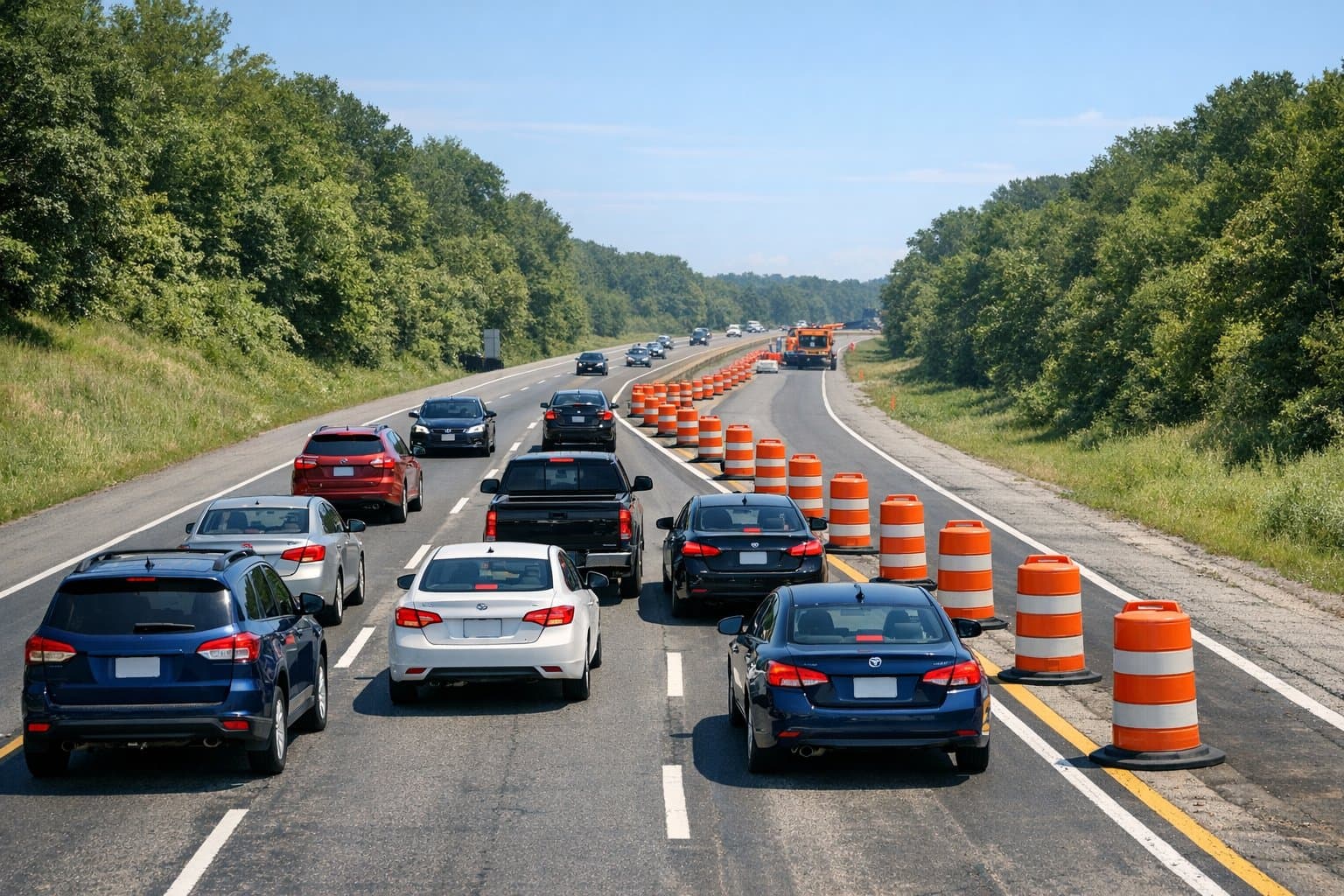
The "late merge," officially known in engineering circles as the dynamic late merge or more colloquially as the "zipper merge," asks drivers to do the exact opposite of their social conditioning. Drivers are instructed to use both available lanes to their absolute fullest extent right up to the point where the lane physically ends or is blocked by a taper of construction cones. At this precise merge point, vehicles in the closing lane alternate seamlessly with vehicles in the continuing lane, proceeding one-by-one like the interlocking teeth of a zipper.
While the early merge leaves valuable roadway unutilized and creates dangerously long, single-file queues, the zipper merge maximizes lane capacity. By utilizing both lanes up to the point of closure and alternating entry, overall queue lengths are drastically reduced, and speed differentials between lanes are minimized. This conceptual shift represents the difference between a chaotic traffic jam and a highly optimized flow of vehicles.

The Empirical Evidence for Zipper Merging
Traffic engineers and transportation researchers have rigorously studied these two methodologies using advanced microsimulation modeling, such as PTV Vissim software, alongside real-world observation. The data overwhelmingly and undeniably supports the zipper merge under heavy traffic conditions.
When traffic is dense and moving slowly, the zipper merge dramatically optimizes both traffic flow and safety. A comprehensive microsimulation study evaluated zipper merging across various roadway types and found staggering efficiency gains. On freeway merge segments, implementing a zipper merge reduced travel time through the work zone by 54% compared to non-zipper, early-merge scenarios.
The benefits extend beyond the interstate. On high-speed urban arterials, the study demonstrated a complete elimination (a 100% reduction) of upstream queues when the zipper merge was strictly applied. Overall volume throughput on freeway segments saw an 8.5% increase, meaning more vehicles successfully passed through the bottleneck in the exact same amount of time, easing regional gridlock.
| Metric | Low-Speed Urban Roads | High-Speed Urban Arterials | Freeway Merge Segments |
|---|---|---|---|
| Travel Time Reduction | 16% Decrease | 42% Decrease | 54% Decrease |
| Queue Length Reduction | 22% Decrease | 100% Decrease (Eliminated) | 87% Decrease |
| Volume Throughput Increase | Minimal Impact | 2.7% Increase | 8.5% Increase |
Data derived from microsimulation modeling comparing zipper merging to traditional early merging.
The safety benefits are equally compelling. The primary, often lethal danger in an early merge scenario is the massive speed differential it creates. One lane comes to a complete standstill, while the adjacent closing lane remains wide open. Drivers eager to bypass the line often accelerate to high speeds in the empty lane, creating a severe risk of high-impact collisions if a frustrated driver in the stationary lane suddenly swerves out to block them. By utilizing both lanes and harmonizing the speeds of all vehicles, the zipper merge essentially eliminates these highly dangerous speed variances.
However, traffic science notes an absolutely critical caveat: the zipper merge is not a universal solution for all conditions. It is specifically designed for congestion. When traffic volumes are low and vehicles are traveling at or near highway speeds, an early merge is entirely appropriate and safe, as drivers have ample space and time to smoothly change lanes without forcing others to tap their brakes. The zipper merge becomes a geometric and safety necessity the moment traffic begins to slow down and queue up.
The Legislative and Behavioral Contradiction
Despite the mountain of empirical data, the widespread implementation of the zipper merge is heavily plagued by a lack of driver compliance, deep-seated psychological resistance, and highly contradictory official guidance. Behavioral science reveals that drivers are deeply habituated to early merging. A study reviewing communications from U.S. state Departments of Transportation noted that while 34 states have officially endorsed the zipper merge in some capacity, drivers still struggle to adopt it due to established social norms and the very real fear of inciting road rage from fellow motorists. For a deeper look at how driver behavior, law, and insurance collide on the road, see the calm, evidence-based framework in Understanding Road Rage, Recklessness, and Insurance Tips.
The state of California provides the most glaring, high-profile example of this administrative contradiction. Traffic officials from Caltrans and the California Highway Patrol (CHP) readily acknowledge that zipper merging uses lanes to their fullest extent and improves overall traffic flow. However, the official California Department of Motor Vehicles (DMV) handbook actively contradicts this engineering consensus. The 2024 handbook advises drivers to merge early in construction zones, stating that drivers should merge into a space large enough to safely join the lane well in advance, which is the exact opposite of late merging.
This mixed messaging leaves drivers completely to their own devices. Because California law does not officially recognize or mandate the zipper merge, the driver in the continuing lane maintains the legal right-of-way, and the driver in the closing lane must yield. This legal framework unintentionally empowers the "early mergers" to aggressively, and sometimes violently, block "late mergers," viewing them as selfish line-cutters rather than efficient navigators optimizing the roadway's capacity.
Zipper Merge Etiquette: A Guide to Safe Execution
Executing a zipper merge safely in a highly charged, congested environment requires a high degree of emotional intelligence and precise vehicular control. To handle a lane closure without causing a crash or inciting hostility, everyday commuters and tech-savvy drivers alike should adhere to a strict code of etiquette:
Read the Signs, But Hold the Line: When the "lane ends" warning appears, drivers should immediately check their mirrors and scan ahead to locate where the actual merge point is near the taper. It is crucial not to panic-merge. Slamming on the brakes to dive into the other lane immediately creates shockwaves of braking behind the vehicle that can ripple for miles. The safest plan is to maintain the current lane, keep a steady speed, and prepare to merge predictably at the taper.
Harmonize Velocity: The absolute ideal merge happens when both lanes move at roughly the exact same speed. If a driver is in the closing lane, they must not race to the front, nor should they crawl far below the flow. Either extreme forces other drivers to brake aggressively. The goal is smooth, moderate acceleration or deceleration so the vehicle arrives at the merge point aligned with a safe, natural gap.
The Rolling Yield: If traffic is stop-and-go, drivers should keep a low, steady pace and leave space ahead so they can roll rather than repeatedly stop. Rolling at 5 to 10 mph with a cushion is significantly safer than creeping bumper-to-bumper, giving the driver options if the next vehicle hesitates.
Never Force the Squeeze: A driver must never attempt to "win" the merge by sprinting to the cones. A last-second surge drastically increases the chance of hitting the taper barrels or clipping another vehicle's mirror. It also encourages the other lane to aggressively block, escalating the situation. If a driver is blocked, the safest response is to stay calm, fall in behind, and continue.
Part II: The Psychology of the Commute and the Epidemic of Road Rage
The severe friction surrounding the zipper merge is merely a localized symptom of a much larger, darker phenomenon plaguing the transportation network: the normalization of road rage. Modern driving is characterized by profound physical and psychological isolation. Drivers are encased in soundproofed steel and tinted glass, moving at lethal speeds while completely anonymous to one another. This deep anonymity strips away the normal social inhibitions that govern human interaction, leading to aggressive behaviors that individuals would never exhibit in a grocery store aisle, an office, or a crowded sidewalk.
The Contagion of Aggressive Driving
The statistics surrounding aggressive driving are not just concerning; they represent a public safety epidemic. A comprehensive, nationwide study conducted by the AAA Foundation for Traffic Safety revealed that a staggering 96% of drivers openly admit to engaging in aggressive driving behaviors, or being on the receiving end of them, over the past year.
The spectrum of these behaviors ranges from the seemingly mundane to the violently criminal. Approximately 92% of drivers reported engaging in actions that put other human beings at direct physical risk, such as extreme speeding, deliberate tailgating, or aggressively cutting off other vehicles. Even more alarming, 11% of drivers admitted to overt violent actions, including intentionally bumping another car with their vehicle or exiting their car in moving traffic to physically confront another driver.
The AAA study identified a chilling psychological dynamic: aggressive driving is highly contagious. Drivers who are exposed to higher levels of aggressive behavior on the road are significantly more likely to drive aggressively themselves, creating a self-fulfilling, cascading cycle of hostility that degrades the safety of the entire corridor. The most common triggers for this rage are highly predictable: having one's progress impeded (such as encountering a slow driver or a perceived "late merger"), feeling put at risk by the reckless maneuvers of others, and experiencing general discourtesy.
The consequences of this collective anger are deadly. Traffic psychology research indicates that high-anger drivers take significantly more risks on the road. They are exponentially more likely to drive 10 to 20 mph over the speed limit, rapidly and unpredictably switch lanes, tailgate, and enter an intersection after the light turns red. Consequently, high-anger drivers experience twice as many car accidents in driving simulations as their calmer counterparts. In the real world, the stakes are measured in human lives. In 2023 alone, 118 people were shot and killed in road rage incidents across the United States, equating to one person shot every 18 hours due to a fleeting traffic dispute. If you ever find yourself witnessing this kind of behavior and need to act safely, the step-by-step guide in Witnessed a Crash? Your Smart, Life-Saving Bystander Playbook can help you respond without putting yourself at risk.
Restoring the Human Element Through Technology
The traditional antidote to the anonymity of the road has been a reliance on manners. Safety experts emphasize that simple road etiquette—using turn signals, allowing others to merge, and offering a friendly wave of acknowledgment—can serve as a powerful protective factor against aggressive driving, actively de-escalating tension before it boils over.
However, modern community safety advocates recognize that etiquette alone is grossly insufficient without structural accountability and new methods of connectivity. This is where advanced technology intersects with neighborhood security. Innovative platforms are emerging to entirely bridge the communication gap between isolated drivers. For example, the community safety platform Carszy utilizes public license plates as unique, secure identifiers, allowing drivers to communicate without ever exchanging personal phone numbers.
This technological capability shifts the entire paradigm of social interaction on the road. Instead of laying on the horn, flashing high-beams aggressively, or initiating a dangerous tailgating sequence, a driver can send a secure License Plate Message. This allows for instant, polite alerts—notifying another motorist that their taillights are out, that a tire is dangerously low, or that a pet appears distressed in a hot car. For the protective parent commuting with children, this de-escalation capability is invaluable. For more on how everyday tech can protect kids and pets, see the analysis in Preventing Child and Pet Heatstroke in Vehicles in 2026.
By shifting away from the inherently toxic, broadcast-heavy nature of traditional "Social Media" toward what safety advocates term "Human Media™"—technology focused strictly on real-world impact and localized utility—communities can mobilize in real-time. The anonymity that breeds road rage is fundamentally undermined when drivers realize they are sharing the road with accessible, accountable members of their own community, all operating on privacy-focused, US-based servers.
Part III: The Geography of Risk – The 10 Most Dangerous Intersection Patterns
While freeways and high-stress merge zones are the primary theaters for aggressive driving and road rage, the absolute deadliest environments on the American roadway network are intersections. An intersection is, by definition, a planned point of conflict. It is the exact geographic location where high-speed multi-ton vehicles, commercial trucks, fragile bicycles, and entirely unprotected pedestrians are forced to share the same physical space.
The mortality statistics associated with these junctions are sobering. Roughly 25% of all traffic fatalities and over 50% of all traffic injuries in the United States occur at intersections. Over a comprehensively studied 18-year period, more than 142,000 fatal crashes occurred at these crossings. For pedestrians, the danger is particularly acute and worsening; in 2022, a 40-year high of 7,522 pedestrians were struck and killed, averaging more than 20 deaths per day across the nation.
Through an exhaustive analysis of Federal Highway Administration (FHWA) data, National Highway Traffic Safety Administration (NHTSA) crash reports, and urban planning audits, safety experts have identified the ten most dangerous intersection patterns. Understanding these geometric and operational failures is the crucial first step toward advocating for their repair.

1. High-Speed Rural Unsignalized Intersections
Contrary to popular belief, the majority of intersection fatalities do not occur in gridlocked urban centers; they occur on two-lane rural roads. At these unsignalized intersections, a minor road controlled by a simple stop sign intersects with a major rural highway where vehicles are routinely traveling at 55 mph or higher. The danger here lies in the extreme "velocity differential" and the catastrophic physics of angle (T-bone) crashes. A driver on the minor road misjudges the speed of an approaching vehicle, or fails to notice the intersection entirely due to a phenomenon known as "highway hypnosis," pulling out directly into the path of a high-speed vehicle. Angle crashes account for a massive 53% of all fatal unsignalized intersection crashes.
2. Urban Arterials with High Driveway Density
In rapidly expanding suburban and urban environments, wide multi-lane arterial roads often serve a deeply flawed dual purpose: moving massive volumes of traffic at high speeds while simultaneously providing direct access to strip malls, gas stations, and residential driveways. This creates severe "Corridor Access Management" failures. Every single driveway acts as an invisible, highly dangerous unsignalized intersection. Drivers are constantly slamming on their brakes to turn right, or making harrowing unprotected left turns across multiple lanes of oncoming traffic. The constant starting, stopping, and crossing generates a high frequency of rear-end and side-swipe collisions.
3. Wide, Multi-Lane Crossings for Pedestrians
The most lethal intersections for pedestrians are characterized by extreme width and exposure. According to safety data, 70% of pedestrian fatality "hot spots" occur on roads that require crossing five or more lanes of traffic. Furthermore, 75% of these lethal hot spots feature speed limits of 30 mph or higher. A pedestrian crossing a massive six-lane arterial is exposed to moving traffic for a significantly long duration. The greatest risk is the "multiple-threat crash": if a driver in the curb lane stops to yield to a pedestrian, a driver in the adjacent lane—their view obstructed by the yielding vehicle—often fails to stop, striking the pedestrian at full speed. To understand how a human-centric design lens can shift these odds, the piece Pedestrian and Cyclist Safety: A Human-Centric Approach explores this risk from the perspective of vulnerable road users.
4. Skewed and Y-Intersections
The ideal, safest intersection meets at a perfect 90-degree angle, providing drivers with clear, unobstructed sightlines in both directions. However, due to geographical constraints, natural topography, or historical road plotting, many roads intersect at severe, skewed angles (less than 90 degrees) or form "Y" shapes. Skewed intersections require drivers to look over their shoulders at awkward, physically straining angles to check for oncoming traffic. This dramatically increases the likelihood of "inadequate surveillance," which NHTSA data identifies as the leading behavioral cause of intersection accidents, responsible for 44.1% of such collisions.
5. Unlit or Poorly Lit Intersections
Visibility is the absolute cornerstone of road safety. The nighttime fatality rate is mathematically three times higher than the daytime rate. At night, standard vehicle headlights simply do not provide enough illumination distance for a driver traveling at speed to perceive a hazard—such as a pedestrian in dark clothing or a vehicle entering the intersection without headlights—and react in time. Intersections lacking adequate overhead lighting are vastly disproportionately represented in pedestrian fatalities and severe right-angle crashes. If you regularly drive after dark and want immediate, practical tactics to cut risk, Night Drive Mastery: 10 Immediate Ways to Cut Risk breaks down simple, science-backed habits.
6. Left-Turn Conflicts on Divided Highways
Making an unprotected left turn across a high-speed, multi-lane divided highway is one of the most cognitively demanding tasks in everyday driving. A driver must accurately judge the speed, distance, and trajectory of vehicles in two, three, or even four oncoming lanes simultaneously. Left-turn crashes account for 8% of fatal crashes at unsignalized intersections. The danger is exponentially magnified when opposing left-turn lanes have a "zero or negative offset," meaning the vehicles waiting to turn left physically block each other's view of the oncoming through-traffic.
7. Inadequate Sight Distances (The Blocked Crosswalk)
In dense, busy urban environments, intersections are frequently choked by parked vehicles, delivery trucks, and dense vegetation right up to the very edge of the crosswalk. This creates an environment with zero effective "intersection sight distance". A driver attempting to turn onto the main road, or a pedestrian stepping off the curb, is entirely blind to approaching traffic. They are forced to inch forward blindly into the active lane just to see if it is clear, creating a terrifyingly high probability of a collision.
8. High-Speed Approaches to Signalized Intersections
When traffic signals are placed on high-speed roads (where the limit is 45 mph or greater), they create a psychological and physical "dilemma zone." When the light turns yellow, a driver traveling at 50 mph must instantaneously decide whether to brake hard or accelerate to clear the vast intersection. If the yellow interval is timed improperly—either too brief or too long—it invites catastrophe. A short yellow leads to unintentional rear-end crashes, as one driver slams on the brakes while the trailing driver assumes they will proceed. A long yellow invites intentional, high-speed red-light running, which causes over 200,000 crashes and 900 deaths annually nationwide.
9. Unsignalized Crossings with Heavy Non-Motorized Traffic
Intersections located near busy transit stops, sprawling shopping centers, or dense school zones see high volumes of pedestrian and bicycle traffic. When these specific intersections lack signals, flashing crossing beacons, or physical pedestrian refuge islands, the entire burden of safety is placed on the pedestrian to accurately judge gaps in fast-moving traffic. These environments heavily penalize the most vulnerable road users: older adults, young children, and disabled residents. Consequently, pedestrian and bicycle crashes make up 14% of all fatal accidents at unsignalized intersections. For a school-zone focused playbook on these kinds of dangers, including low-cost fixes, see 2026 Pedestrian Safety Crisis and Community Solutions.
10. Complex Multi-Leg Junctions
Intersections featuring more than four intersecting legs (such as chaotic five-way or six-way junctions, or outdated traffic circles not built to modern roundabout standards) completely overwhelm the human brain's processing capacity. The sheer number of conflict points makes it nearly impossible for a driver to simultaneously track every potential threat. This sensory overload directly leads to the second most common behavioral cause of intersection crashes: the "false assumption of another's action" (responsible for 8.4% of crashes), where a driver mistakenly assumes another vehicle's intended path and pulls out into a collision.
Part IV: The Economics of Safety – Low-Cost Fixes Communities Can Advocate For
Recognizing a highly dangerous intersection is only the diagnostic phase; the actual cure lies in structural and geometric modification. Historically, communities assumed that fixing a deadly intersection required multi-million-dollar infrastructure overhauls, massive land acquisition, and years of environmental studies. However, the Federal Highway Administration (FHWA) has explicitly identified a suite of "Proven Safety Countermeasures"—low-cost interventions ranging from a mere $1,000 to $50,000 per intersection—that yield massive, immediate reductions in fatalities and injuries.
Because these treatments are highly inexpensive, transportation agencies can deploy them systematically across hundreds of intersections, maximizing the return on investment and saving lives immediately. Neighborhood watch advocates, safety-conscious parents, and local community leaders can directly lobby their city councils and departments of transportation to implement these data-backed, low-cost fixes.
1. Systemic Stop-Controlled Enhancements
For rural and suburban stop-controlled intersections, simply ensuring drivers actually see the intersection in time can save countless lives. The FHWA recommends a package of basic, systemic enhancements: installing doubled-up (left and right side of the road) oversized advance warning signs, applying high-visibility retroreflective sheeting to the sign posts themselves, painting clear, thick stop bars on the pavement, and ruthlessly removing vegetation that blocks sightlines.
The Data: The systemic application of these low-cost countermeasures across a jurisdiction results in a 10% overall reduction in fatal and injury crashes, a 15% reduction in nighttime crashes, and boasts a highly cost-effective 12:1 benefit-cost ratio.
2. Retroreflective Backplates for Traffic Signals
Red-light running often occurs not out of malice or impatience, but because a driver simply did not perceive the traffic signal against the harsh glare of the setting sun or a cluttered backdrop of neon city lights. A remarkably cheap and highly effective fix is adding a 1- to 3-inch wide yellow retroreflective border to the black backplate of the traffic signal head. This provides a controlled-contrast background that draws the driver's eye directly to the current phase of the signal.
The Data: This exceptionally simple upgrade reduces total intersection crashes by 15%. It is particularly beneficial for older drivers and those with color-vision deficiencies, and it provides a critical, life-saving visual cue during power outages when the signal is completely dark but the reflective border illuminates in headlights.
3. Intersection Daylighting
"Daylighting" is a somewhat deceptive urban planning term; it has nothing to do with artificial lights and everything to do with clearing physical sightlines. It involves the physical removal of car parking spaces immediately adjacent to intersections and pedestrian crosswalks. By strictly restricting parking within 20 to 25 feet of the corner, the massive blind spots created by large SUVs and delivery trucks are instantly eliminated. Drivers can clearly see pedestrians waiting to cross, and pedestrians can see approaching vehicles without having to step dangerously into the active roadway.
The Data: According to the FHWA, daylighting reduces pedestrian crashes by an impressive 30%. It is incredibly inexpensive—often requiring only a bucket of yellow curb paint or the installation of a few flexible delineator posts. Cities like Hoboken, NJ, achieved zero traffic deaths over a seven-year period by heavily utilizing intersection daylighting.
4. Leading Pedestrian Intervals (LPI)
At standard signalized intersections, pedestrians and turning vehicles often receive a green light at the exact same moment. This fundamentally flawed design forces pedestrians to immediately compete for space with multi-ton vehicles attempting to turn right or left. A Leading Pedestrian Interval (LPI) changes the traffic signal programming to give pedestrians a 3- to 4-second head start before the vehicles parallel to them are given the green light. This crucial interval allows the pedestrian to establish themselves firmly within the crosswalk, making them highly visible to drivers before the vehicles even begin to move.
The Data: Implementing an LPI is virtually free, requiring only a software timing adjustment to the existing signal cabinet, yet it results in a massive 58.7% reduction in pedestrian-vehicle crashes.
5. High-Friction Surface Treatments (HFST)
Intersections uniquely require vehicles to brake heavily and repeatedly. Over time, this constant braking polishes the asphalt completely smooth, severely reducing tire grip, especially during rain or snow. High-Friction Surface Treatments (HFST) involve laying down a durable thermosetting polymer resin binder topped with calcined bauxite—an extremely hard, crush-resistant aggregate. Applied roughly 300 feet in advance of the intersection, it dramatically and permanently increases the pavement's skid resistance.
The Data: HFST virtually eliminates hydroplaning and reduces total crashes at intersections by up to 20%. It is specifically recommended for intersections with a documented history of wet-weather, rear-end, or failure-to-yield crashes.
6. Tactical Urbanism and Traffic Calming
When wide, straight residential roads naturally encourage speeding, communities do not have to wait for major construction to physically alter the road geometry. Using "Tactical Urbanism"—short-term, low-cost pilot projects—neighborhoods can design interventions to instantly slow cars down.
Lane Narrowing & Pinchpoints: Using highly visible paint, flexible bollards, or temporary planters to narrow the travel lanes visually forces drivers to slow down to maintain a comfortable driving threshold.
Chicanes: Creating an S-shaped path of travel using alternating parking spaces or curb extensions physically prevents drivers from maintaining a straight, high-speed trajectory through a neighborhood.
Mini-Roundabouts & Neighborhood Circles: Installing small, landscaped circles in the center of minor residential intersections forces vehicles to slow down and route around the island, replacing dangerous two-way stops with a low-speed, continuous, and highly visible flow.
| Proven Countermeasure | Primary Safety Problem Addressed | Estimated Crash Reduction Factor | Implementation Cost Range |
|---|---|---|---|
| Systemic Stop Sign Upgrades | Inadequate warning at rural/suburban stops | 10-15% overall reduction | Low ($1,000 - $10k per intersection) |
| Retroreflective Backplates | Signal invisibility, red-light running | 15% reduction in total crashes | Very Low (<$1,000 per intersection) |
| Intersection Daylighting | Blocked crosswalk sightlines by parked cars | 30% reduction in pedestrian crashes | Very Low (Paint/Bollards only) |
| Leading Pedestrian Interval | Pedestrian vs. Turning Vehicle conflicts | 58.7% reduction in pedestrian crashes | Very Low (Software/Timing tweak) |
| High-Friction Surface (HFST) | Rear-end crashes due to slick, polished pavement | 20% reduction at intersections | Medium ($10k - $50k per approach) |
Part V: Structural Transformations – The Long-Term Vision
While low-cost fixes represent the vital first line of defense for community advocates, certain high-volume, highly dangerous intersections require fundamental geometric transformations. Communities must understand these long-term engineering solutions to advocate effectively for state and federal infrastructure grants. For a broader look at how urban design and civic tech combine to reduce fatalities across whole corridors, see Reducing Traffic Fatalities with Urban Design and Tech, which explores how reporting tools and intersection redesign work together.
The Modern Roundabout
The traditional four-way signalized intersection is a chaotic environment with 32 potential conflict points where vehicles can collide. The modern roundabout elegantly reduces that number to just 8. By utilizing channelized, curved approaches, roundabouts physically force vehicles to drastically reduce their speed upon entry. Traffic flows counterclockwise around a central island, completely eliminating the possibility of the most lethal crash types: head-on collisions and high-speed angle (T-bone) collisions.
The Safety Impact: Converting a high-speed two-way stop-controlled intersection to a roundabout provides an astonishing 82% reduction in fatal and injury crashes. Converting an existing signalized intersection to a roundabout yields a 78% reduction in severe crashes. Furthermore, the continuous yield-control flow reduces overall delay, idling emissions, and congestion compared to waiting at a red light.
Reduced Left-Turn Conflict Intersections (J-Turns / RCUTs)
For highly dangerous multi-lane divided highways where minor roads attempt to cross, the "Restricted Crossing U-Turn" (RCUT), commonly known to drivers as a J-Turn, is a life-saving geometric innovation. Instead of allowing a driver on the minor road to shoot straight across four lanes of high-speed traffic or make a direct, unprotected left turn, the intersection physically blocks the median. The driver is instead forced to make a right turn, safely merge into the traffic flow, and then make a protected U-turn a short distance downstream.
The Safety Impact: While drivers often initially resist J-Turns because they perceive them as slightly inconvenient, the mortality data is indisputable. Converting an unsignalized intersection to an RCUT results in a massive 63% reduction in fatal and injury crashes. A rigorous study by the Missouri Department of Transportation found that one of the most severe crash types—the left turn, right angle crash—was completely eliminated by the implementation of the J-Turn.
Corridor Access Management
Instead of allowing dozens of businesses to have individual driveways emptying directly onto a high-speed arterial, corridor access management involves systematically consolidating driveways, installing raised central medians to permanently prevent across-roadway left turns, and utilizing off-arterial frontage roads.
The Safety Impact: Simply reducing the density of driveways on an urban or suburban arterial leads to a 25% to 31% reduction in fatal and injury crashes. Providing dedicated positive-offset left-turn lanes provides physical storage for turning vehicles while keeping them entirely out of the high-speed through lanes, yielding up to a 48% reduction in total crashes.
Part VI: Human Media™ and the Power of Community Advocacy
The architecture of a genuinely safe road network relies heavily on concrete, asphalt, calcined bauxite, and meticulously timed traffic signals, but the ultimate foundation of community safety relies entirely on the people who use it. Transforming dangerous streets from lethal corridors into livable spaces requires proactive, organized, and technologically empowered citizens.
Neighborhood watch leads and local community advocates no longer have to wait for years of bureaucratic red tape and funding cycles to see change. The "Tactical Urbanism" movement empowers citizens to work directly with local transportation departments to implement temporary "quick builds". Using materials as simple as hay bales, street chalk, traffic cones, and temporary planters, communities can mock-up a pedestrian plaza, a curb extension, or a traffic circle over a single weekend. Cities spanning from Fayetteville, AR, to South Bend, IN, have effectively used these demonstration projects to prove the efficacy of traffic calming to skeptical city councils, simultaneously slowing down vehicles and building profound community trust.
However, effective advocacy and safety in the digital age go far beyond physical road alterations; it requires real-time data, instant connectivity, and mutual accountability. This is the precise ethos driving modern safety platforms like Carszy. By pioneering the concept of "Human Media™"—a deliberate, necessary shift away from the toxic, algorithmic engagement of traditional social media toward real-world, localized impact—communities can literally crowdsource their own physical security. For a city-scale example of how this looks in practice, OC Road Safety Hub: Community Power Using Carszy App shows how one county turns reporting and events into safer streets.
When tech-savvy drivers can securely communicate via License Plate Messaging, the dangerous anonymity that breeds road rage evaporates. A potentially explosive situation involving a perceived slight or a misunderstood zipper merge can be instantly defused through accountability and polite, secure notification. More importantly, when an intersection crash occurs, or a vehicle acts recklessly in a school zone, advanced platform features like the Vehicle of Interest Search (VOIS™) allow the community to instantly flag the hazard. This vast network of empowered drivers effectively acts as a real-time immune system for the local roadway network. By utilizing secure geolocation and community mobilization, platforms dramatically reduce emergency response times, help track down hit-and-run vehicles that flee dangerous intersections, hold reckless drivers accountable, and provide the hard data needed to identify the specific intersections that require immediate municipal intervention. To understand how near-miss reporting can feed that data and prevent the next crash, see Almost Collided: Inside the Hidden World of Near-Misses, which explains how everyday “almost moments” become life-saving heatmaps.
Conclusion: Merging Safely into the Future
The modern roadway is a deeply shared ecosystem, intricately linking the daily commuter, the protective parent, and the neighborhood advocate. Whether a driver is navigating the intense psychological friction of a zipper merge on a crowded interstate or traversing a high-risk, poorly lit intersection in their own suburban neighborhood, true safety dictates a reliance on both empirical engineering science and profound mutual respect.
The empirical data proves definitively that utilizing all available lanes and taking turns at a merge point vastly reduces congestion and prevents the highly dangerous speed differentials that cause multi-vehicle accidents. Likewise, the data proves that minor, exceptionally low-cost alterations to our local intersections—clearing sightlines through daylighting, adding reflective borders to signals, and reprogramming crosswalks for leading pedestrian intervals—can eliminate a massive percentage of roadway fatalities.
Yet, geometry and infrastructure alone cannot solve the human element. Defeating the devastating epidemic of aggressive driving and reclaiming the streets requires communities to stay intimately connected, vigilant, and accountable to one another. By advocating loudly for data-driven geometric fixes and utilizing privacy-focused technology to communicate, de-escalate, and protect one another, everyday drivers hold the ultimate power to fundamentally alter the safety of their daily commutes.
To join the movement for accountable, connected driving, report road hazards, and help identify the dangerous intersections in your own neighborhood, download the app at carszy.com and become an active, empowered participant in keeping the community safe.