Stranded: The Roadside Breakdown Protocol That Keeps You Alive
The modern highway system is a marvel of civil engineering, designed to keep millions of vehicles moving quickly and smoothly every day. But that same system turns into a hostile environment the moment your car breaks down. In just seconds, you go from a protected, fast-moving driver to a stopped, highly exposed person sitting inches from multi-ton vehicles traveling at lethal speeds. The highway shoulder might feel like a safe place to pull over in a crisis, but in reality it is one of the most dangerous zones in modern transportation. When an engine sputters and dies, or a tire blows out without warning, everyone in the vehicle is suddenly thrown into a high-stakes survival situation on the edge of high-speed traffic.
Navigating a roadside emergency takes more than guesswork or “common sense.” It requires a clear step-by-step protocol, a basic understanding of traffic physics, awareness of evolving “Move Over” laws, and smart use of community-driven safety technology to get help faster than traditional dispatch alone. Simply pulling over and waiting for a tow truck is no longer enough. A more proactive approach is now essential for safety-conscious parents, daily commuters, neighborhood watch advocates, and tech-savvy drivers. This in-depth guide walks through the critical moves you must make when stranded, the hidden dangers of the secondary collision, the changing landscape of roadway liability, and the rise of driver-to-driver communication platforms that are reshaping roadside safety.
The Hidden Epidemic of Roadside Fatalities
The danger of the breakdown lane isn’t just a scary story; it shows up clearly in national data as a largely hidden epidemic of roadside deaths. The National Highway Traffic Safety Administration (NHTSA) reports that more than 2,100 people were killed outside of disabled vehicles at the roadside between 2019 and 2023. The victims include professional roadside assistance workers, law enforcement officers, emergency medical services (EMS) staff, Good Samaritans who stop to help, and everyday motorists who simply got out of their stalled vehicles.
Researchers believe that even this alarming number is still an undercount of the true toll. A major 2024 study by the AAA Foundation for Traffic Safety uncovered deep problems in how roadside fatalities are labeled and recorded across different crash databases.
The Data Discrepancy
The AAA Foundation team audited multiple crash databases and discovered that roadside assistance providers—tow truck drivers, mobile mechanics, emergency roadside techs, and safety service patrol workers—are struck and killed at a rate almost four times higher than what national crash data officially shows.
Between 2015 and 2021, the AAA Foundation verified 123 roadside assistance providers killed by passing vehicles. National crash data, however, logged only about 34 such deaths for the same period. This huge gap comes from a long-running failure on many state police crash report forms to record the victim’s job. These workers are often listed simply as “pedestrians,” which hides the context and masks how dangerous shoulder work really is. Earlier research also showed that nearly one-third of fatal crashes involving a tow provider weren’t even coded as being related to a disabled vehicle or traffic incident.
| Fatality Reporting Metric | AAA Foundation Findings (2015-2021) | National Crash Data Reports | Discrepancy Factor |
|---|---|---|---|
| Roadside Worker Fatalities | 123 verified deaths | ~34 reported deaths | Nearly 4x underreported |
| Total Roadside Deaths (2019-2023) | N/A | > 2,100 civilian & worker deaths | Potentially higher due to miscoding |
| Pedestrian Highway Fatalities | ~515 deaths annually on interstates | Represents 10% of all pedestrian deaths | Consistent high-risk environment |
As overall annual traffic deaths climbed during this period, fatalities among roadside assistance providers rose even faster. This trend shows a worsening safety picture on the shoulders of our highways, and it demands a change in both driver behavior and how we manage incidents. If you want a broader lens on why modern safety features still haven’t stopped traffic violence from rising, you can also explore our analysis in Bridging the Gap in Vehicle Safety and Traffic Violence.

The Anatomy and Physics of the Secondary Crash
To survive a roadside breakdown, you need to understand the real threat. The original mechanical failure or the first minor fender-bender is rarely what kills people. The real danger comes from what happens next: the “secondary crash.”
The Federal Highway Administration (FHWA) defines a secondary crash as “a crash that occurs as a result of an original crash either within the crash scene or within the queue or backup in either direction.” These crashes don’t only happen on multilane city freeways; they can happen on any road where there’s a traffic incident. The first crash or breakdown doesn’t have to block a lane or injure anyone to set off a chain reaction. Even a minor, no-injury breakdown fully on the shoulder can create unstable and risky traffic conditions.
The Time-Risk Multiplier
The harshest factor in any roadside breakdown is time. Traffic incident management (TIM) experts use a chilling rule of thumb: the chance of a secondary crash goes up by about 2.8% for every single minute the original incident remains on or near the roadway.
This compounding risk means that a vehicle stranded on the shoulder for 30 minutes faces a dramatically higher chance of being involved in a secondary crash. Every minute of delay also multiplies traffic queues about four times, quickly stretching the danger zone backward and exposing more drivers to sudden slowdowns and panic stops.
FHWA data shows that nearly 45% of documented secondary crashes occur on Interstate Highways, where speeds and crash forces are highest, and about 38% occur on principal arterials. State-level data tells the same story. For incidents lasting 30 to 60 minutes, roughly 4% of cases in Florida and Virginia and 6% to 7% in Maryland and Tennessee led to a secondary crash. When an incident drags on toward two hours, that rate jumps to between 8% and 15% of incidents. If you often drive in heavy weather, it’s worth learning how secondary crash risk combines with slick roads and poor visibility, as covered in our guide to Hydroplaning Safety and Intersection Design for 2026.
| Incident Duration | Approximate Secondary Crash Rate | Compounding Risk Factor |
|---|---|---|
| 0 - 15 Minutes | Baseline Risk | +2.8% increase per minute |
| 30 - 60 Minutes | 4% to 7% | Queue lengths multiply 4x per minute |
| 60 - 120 Minutes | 8% to 15% | High probability of compounding collisions |
| 300 - 600 Minutes | Up to 21%+ | Severe infrastructure disruption |
Driver Psychology: The Catalysts of Collision
To understand why secondary crashes keep happening, you have to look at how people actually drive. The AAA Foundation and other crash researchers point to three main behavior patterns behind many roadside crashes: speed, distraction, and impairment.
- Target Fixation: Human eyes tend to lock onto whatever looks unusual or threatening, and our hands naturally follow our eyes. At highway speeds, when drivers spot flashing hazard lights, reflective gear, or a stopped car on the edge of their vision, they may unconsciously steer toward it. This “moth to a flame” effect is one reason why even highly visible emergency vehicles are often rear-ended on the shoulder.
- Distracted Driving: Modern vehicle cabins are full of screens, alerts, and phone integrations. A car going 70 mph covers more than 100 feet every second. A two-second glance at a text or navigation screen means the driver just went the length of a hockey rink without looking at the road. If a stranded car is partly in the lane during those two seconds, there is essentially no time left to react. For a deeper breakdown of how dashboard alerts and warning systems can help you react sooner, see Decoding Dashboard Lights for Safer Driving in 2026.
- Impaired Driving: Alcohol, drugs, and extreme fatigue all play an outsized role in deadly roadside crashes. NHTSA data shows that alcohol-impaired driving alone accounts for about 30% of all traffic deaths in the U.S. Impaired drivers have poor peripheral vision, slower reflexes, and reduced muscle control. That combination makes parked vehicles on the shoulder especially vulnerable to high-speed sideswipes and rear-end collisions.
Because these behaviors are so common, even strong traffic laws can’t eliminate the danger on their own. The roadside environment itself demands that stranded drivers follow strict, defensive protocols to protect themselves.
The Roadside Breakdown Protocol: Step-by-Step Survival
Survival on the shoulder comes down to preparation, awareness, and quick but calm action. When your vehicle starts to fail, you need to run a clear mental checklist designed to control your speed, manage surrounding traffic, and cut your time in the danger zone. Thinking about these steps before a crisis—just like you would plan how to help your teen in their first car—can make the difference between a scare and a tragedy. (You can also build a broader family safety plan using our framework in Smart Strategies to Keep Teens Safe in Their First Car.)
Pre-Incident Preparation: The Engineered Emergency Kit
Roadside survival actually starts long before you turn the key. Every vehicle should carry a stocked, working, easy-to-reach emergency kit. Safety experts recommend checking and updating your kit at least once per season. Seasonal checks help you catch expired items, dead or corroded batteries, and damaged gear before you need them on a dark shoulder or in bad weather. Skipping these checks can leave you in total darkness with a dead flashlight, nearly invisible to passing traffic.

| Essential Kit Item | Purpose and Roadside Safety Rationale |
|---|---|
| High-Lumen Emergency Flashlight | Crucial for nighttime visibility, signaling distress, and checking your vehicle. Always include fresh spare batteries. |
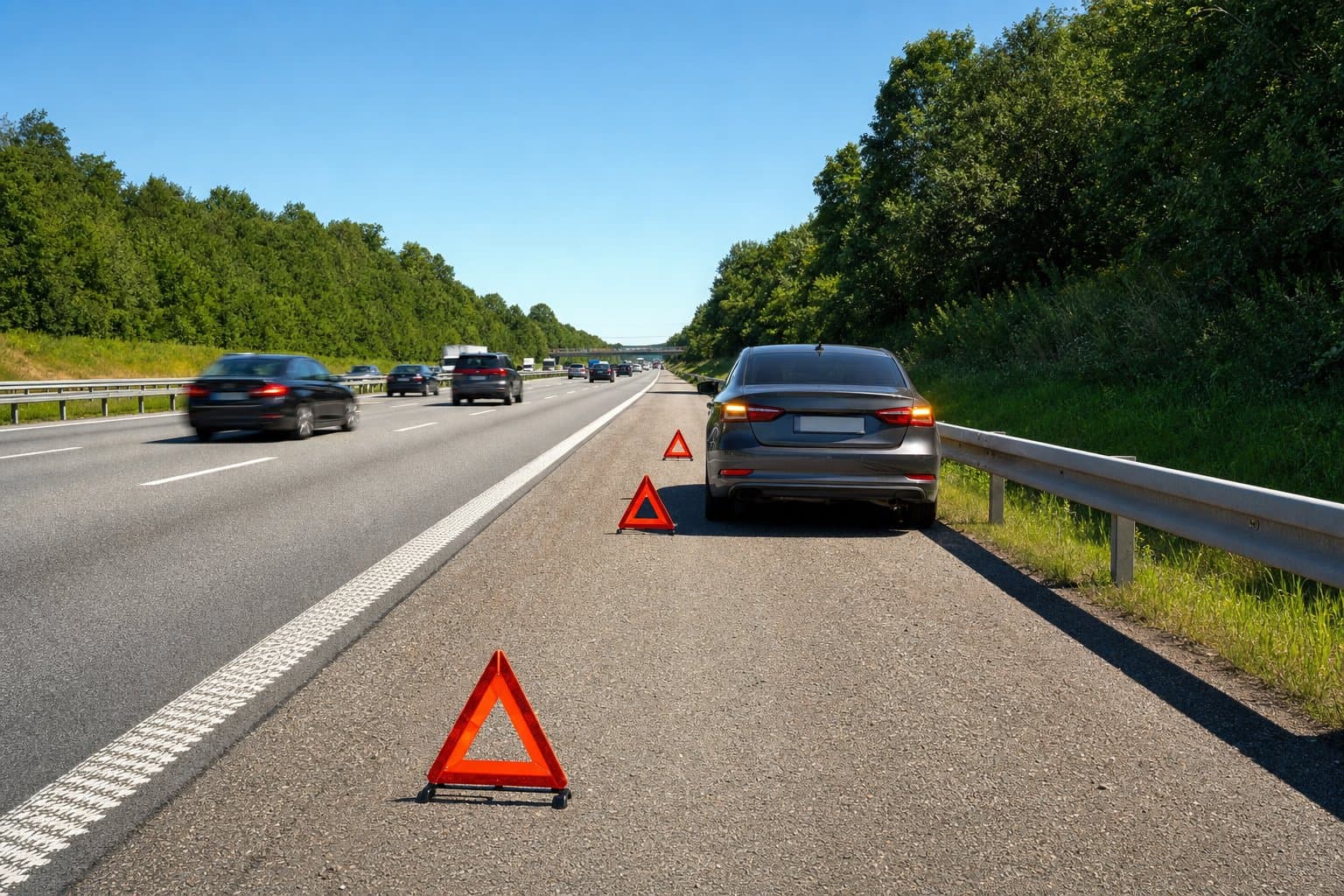
| Reflective Triangles & Road Flares | Give early visual warning to approaching traffic. Place triangles in a staggered pattern well behind your car so fast drivers have time to slow or move over. |
| 10k+ mAh External Battery Pack | Keeps phones and devices charged during long waits. This is especially important in rural areas with poor signal, heavy weather, or during long dispatch delays. |
| High-Visibility Cloth | A white T-shirt, bright cloth, or signaling flag hung from a window is a widely recognized distress signal for other drivers and highway patrol. |
| Safety Blanket & Bottled Water | Protects you from cold, heat, and dehydration if you have to wait a long time in harsh weather or extreme temperatures. |
If you want a broader checklist that covers what to keep in your car year-round—including legal and medical essentials—our guide What’s in Your Glovebox? The Survival and Legal Checklist is a useful companion to this emergency kit.
The Maneuver: Kinetic Energy Management and Safe Positioning
If your engine starts to lose power, a tire blows, or warning lights suggest a serious failure, your first priority is to manage your speed and path, not slam on the brakes. Panic braking in fast traffic is one of the quickest ways to trigger a crash behind you.
First, signal and slow down smoothly. Sudden braking or sharp lane changes send “shockwaves” through traffic, often causing rear-end collisions in the lanes behind you. As soon as you realize something is wrong, turn on your hazard flashers to signal to everyone around you that your vehicle is in trouble.
Next, aim for the right shoulder. Steer steadily out of traffic and use whatever momentum you have left to coast to a safe spot, especially if the engine is dying. Avoid heavy braking until you’re close to the shoulder so you don’t stop short in a live lane. Whenever possible, use the right shoulder instead of the left. The left shoulder is usually narrower and sits next to the fastest lane, which makes it much riskier. Think of the shoulder as an emergency last resort, not a comfortable parking spot; if you can safely reach an exit or wider area, do it.
Finally, create as much space as possible. Once you’re on the shoulder, pull as far to the right as you safely can. Every extra inch between you and the travel lane lowers the chance that a passing vehicle will clip your mirror or sideswipe your car. This same “maximize your buffer” rule applies in other danger zones too, such as tight urban school areas where kids and cars mix; see our breakdown in Urban School Zones Safety: Risks & Solutions Explained for how similar spacing principles save lives around schools.
The Golden Rule: The Inside vs. Outside Debate
The most critical choice you’ll make in a roadside emergency is whether to stay inside the vehicle or get out. The inside of a modern car is a carefully engineered safety shell, built with strong steel, crumple zones, and multi-stage airbags to absorb impact forces in a crash.
The Imperative of Staying Inside: If your vehicle is fully on the right shoulder and out of the direct flow of traffic, everyone should stay inside the car. Keep your seatbelts on, hazard lights flashing, and the car in “Park” to prevent it from rolling forward, backward, or into someone who may come to help. Staying buckled while you wait is vital. If a distracted driver slams into your parked car at highway speed, your seatbelt and airbags are your best defense against serious injuries or being thrown around inside the cabin.
Also, avoid zoning out on your phone. A roadside emergency is not the time to scroll, play games, or take selfies. You want your eyes up and your ears open so you can hear and see signs of danger coming.
When Exiting is Mandatory: There are exceptions. If your car is smoking, on fire, leaking fuel, or stuck in a live lane where you’re likely to be hit, staying inside can be more dangerous than getting out. If you must leave the vehicle, follow these strict rules:
- Exit Away from Traffic: Never step out into live lanes. Use the doors on the side away from traffic, usually the passenger side, even if that means climbing across seats.
- The 40-Foot Buffer Rule: Once you’re out, move at least 40 feet away from the vehicle, and if possible, get behind a guardrail or up an embankment. That distance helps shield you from the impact and flying debris if your car is later struck.
- Avoid DIY Repairs: Trying to change a tire or work under the hood on a busy highway is extremely risky, especially on the driver’s side. Your safety matters more than your rims. Leave complex or exposed repairs to pros who arrive in marked vehicles with proper warning equipment. Our article Highway Horror Survival: What Every Driver Must Know walks through more real-world scenarios where staying put or stepping away can be the difference between a close call and a disaster.
Legislative Evolution: The “Move Over” Paradigm and AB 390
For many years, roadside safety rules focused almost entirely on the person who broke down. The unspoken message was: “If you’re the one with the problem, it’s your job to get out of the way.” That mindset is slowly changing. New “Move Over” laws are shifting more responsibility onto passing drivers, changing both etiquette and legal liability.
The Origins and Limitations of Move Over Legislation
Move Over laws were first written to protect people who work in the danger zone every day: highway workers, police, firefighters, and EMS. In California, for example, Vehicle Code (CVC) 21809 required drivers approaching a stationary emergency vehicle with flashing lights—or a tow truck with amber flashers—to approach carefully. Drivers had to move to another lane away from the stopped vehicle when safe, or slow down to a “reasonable and prudent” speed if a lane change wasn’t possible. Ignoring these rules could result in tickets, fines, and points on a driving record.
But this older framework had a serious blind spot: it left ordinary drivers unprotected. A parent dealing with an overheating minivan, a commuter changing a tire, or a teen waiting for a tow truck had no guaranteed buffer from passing traffic. Because the law only applied if special emergency lights were flashing, there was no legal requirement to move over for a regular car with its hazard lights on. That loophole helped fuel the high number of civilians hit and killed along highway shoulders. If you want to see how similar legal and design gaps show up at intersections, we dig into those patterns in Reducing Traffic Violence with Roundabouts and Safe Tech.
The AB 390 Revolution (Effective January 1, 2026)
To close this gap in civilian protection, California passed Assembly Bill 390 (AB 390), which significantly expands the Move Over law. Starting January 1, 2026, the legal duty to move over or slow down applies to any stopped vehicle on the roadside that is using hazard lights, flares, cones, or other warning devices.
Under AB 390, a regular sedan stalled on the shoulder with its hazards on now commands the same legal respect as a marked patrol car or tow truck. Drivers must either change lanes away from the stopped vehicle when safe or slow down to a reasonable speed. This shift also means that smart, defensive habits—like moving over early when you spot hazards ahead—are no longer just “good manners.” They’re backed by law, just as we outline for EV drivers navigating public charging spots in Charger Etiquette 2026: Beat Charger Rage and Charge Smart.
| Legal Dimension | Pre-2026 Regulations (CVC 21809) | Post-2026 Regulations (AB 390 Expansion) |
|---|---|---|
| Protected Vehicle Class | Police, Fire, EMS, Tow Trucks, and Caltrans crews displaying specific flashing lights. | All stationary vehicles using hazard lights, flares, cones, or similar warning devices. |
| Driver Action Required | Move over one lane away from the incident, or slow to a reasonable/prudent speed. | Move over one lane away from the incident, or slow to a reasonable/prudent speed. |
| Liability Implications | Hitting a marked emergency worker or truck was strong evidence of negligence by the passing driver. | Hitting any vehicle using hazard lights can serve as strong evidence of negligence per se. |
| Primary Legislative Goal | Protect first responders and service workers from being struck on the job. | Create a universal buffer zone so everyday drivers aren’t killed by a single moment of inattention from passing traffic. |
Because California uses a comparative negligence system—fault can be shared among multiple parties—drivers who ignore AB 390 and strike a clearly marked civilian vehicle will likely face serious legal consequences. Violating the Move Over law can be used as powerful evidence of negligence in injury cases, changing how many roadside crashes are argued in court and making it clear that passing drivers share responsibility for the safety of stranded motorists.
The Response Time Roulette and the Vulnerability Window
Even if you follow every breakdown protocol and benefit from stronger laws like AB 390, your car remains at risk until it’s physically moved out of harm’s way. The length of this “vulnerability window” depends heavily on how fast help can reach you.
Digitized tow dispatch systems have improved the way calls are processed, but on-the-ground response times still vary wildly. AAA alone handles about 32 million roadside calls a year in the U.S.—around 62 calls every minute. Advanced dispatch tools and virtual agents can get a tow request entered in under four minutes, but actually getting a truck to your location takes much longer.
Analyzing the Disparity in Wait Times
Your wait on the shoulder depends on where you are, how many providers are nearby, what time it is, and what the weather is doing.
- National Averages: Large assistance networks report average response times between 21 and 35 minutes in good conditions.
- The Urban vs. Rural Divide: In busy urban corridors with many tow services, help may arrive in 30 to 45 minutes. In suburban or rural areas, that window often stretches to 45 to 75 minutes or more.
- Extreme Delays: Severe storms, gridlock, or local dispatch issues can send wait times spiraling. Real-world reports include people waiting three hours—or even up to 17 hours in rare, worst-case situations.
On the other hand, some public programs show what’s possible when response is built around safety first. The Metro Freeway Service Patrol (FSP) in Los Angeles County, the largest of its kind in the U.S., runs roving tow and service trucks that constantly patrol major freeways instead of sitting at a yard waiting for calls.
Because these trucks are already on the road in high-traffic areas, the average wait time for help from FSP is about seven minutes. By quickly clearing around 25,000 disabled vehicles every month, the program helps prevent thousands of secondary crashes, saves drivers an estimated 9.4 million hours in delay, and delivers a 13-to-1 benefit-to-cost ratio. For broader strategies to prepare for breakdowns anywhere—not just on LA freeways—see our checklist in Road Ready: The Modern Driver’s Guide to Staying Safe.
| Roadside Assistance Model | Operational Method | Average Wait Time | Impact on Secondary Crash Risk |
|---|---|---|---|
| Municipal Roving Patrols (e.g., LA FSP) | Continuous patrol of major freeways; proactive detection and response. | ~7 minutes. | Greatly reduces risk; hazards are cleared before long queues form. |
| Standard Urban/Suburban Commercial Towing | Reactive dispatch by phone or app from fixed depots. | 21 to 45 minutes. | Moderate to high risk; plenty of time for the 2.8% per-minute risk to build. |
| Rural Commercial Towing | Reactive dispatch across large territories. | 45 to 75+ minutes. | Severe risk; long exposure to fast-moving traffic. |
Because roving patrols are limited to certain routes and hours, most drivers on state highways, rural roads, and smaller arterials still face a 30- to 75-minute wait. Given the FHWA’s time-risk multiplier, a 45-minute wait more than doubles the odds of a secondary crash. This is why “pull over and just wait” is no longer a safe strategy by itself. You also need to actively broadcast your hazard to people and systems that can protect you—long before a tow truck arrives.
The Technological Cavalry: V2X and Digital Alerting
To shrink the danger gap between breakdown and rescue, the transportation world is leaning hard into connected technology. The idea is simple: if vehicles and road systems can talk to each other in real time, they can warn approaching drivers about a hazard long before the human eye sees it.
V2X: Vehicle-to-Everything Communication Architecture
The backbone of this future is Connected Vehicle (CV) technology, which includes Vehicle-to-Vehicle (V2V) and Vehicle-to-Infrastructure (V2I) communication. The U.S. Department of Transportation has invested heavily in systems that use dedicated short-range communications (DSRC) so that vehicles can broadcast their location, speed, and direction up to 10 times a second.
NHTSA estimates that V2V and V2I safety tools could reduce or soften the impact of up to 82% of all non-impaired crashes. In a breakdown, a connected car could instantly send a distress message to nearby vehicles, triggering warnings on dashboards or even automatic braking if needed—well before drivers can see your hazards or triangles. Human factors research shows that forward-collision warnings are most effective when they give at least about 3.2 seconds of time-to-collision (TTC), enough for the brain to process and respond.
The Power of Crowdsourced Data and Navigation Alerts
While full-scale V2V systems are still being rolled out and regulated, crowdsourced apps are already changing the game. Platforms like Waze collect live data from over 140 million monthly users to map traffic jams, police activity, and roadside breakdowns in real time.
Digital alerting tools like Haas Alert Safety Cloud plug into these navigation systems so that emergency vehicles, tow trucks, and even civilian users can push high-visibility warnings directly onto the screens of approaching drivers.
- The 30-Second Warning: These alerts typically give drivers 30 seconds or more of advance notice about a roadside hazard. That’s far better than the two or three seconds of reaction time drivers get from spotting flares or hazards with their eyes alone.
- Driver Behavior Modification: Field data from commercial fleets shows that 15% to 26% of drivers noticeably slow down and change lanes after they receive in-cab digital alerts about stopped vehicles or traffic snarls.
- Empirical Crash Reduction: A joint safety study by Cleveland State University and the Ohio DOT found that in-cab alerts for commercial vehicles cut secondary crashes by 29%. That reduction saved about $14 million in costs for the DOT and delivered a benefit-cost ratio of 22.56—one of the strongest returns for any safety measure on the road today.
By sending warnings ahead of the hazard, these systems smooth out the shockwaves that usually form when drivers slam their brakes at the last second. Instead of chain-reaction rear-end crashes, traffic slows predictably over a longer distance. For EV owners worried about balancing battery range with safety, pairing smarter route planning with these alerts—as we outline in Range Anxiety, Decoded: How to Drive Farther with Confidence—can make long trips safer and less stressful.
Community Mobilization: The Human Media™ Revolution
Navigation apps are powerful, and digital alerts protect fleets, but there’s still a gap when an ordinary driver breaks down on an ordinary road. Often, the only people close enough to really help—or to be warned—are other local drivers right there in the moment. That’s where new, community-focused communication platforms come in.
Carszy sits right at the crossroads of safety tech and community watch. It’s a privacy-first, U.S.-based platform that turns your license plate into a secure digital ID. This creates a new type of communication layer called Human Media™—moving away from passive social scrolling and toward real-world actions that directly make streets and highways safer.
License Plate Messaging: The Ultimate Digital Buffer
When your car suddenly dies on a narrow, dark shoulder, you’re usually cut off from the people who pass you every few seconds. Traditional assistance connects you to a far-away dispatcher, but it doesn’t talk to any of the hundreds of drivers flying by while you wait.
Carszy changes that with License Plate Messaging. This feature lets people text or call other drivers using just their license plate, without exposing personal phone numbers or private identity details. In a breakdown, this creates instant, ultra-local awareness that big navigation apps can’t easily match.
- Proactive Community Alerts: If a driver, neighbor, or community safety volunteer sees a car stranded in a blind curve with no lights, they can use Carszy to send a quick, secure message to the driver. That contact can confirm whether help is already on the way, whether the person is okay, or whether 911 needs to be called.
- Active Hazard Broadcasting: Stranded drivers can also reach out to the local community. Instead of silently waiting 45 to 75 minutes for a tow and hoping that passing traffic understands the Move Over law, they can tap into Carszy’s network to flag their own vehicle as a hazard. This can speed up law-enforcement awareness, focus attention on the exact location, and make nearby commuters more alert to the danger ahead. For a broader look at how to use tech and community tools to protect yourself during any minor collision, see Reducing Road Crash Harm with Community, Tech, and Protocols.
VOIS™ and the Expansion of Roadway Accountability
Carszy’s tools don’t just apply to breakdowns. VOIS™ (Vehicle of Interest Search) is a community-powered alert system that helps locate vehicles tied to critical incidents. While standard map apps might only show slower traffic or road closures, VOIS™ can help the public assist in locating vehicles linked to abductions, human trafficking, or serious hit-and-run crashes where a driver fled the scene.
This shifts online interaction into real-world protection. Tech-savvy drivers and watchful parents can report dangerous driving, extreme swerving near the shoulder, or suspicious vehicles in real time. That creates a kind of digital “immune system” for the road, where the community helps spot and respond to threats before they turn into tragedies for stranded motorists. Because Carszy uses U.S.-based servers and tightly limits data use to safety alerts, it can increase accountability and protection without sacrificing privacy. If you’re also active in buying or selling cars privately, many of the same community and verification ideas show up in our guide Sell Smart, Stay Safe: The Private Car Sale Playbook—another place where shared awareness reduces risk.
Comprehensive Summary
A roadside breakdown is far more than an inconvenience. It’s a complex and statistically dangerous event shaped by high speeds, common distractions, and the relentless ticking of the clock. The shoulder is not a safe destination; it’s a temporary escape route that becomes riskier with every passing minute. Staying alive there requires moving from passive waiting to active, layered protection:
- Preparation and Positioning: Keep a fully equipped emergency kit and check it regularly. When trouble starts, signal early, move smoothly to the right shoulder, and pull as far from the travel lane as you can. Unless there’s fire, smoke, fuel leaks, or you’re stuck in a live lane, stay inside the vehicle, buckled up, with hazards on.
- Legislative Awareness: Understand that laws like California’s AB 390 now require drivers to move over or slow down for any vehicle stopped with hazards or warning devices. This doesn’t just protect you—it also means passing drivers can be held accountable when they ignore that duty.
- Technological Integration: Because tow trucks often take 30 to 75 minutes to arrive, use every tool available: crowdsourced apps, digital alerts, and driver-to-driver platforms like Carszy. Broadcasting your hazard upstream cuts into the 2.8% per-minute rise in secondary crash risk and gives other drivers time and space to protect you.
By replacing the old habit of “pull over and hope for the best” with a plan that blends preparation, law, technology, and community, everyday drivers can dramatically reduce their risk on the shoulder. The more we treat breakdowns as shared safety events—not just personal inconveniences—the fewer families will lose someone to a crash that could have been prevented.
Frequently Asked Questions
What is the most critical action to take immediately after a vehicle breakdown on a busy highway to minimize the risk of a secondary collision?
The single most important action is to steer smoothly and safely to the right shoulder, get as far away from the travel lane as you can, turn on your hazard flashers, and stay inside the vehicle with your seatbelts fastened. Do not step out into high-speed traffic unless there is an immediate threat such as fire or fuel leaks. Staying inside your car keeps you within a carefully engineered safety shell, where seatbelts and airbags can protect you if a distracted or impaired driver crashes into your vehicle while you wait for help.
Next Steps for the Safety-Conscious Driver:
- Audit Your Equipment: Check that your roadside emergency kit is complete and up to date. Test flashlights, confirm you have reflective triangles and flares, and keep an external battery pack charged for your phone.
- Adopt Defensive Habits: Make it a personal rule to move over or slow down for any vehicle on the shoulder, not just police or tow trucks. This habit mirrors what new Move Over laws already expect from you—and it saves lives.
- Join the Network: Download the Carszy app and connect your vehicle so you can send and receive plate-based alerts, use License Plate Messaging, and take part in a local safety network that looks out for stranded drivers, kids, and vulnerable road users.
Supporting Research and Articles: