The Modern Driver's Guide to Automotive Preparedness: Navigating Roadway Hazards, Intersections, and Emergency Readiness
The reality of the modern roadway is defined by its inherent unpredictability and the compounding risks of physical infrastructure, environmental volatility, and human error. Despite remarkable advancements in automotive telematics, autonomous safety systems, and vehicle crashworthiness, the driving environment remains a fundamentally hazardous domain. A sudden mechanical failure, an unexpected plunge in ambient temperature, or the traversal of a poorly designed, antiquated intersection can instantly transform a routine commute into a high-stakes survival situation. With 40,901 motor vehicle crash deaths occurring in the United States in 2023—translating to 12.2 deaths per 100,000 people and 1.26 deaths per 100 million miles traveled—the need for comprehensive vehicular preparedness and infrastructure awareness cannot be overstated. The pedestrian safety crisis is equally alarming, with 7,522 people struck and killed while walking in 2022, marking a 40-year high and a 75 percent increase since 2010.
For safety-conscious parents, daily commuters, and neighborhood watch advocates, reducing these everyday risks requires a multifaceted, highly proactive approach. True automotive safety operates on three distinct but connected pillars: internal vehicular readiness, external environmental advocacy, and digital community connectivity. Internal readiness involves equipping the vehicle with a carefully built emergency kit tailored for both year-round hazards and extreme seasonal variations. External advocacy means understanding the geometric flaws of dangerous intersection patterns and mobilizing local communities to demand low-cost, high-impact infrastructure changes. Finally, digital connectivity addresses the physical isolation of the modern driver, using community-driven communication networks to bridge the gap between isolated motorists and collective safety.
This exhaustive research report lays out the exact emergency kit essentials required for modern driving, analyzes the ten most dangerous intersection patterns alongside the low-cost structural fixes communities can champion, and explores how technological platforms are transforming driver accountability, real-time emergency response, and localized safety ecosystems. If you want a shorter, step-by-step overview of these themes, you can also read Road Ready: The Modern Driver's Guide to Staying Safe, which pairs well with this deep dive.
Part I: The Definitive, Year-Round Car Emergency Kit

The idea of a vehicle emergency kit often brings to mind a cheap plastic box with a few bandages and a set of flimsy jumper cables. However, modern automotive safety and disaster preparedness demand a modular, more specific approach. A true survival and recovery kit acts as a comprehensive lifeline, bridging the critical gap between the start of an emergency—whether it’s an unexpected breakdown, severe weather, or a serious collision—and the arrival of professional roadside assistance or first responders.
Preparedness is not just about keeping a vehicle in good condition for fuel efficiency; it is about anticipating mechanical failures, dead batteries, flat tires, and extreme weather strandings. The foundation of this readiness is the year-round baseline kit, consisting of tools universally required regardless of geography or season. For a real-world checklist of what to pack and why it matters on highways, see how these principles play out in Highway Horror Survival: What Every Driver Must Know.
The Baseline: Power, Recovery, and Illumination
Mechanical failures are statistically inevitable over the lifespan of a vehicle. Addressing these issues immediately prevents a minor inconvenience from escalating into a dangerous roadside stranding, particularly on high-speed arterials or unlit rural routes.
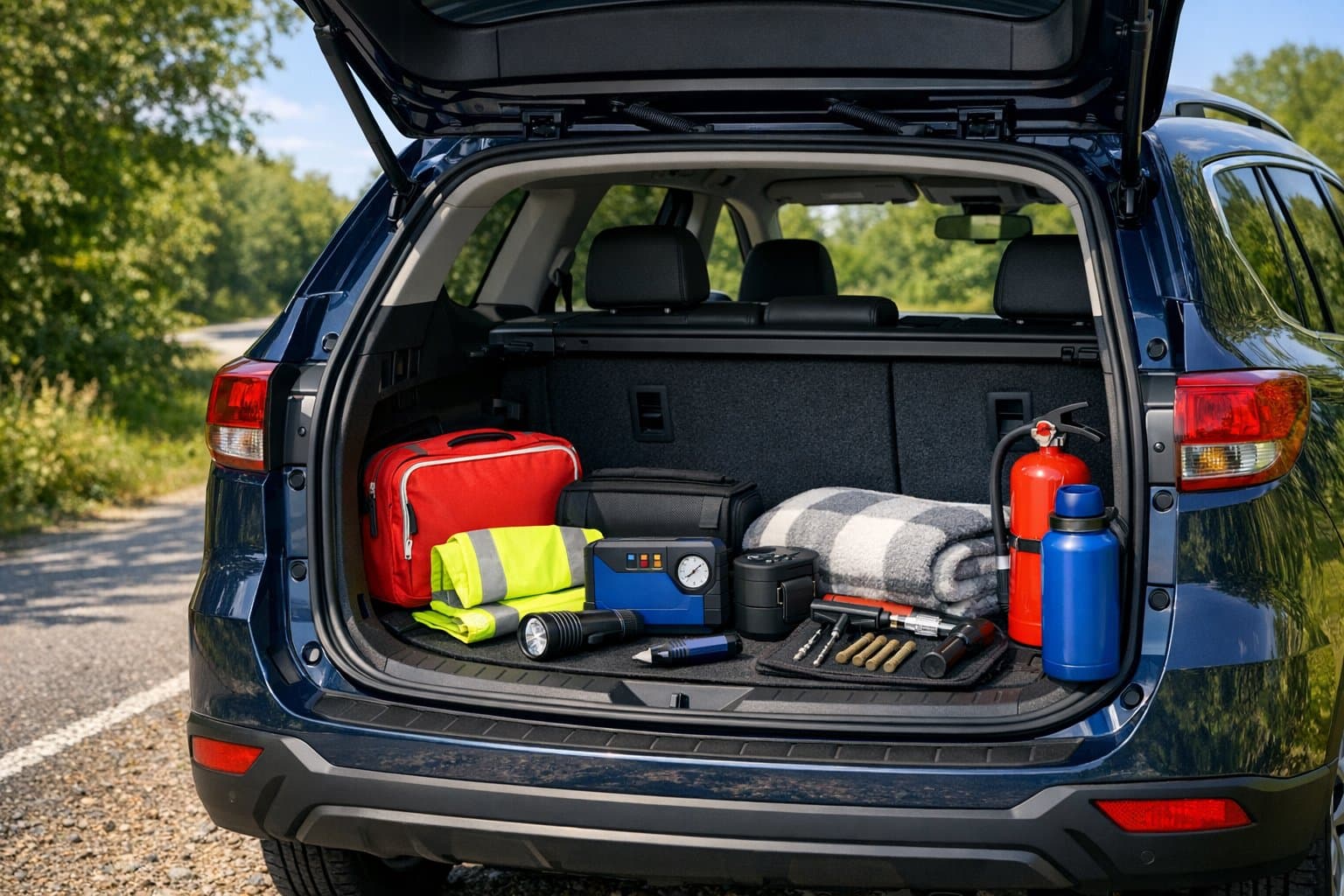
Portable Lithium-Ion Jump Starters Gone are the days of relying exclusively on heavy, lead-acid-based jump packs or waiting for a Good Samaritan to provide a secondary vehicle for traditional jumper cables. A compact, lithium-ion portable jump starter, such as the Noco Boost Plus GB40, can deliver sufficient amperage to revive dead batteries in all but the largest consumer vehicles. These devices operate autonomously, require minimal maintenance, and allow a stranded driver to restore power and retreat to a safe location within minutes.
Tire Recovery Systems Many modern vehicle manufacturers omit full-size spare tires to reduce weight and improve fuel economy. Consequently, a flat tire kit is an essential "kit within a kit." A 12V portable air compressor or inflator, such as the Avid Power Tire Inflator, combined with a heavy-duty tire plug kit and foam tire sealant, provides the tools for temporary on-the-spot repairs of minor punctures. A properly inflated spare tire (checked every six months), a compatible car jack, and a lug wrench remain critical for catastrophic blowouts.
Illumination and High-Visibility Markers Roadside emergencies frequently occur at night or in low-visibility conditions. A smartphone flashlight is drastically insufficient for diagnosing engine issues or changing a tire. High-lumen, dedicated illumination is mandatory. Tools like the ThruNite Archer 2A V3 or the Coast G22R (a 4-inch flashlight outputting 150 lumens with a 206-foot beam) offer reliable, rechargeable light that can be easily stowed in a center console.
Furthermore, preventing secondary collisions requires making the disabled vehicle highly visible to approaching traffic. Reflective warning triangles or DOT-approved LED road flares must be deployed well behind the vehicle. A brightly colored, high-visibility reflective vest should be worn by the driver whenever exiting the vehicle on a live roadway.
The Advanced First Aid and Trauma Module
A basic first aid kit is essential, but standard consumer kits are often woefully inadequate for vehicular trauma. While adhesive bandages, antiseptic wipes, antibiotic ointment, and pain relievers (ibuprofen/acetaminophen) address minor parking lot scrapes, highway collisions require serious bleeding control.
Medical gear experts advise keeping a comprehensive trauma kit in the vehicle. Products like the MyMedic MyFAK Standard or the Adventure Medical Kits Trauma Pak Pro include supplies chosen with guidance from emergency services professionals. If you want to understand how to use this kind of kit when you come upon a crash, the step-by-step advice in Witnessed a Crash? Your Smart, Life-Saving Bystander Playbook is a powerful companion to this section.
Essential medical upgrades for the vehicle include:
- Hemostatic Agents: QuikClot or similar dressings designed to speed up blood clotting in deep cuts.
- Trauma Shears: Heavy-duty shears capable of cutting through seatbelts, thick winter clothing, or leather to reach injuries fast.
- Tourniquets: For catastrophic limb bleeding caused by severe impacts.
- Personal Protective Equipment (PPE): Nitrile or latex gloves, and a CPR mask or face shield.
- Burn Care: Burn cream and instant cold packs.
The Expert's Additions: What People Routinely Forget
While jumper cables and bandages are common, survival experts, safety journalists, and community advocates point to several critical omissions in the average emergency kit. These forgotten items address the complex secondary problems that follow breakdowns and crashes.
1. Window Breaker and Seatbelt Cutter Tools In rollover crashes, submerged vehicle scenarios, or severe electrical fires, the vehicle's electrical system may short-circuit, making power windows and automated door locks inoperable. At the same time, seatbelt tensioners can lock permanently on impact. A hardened steel or tungsten-tipped window breaker, combined with a shielded seatbelt cutter blade, allows occupants to quickly escape a disabled, hazardous vehicle.
2. Automotive-Grade Fire Extinguisher After an accident or during certain mechanical failures, engine fires from ruptured fuel lines or electrical shorts present an immediate, life-threatening risk. A compact, automotive-rated fire extinguisher (typically Class B and C, rated for flammable liquids and electrical fires) such as the First Alert Auto5, is a critical safety device that is almost universally overlooked by everyday drivers.
3. Heavy-Duty Triage Tools: Duct Tape, Paracord, and Multi-Tools Temporary mechanical triage often requires improvised solutions. Securing a dragging undercarriage, taping a shattered window to keep out the elements, or tying down a compromised trunk lid requires tough materials. Gorilla Tape (or similar high-strength duct tape) and high-tensile 550 paracord are indispensable for stabilizing a vehicle just enough to limp to a service station. A high-quality multi-tool (e.g., Leatherman Wave) provides the pliers, wire cutters, blades, and screwdrivers necessary for these roadside repairs.
4. High-Decibel Emergency Whistle If a vehicle veers off a rural highway, plunges down an embankment, or becomes hidden by dense brush or a snowdrift, visual signaling becomes almost impossible. Audio signaling is the most effective local rescue beacon. A survival whistle, such as the SOL Slim Rescue Howler, requires little physical effort to produce a piercing, high-decibel sound that carries much farther than the human voice, alerting nearby search parties or passing motorists.
5. Hydration and High-Energy Nutrition Stranding can last for hours, particularly in remote areas or during extreme weather that delays towing services. Storing water in standard plastic bottles risks freezing and bursting in winter or chemical leaching in summer heat. A vacuum-insulated container (e.g., a 24 fl. oz. Hydro Flask) helps keep liquid water available even if occupants are forced to spend the night on the side of the road. Non-perishable, high-energy foods such as unsalted nuts, dried fruits, granola bars, and hard candies maintain energy and blood sugar during stressful waits.
| Core Category | Expert-Recommended Kit Additions | Primary Function & Rationale |
|---|---|---|
| Extraction | Window Breaker / Seatbelt Cutter | Rapid escape from submerged or electrically failed vehicles. |
| Fire Safety | Class B/C Fire Extinguisher | Suppressing engine or electrical fires after a collision. |
| Improvised Repair | Heavy-Duty Duct Tape & Paracord | Securing dragging parts, broken windows, or loose cargo. |
| Signaling | High-Decibel Survival Whistle | Acoustic location when visual lines of sight are blocked. |
| Utility | Mechanics Gloves & Multi-Tool | Preventing cuts and burns while doing repairs. |
| Communication | Power Bank & Physical Maps | Charging mobile devices (e.g., Anker 737) and navigating if GPS fails. |
Part II: Seasonal Modules and Extreme Climate Readiness
The geographic diversity of the driving environment means a static emergency kit is not enough. As weather patterns shift, the baseline kit must be upgraded with seasonal modules that address specific, local threats. Adverse weather conditions were present in 21% of all crashes nationally, with regional variations ranging from 5.7% in the West during summer to a staggering 57.8% in the Midwest during winter. For a focused guide on staying safe when the weather turns brutal, many drivers also lean on the strategies in Reducing Road Collisions: Strategies for Safer Communities, which zooms in on rain, smoke, floods, and risky junctions.
The Cold Weather Module (Winter / Blizzard Driving)
Winter driving introduces the serious risks of hypothermia, black ice crashes, and deep snow strandings. Crashes on snow-covered roads account for 3.0% of incidents, while ice accounts for 2.6%.
- Thermal Retention and Clothing: When a vehicle's engine cannot run, the cabin rapidly loses heat. Lightweight emergency Mylar blankets are essential, as they reflect up to 90% of your body heat back at you. Heavy wool blankets, hand and foot warmers, and a dedicated "skivvy roll" (a tightly rolled set of dry thermal underwear, socks, and a shirt) ensure occupants can survive sub-zero overnight strandings.
- Traction Aids: Regaining momentum on ice or packed snow requires extra friction. Non-clumping kitty litter or specialized traction sand should be kept in the trunk to provide immediate grip for spinning drive wheels, while also adding helpful weight over the rear axle.
- Snow Excavation Tools: An extendable ice scraper and snow brush are baseline requirements. However, survival in deep drifts calls for a robust, packable shovel, such as the Black Diamond Evac 9 or a military-style entrenching tool. Moving serious amounts of snow is critical not only for freeing the vehicle but also for keeping the exhaust pipe clear, preventing deadly carbon monoxide buildup in the cabin.
The Warm Weather Module (Summer / Desert Driving)
Extreme heat speeds up dehydration and can turn a disabled vehicle's cabin into a lethal environment. When ambient temperatures exceed 90°F, the interior of a parked vehicle can reach 130°F within an hour. Heat also puts kids and pets at extreme risk, a danger explored in more depth in Preventing Child and Pet Heatstroke in Vehicles in 2026.
- Solar Mitigation: A highly reflective sunshade for the windshield and lightweight emergency blankets used as tarps block radiant solar energy from baking the cabin while you wait for help.
- Evaporative Cooling: Cooling towels or battery-operated misting fans are critical for keeping body temperature down when the vehicle's air conditioning fails.
- Ultraviolet Protection: Stranded drivers who must wait outside the vehicle need SPF 30+ sunscreen, wide-brimmed hats, and polarized sunglasses to guard against severe sunburn and eye strain from glare.
The Deluge Module (Rain / Flood Season)
Wet roads are the most common adverse driving condition, accounting for 14.2% of all crashes and sharply increasing the odds of hydroplaning.
- Visibility and Dryness: Heavy-duty rain ponchos are essential. Trying to change a flat tire in a downpour without protection leads to immediate soaking and rapid chilling. Paired with a reflective vest, the poncho helps keep the driver dry and highly visible to passing traffic already struggling with reduced visibility.
- Windshield Maintenance: Heavy rain combined with road grime from trucks can instantly blind a driver. Keeping an extra gallon of high-quality windshield washer fluid ensures your wipers and sprayers can keep up.
The Smoke and Wildfire Module
With the rising intensity of wildfire seasons, especially in California and the broader American West, smoke inhalation inside a vehicle has become a serious health hazard. Wildfire smoke is a complex mix of pollutants, packed with microscopic particulate matter (PM2.5) that easily seeps into standard vehicle cabins, posing extreme risks to children, older adults, and anyone with respiratory or heart conditions.
- N95 Respirators: Standard cloth dust masks and bandanas offer no real protection against PM2.5. If drivers must travel through smoky areas or evacuate through heavy particulates, tightly fitting N95 or P100 respirators should be stored in the glovebox for all occupants.
- Cabin Air Filtration Strategy: Drivers must actively manage the vehicle's HVAC system. When you encounter smoke, windows and vents should be closed, and the air conditioner set strictly to recirculate mode. This closes the fresh air intake and prevents drawing outside smoke into the cabin. Upgrading the vehicle's cabin air filter to a higher efficiency MERV rating or a true HEPA standard helps scrub smoke particles from recirculated air.
- Medical Redundancy: Asthmatic occupants and those with respiratory conditions should keep backup inhalers and allergy medications in the emergency kit, as smoke exposure can quickly trigger acute breathing problems.
Part III: Infrastructure Diagnostics: The 10 Most Dangerous Intersection Patterns

While meticulous vehicular readiness protects people during and after an incident, proactive community safety requires a deep understanding of where and why crashes happen in the first place. Intersections represent the ultimate high-risk convergence of competing kinetic energies. Each year, roughly one-quarter of all traffic deaths and nearly one-half of all traffic injuries in the United States are tied to intersections.
The danger of an intersection is measured partly by its "conflict points"—the specific spots where the paths of vehicles, pedestrians, and cyclists cross. A standard four-way intersection has 32 vehicle-to-vehicle conflict points and 24 vehicle-to-pedestrian conflict points. When community advocates, neighborhood watch leaders, and municipal planners understand these geometric flaws, they can push for targeted, low-cost engineering countermeasures under the principles of Vision Zero. For a people-focused perspective on how these designs affect walkers and cyclists, Pedestrian and Cyclist Safety: A Human-Centric Approach digs deeper into these same dangers.
The disparity in roadway safety becomes obvious when you compare states. The fatality rate per 100,000 people varies widely, showing how much infrastructure, policy, and engineering shape survivability.
| State / Region | Population (2023) | Total Motor Vehicle Deaths | Deaths per 100,000 Population | Deaths per 100M VMT (Vehicle Miles Traveled) |
|---|---|---|---|---|
| Massachusetts | 7,001,399 | 344 | 4.9 (Lowest National Rate) | 0.56 |
| District of Columbia | 678,972 | 44 | 6.5 | 1.26 |
| California | 38,965,193 | 4,061 | 10.4 | 1.28 |
| Florida | 22,610,726 | 3,396 | 15.0 | 1.42 |
| Mississippi | 2,939,690 | 732 | 24.9 (Highest National Rate) | 1.79 |
To make this danger concrete, organizations like Smart Growth America highlight specific metropolitan areas facing severe pedestrian safety crises. Memphis, Tennessee, for example, has risen to the #1 most deadly metro area, with a rate of 5.14 pedestrian deaths per 100,000 people, showing how dangerous-by-design streets often favor fast-moving cars over vulnerable lives. Many of the worst trouble spots are school zones and busy neighborhood crossings, the same kinds of streets explored in Urban School Zones Safety: Risks & Solutions Explained.
The following are the ten most dangerous intersection patterns and the low-cost fixes communities can advocate for to reduce them.
1. The Unsignalized Multi-Lane Crossing (The "Far-Side" Threat)
The Flaw: This pattern involves a two-lane minor road intersecting a four-lane divided arterial highway, controlled only by stop signs on the minor approach. Drivers trying to cross completely or turn left must navigate several lanes of high-speed cross-traffic. The mental load required to judge the speed and distance of vehicles in four separate lanes often leads to deadly "far-side" right-angle (T-bone) collisions. In 2022, there were 7,832 fatalities involving unsignalized intersections.
The Low-Cost Fix: The Reduced Conflict Intersection (RCI), also known as a Restricted Crossing U-Turn (RCUT), J-Turn, or Superstreet. Instead of allowing minor-street traffic to cross directly, physical concrete islands force all minor-street traffic to turn right. The driver merges, travels to a median opening downstream, and makes a U-turn. This seemingly small geometric change cuts intersection conflict points from 32 to just 14, yielding an 80% reduction in severe frontal crashes and a 50% reduction in total crashes.
2. The Skewed or Offset Intersection
The Flaw: Not all roadways meet at a clean 90-degree angle. Skewed intersections force drivers to look over their shoulders at awkward, uncomfortable angles to see approaching traffic. This strain increases the odds that a driver will miss an oncoming vehicle hidden in the car's B-pillar or C-pillar blind spots.
The Low-Cost Fix: Intersection Realignment. Through tactical urbanism or minor curb work, engineers can "square up" the approach. Using heavy paint, flexible plastic bollards, and physical curb extensions (bulb-outs), the roadway geometry is changed so vehicles approach at a true 90-degree angle, improving sightlines and slowing turning speeds without the high cost of buying extra right-of-way.
3. The Wide-Throat Urban Crossing
The Flaw: Intersections built with overly wide travel lanes and sweeping, gentle corner radii encourage vehicles to take right turns at high speeds. The "wide throat" also increases the distance pedestrians must cross, maximizing their time spent in the open roadway.
The Low-Cost Fix: Curb Extensions and "Road Diets." Installing painted pedestrian refuge islands in the median and extending curbs at the corners physically narrows the intersection. This forces drivers to slow down for the tighter turn and cuts pedestrian crossing distance—and thus exposure time—in half.
4. Poor Daylighting and Obstructed Sightlines
The Flaw: In dense urban or suburban neighborhoods, parallel parking often runs right up to the edge of the crosswalk. This creates a solid wall of vehicles that completely hides a driver's view of a pedestrian—especially children or wheelchair users—until they step directly into the travel lane.
The Low-Cost Fix: "Daylighting" the intersection. This life-saving strategy simply removes the parking spaces closest to the intersection corners (usually the first 20–30 feet). Communities can convert this space into low-cost "parklets," adding raised planters, bike corrals, or bright street art to physically block cars from parking there, dramatically improving sightlines for both drivers and pedestrians.
5. High-Speed Slip Lanes
The Flaw: Slip lanes are channelized right-turn lanes separated from the main intersection by a triangular concrete island. Designed for vehicle throughput, they let cars turn right without stopping. However, they create a large blind spot for drivers watching left for a gap in traffic while rolling forward, often leading to vehicles striking pedestrians stepping into the crosswalk on their right.
The Low-Cost Fix: Removal or elevation of the slip lane. A quick, low-cost interim fix is to paint out the slip lane and use soft hit posts to force right-turning vehicles to stop at the main intersection. If the slip lane must stay, the crosswalk can be raised into a "Raised Intersection" or speed table, physically forcing vehicles to slow to 10–15 mph before they reach the pedestrian zone.
6. The High-Speed Rural Stop-Controlled Intersection
The Flaw: On long, monotonous stretches of high-speed rural roads, drivers often fall into "highway hypnosis." When they reach an isolated, stop-controlled intersection, they may not notice the stop sign in time to slow down, leading to catastrophic, high-speed right-angle blow-throughs.
The Low-Cost Fix: Advanced warning systems and visual disruption. Low-cost treatments include grinding transverse rumble strips into the pavement before the stop sign and painting huge "Stop Ahead" warnings directly on the asphalt. Replacing standard 8-inch signal heads with 12-inch lenses, adding retroreflective backplates to signals, and installing double stop signs on both sides of the road all boost visibility.
7. Pedestrian-Blind Signalized Crossings
The Flaw: At many signalized intersections, pedestrians get a "Walk" signal at the exact same moment that parallel vehicle traffic gets a green light. Right-turning drivers, focused on the green and the flow of traffic, accelerate into their turn and often hit pedestrians stepping off the curb at the same time.
The Low-Cost Fix: Leading Pedestrian Intervals (LPI). This software-only timing change in the signal cabinet gives pedestrians a 3 to 7-second head start to enter the crosswalk before vehicles get a green. By the time cars begin to turn, pedestrians are already in the middle of the crosswalk and much easier to see. LPIs are extremely cheap to implement and have been widely adopted; for example, the District Department of Transportation (DDOT) has installed LPIs at about 75% of all signalized intersections in Washington D.C.
8. Permissive Left-Turns on High-Speed Arterials
The Flaw: A permissive left turn (a solid green light where the driver must judge the gap and yield to oncoming traffic) depends entirely on human depth perception to judge oncoming speed. On arterials above 45 mph, human estimates are notoriously poor, leading to severe, high-energy angle crashes.
The Low-Cost Fix: Upgrading traffic signal phasing. Adding a protected left-turn phase (a green arrow) removes the guesswork. Alternatively, a Flashing Yellow Arrow (FYA) provides a much clearer warning that drivers must yield. If phasing changes are too costly, Left-Turn Traffic Calming—using modular rubber speed bumps in the intersection to guide the turning path—forces left-turning vehicles to take a sharper, slower, and safer path.
9. The Red-Light Running Zone (Stale Yellows)
The Flaw: Signalized intersections produce about one-third of all intersection deaths, with red-light running (1,272 specific deaths in 2022) as a major cause. This often happens when yellow light times are not matched to the real travel speeds, trapping drivers in a "dilemma zone" where they can neither stop safely nor clear the intersection before the light turns red.
The Low-Cost Fix: Retiming the all-red clearance intervals. By adjusting the software to hold all signals red for an extra 1.5 to 2 seconds, engineers create a safety buffer that lets late-crossing vehicles clear the intersection before opposing traffic moves.
10. The Uncontrolled Residential T-Intersection
The Flaw: T-intersections in dense residential neighborhoods often lack stop signs entirely. As local traffic grows, the unclear right-of-way combined with poor sight distance leads to corner-cutting crashes and serious danger for pedestrians.
The Low-Cost Fix: Mini-Roundabouts or Residential Traffic Circles. By placing a small, raised circular island (often landscaped) in the center of the intersection, vehicles must slow down and drive around it. This design removes left-turn and right-angle conflict points, naturally calms neighborhood traffic, and works efficiently without the operating costs of a traffic signal.
Quantifying the Impact: Crash Modification Factors (CMF)
To really see the value of community advocacy for these fixes, it helps to look at the numbers behind crash reduction. Transportation engineers use Crash Modification Factors (CMF) to estimate the safety benefits of different treatments. The formula is:
CMF = Expected Crashes with Treatment / Expected Crashes without Treatment
A CMF below 1.0 means a proven reduction in crashes. For example, a CMF of 0.8 gives a 20 percent crash reduction.
| Countermeasure / Treatment | Target Intersection Problem | Estimated Cost | Crash Modification Factor (CMF) & Efficacy Data |
|---|---|---|---|
| Reduced Conflict Intersection (RCUT) | High-Speed Unsignalized Crossings | Low to Medium | 80% reduction in severe frontal impacts; 50% overall crash reduction. |
| Transverse Rumble Strips | Rural Stop-Controlled Blow-Throughs | < $1,000 | CMF = 0.72 (28% crash reduction). |
| "Stop Ahead" Pavement Markings | Rural Stop-Controlled Blow-Throughs | < $1,000 | CMF = 0.85 (15% crash reduction). |
| Leading Pedestrian Intervals (LPI) | Pedestrian-Blind Signalized Crossings | Minimal (Software) | Extremely high efficacy; provides a 3–7 second head start for pedestrians. |
| Signal Backplates (Reflective) | Signal Visibility / Conspicuity at Night | Low | Reduces right-angle crashes by framing the signal head against background light. |
Part IV: The Tech-Forward Shift in Community Road Safety
While emergency kits prepare the individual and physical infrastructure protects everyone who uses a street, a crucial third pillar has emerged in the push for road safety: community mobilization through technology.
The modern automobile is a highly insulated steel and glass capsule, with advanced sound dampening, tinted windows, and climate-controlled isolation. This comfort comes at a cost: drivers lose the ability to communicate clearly with one another. When a driver notices another vehicle with its headlights off at night, a dangerously low rear tire, an unsecured load, or a dog suffering in a hot car, traditional communication—honking, tailgating, or flashing high beams—is vague, aggressive, and often mistaken for road rage. Understanding the difference between simple negligence, reckless driving, and full-blown rage is part of staying calm; that’s explored in more detail in Understanding Road Rage, Recklessness, and Insurance Tips.
Breaking the Isolation: License Plate Communication
The next wave of safety technology is shifting from passive in-car systems toward active, driver-to-driver connectivity. Platforms like Carszy are tackling the "isolated nature" of driving by using the one universal, public-facing identifier visible on every vehicle: the license plate.
While the idea of connecting vehicles has older precedents—like early experiments with cars auto-posting tweets or the "Bump Network" app—modern versions focus on security, privacy, and real-world usefulness. Through secure, US-based servers, this technology lets drivers message or call one another anonymously using just the plate number. The safety uses are powerful. Instead of risky maneuvers to wave someone down, a driver can send a secure, instant alert: "Your brake lights are out," or "Your child's door is not latched." This shifts the roadway from isolated hostility toward mutual, proactive help, preventing some crashes before they ever happen. For a broader picture of how smart vehicles and connected streets work together, How Software-Defined Vehicles Transform Road Safety in 2026 shows how cars themselves are becoming safety nodes.
Overcoming Law Enforcement Response Times via VOIS™
A major systemic factor in roadway safety is emergency response time. In many big cities, law enforcement response times for non-life-threatening calls have climbed sharply due to staffing shortages and strict priority rules. Analysts have noted that cities like Nashville saw one of the biggest increases in response times from 2019 to 2022. Departments like the NOPD have had to prioritize only Code 2 or higher emergencies, often leading to "Gone on Arrival" outcomes for lesser incidents.
In critical, time-sensitive events such as an AMBER Alert, suspected human trafficking in motion, or a hit-and-run getaway vehicle, waiting for a police unit to reach the scene can let the trail go cold. To counter this lag, community platforms have built systems like Vehicle of Interest Search (VOIS™).
By tapping into a local, geo-fenced network of active drivers, a community-generated alert can be sent instantly to nearby users, turning everyday commuters into a mobile, digital neighborhood watch. If a vehicle involved in a violent incident flees, the crowdsourced eyes of the community can track and report its movements far faster than a limited number of patrol cars, shrinking the crucial response window and giving law enforcement far better leads.
Human Media™: Accountability over Outrage
The built-in anonymity of the road often feeds reckless behavior, aggressive driving, and violent road rage. Traditional social media treats traffic incidents as viral content, sharing dashcam clips for clicks with no path to resolution. The concept of "Human Media"—pioneered by community safety platforms—reframes this dynamic.
By offering a structured, secure way to report aggressive driving, drunk driving, and road rage incidents tied to a specific vehicle identifier, communities create a local layer of accountability. This is a shift from "Social Media" to real-world safety impact. Drivers tend to be more cautious and courteous when they realize the vehicles around them are not just anonymous metal boxes, but connected neighbors who can document and report dangerous behavior. Dashcams play a growing role here too; if you’re considering one as a safety tool, Silent Witnesses: Dashcams and the Fight for Safer Streets explains how to use them to support this kind of Human Media network.
Conclusion
The pursuit of safer roads is an ongoing, layered effort that calls for steady focus from individuals, communities, and local governments. It starts in the trunk of your vehicle, where a carefully packed emergency kit—complete with seasonal modules, trauma-ready medical supplies, and critical extraction tools like window breakers—helps ensure occupants can survive the immediate, violent aftermath of an unexpected breakdown or collision.
It then stretches out to the asphalt itself, asking safety-conscious citizens, parents, and neighborhood watch advocates to understand the geometric dangers of skewed sightlines, wide-throat crossings, and high-speed slip lanes. With this knowledge, communities can push hard for low-cost, high-impact Vision Zero infrastructure changes that put human life ahead of vehicle speed. If you’ve already had a close call at one of these intersections, the reflection and action steps in Effective Safety Strategies After Near-Miss Collisions can help turn that scare into lasting change.
Finally, the future of safety depends on breaking the digital silence and physical isolation of the roadway. By embracing privacy-focused, driver-to-driver communication tools, the driving public can shift from passive, isolated participants to an active, protective community network. To add this powerful layer of digital safety to your daily commute, build real-time connections with the drivers around you, and protect your neighborhood, download the app and stay connected at carszy.com. True automotive safety is not just about how well a vehicle protects its occupants in a crash; it is about how effectively the driver, the infrastructure, and the community work together to make sure that crash never happens at all.