Freeway On-Ramps and Short Merge Lanes: A Common Source of Anxiety for Newer Drivers
For novice motorists and experienced commuters alike, few driving scenarios induce as much visceral panic as a short freeway on-ramp. The challenge of accelerating a multi-ton vehicle to highway speeds while simultaneously monitoring mirrors, checking blind spots, and predicting the behavior of fast-moving mainline traffic represents a peak cognitive load. When the acceleration lane is truncated, or when visibility is obscured by structural elements, this everyday maneuver transforms into a high-stakes kinetic puzzle.
The anxiety surrounding freeway merges is not merely a psychological phenomenon; it is entirely validated by traffic safety data, physiological studies, and civil engineering constraints. The National Highway Traffic Safety Administration (NHTSA) reports that over 300,000 merging-related accidents occur annually in the United States, with improper merging contributing to 8.7% of all fatal crashes.
This comprehensive analysis delves into the anatomy of the freeway merge, exploring the physiological stress it induces, the statistical realities of crash risks—particularly for teen drivers—and the engineering dynamics of highway design. Furthermore, this report examines how modern driver-to-driver communication platforms, alongside advanced vehicle safety technologies, are reshaping the landscape of community safety and road rage prevention. For an even wider view of how today’s traffic risks add up, see our overview of 2026 auto insurance and community safety trends.
The Cognitive and Physiological Toll of Merging
Driving is a complex activity that demands high-level cognitive processing, but merging onto a high-speed freeway pushes human sensory processing to its limits. During a merge, a driver must continuously calculate relative speeds, distance gaps, and the trajectories of multiple independent vehicles.
Heart Rate Variability and Driving Stress
Recent physiological studies utilizing biometric sensors have quantified the exact toll that merging takes on the human body. Researchers monitoring drivers via electrocardiograms have found that merging onto a freeway significantly impacts driver workload and driving performance, generating a potential risk that cannot be ignored.
The most reliable indicator of this stress is Heart Rate Variability (HRV), specifically the ratio of Low Frequency (LF) to High Frequency (HF) heart rate bands. The LF/HF ratio measures the cardiac balance of the autonomic nervous system, essentially representing sympathetic nervous tension.
When the volume of merging vehicles exceeds 564 passenger car units per hour (pcu/h), or when traffic saturation surpasses 0.485, the driver workload spikes above established safety thresholds. Despite freeways generally possessing better geometric conditions than urban surface roads, the sheer velocity and split-second decision-making required during a merge elevate the driving risk exponentially.
| Workload Level | Driver Workload Classification | HRV Threshold (K-Value) |
|---|---|---|
| Danger | High driver workload (Stress/Panic) | K > 0.056 |
| Safety | Normal driver workload | -0.0127 < K ≤ 0.056 |
| Danger | Low driver workload (Fatigue/Under-stimulation) | K ≤ -0.0127 |
Table 1: Physiological driver workload thresholds based on Heart Rate Variability (HRV) during freeway merging maneuvers.
The Physics of Traffic: Phantom Jams and Kinematic Shockwaves
The stress of merging is often compounded by unpredictable traffic behavior. Drivers frequently encounter sudden, inexplicable slowdowns near on-ramps. These are known in traffic engineering as “phantom traffic jams” or kinematic shockwaves, and the same dynamics show up in situations like work zones, roundabouts, and lane drops.
There is a critical threshold for traffic flow volume upstream of a slow-moving or merging vehicle. When a vehicle merges too slowly due to a short ramp or driver hesitation, the driver immediately behind it is forced to brake. In dense traffic, this slight tap on the brakes ripples backward through the line of cars. Each successive driver brakes a little more strongly than the last, creating a wave of brake lights that propagates upstream. If you’ve ever wondered why traffic suddenly stops for no visible reason, you’ve experienced this first-hand; you can learn more in our guide to modern traffic flow and roundabout design.
This shockwave can cause traffic miles behind the merge point to come to a complete standstill, even though there is no physical blockage, accident, or lane closure. The ensuing frustration often leads to aggressive driving and road rage, further elevating the accident risk for everyone in the vicinity.
By the Numbers: Merging Accidents and Driver Risk
Understanding the scale of the problem requires an examination of national crash data. While total traffic fatalities have seen slight recent declines—dropping 3.8% to an estimated 39,345 deaths in 2024, marking the first time since 2020 that fatalities fell below 40,000—the baseline risk of highway travel remains historically high. The fatality rate stands at 1.20 fatalities per 100 million vehicle miles traveled (VMT), still above pre-pandemic averages.
In the context of lane changes and merging, the numbers are stark. A foundational NHTSA analysis of the General Estimates System (GES) crash database identified approximately 539,000 two-vehicle lane change crashes in a single year.
Rear-end collisions are the most common outcome of a botched merge, accounting for nearly 16% of all merging-related crashes. These typically occur when a merging vehicle fails to accelerate to the speed of mainline traffic, causing sudden braking. Sideswipe accidents are equally prevalent, primarily caused by drivers failing to check their blind spots before committing to the lane transition. Furthermore, commercial motor vehicles (CMVs) play a disproportionate role in these incidents; large trucks account for 42% of crashes in merging scenarios, largely due to their massive blind spots and inability to alter speed quickly. For a deeper dive into how physics and truck dynamics turn small errors into serious crashes, see our article on why tailgating a semi is a death wish.
Teen and Novice Drivers: The High-Risk Demographic

Short merge lanes provoke anxiety in all demographics, but they pose a statistically lethal threat to teen and novice drivers. The combination of high cognitive workload and a lack of behind-the-wheel experience creates a perfect storm for critical driving errors, validating the intense concern of the protective parent persona.
According to the Insurance Institute for Highway Safety (IIHS), teen drivers have crash rates over four times higher than drivers aged 20 and older per mile driven. The fatal crash rate for 16-to-19-year-olds is approximately three times higher than that of adult drivers, with 2,899 teenagers dying in motor vehicle crashes in 2024 alone.
Young drivers frequently lack the experiential intuition required to properly select and time gaps in moving traffic. Studies by the Texas A&M Transportation Institute indicate that proper gap selection can prevent up to 37% of merging-related accidents. Furthermore, teens are highly susceptible to peer distraction; the presence of teen passengers increases the risk of death in a crash by 51% for everyone involved, including occupants of other vehicles. Families coaching new drivers through these situations can benefit from structured approaches like the ones in our guide to teaching teens to drive without panic.
| Driver Age Group | Fatal Crash Rate (per 100M miles) | Primary Crash Contributors |
|---|---|---|
| 16-19 Years | ~3x higher than adults | Gap misjudgment, speeding, passenger distraction, nighttime driving |
| 20+ Years | Baseline (1x) | Impairment, fatigue, complex aggressive maneuvers |
Table 2: Relative fatal crash risk and contributing factors for teen drivers compared to adult populations.
To mitigate these risks, safety advocates strongly recommend that parents prioritize vehicle crashworthiness and active safety technologies over aesthetics or speed. The IIHS advises selecting heavier vehicles (with a curb weight over 2,750 pounds) that possess a “Good” rating in driver-side small overlap front tests. Vehicles equipped with Electronic Stability Control (ESC) and Automatic Emergency Braking (AEB) can correct novice mistakes—such as braking too late when a merge gap closes unexpectedly—before they result in a catastrophic rear-end collision. Car choice is only one piece of the puzzle; consistent coaching, graduated licensing, and clear family rules, like those outlined in our teen-driving safety playbook, help turn these tools into real-world protection.
Highway Engineering: High-Risk Corridors and Ramp Geometry
The anxiety associated with merging is frequently a highly rational response to poor highway engineering. Freeway systems designed in the mid-20th century were not built to accommodate modern traffic volumes or the acceleration profiles of contemporary commercial trucks.
Ramp Length and Interchange Spacing
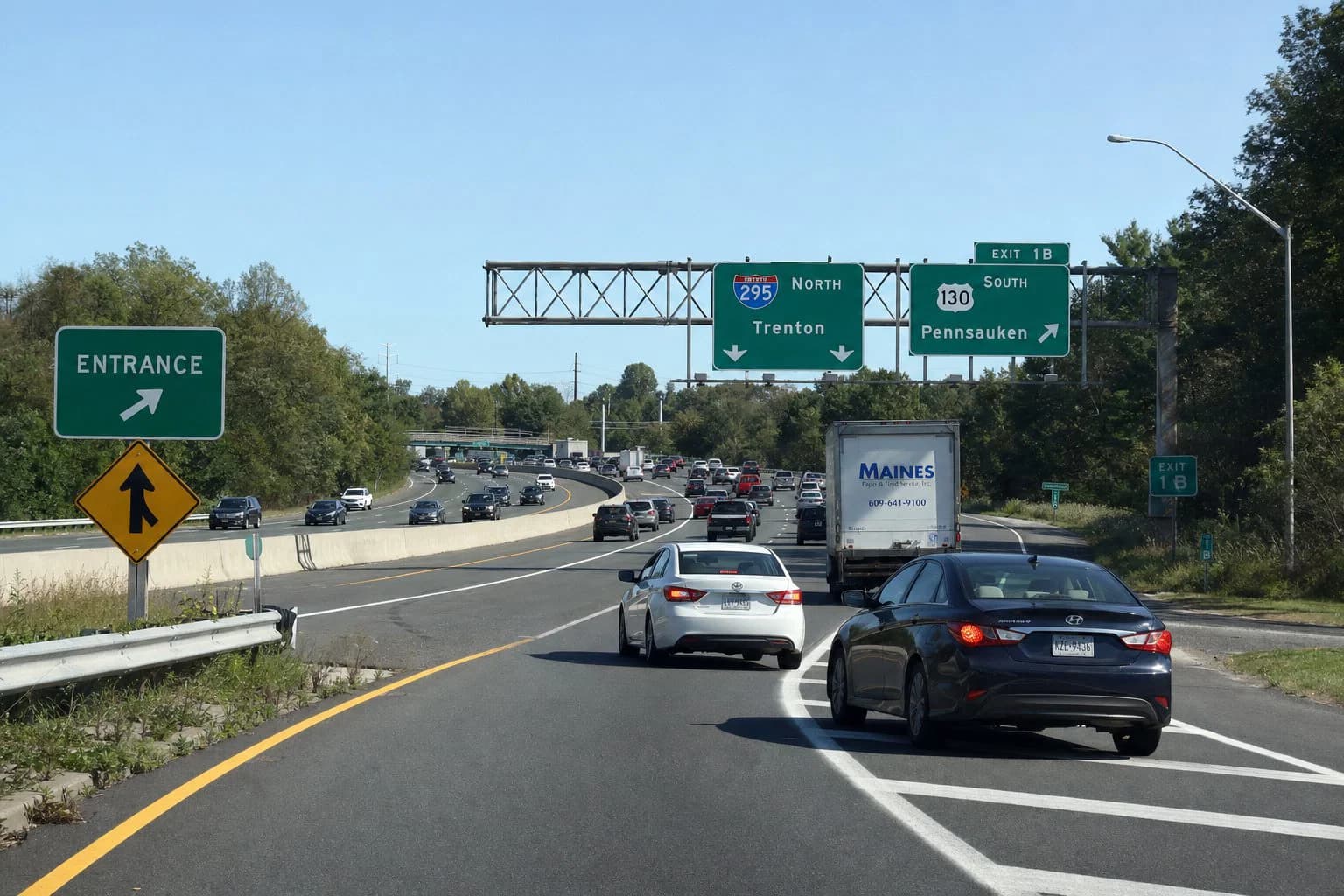
The geometry of the entrance ramp and the acceleration speed-change lane (SCL) dictates the fundamental safety of the merge. Research indicates that shorter acceleration lanes force higher, uncomfortable acceleration rates, and tight ramp curves cannot be fully compensated for even if the subsequent straightaway is long. The maximum usable acceleration lane length during off-peak periods is approximately 425 meters; lengths beyond this do not significantly increase driver comfort or merge safety.
Furthermore, the density of highway interchanges plays a critical role in corridor safety. Studies utilizing the Highway Safety Information System (HSIS) have demonstrated that splitting a freeway segment by adding a new interchange increases the overall number of fatal and injury crashes per year. According to Access Management Manual guidelines, a minimum spacing of 3 miles in rural areas and 1 mile in urban areas is recommended to provide adequate decision distance. Close interchange spacing forces entering drivers to weave through exiting drivers, creating friction and elevating the crash risk. In areas with complex weaving and short spacing, the risk is multiplied at night or in bad weather, similar to the compounding risks described in our overview of California’s impaired driving problem.
Case Study: The “Orange Crush”
One of the most notorious examples of geometric hostility is the “Orange Crush” interchange in Orange County, California. As the nexus of Interstate 5 (I-5), State Route 22 (SR-22), and State Route 57 (SR-57), it is one of the busiest and most dangerous interchanges in North America.
The hazard of the Orange Crush lies in its labyrinthine layout—spanning over 8,290 feet at its widest point and featuring 13 bridges, 34 lanes, and five entry points. The lane-change geometry forces last-second merging at speeds exceeding 55 mph. The acute angles of the freeways require sharp turns, while the sheer number of route choices overwhelms drivers’ split-second decision-making capabilities. Consequently, this interchange produces the highest absolute number of injury crashes in the county, heavily dominated by rear-end collisions from sudden stops and side-swipes from panicked lane changes.
To address such bottlenecks, transportation authorities rely on constructing auxiliary lanes—continuous lanes connecting an on-ramp directly to the next off-ramp. When designed correctly without creating lane-drop bottlenecks, auxiliary lanes reduce collisions by an average of 34% by allowing merging vehicles to adjust their speed without disrupting the mainline traffic flow.
Traffic Management Interventions: Ramp Metering
To combat the chaos of short merge lanes and aggressive driving, traffic engineers employ specialized interventions, the most prominent being ramp metering.
Ramp meters are traffic signals installed on freeway on-ramps that control the frequency at which vehicles enter the mainline flow. While drivers often view these red lights as a nuisance that delays their commute, they are a vital safety mechanism designed to prevent kinematic shockwaves.
Without ramp meters, vehicles enter the freeway in tightly packed groups known as platoons. This forces drivers on the mainline to slow down or brake aggressively, triggering a cascading collapse of traffic flow. Ramp meters break up these platoons by releasing vehicles one or two at a time. This controlled rhythm provides each driver with a predictable gap in traffic, allowing them to utilize the acceleration lane to match freeway speeds safely.
The results of ramp metering are profound. Studies show that when ramp meters are deactivated, freeway travel times become almost twice as unpredictable, and mainline throughput declines by an average of 14%. Conversely, active ramp metering systems have been shown to reduce accident rates by up to 30%, eliminate millions of hours of unexpected delay, and increase overall traffic speed.

| Metric | Without Ramp Metering | With Ramp Metering |
|---|---|---|
| Vehicle Entry Pattern | Tightly packed platoons | Individually spaced vehicles |
| Mainline Traffic Flow | Highly susceptible to shockwaves | Stable, near-capacity flow |
| Travel Time Reliability | Highly unpredictable | Predictable (reduces unexpected delays) |
| System Throughput | Decreases by ~14% in peak hours | Maximizes corridor capacity |
Table 3: Operational impacts of ramp metering on freeway merging and traffic flow.
The Zipper Merge and the Politeness Paradox
When construction or lane closures force two lanes to merge into one, drivers are presented with a psychological test. The traditional instinct—often taught in older driver’s education curricula—is to merge as early as possible out of a sense of courtesy. This creates one heavily congested lane while the adjacent closing lane remains empty.
Traffic engineers, however, advocate for the “zipper merge,” also known as a late merge. In this system, drivers are encouraged to use both open lanes until the very end, reaching the merge point before taking turns entering the open lane in an alternating, zipper-like fashion. You’ll often see this recommended in work zones or on approach to busy interchanges, just like the shared-responsibility movements around Move-Over and failure-to-yield laws for emergency vehicles.
Research overwhelmingly supports the zipper merge under heavy traffic conditions. It utilizes the full capacity of the roadway, increasing traffic flow by 15% and reducing the length of the traffic queue by up to 50%.
Despite the mathematical superiority of the zipper merge, driver compliance remains low due to behavioral psychology and the “politeness paradox.” Drivers who merge early often view those who use the empty lane as rude “queue jumpers” attempting to cut the line. This perceived unfairness frequently triggers road rage. Drivers may intentionally straddle the center line to block others from passing, an action that is not only illegal but dramatically increases the risk of collisions. Overcoming this resistance requires robust public education, appealing to reason and social norms, and standardizing physical signage that explicitly instructs drivers to “Use Both Lanes to Merge Point” and “Take Turns.”
Navigating the Legal Landscape: Right of Way and Liability
When an accident does occur during a merge, determining fault is a complex process governed by state-specific vehicle codes and the principles of negligence.
A common misconception among motorists is that vehicles traveling on the mainline highway universally possess the right-of-way, and the merging vehicle must always yield, even to the point of stopping on the ramp. While the initial burden rests on the entering driver, the legal reality is far more nuanced.
Taking the California Vehicle Code (CVC) as a representative example, the law dictates a shifting burden of care. Under CVC §21804, a driver entering a highway must yield the right-of-way to all traffic approaching on the highway that is “so close as to constitute an immediate hazard.”
However, the statute contains a critical second clause. Once the entering driver has yielded and proceeds to enter the highway safely, the drivers of all other vehicles approaching on the highway shall yield the right-of-way to the vehicle entering. This means the right-of-way is not a permanent shield for the mainline driver. Once a merging vehicle establishes possession of the lane, the duty of care transfers to the driver behind them to maintain a safe following distance, as mandated by CVC §21703.
In jurisdictions that follow pure comparative negligence, fault can be shared between multiple parties. If a merging driver enters a tight gap, but the mainline driver aggressively accelerates to block the merge (a practice known as “the block-out”), a jury or insurance adjuster may assign partial or majority fault to the mainline driver. Accelerating to prevent a merge violates the standard of reasonable care; no driver is legally entitled to intentionally close a gap to defend their position in a lane if it risks a collision. And when a crash does occur, issues like uninsured or underinsured motorists, diminished vehicle value, and injury claims quickly come into play, as explored in our primer on uninsured drivers and AI-driven claims.
Community Safety and the Role of Technology
The stress of merging, combined with heavy congestion, short acceleration lanes, and perceived discourtesies like the zipper merge, frequently boils over into dangerous road rage. A recent AAA Foundation for Traffic Safety study revealed a staggering reality: 96% of drivers admit to engaging in aggressive driving behaviors over the past year, and 11% admit to violent actions such as intentionally bumping another car or confronting a driver.
Aggressive driving is highly contagious; drivers exposed to hostility on the road are more likely to drive aggressively themselves, creating a self-fulfilling cycle of danger. Combating this epidemic requires moving beyond simple traffic enforcement and leaning into community accountability and technology.
The Shift to Human Media™ and Driver Connectivity
Historically, drivers have been isolated in their metal and glass cabins, unable to communicate with one another beyond the blunt, aggressive instruments of a car horn or a hand gesture. This anonymity breeds detachment and emboldens aggressive behavior.
Platforms like Carszy have emerged to bridge this gap. Operating as a driver-to-driver communication and community safety platform, Carszy utilizes license plates as unique identifiers, allowing individuals to securely text or call other vehicle owners.
This technology represents a shift toward Human Media™—moving away from the toxicity of traditional social media toward real-world impact and community safety. By simply entering a license plate number into the privacy-focused, US-based app, a commuter can alert a fellow driver that their taillights are out, that a tire is dangerously underinflated, or that a pet has been left in a hot car. These same tools can also support safer behavior when someone is stranded on the roadside after a bad merge or mechanical failure, complementing best practices like those outlined in our roadside breakdown safety playbook.
Mitigating Road Rage and Aiding Law Enforcement
Crucially, this technology serves as a pressure valve for road rage. Instead of engaging in dangerous, high-speed retaliation when cut off during a freeway merge, a driver can report the dangerous behavior through the platform, fostering a sense of accountability without the physical risks of a roadside confrontation.
Furthermore, community-driven alert systems integrated into such platforms—like the VOIS™ (Vehicle of Interest Search) feature—mobilize the public to assist in critical incidents. If a vehicle is involved in a hit-and-run at a treacherous on-ramp, or if law enforcement issues an alert for a vehicle involved in human trafficking or an abduction, the community network can help locate the vehicle using geolocation safety features. This crowdsourced vigilance dramatically reduces law enforcement response times and empowers the Neighborhood Watch Lead to promote safer streets. Similar community tools are also being explored to reduce specific crash types, such as motorcycle collisions in complex merges and intersections; for example, our analysis of motorcycle visibility at intersections shows how connected alerts can literally save lives.
Actionable Safety Takeaways for the Modern Commuter
Navigating short merge lanes safely requires a combination of defensive driving techniques, situational awareness, and emotional regulation.
- Maximize the Acceleration Lane: The primary purpose of an on-ramp is to build speed. Drivers should use the full length of the acceleration lane to match the speed of the freeway traffic before attempting to merge. Entering a 65 mph highway at 40 mph is a leading cause of rear-end collisions.
- Target the Gap, Not the Car: Instead of focusing on the vehicle to be merged behind, drivers should focus on the empty space (the gap) between vehicles. Adjust speed dynamically to align the vehicle with the target gap.
- Adhere to Ramp Meters: When ramp metering lights are active, stop completely at the limit line on red. When the light turns green, accelerate decisively. Hesitation undermines the system and ruins the spatial gap the meter just created.
- Practice Emotional Regulation: Understand that getting cut off or dealing with a slow merger is a statistical inevitability. Refrain from aggressive retaliation, brake-checking, or blocking maneuvers. Taking a deep breath and leaving extra space are scientifically proven methods to de-escalate tension and reduce accident risk. The same calm mindset is vital in other high-stress situations like wildfire evacuations or mountain descents, where planning ahead and controlled driving, as described in our mountain driving safety guide, can make the difference between a close call and a catastrophe.
Conclusion
Freeway on-ramps and short merge lanes will always demand heightened attention, but they do not have to be a source of paralyzing anxiety. By understanding the physiological stressors at play, respecting the kinematic physics of traffic flow, and mastering defensive merging techniques, drivers can navigate these bottlenecks with confidence.
Furthermore, the integration of advanced vehicle safety features and community-centric technology offers a new paradigm for road safety. Fostering a culture of cooperation—whether through embracing the zipper merge, respecting right-of-way laws, or utilizing secure driver-to-driver communication platforms—can dismantle the anonymity that breeds road rage.
For safety-conscious parents, daily commuters, and neighborhood watch advocates, taking an active role in road safety is paramount. Drivers are encouraged to stay connected, report dangerous conditions, and leverage technology to protect their communities. Download the Carszy app to stay connected, ensuring that motorists are never truly alone on the road, and transforming a stressful commute into a shared, accountable journey.
Frequently Asked Question
Why do freeway on-ramps and short merge lanes cause so much anxiety for newer drivers, and how can they navigate them safely?
Short merge lanes cause anxiety because they require a driver to process a massive amount of high-speed information—matching vehicle speeds, checking blind spots, and judging spatial gaps—in a matter of seconds. Physiologically, this spikes the driver’s heart rate and cognitive workload into “danger” thresholds. Newer drivers lack the experience to intuitively judge these gaps, making the maneuver feel overwhelming. To navigate them safely, drivers should use the entire length of the acceleration lane to match highway speeds, signal their intentions early, rely on shoulder checks rather than just mirrors, and target the empty space between cars rather than focusing on the cars themselves. These same habits—looking ahead, managing space, and staying calm—also reduce risk in related scenarios like lane splitting interactions with motorcycles; for more perspective, see our overview of California lane-splitting safety and law.