Move-Over Laws and Emergency Vehicles: How to Yield Correctly, and Why Drivers Get It Wrong
The sudden wail of an approaching siren or the flash of red, blue, and amber lights reflecting in a rearview mirror creates a highly stressful, time-critical situation for any driver. In those fleeting seconds, law enforcement and public safety leaders expect one thing: a clear, calm, and predictable maneuver to open a path or create a wide safety buffer. Yet on roads across the nation, interactions between everyday drivers and emergency vehicles still turn into confusion, gridlock, and sometimes catastrophic crashes.
For a safety-conscious parent driving kids, a daily commuter on a crowded freeway, or a neighborhood watch advocate keeping an eye on local streets, understanding exactly how to yield and move over is a core skill of modern driving. To explain why these situations so often go wrong, we need to unpack the specific laws that govern emergency vehicle encounters, look at how modern car design makes it harder to hear or see danger, and examine the real crash data behind roadside deaths. We’ll also look at how new driver-to-driver tools and digital alerts can help communities actively cut down these tragedies.
The Legal Architecture: The Distinction Between Yielding and Moving Over
A major source of driver confusion is not realizing there are two very different legal situations involving emergency vehicles: an active, approaching response versus a stationary roadside incident. These scenarios are covered by separate laws, and each demands a specific set of actions from drivers. The California Vehicle Code (CVC) is a useful benchmark, because its strict enforcement and detailed definitions mirror the intent of many other North American jurisdictions.

The Mandate to Yield to Approaching Vehicles (CVC 21806)
When an emergency vehicle is actively moving, it becomes a fast-moving hazard that demands the immediate clearing of the roadway. Under California Vehicle Code 21806, all surrounding traffic is legally required to yield the right-of-way when an authorized emergency vehicle approaches with proper warning.
The law kicks in when the emergency vehicle is sounding a siren and displaying at least one lighted red lamp that is visible from a distance of 1,000 feet under normal conditions. Once those conditions are met, the law demands an immediate and decisive response: the driver of every other vehicle must drive to the right-hand edge or curb of the highway, clear of any intersection, and come to a complete stop until it is clearly safe to move again.
Crucially, the driver must stay completely stopped until the emergency vehicle—and any additional responding units behind it—has safely passed. The law is uncompromising in how broadly it applies. Drivers in an exclusive or preferential use lane, such as a High-Occupancy Vehicle (HOV) or carpool lane, must exit that lane as soon as it can be done with reasonable safety. Similarly, the operator of every streetcar must immediately stop clear of any intersection, and all pedestrians on the roadway must move to the nearest curb or safe place. Parents coaching new drivers can reinforce this rule alongside other core habits like staying calm and structured when teens are behind the wheel, so the response becomes automatic.
The Requirement to Move Over for Stationary Hazards (CVC 21809)
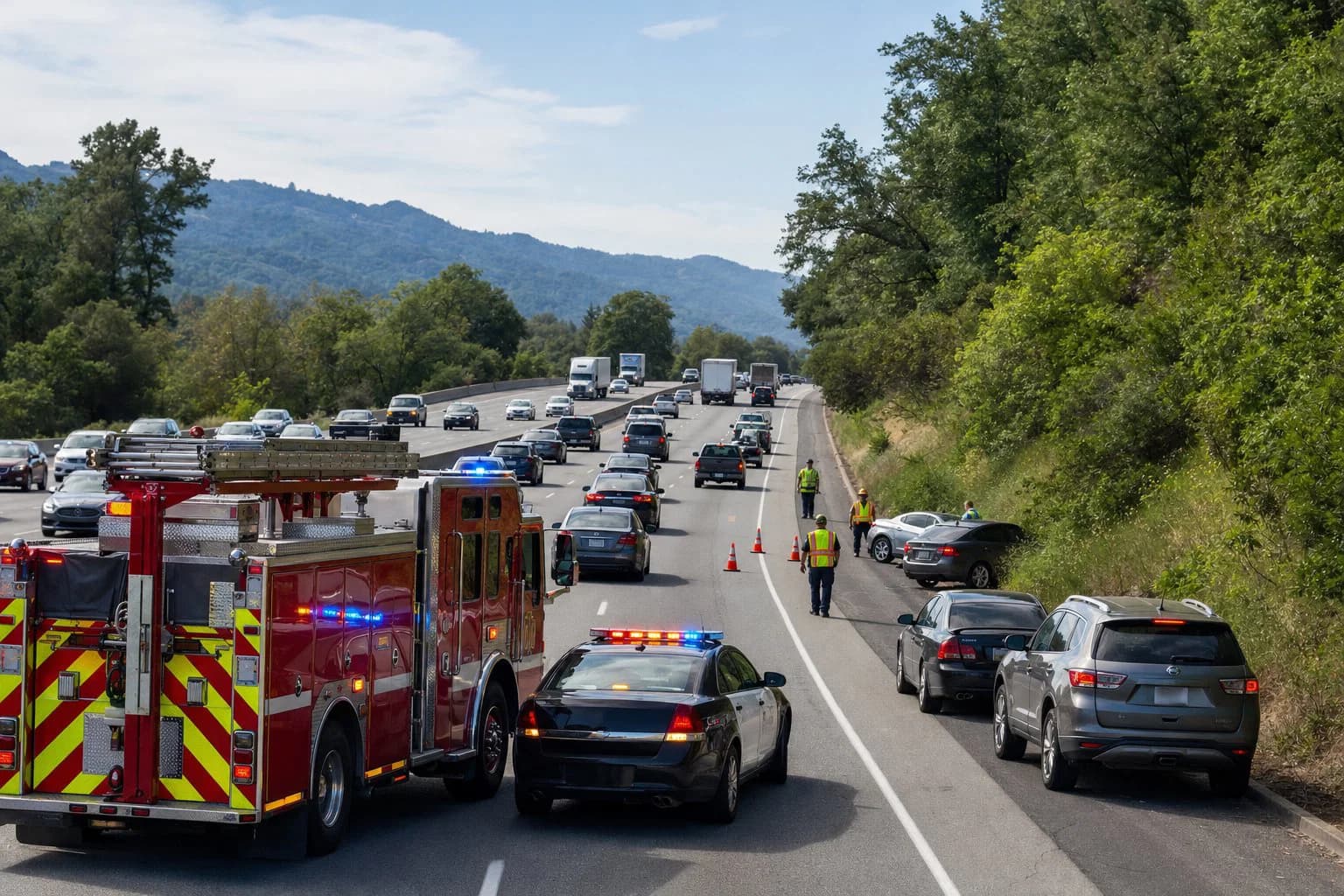
In contrast, when an emergency vehicle, tow truck, or Department of Transportation (DOT) vehicle is parked or stopped on the shoulder of a freeway, a different law applies. California Vehicle Code 21809, often called the “Move Over” law, governs how drivers must behave when passing active roadside incidents.
This statute requires motorists to approach stationary authorized emergency vehicles displaying flashing red or emergency lights, as well as stationary tow trucks or DOT vehicles displaying flashing amber warning lights, with extra caution. The required response has two main parts:
Lane Change: The driver must try to make a lane change into an available lane that is not immediately next to the emergency vehicle or tow truck.
Speed Reduction: If traffic, weather, or the roadway design make changing lanes unsafe or impossible, the driver is legally required to slow down to a “reasonable and prudent speed” for the situation.
Because “reasonable and prudent speed” is a judgment call, compliance is all over the map. Many drivers simply keep their freeway speed while passing within a few feet of vulnerable emergency workers, assuming that staying in their lane is enough. This false sense of safety is a major contributor to roadside deaths and serious injuries, especially during nighttime breakdowns where drivers already struggle to manage risk. For a step-by-step playbook on safer breakdown behavior, see this roadside survival guide for drivers in 2026.
The True Cost of Non-Compliance: Financial and Administrative Penalties
The penalties used to enforce these laws are intentionally severe. Yet most drivers have only a vague idea of the real financial and administrative cost of a citation. In states like California, traffic tickets use a base fine system that hides what you’ll actually pay out of pocket.
| Violation Category | Statute | Base Fine | Estimated Total Cost (Including Surcharges) | DMV Point Assessment |
|---|---|---|---|---|
| Failure to Yield to Right | CVC 21806 | $100 | ~$490 | 1 Point |
| Failure to Slow/Move Over | CVC 21809 | $50 | ~237 – 295 | 1 Point |
A driver cited under CVC 21809 might see a base fine of just $50 on their ticket. However, traffic courts stack on a long list of state and county surcharges. That $50 base fine is doubled by a 100 percent state penalty, then bumped again by a 70 percent county surcharge, a 50 percent DNA ID fund fee, a court construction fee, an Emergency Medical Services surcharge, and even night court fees in some cases. The result: the real financial hit is closer to $300 for a move-over violation and around $490 for failing to yield.
The secondary financial impacts can be even worse. A conviction for either offense adds one point to the driver’s Department of Motor Vehicles (DMV) record. Under the Negligent Operator Treatment System (NOTS), collecting four points in 12 months, six points in 24 months, or eight points in 36 months allows the DMV to suspend your license entirely.
Insurance companies closely track these violations too. Once an insurer finds a moving violation, they typically revoke the driver’s “good driver discount,” which often saves about 20 percent on premiums. On top of that, the higher-risk profile from the conviction can raise annual premiums by roughly one-third. Over the three years that the point remains on your record, one failure-to-yield or move-over ticket can easily cost well over $1,200 in added insurance and court-related expenses. Protecting that record starts with understanding how to read and respond to your car’s signals—something covered in depth in our guide to decoding dashboard warning lights for safer driving.
The Human Factor: Acoustic Isolation and the Engineering of Silence
If the laws are clear and the penalties are painful, the root cause of non-compliance must be more than simple carelessness. The AAA Foundation for Traffic Safety reports that most drivers say they support move-over and yield laws, but roadside video shows that up to 36 percent of vehicles still fail to either slow down or move over when passing an incident.
The biggest barrier is the physical environment of the modern vehicle cabin. Sirens were designed for an era when cars had thin glass, minimal insulation, and relatively low background traffic noise. Today, most vehicles are deliberately engineered as quiet, sealed spaces. That comfort comes at a cost: traditional sirens simply don’t cut through the way they used to, especially when paired with loud music or chatty infotainment systems that already compete hard for a driver’s attention. If you’ve ever been surprised by how quickly a siren “suddenly appears,” you’ve felt this design trade-off first-hand.
Sound Attenuation in Modern Automobiles
Automakers use advanced acoustic materials, thicker glass, and dense weather stripping to create a quieter ride by blocking outside noise and vibration.
Measurements by organizations such as the German Aerospace Center (DLR) and the European Environment Agency show how dramatically the cabin seals out sound:
Open windows: Only about 5 to 11 dB(A) of noise reduction.
Tilted / slightly open windows: About 12 to 17 dB(A) of sound reduction.
Closed windows: Modern cabins with fully closed windows often achieve a 25 to 29 dB(A) drop in outside noise.
Because the decibel scale is logarithmic, a 10 dB(A) drop sounds like the volume is cut in half. So a 25 to 29 dB(A) reduction can make a 115 dB siren—which is extremely loud at the source—sound distant or muffled. Inside the car, that siren now competes with the HVAC system, engine noise, and any music, podcasts, or navigation prompts you’re using.
High-end vehicles with Active Noise Cancellation (ANC) add another complication. ANC uses phase-cancellation to remove steady hums, which is especially effective between about 50 and 600 Hz. Unfortunately, the lower end of that range is exactly where emergency sirens lean when they’re trying to shake the cabin and create that “feel it in your chest” vibration that used to grab driver attention. When ANC cancels that low-frequency punch, drivers may hear only the faint, high-pitched part of the siren—often too late.
The Crisis of Auditory Localization
Even when a siren does cut through, the human brain has a hard time pinpointing where it’s coming from. We rely on tiny differences in arrival time (Interaural Time Differences, or ITD) and loudness (Interaural Level Differences, or ILD) between our two ears to figure out direction.
Low-frequency siren tones have wavelengths longer than the width of the human head, so there’s almost no difference in sound level between the two ears—making ILD cues nearly useless. At the same time, mid- to high-frequency sweeps (around 500 to 1,500 Hz) bounce off buildings, trucks, and barriers in urban settings, creating confusing echoes that scramble ITD processing. The result is auditory disorientation: a driver hears the siren, knows help is close, but can’t tell if the unit is ahead, behind, or about to burst through a blind intersection. That confusion leads to delayed reactions and sudden, unpredictable braking or lane changes. It’s the same kind of split-second misjudgment that also drives risk in other specialized scenarios, like mountain descents where brake fade appears faster than drivers expect.
Visual Confusion and Cognitive Overload
When sound fails, the responsibility for detection shifts entirely to the driver’s eyes and brain. Emergency vehicles rely on intense arrays of flashing warning lights. In California, for example, law enforcement vehicles must display a steady red lamp visible from 1,000 feet, backed up by alternating blue and red flashes. Tow trucks, road service vehicles, and utility fleets are limited to flashing amber lights while they’re actively creating a hazard or assisting a motorist.
Target Fixation and the Moth Effect
Those bright strobe lights are highly visible—but they can also trigger a psychological and physical hazard called target fixation, sometimes described as the “moth effect.” In stressful, low-visibility, or nighttime driving, your eyes are naturally drawn to the brightest, flashing thing in your field of view. And where the eyes go, the hands on the wheel tend to follow. That’s why drivers sometimes drift out of their lane and into the very crash scene they’re trying to avoid. The same eye–hand loop shows up with other roadway threats too, like large-hood vehicles that hide pedestrians and children in front blind zones.
The Pressures of the Dilemma Zone
For emergency vehicle operators, the intense urgency of a true emergency pushes them toward the edge of what’s safe. Biological studies tracking volunteer emergency drivers show cortisol and other stress hormones jump by about 30 percent during emergency driving compared with routine driving. That stress can impair judgment, raise risk tolerance, and lead to quicker, less cautious decisions.
This high-stress state slams into civilian panic at signalized intersections. When a driver enters the “dilemma zone”—the critical stretch of road just before an intersection where you must choose to brake or continue—and suddenly realizes a fire engine is bearing down with lights and siren, clear decision-making often disappears. Emergency drivers may assume that civilians will naturally obey right-of-way rules. But when a civilian panics and slams on the brakes in the middle of the intersection—directly violating CVC 21806—they block the emergency vehicle’s path and expose themselves and their passengers to devastating side-impact crashes. Understanding how to handle these intersections is just as important as learning why waving other cars through can be deadly, a topic covered more deeply in our guide on why predictable behavior at intersections saves more lives than “being nice”.
The Statistical Reality: Casualties and Operational Delays
The deadly mix of quiet cabins, visual overload, and human panic shows up clearly in national crash data. Working on the roadside and responding to emergencies are some of the most dangerous jobs in the United States.
The Struck-By Epidemic
The Emergency Responder Safety Institute (ERSI) tracks “struck-by” incidents, recording line-of-duty deaths of law enforcement officers, firefighters, EMS personnel, and tow operators. In 2024, 46 emergency responders were struck and killed by vehicles while working at roadway incidents. In 2025, that number dipped slightly to 35, but the broader trend shows an ongoing failure by the driving public to consistently move over and slow down.
The towing and recovery sector bears an outsized share of this risk. Federal data shows tow operators suffer a fatality rate of nearly 43 deaths per 100,000 workers—compared with about 3 per 100,000 across all industries. In AAA Foundation surveys, 60 percent of tow workers reported experiencing a near-miss while working roadside, and an alarming 15 percent said they had already survived being physically struck by a passing vehicle at least once.
This difference in risk highlights a serious gap in public education. AAA field footage showed only 58 percent of drivers slowed or moved over for a stationary tow truck with amber lights, compared with 66 percent when facing a police vehicle with red and blue lights. Too many drivers still believe move-over rules mainly protect police and fire, rather than all roadside workers—tow operators, utility crews, and even motorists changing a tire. In reality, every stopped vehicle on the shoulder deserves respectful space, and that starts with basic tire and maintenance awareness, as explained in our in-depth tire safety guide that helps prevent dangerous roadside breakdowns.

Civilian Casualties in Active Responses
When an emergency vehicle is running lights and siren in a “Code 3” response, the risk shifts heavily toward civilian road users. According to National Safety Council and NHTSA Fatality Analysis Reporting System (FARS) data, 225 people died in crashes involving emergency vehicles in 2024.
| Fatality Category in Emergency Vehicle Crashes (2024) | Percentage of Total Deaths |
|---|---|
| Occupants of Non-Emergency Vehicles | 56% |
| Pedestrians | 24% |
| Emergency Vehicle Drivers | 9% |
| Emergency Vehicle Passengers | 8% |
The data makes it clear: civilians in regular cars pay the highest price when intersection yields fail. The sheer weight and momentum of a responding fire truck or ambulance all but guarantee catastrophic outcomes for standard passenger vehicles. Crashes involving police vehicles accounted for 150 of these deaths, ambulances for 47, and fire trucks for 28. Using lights and sirens increases crash risk for responders too; ambulance crash rates rise from 4.6 per 100,000 responses during routine driving to 5.5 per 100,000 when lights and sirens are active.
The Degradation of Response Times
Beyond the lives lost, drivers who don’t yield also slow down the entire emergency response system. In a recent survey of 2,500 first responders, 49.5 percent of agencies reported worse response times in 2024 compared with the year before. Traffic congestion and driver failure to clear lanes were cited by 41.7 percent as the biggest challenges to staying within target response windows.
When an emergency vehicle crashes en route to a call, the ripple effect is severe. The original medical or fire emergency must wait for a second unit, and the damaged apparatus is taken out of service. Fleet maintenance reports show that a damaged emergency vehicle spends an average of 9.5 days out of operation per collision claim. That kind of downtime strains local budgets and leaves fewer units available to respond the next time a 911 call comes in.
A Paradigm Shift: Intelligent Technology and Community Platforms
As it becomes obvious that old-school sirens and light bars can’t reliably cut through today’s driving environment, the safety world is shifting toward connected digital tools. Solving this problem means linking municipal infrastructure, smarter in-vehicle tech, and real community accountability—rather than assuming law enforcement alone can handle it.
Vehicle-to-Everything (V2X) and Digital Alerting
To overcome the soundproofing of modern cabins, technology companies have created digital alerting systems that send real-time warnings straight into the driver’s line of sight. Using Vehicle-to-Everything (V2X) architecture, platforms like Safety Cloud by HAAS Alert allow emergency vehicles, tow trucks, and construction fleets to broadcast their presence directly to nearby civilian vehicles.
When an emergency vehicle activates its flashing lights, a digital alerting transponder triggers an event that is sent to the cloud. That alert is then delivered to drivers up to 30 seconds in advance through popular navigation apps like Waze, or directly into the infotainment systems of compatible brands such as Stellantis (Chrysler, Dodge, Jeep, RAM). This early warning can be especially helpful for EV drivers planning stops or lane choices ahead of time, complementing the kind of planning discussed in our guide on reducing EV range anxiety while staying safe.
The system sends two main types of alerts:
Moving alerts: Sent when a responding vehicle is actively navigating traffic, warning drivers ahead to pull to the right and prepare for its approach.
Stationary alerts: Sent when a vehicle has been stopped with its hazard lights on for at least 30 seconds, giving drivers early warning to move over and slow down.
The safety gains from digital alerting are compelling. An analysis of more than 40,000 digital alert interactions found that drivers who received an in-cabin visual warning slowed their vehicles by an average of 17 percent. Just as important, that slowdown was smooth and controlled, rather than the hard, panic braking that often leads to rear-end crashes. Overall, advance warning of an emergency vehicle can cut the chance of a collision between the two vehicles by up to 90 percent. By shifting from external sounds to internal, visual awareness, the industry is starting to offset the downsides of our quieter, more insulated cars.
Preempting the Intersection Crisis
To tackle the high number of intersection crashes, more cities are adopting Emergency Vehicle Preemption (EVP) technology. Because up to 65 percent of EMS crashes involve some kind of intersection conflict, taking the decision-making burden off civilian drivers is critical.
EVP systems use GPS and wireless radios to track the speed and direction of an approaching emergency vehicle. They then communicate directly with the traffic signal controller, switching the light to green for the responder and holding all cross-traffic at a firm red. This removes the “dilemma zone” entirely; civilian drivers are automatically stopped by the red light long before the fire engine enters the intersection, sharply cutting the risk of side-impact collisions.
Carszy: Human Media™ and Driver-to-Driver Accountability
While infrastructure and V2X tools address the mechanical side of yielding, building truly safe roads also demands a shift in social behavior. That’s the space the Carszy platform is designed to fill. Recognizing that everyday drivers, caring parents, and neighborhood watch leaders are the real front line of local road safety, Carszy has created a new type of engagement called Human Media™.
Unlike traditional social media, which often encourages passive scrolling and emotional reactions, Human Media™ uses connectivity for direct, real-world safety impact. By using license plates as unique, searchable identifiers, Carszy creates a secure driver-to-driver communication channel that helps people speak up when something isn’t right—whether that’s failing to yield, texting behind the wheel, or aggressive driving that puts kids and vulnerable road users at risk. This same model of shared responsibility also shows up in our work on protecting motorcyclists who “disappear” at intersections, where small behavior changes by drivers can save lives.
- License Plate Messaging: If a driver notices another motorist behaving dangerously—such as refusing to move over for a roadside tow truck, weaving recklessly through traffic, or driving with defective or missing taillights—they can securely message the driver using only the license plate. This creates a real-time feedback loop of accountability that traditional law enforcement simply doesn’t have the staffing to provide. It’s just as useful for flagging urgent issues like a pet left in a hot car or a serious fluid leak under a parked vehicle.
- VOIS™ (Vehicle of Interest Search): For community watch groups and safety-minded vehicle owners, VOIS™ acts as a shared alert system. When a critical event occurs—such as a hit-and-run, a suspected kidnapping, or human trafficking—VOIS™ mobilizes nearby community members to keep an eye out for the vehicle of interest. By crowdsourcing awareness, the platform helps cut response times and shrink the search area dramatically.
- Privacy-first infrastructure: Because location and driver communications involve highly sensitive data, Carszy operates on US-based servers and uses strict security practices. This approach protects user privacy while still allowing neighborhoods to react quickly and safely when road risks appear.
By integrating platforms like Carszy into daily life, drivers shift from passive observers to active guardians of their roads. Reckless driving, refusal to yield, and chronic speeding are less likely to go unnoticed, and more likely to be corrected early—before a near-miss becomes a tragedy.
Actionable Advice: How to Execute the Perfect Yield
To connect new technology with everyday habits, drivers need clear, simple instructions on how to move their vehicles in stressful moments. The following scenarios lay out safe, legally compliant ways to interact with emergency vehicles on real roads.
Scenario 1: The Commuter in Congested Traffic
A commuter is driving in the far-left lane of a crowded, multi-lane highway. Suddenly, they see the flashing red and blue lights of a police cruiser rapidly approaching from behind.
- The mistake: The driver panics and slams on the brakes, stopping in the far-left lane and blocking traffic.
The correct action: The driver should immediately turn on their right turn signal to show their intent. Then, checking rearview and side mirrors, they should carefully work their way across the lanes toward the extreme right-hand edge of the road and come to a smooth, controlled stop.
The exception: If traffic is completely gridlocked and moving right is physically impossible, the driver should stay stopped where they are. Sudden, creative maneuvers into center medians or oncoming lanes can create serious new hazards. Emergency drivers are highly trained to navigate blocked traffic and will use their public address (PA) systems to direct specific vehicles when needed. It is also strictly illegal to “draft” or follow within 300 feet of an emergency vehicle after it passes just to slip through traffic—this behavior raises crash risk and can quickly turn into a costly citation.
Scenario 2: The Protective Parent at an Intersection
A parent is approaching a green light at a busy city intersection. As they enter the intersection, they hear the deep rumble of a fire engine’s air horn and siren but cannot immediately see where it’s coming from.
- The mistake: Afraid of being hit, the parent slams on the brakes and stops in the middle of the intersection.
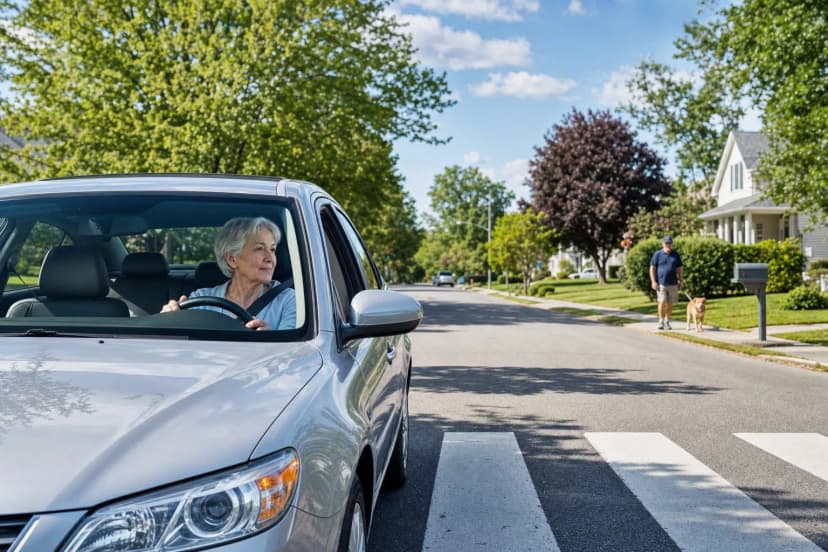
The correct action: Under CVC 21806, it’s explicitly illegal to stop inside an intersection. The driver should stay calm, continue driving completely through the intersection to clear the conflict zone, then pull over to the right-hand curb and stop as soon as it is safe. If the driver hasn’t yet entered the intersection when they first hear the siren, they should pull to the right and stop before the crosswalk, leaving the intersection itself open for the emergency vehicle.
Scenario 3: The Neighborhood Watch Lead on a Highway
A driver is traveling in the right lane of a divided highway at 65 miles per hour. A quarter-mile ahead, they see a tow truck on the right shoulder with flashing amber lights, actively loading a disabled minivan.
- The mistake: Believing only red and blue lights require a response, the driver maintains 65 mph and stays in the right lane, passing dangerously close to the tow operator.
The correct action: Recognizing the amber lights as a protected roadside operation under CVC 21809, the driver should turn on the left signal and safely merge into the lane to the left, creating a full lane of buffer space. If traffic in the left lane is too heavy to allow a safe lane change, the driver is legally required to make a strong speed reduction to a clearly prudent level—often well below the posted limit—and pass the scene slowly and with maximum caution. This same “slow down and create space” mindset also applies when encountering pedestrians, cyclists, or e-scooter riders near the edge of the roadway, as discussed in our analysis of micromobility collisions and sidewalk conflicts.
Legal Defenses and the Standard of Due Regard
When yielding goes wrong and a ticket is issued, many drivers turn to traffic court. Citations for violating CVC 21806 or 21809 can be challenged, but the bar is high.
To win a conviction, the citing officer must appear in court and convince the judge that the driver had the present, physical ability to yield safely and chose not to. Common defenses include showing photos or video suggesting the emergency vehicle wasn’t sounding a siren, that the red lights weren’t visible from 1,000 feet because of heavy rain or sharp curves, or that surrounding traffic made pulling over physically impossible without likely causing another crash.
On the other side, emergency operators are not given a blank check to drive recklessly. While they may be exempt from some standard traffic rules under CVC 21055 when responding to true emergencies, they are still bound by the legal standard of “due regard.” In civil lawsuits after a crash, attorneys use data from Computer-Aided Dispatch (CAD) logs, Automatic Vehicle Location Systems (AVLS), and braking-force records to determine whether a responder acted with reckless disregard for the safety of others. Still, when civilian drivers fail to yield or move over, they are often found negligent per se—meaning their clear violation of the vehicle code creates a strong presumption of fault in any resulting injury case.
Conclusion: Restoring Safety Through Community Accountability
The interaction between everyday drivers and emergency vehicles remains one of the riskiest parts of modern transportation. The numbers are sobering: 225 deaths involving emergency vehicles in a single year, and tow operators killed at a rate of 43 per 100,000 workers. While the laws behind CVC 21806 and 21809 spell out exactly what drivers must do, true compliance means overcoming quiet cabins, visual overload, and split-second panic at intersections.
New tools—including digital alerting systems and emergency vehicle preemption—are already helping. By cutting average speeds by 17 percent and reducing collision risk by up to 90 percent when alerts are delivered early, technology is steadily removing confusion from the yielding process and supporting safer decision-making for both drivers and responders.
Ultimately, though, safety on the road is a shared community responsibility. It asks everyday drivers to take an active role in building a safer driving culture. Platforms like Carszy help people step out of the isolation of their vehicles and connect directly with neighbors, parents, and other road users who care. By using License Plate Messaging to call out dangerous behavior and VOIS™ to help recover vehicles involved in serious crimes or hit-and-runs, communities can achieve what traditional enforcement alone cannot: fast, peer-to-peer accountability.
Knowing the rules is just the beginning. Protecting first responders, roadside workers, and fellow motorists requires a steady commitment to awareness and predictable behavior. When the sirens sound and the lights flash, the right response isn’t panic—it’s a calm, swift, and clearly understandable action that everyone on the road can anticipate.
Download the Carszy app today to stay connected to your community, report dangerous driving, and become an active participant in keeping your neighborhood’s roads safe.
Frequently Asked Questions
What exactly is the difference between a “Move Over” law and a “Failure to Yield” law?
While they’re often mixed up, these two laws cover very different situations. A “Failure to Yield” law (such as CVC 21806) applies when an emergency vehicle is actively moving and responding to an incident with its sirens and red lights on. The law requires you to pull to the right-hand edge of the road and come to a complete stop until the vehicle passes. A “Move Over” law (such as CVC 21809) applies when an emergency vehicle, tow truck, or DOT vehicle is parked or stationary on the side of the road with flashing lights. This law requires you to safely change lanes away from the stopped vehicle, or if you cannot change lanes, to slow down sharply to a safe and prudent speed as you pass.