Invisible Riders: Why Drivers Don't See Motorcyclists
Introduction: The Phenomenology of the Invisible Motorcyclist
Navigating modern roadways requires a profound level of cognitive processing, situational awareness, and split-second decision-making. For the daily commuter traversing multi-lane arterials, the protective parent handing the car keys to a newly licensed teenager, or the neighborhood watch lead monitoring the safety of a residential subdivision, the intersection represents the most complex and dangerous point in the transportation network. Despite decades of safety campaigns, the deployment of high-visibility riding apparel, and the mandatory integration of daytime running lights on motorcycles, a profound and fatal cognitive illusion continues to plague the driving public: the phenomenon of the “invisible” motorcyclist.
As a natural companion to the study of pedestrian and cyclist cognitive illusions, the motorcycle-specific visibility crisis presents a unique and deadly challenge. Across the globe, accident investigators and safety advocates share a collective anxiety regarding intersection safety, an anxiety often summarized by the chilling and ubiquitous refrain of the surviving motorist in a collision: “I looked, but I just did not see them.”
This recurring tragedy is rarely a consequence of malicious negligence, reckless distraction, or poor infrastructure alone. Instead, the failure to perceive motorcyclists is deeply rooted in the neurobiological limitations of the human brain, the evolutionary biomechanics of the human eye, and the psychological heuristics that govern visual processing. When a driver enters an intersection, their visual system acts as a limited-capacity prediction engine, unconsciously filtering out unexpected stimuli to prioritize the most common threats—namely, other large passenger vehicles.
Consequently, the intersection has evolved into an arena of disproportionate trauma for the motorcyclist. The vast majority of these fatal encounters involve a highly specific mechanism: the left-turn right-of-way violation. Addressing this crisis requires moving far beyond outdated, reductive advice instructing drivers to simply “look harder.” It necessitates a multidimensional approach that combines a nuanced understanding of cognitive psychology, the deployment of advanced vehicle crash avoidance technologies, and the mobilization of crowdsourced community alerts to identify and mitigate high-risk corridors. Furthermore, it demands the integration of decentralized, peer-to-peer communication platforms designed for tech-savvy vehicle owners who wish to actively participate in community safety and learn why predictability at intersections must come before courtesy.
This exhaustive research report investigates the statistical realities of motorcycle left-turn collisions, meticulously deconstructs the four primary psychological mechanisms that render motorcyclists invisible to the human eye, evaluates the state of modern technological interventions, and explores how community-driven platforms are establishing a new paradigm for proactive, real-world road safety.

The Statistical Architecture of Motorcycle Trauma
To fully comprehend the severity and scale of the visibility crisis, the statistical realities documented by organizations such as the National Highway Traffic Safety Administration (NHTSA) and the Insurance Institute for Highway Safety (IIHS) must be examined in granular detail. Motorcycles represent a small fraction of the total vehicles operating within the national fleet, yet their riders suffer a vastly disproportionate share of traffic fatalities and catastrophic injuries. These patterns echo broader trends in traffic violence and vehicle risk explored in depth in Carszy’s guide to bridging the gap in vehicle safety and traffic violence.
The federal government estimates that, per mile traveled, the number of deaths on motorcycles is nearly 28 times higher than the number of fatalities in enclosed passenger cars. When a motorcycle is involved in a collision, the fundamental physics of the event dictate the outcome. The lack of an enclosed vehicle chassis, deploying airbags, and structural crumple zones leaves the rider entirely exposed to severe kinetic forces, resulting in high rates of traumatic brain injuries, spinal cord trauma, and blunt force poly-trauma.
The Dominance of the Left-Turn Right-of-Way Violation
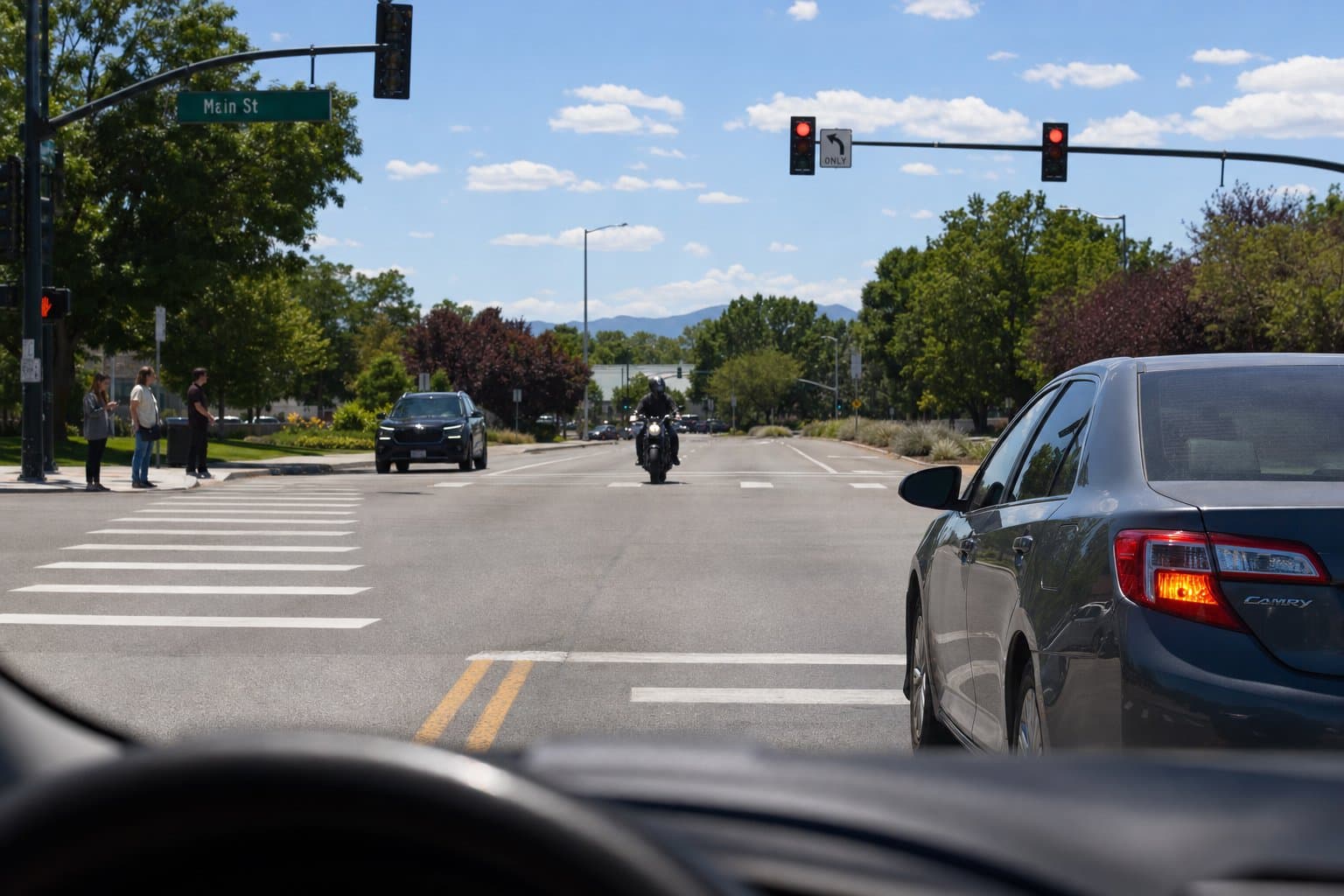
While single-vehicle motorcycle crashes frequently involve speed or alcohol, the most prominent and consistently fatal configuration in multi-vehicle motorcycle crashes is the intersection collision. Specifically, the apex of danger occurs when a passenger vehicle turns left directly into the path of an oncoming motorcycle, violating the rider’s right-of-way.
According to extensive IIHS data evaluating two-vehicle motorcycle crashes, passenger vehicles turning left in front of an oncoming motorcycle account for an overwhelming 36 percent of all fatal two-vehicle crashes. Furthermore, this specific collision geometry accounts for 21 percent of all nonfatal injury crashes and 19 percent of all police-reported crashes involving a motorcycle. In an updated analysis of fatal and police-reported crashes spanning from 2017 to 2021, the IIHS concluded that the left-turn configuration remained the most frequent type of fatal two-vehicle motorcycle crash, hovering consistently at 26 percent of all fatal involvements overall.
Recent data compiled by the NHTSA’s National Center for Statistics and Analysis further solidifies this deeply concerning trend. In 2020, the United States witnessed 2,741 fatal two-vehicle crashes involving a motorcycle and another type of vehicle. In 42 percent (1,158) of these devastating crashes, the other vehicle was actively turning left while the motorcycle was traveling straight, passing, or overtaking other vehicles. By the following year, in 2021, the total number of fatal two-vehicle crashes increased to 3,052, with 43 percent (1,315) involving the left-turn configuration.
The table below illustrates the alarming year-over-year escalation in total motorcyclist fatalities and the persistent danger of the left-turn collision, underscoring a systemic failure that traditional safety campaigns and high-visibility clothing have failed to reverse.
| Year | Total Motorcyclist Fatalities | Fatal Two-Vehicle Crashes | Percentage Involving Left-Turning Vehicles | Total Vehicle Miles Traveled (Millions) |
|---|---|---|---|---|
| 2008 | N/A | 2,387 | 41% | N/A |
| 2018 | 5,038 | N/A | N/A | 8,659,741 |
| 2019 | 5,044 | N/A | N/A | 8,596,314 |
| 2020 | 5,506 | 2,741 | 42% | 8,347,435 |
| 2021 | 5,932 | 3,052 | 43% | 9,881,414 |
| 2023 | 6,366 | N/A | N/A | N/A |
| 2024 | 6,228 | N/A | N/A | N/A |
Data sourced from NHTSA Fatality Analysis Reporting System (FARS) and IIHS Fatality Facts.
Demographics and Environmental Variables
A deeper analysis of the fatality data dispels common societal misconceptions regarding the nature of these crashes. The cultural archetype of the reckless, speeding youth crashing in adverse weather conditions is not reflected in the data regarding left-turn intersection fatalities. In fact, environmental variables often assumed to obscure visibility play a remarkably small role in these specific collisions.
According to the 2020 NHTSA data, a staggering 97 percent of fatal motorcycle crashes occurred in clear or cloudy conditions, while only 2 percent occurred in the rain. Furthermore, the majority of these collisions do not happen under the cover of darkness; 57 percent of fatalities occurred during broad daylight, compared to 37 percent in the dark, 4 percent at dusk, and 1 percent at dawn.
Demographically, the victims of these crashes are increasingly older, highly experienced riders. The 55-and-older age group accounted for 23 percent of motorcyclists killed in 2011, a figure that surged to 27 percent by 2020. Over the 10-year period spanning 2011 to 2020, motorcyclist fatalities among the 55-and-older age group increased by 37 percent, rising from 1,087 to 1,486. Correspondingly, the average age of a motorcycle rider killed in a traffic crash rose from 42 in 2011 to 43 in 2020.
The data suggests a chilling reality that terrifies the daily commuter and the protective parent alike: experienced, mature riders operating in perfectly clear, bright daylight conditions are being struck and killed at unprecedented rates by drivers who simply turn left directly into their path. The failure is not environmental, nor is it primarily related to rider inexperience or recklessness; the failure occurs almost entirely within the cognitive processing centers of the turning driver, the same blind spots that endanger teen drivers, older adults, and other vulnerable users discussed in Carszy’s modern driver’s guide to staying safe.
Deconstructing Cognitive Illusions: Why the Brain Erases Motorcycles
When a driver involved in a fatal intersection collision claims, “I looked right at the intersection, but I failed to see the motorcycle,” legal frameworks and insurance adjusters often interpret this statement as an admission of distraction, texting, or malicious negligence. However, cognitive psychologists and human factors engineers categorize this exact scenario as a “Looked But Failed To See” (LBFTS) error.
For decades, the proposed solution from the safety community has been to increase the physical conspicuity of the rider. Motorcyclists are routinely instructed to wear high-visibility neon clothing, apply reflective tape to their helmets, and utilize modulating headlights to capture the attention of motorists. Yet, despite widespread adoption of these conspicuity aids, the collision statistics remain largely unchanged.
The implication of available psychological research is that the current societal recommendation to prompt drivers to simply “look harder and longer” for motorcycles is fundamentally ineffective. The LBFTS phenomenon is not a failure in the physical act of searching; rather, it is a structural failure in the way the human brain processes, prioritizes, and discards visual information. This lethal cognitive illusion is driven by four distinct, overlapping mechanisms: Inattentional Blindness, Saccadic Masking, the Size-Arrival Effect, and the “Saw But Forgot” short-term memory error.
Inattentional Blindness and the Visual Filtering Engine
Humans routinely miss critical visual information that is presented directly in front of their eyes. This phenomenon, known as inattentional blindness, occurs because the human visual system is a limited-capacity prediction engine. The processes that evolved to allow humans to move through the world with ease are virtually guaranteed to cause the brain to miss significant stimuli, especially during highly demanding cognitive tasks like driving.
The most famous demonstration of this psychological phenomenon in cognitive science is the Simons and Chabris “gorilla experiment”. In this study, observers are asked to watch a video clip of two teams passing a basketball. The observers are given a specific, demanding task: count the exact number of passes made by the team wearing white shirts. In the middle of this game, a person wearing a full gorilla suit walks directly through the center of the screen, turns to the camera, thumps their chest, and exits. Surprisingly, when asked after the video, roughly 50 percent of observers fail to report seeing the gorilla entirely, despite the image being clearly projected onto their retinas. Because their cognitive resources were tightly focused on a highly demanding task (tracking the white shirts), their brains actively filtered out the unexpected, irrelevant stimulus (the gorilla) as background noise.
In the context of modern driving, approaching and navigating an intersection is a highly demanding cognitive task. A driver must simultaneously monitor traffic lights, scan for pedestrians, calculate opposing vehicle speeds, and plot their own turning trajectory. To manage this overwhelming influx of data, the driver’s brain unconsciously prioritizes the most common and dangerous threats—heavy, four-wheeled passenger cars, commercial trucks, and buses.
Because motorcycles are relatively rare in the overall traffic mix, the driver’s brain does not actively anticipate their presence. Therefore, a driver can be paying full attention to the road, look directly at an oncoming motorcycle, and filter it out of conscious perception entirely because the visual cortex was exclusively scanning for the wider, rectangular silhouette of a passenger car. The term “inattentional” is often misunderstood by the public; the blindness occurs precisely because the driver is paying strict, focused attention to a specific task, resulting in the failure to perceive an unexpected stimulus that is in plain sight.
Saccadic Masking and Visual Blackouts
The biomechanics of human vision add another layer of severe vulnerability for the motorcyclist. When a driver scans a complex intersection, looking left and then right to clear the lanes, their eyes do not pan smoothly across the horizon like a motorized video camera. Instead, the eyes move in rapid, jerky jumps known as “saccades”.
During these rapid eye movements, the brain actively shuts down visual processing to prevent the conscious mind from experiencing severe, nauseating motion blur as the eyes sweep across the scene. This brief, automatic neurological shutdown is called “saccadic masking” or “saccadic suppression”. Because saccadic suppression initiates just prior to the actual onset of the eye movement, it is a centrally activated process in the brain rather than a reactionary reflex to retinal motion.
During this visual blackout, the brain utilizes a “filling in” process to spatially reconstruct the environment in real time, relying heavily on memorized past experiences, peripheral cues, and assumptions about what should be in the intersection. Consequently, each saccade effectively acts as a moving, temporary blind spot.
If a narrow object, such as a motorcycle viewed from the front, happens to fall within the line of sight precisely during a saccadic jump, it is completely masked from the driver’s perception. The driver’s eyes sweep right past the rider, but the brain records nothing but empty asphalt. The faster a driver sweeps their head left and right to scan a busy intersection—a common habit for rushed commuters—the larger and longer the saccadic blind spots become, drastically increasing the mathematical probability that a motorcycle will be neurologically erased from the scene. Small objects easily get caught in the saccades and are left out of the brain’s spatial reconstruction, explaining the terrifying sincerity of the driver who claims they never saw the collision coming.
The Size-Arrival Effect and Distance Illusions
Even if a driver successfully overcomes inattentional blindness and saccadic masking to register the physical presence of a motorcycle, a third cognitive illusion—the Size-Arrival Effect—frequently sabotages their ability to accurately judge the motorcycle’s speed, proximity, and time-to-collision.
When drivers attempt to judge the arrival time of an oncoming vehicle, they rely heavily on a visual heuristic called “tau,” which is the mathematical rate at which the object’s image expands on the observer’s retina as it approaches. However, the human visual perception system is deeply flawed and easily tricked when comparing objects of drastically different physical sizes. Visually, the human brain inherently equates angular size (how big an object appears in the field of view) with physical distance.
Because a large SUV or commercial truck produces a massive image on the retina even from a distance, the subconscious assumes it is very close and arriving immediately. Conversely, because a motorcycle presents a very narrow, slender frontal profile, it produces a small retinal image, tricking the brain into assuming the vehicle is much farther away and traveling at a slower speed than it actually is.
Extensive psychological studies utilizing temporal occlusion paradigms—where participants view computer simulations of approaching vehicles that are suddenly hidden from view—consistently demonstrate the lethality of this effect. Researchers, including a prominent team led by Pat DeLucia at Texas Tech University, found that even when a large object and a small object start at the exact same distance and travel at the exact same speed on the same trajectory, observers overwhelmingly believe the larger object will reach them first.
This optical illusion has devastating consequences on the roadway. Research confirms that drivers adopt significantly smaller safety margins when pulling out in front of motorcycles compared to pulling out in front of cars. A driver sees a motorcycle, miscalculates its distance due to its small angular size, and assumes they have ample time to execute a left turn across the intersection. This miscalculation is further compounded by the mechanical reality that motorcycles generally possess vastly superior acceleration capabilities compared to passenger cars, causing them to arrive at the intersection even faster than the driver’s flawed spatial projection anticipated.
The “Saw But Forgot” (SBF) Error and Short-Term Memory Decay
While Inattentional Blindness, Saccadic Masking, and the Size-Arrival Effect explain why drivers fail to see or accurately judge a motorcycle, emerging research from the University of Nottingham points to a fourth, deeply troubling mechanism: rapid short-term memory decay, categorized as the “Saw But Forgot” (SBF) error.
Dr. Peter Chapman and his research team hypothesized that many junction crashes historically categorized as “Looked But Failed to See” were actually situations where the driver did see the motorcycle, but their brain immediately discarded the information. To test this hypothesis, researchers placed 60 participants in a high-fidelity driving simulator featuring a Mini housed within a projection dome that provided a 360-degree view of a simulated driving environment.
The drivers were tasked with navigating intersections while their eye movements were precisely tracked via advanced optics. Occasionally, the researchers would freeze the simulation just as the driver began to pull out into the intersection, requiring the driver to use a laser pointer to indicate the exact locations of the oncoming vehicles they had just scanned.
The results fundamentally challenged the traditional understanding of intersection crashes. On numerous occasions, drivers completely failed to recall the presence of an oncoming motorcycle, despite eye-tracking data unequivocally proving that their eyes had fixated directly on the motorcycle mere seconds prior to pulling out. Crucially, the data revealed that drivers were five times more likely to forget the presence of a motorcycle than they were a passenger car.
The analysis indicates that failures to report a motorcycle were not predicted by how long the driver’s eyes fixated on the vehicle. Rather, the memory failure was tightly associated with the driver’s subsequent head movements. If a driver looked at a motorcycle, consciously registered its presence, but then turned their head to check the opposing lane of traffic, the subsequent cognitive load required to process the new lane overwrote the short-term memory buffer containing the motorcycle. The brain successfully perceived the threat, but literally forgot it existed in the fraction of a second before the driver made the executive decision to pull forward into the intersection.
Technological Mitigations in Modern Vehicles
The realization that the invisibility of motorcyclists is a deeply ingrained neurobiological flaw necessitates a monumental shift in how society approaches traffic safety. If the human brain is mathematically predisposed to filter out, mask, misjudge, and forget motorcycles during complex tasks, the responsibility for safety must partially shift to automated technological interventions that do not suffer from cognitive fatigue, saccadic blindness, or working memory decay.
The Limitations of Traditional ADAS
Advanced Driver Assistance Systems (ADAS) have proliferated across modern vehicle fleets over the last decade, offering safety-conscious parents and commuters features such as blind-spot detection, lane-keeping support, and front crash prevention (which includes forward collision warning and automatic emergency braking). However, an analysis of these systems reveals distinct limitations regarding motorcycle safety, a gap that mirrors broader concerns about how smart cars interact with imperfect streets, as explored in Carszy’s deep dive on ADAS limits and dangerous intersections.
Same-direction blind spot detection and lane departure warnings effectively address side-swipe and rear-end collisions, but they are entirely blind to the most lethal geometric configuration: the intersection left-turn. Current research from the IIHS highlights that traditional ADAS technologies combined have the potential to prevent an estimated 10 percent of fatal two-vehicle motorcycle crashes, 19 percent of nonfatal injury crashes, and 23 percent of police-reported crashes. Because less than half of all motorcycle crashes involve a collision with a passenger vehicle (due to a high rate of single-vehicle motorcycle crashes), these legacy systems would only avoid roughly 4 percent of all fatal motorcycle crashes overall.
The Promise of Left-Turn Assist Technology
The critical technological intervention required to save lives at the intersection lies in the rapid development and deployment of Left-Turn Assist technology. This emerging safety feature utilizes a sophisticated array of forward-facing cameras, millimeter-wave radar, and LiDAR sensors to detect oncoming vehicles when a driver activates their left turn signal or begins turning the steering wheel across a lane.
If the software calculates that a collision is imminent based on the trajectory, velocity, and distance of the oncoming vehicle, the system will issue a severe audible and visual warning. If the driver fails to react, the system can autonomously engage the vehicle’s braking system to immediately halt the turn.
According to the IIHS, developing and adapting these systems specifically to recognize the narrow radar cross-section, asymmetrical lighting, and unique movement profiles of motorcycles is of paramount importance. If left-turn assist systems are widely mandated and successfully calibrated to detect the smaller profile of motorcycles, they hold the potential to more than quadruple the number of fatal crashes prevented by passenger-vehicle crash avoidance technology. This represents a monumental leap in intersection safety, serving as an algorithmic, fail-safe guardian against the human brain’s Size-Arrival miscalculations and Saw-But-Forgot memory errors.
The Geography of Risk: Identifying High-Risk Corridors
While advanced vehicle technology represents the ultimate future of collision avoidance, widespread fleet penetration of Left-Turn Assist will take decades to achieve. In the interim, urban planners, safety advocates, and departments of transportation must identify and proactively neutralize the specific geographical environments where these neurocognitive failures are most likely to occur. This necessitates a transition from reactive infrastructure planning to the dynamic, data-driven identification of “high-risk corridors.”
The Anatomy of a High-Risk Corridor
High-risk corridors are specific stretches of roadway that exhibit a disproportionate concentration of severe injuries and fatalities over time. These areas form what traffic engineers refer to as a High Injury Network (HIN). Identifying and addressing these corridors is a core component of the Vision Zero methodology, a strategy adopted by numerous municipalities that aims to eliminate all traffic-related deaths by restructuring the transportation system to accommodate human error.
The systemic risk factors that define a high-risk corridor often directly exacerbate the psychological limitations of drivers. According to safety action plans across various jurisdictions, the defining characteristics of a high-risk corridor include:
Speed limits of 50 mph or higher, which drastically reduce reaction times and exponentially increase the severity of kinetic impacts.
Two-way streets featuring four or more lanes without a divided median, increasing the cognitive load required to scan opposing traffic.
Lane widths narrower than 10 feet, leaving little margin for error.
High traffic volumes, specifically between 8,000 and 17,000 vehicles per day on four-lane roads.
- Complex, multi-lane intersections that induce cognitive overload, thereby increasing the likelihood of inattentional blindness and saccadic masking.
To mitigate these physical dangers, agencies are increasingly employing “rightsizing” or “road diet” strategies. By converting four-lane undivided roadways into three lanes (two through lanes with a dedicated center two-way left-turn lane), the cognitive complexity of the intersection is significantly reduced. This dedicated left-turn lane removes the psychological pressure of trailing traffic behind the turning driver, allowing the motorist more time to execute slower, deliberate visual scans that defeat saccadic masking and properly register oncoming motorcycles. Many of the same low-cost changes—like roundabouts, protected left turns, and shorter crossings—are highlighted as lifesavers in Carszy’s playbook on safer intersections and roundabouts.
The Role of Crowdsourced Data and EDC-6
Historically, identifying high-risk corridors relied exclusively on institutional crash data collected by law enforcement agencies. This process suffers from severe latency; by the time statistical models identify an intersection as an anomaly, dozens of fatalities may have already occurred. Furthermore, institutional data only captures collisions that result in a formal police report, completely missing near-misses, minor impacts, and localized congestion patterns that serve as leading indicators of a hazardous corridor.
To bridge this critical data gap, the Federal Highway Administration (FHWA) championed the “Crowdsourcing for Advancing Operations” initiative as a vital part of its Every Day Counts (EDC-6) program. This paradigm shift recognizes that crowdsourced data—harvested from millions of mobile devices, connected cars, 511 applications, social media, and third-party navigational platforms—provides a real-time, high-fidelity mapping of roadway hazards.
The integration of crowdsourced data allows traffic management centers (TMCs) to monitor rural regions, sprawling arterials, and areas between static infrastructure sensors without the heavy lifecycle costs of deploying physical field equipment. The actionable insights derived from this data are actively transforming roadway safety across the nation:
Nevada Department of Transportation (NDOT): By integrating crowdsourced Waze data with machine learning algorithms developed by Waycare, NDOT transitioned from basic incident response to advanced incident prediction. The predictive model identified high-risk events before they materialized, allowing the agency to deploy proactive measures that successfully reduced traffic incidents by 17 percent along a major interstate sector in Las Vegas.
Indiana Department of Transportation (INDOT): By utilizing third-party probe data and interactive dashboards like the “Traffic Ticker,” INDOT avoided an estimated $28 million in physical infrastructure deployment costs while saving $750,000 annually in communication and maintenance fees, reallocating those funds to actual safety improvements.
Pennsylvania Turnpike Commission: The agency utilizes an Early Warning Detection Tool powered by crowdsourced speed, alerts, and weather data to score half-mile segments of roadways in real time, allowing TMC operators to focus monitoring efforts exclusively on emerging high-risk segments.
U.S. DOT Volpe Center: The Volpe Center’s Safety Data Initiative uses crowdsourced incident reports to feed machine learning algorithms that accurately predict crashes, allowing agencies like the Tennessee Highway Patrol to deploy first responder resources to areas before a statistical cluster forms in traditional police databases.
By replacing static, retroactive analysis with dynamic, predictive crowdsourcing, safety advocates and tech-savvy drivers can flag high-risk corridors to commuters before they approach, providing the critical spatial awareness needed to heighten a driver’s expectation of encountering a motorcycle.
The Golden Hour: Emergency Response Times and Survivability
When technological interventions fail, and cognitive awareness is breached, the survival of the motorcyclist relies entirely on the efficiency of post-crash care. In the framework of the Safe System approach, the Haddon Matrix applies fundamental public health principles to motor vehicle injuries, emphasizing that the post-crash phase—specifically emergency response time and proximity to specialized trauma centers—is highly determinative of a victim’s ultimate survivability.
Research indicates that a highly coordinated, county-level emergency trauma system can reduce overall crash fatalities by an astonishing 50 percent, and improve survival rates for serious injuries by 25 percent. However, an analysis of Emergency Medical Services (EMS) response times following fatal crashes in the United States highlights severe, geographically dependent vulnerabilities that frequently cost riders their lives.
The nationwide average EMS response time—measured from the exact moment of notification to the arrival of the ambulance at the scene of a fatal crash—is exactly 10.0 minutes. Yet, this national average obscures a dangerous disparity between urban and rural operating environments. While the average response time for urban fatal crashes is 7.6 minutes, rural crashes face an average wait time of 13.3 minutes.
The latency in medical intervention correlates directly with state-level infrastructure, funding, and expansive geography. The following table illustrates the drastic divergence in average EMS response times across various jurisdictions:
| Rank | State / Jurisdiction | Average EMS Response Time (Minutes) | Demographic / Geographic Context |
|---|---|---|---|
| 1 | District of Columbia | 4.7 | Highly dense urban core; less than half the national average. |
| 2 | Massachusetts | 6.4 | Dense, well-connected municipal infrastructure. |
| 3 | Nevada / Rhode Island | 6.5 | Tie for third fastest response time. |
| ... | ... | ... | ... |
| 48 | Montana | 12.9 | Rural, expansive geography complicating dispatch. |
| 49 | North Dakota | 15.7 | High rural isolation. |
| 50 | Wyoming | 17.8 | Second slowest response time in the nation. |
| 51 | California | 19.6 | Nearly double the national average; heavily impacted by severe traffic congestion. |
Data sourced from LendingTree analysis of NHTSA Fatality Analysis Reporting System (FARS).
A critical, often overlooked component of this delay is the “communication time,” defined as the time it takes for an observer or the police to successfully notify an ambulance dispatcher. Studies indicate that in roughly 10 to 20 percent of fatal accidents, there is a delay of five minutes or more simply in initiating the EMS dispatch due to the bystander effect or confusion regarding the severity of injuries.
When a motorcyclist is struck in an intersection, they lack the protection of a vehicle chassis, meaning injuries often involve massive trauma, internal hemorrhaging, and severe traumatic brain injury. In these catastrophic scenarios, every passing minute compounds the likelihood of a fatality. The data heavily suggests that bridging the communication gap between the moment of impact and the notification of emergency services is critical to reversing the fatality trend, just as it is for other high-risk crash types like highway breakdowns and pileups covered in Carszy’s highway horror survival guide.
The Decentralized Safety Ecosystem: The Carszy Paradigm
While institutional programs like the FHWA’s EDC-6 harness crowdsourced data at a macro-level for municipal traffic management, a new ecosystem of decentralized, community-driven platforms is emerging to address micro-level, vehicle-to-vehicle safety. For the Protective Parent, the Neighborhood Watch Lead, and the Tech-Savvy Driver, one of the most prominent frameworks bridging this gap is the Carszy platform. Carszy utilizes the omnipresent, publicly visible identifier of a vehicle—the license plate—as a conduit for secure, localized communication, establishing a new paradigm of accountability and rapid response.
License Plate Messaging: A Direct Line for Safety
Historically, if a commuter observed a highly dangerous situation—a driver dragging an unseen object, operating with broken taillights in dense fog, or exhibiting erratic lane deviations indicative of medical distress or severe distraction—they had absolutely no mechanism to warn the operator short of honking the horn or attempting dangerous, rolling window-to-window communication.
The Carszy platform architecture resolves this exact vulnerability through License Plate Messaging. By utilizing the license plate as a secure, unique identifier via the platform’s Android/iOS App integration, individuals can text or call other drivers anonymously to issue real-time alerts. For a motorcyclist navigating a high-risk corridor, this represents a profound layer of community protection. If a neighborhood watch advocate or fellow commuter observes a vehicle operating with systemic blind spots, swerving erratically, or driving at night without headlights, they can directly intercede. This direct line of communication provides immediate spatial awareness that institutional traffic cameras and delayed police interventions simply cannot match.
VOIS™ (Vehicle of Interest Search) and Rapid Mobilization
The severe latency in law enforcement and EMS response times, particularly in densely congested areas like California (where response times average a staggering 19.6 minutes), highlights the desperate need for rapid community mobilization. When a hit-and-run occurs—a frequent and devastating reality for motorcyclists struck at intersections—law enforcement relies on Amber Alert-style broadcasting and radio dispatch, which can take hours to authorize and deploy across a region.
Carszy’s proprietary VOIS™ (Vehicle of Interest Search) system democratizes this alert mechanism. It allows the community to instantly flag and help locate vehicles involved in critical incidents, such as hit-and-runs, abductions, or severe reckless driving. By mobilizing a decentralized network of everyday drivers, VOIS™ drastically reduces the temporal gap between an incident occurring and the location of the offending vehicle being tracked. This crowdsourced surveillance matrix leverages geolocated safety features and secure, US-based, privacy-focused servers to ensure high levels of community accountability without compromising civilian data security.
The Shift to “Human Media™”
At its core, this technological integration represents a philosophical pivot away from the vanity-driven metrics of traditional “Social Media” toward what the platform designates as “Human Media™.” Human Media focuses exclusively on real-world impact, channeling the immense connectivity of mobile technology into tangible neighborhood security and actionable road safety.
By empowering everyday users to report dangerous driving, document road rage incidents, and flag localized hazards in real time, the community itself becomes an active, vital participant in enforcing the Safe System approach. This interconnected digital ecosystem directly counteracts the isolating, insulated nature of modern passenger vehicles, turning every commuter into a node of situational awareness that actively protects vulnerable road users like pedestrians, cyclists, and the often-invisible motorcyclist.
Actionable Countermeasures for Commuters and Communities
Understanding the psychological mechanisms, statistical realities, and technological advancements surrounding motorcycle visibility must ultimately culminate in actionable strategies. Eradicating the Looked But Failed to See (LBFTS) error requires a conscious retraining of driver habits, combined with community-wide vigilance. Many of these habits also protect people on foot, cyclists, riders of e-bikes and scooters, and children in school zones, themes discussed at length in Carszy’s guide to urban school zone safety.
1. Implement the “See Bike, Say Bike” Strategy To actively combat the “Saw But Forgot” (SBF) short-term memory error, drivers must transition their visual scanning habits into an active auditory process. The Perceive Retain Choose (PRC) model suggests a surprisingly simple, scientifically proven countermeasure: drivers should speak out loud when they spot a vulnerable road user. By vocalizing the phrase, “See bike, say bike” (or simply saying “motorcycle” out loud), the relevant visual information is encoded phonologically within the brain. This auditory encoding anchors the information deeply in the working memory, preventing the brain from discarding the data during subsequent head movements and rendering the driver significantly less likely to pull out into the path of an oncoming rider.
2. The Deliberate Double-Take To neutralize the visual blackout caused by saccadic masking, drivers must completely abandon the rapid “sweep” method of checking an intersection. Because fast head movements create massive cognitive blind spots that easily hide narrow objects, the solution is to look slowly and deliberately. Safety protocols advise drivers to look left and focus on a specific point, look right and focus, and look forward, repeating this process at least one more time. This intentional pausing—the “double-take”—allows the brain sufficient time to fully reconstruct the visual field without masking smaller objects, effectively forcing the cognitive filtering engine to acknowledge the physical presence of a motorcycle.
3. Calibrating for the Size-Arrival Effect Recognizing that the human brain inherently miscalculates the distance and speed of smaller objects, drivers must consciously override their visual instincts at the intersection. When a motorcycle is observed approaching, drivers must assume the vehicle is traveling significantly faster and is much closer than it appears visually. Delaying the left turn until the motorcycle has safely passed is the only guaranteed mitigation against this potent, evolutionarily ingrained optical illusion. This conservative mindset also pays off in bad weather, at night, and near complex junctions where hydroplaning, glare, or ice can hide vulnerable users, as outlined in Carszy’s hydroplaning and safer streets guide.
4. Defensive Riding at the Junction Motorcyclists must accept the stark reality that they are operating within a cognitive blind spot and adapt their riding styles accordingly. Safety experts advise riders to “never accelerate toward an intersection with a vehicle waiting to turn”. Instead, riders should approach on the deceleration, creating a crucial temporal and spatial buffer. Furthermore, executing a slight, controlled lateral weave within the lane as the rider approaches an intersection disrupts the static background, breaking the driver’s saccadic masking. This lateral movement makes the motorcycle exponentially easier to detect by forcing the driver’s peripheral vision to register anomalous motion. Riders can pair these tactics with vehicle choices that prioritize braking performance, visibility, and safety tech—similar to the framework families use when picking safer first cars in Carszy’s teen driver safety guide.
Conclusion
The ongoing tragedy of intersection collisions involving motorcycles is not merely a localized failure of driving etiquette; it is a complex intersection of human neurobiology, geometric illusions, and infrastructural hazards. The brain’s inherent tendency to filter out unexpected stimuli (Inattentional Blindness), erase visual data during head movements (Saccadic Masking), misjudge the speed of small objects (Size-Arrival Effect), and overwrite short-term memory (Saw But Forgot) ensures that motorcycles will remain fundamentally invisible unless active, conscious countermeasures are deployed.
As automotive engineering advances toward sophisticated Left-Turn Assist systems and organizations like the FHWA leverage Every Day Counts (EDC-6) crowdsourcing to neutralize high-risk corridors, the tools to protect vulnerable road users are rapidly expanding. Furthermore, the rise of Human Media platforms empowers individuals to break the isolation of the vehicle cabin, mobilizing localized, driver-to-driver communication to report hazards and drastically compress emergency response times. Drivers are encouraged to download these safety-oriented applications to stay connected, hold communities accountable, and build a safer transportation network. By combining mindful, psychologically aware driving techniques with community-driven technological networks, society can finally bring the invisible rider into plain sight—and extend the same protections to pedestrians, cyclists, and micromobility users highlighted in Carszy’s analysis of the micromobility collision.
Frequently Asked Question
Why do drivers look right at motorcyclists but still pull out in front of them?
Drivers frequently pull out in front of motorcyclists due to a combination of powerful psychological and visual illusions that override their conscious intent. When approaching an intersection, the brain acts as a prediction engine, prioritizing large threats (cars) and actively filtering out unexpected, smaller objects, a phenomenon known as inattentional blindness. Furthermore, when a driver turns their head quickly to scan traffic, the brain temporarily shuts down visual processing to prevent motion blur (saccadic masking), creating a brief blind spot where a narrow motorcycle can be easily hidden. Even if the driver successfully sees the motorcycle, the size-arrival effect tricks the brain into believing the smaller vehicle is much farther away and traveling slower than it actually is. Finally, short-term memory decay, known as the “Saw But Forgot” error, can cause a driver to look directly at a bike, turn their head to check the other lane, and completely forget the bike is there before pulling out into the intersection.
Further Reading on Road Safety
*( https://smarter-usa.org/wp-content/uploads/2021/01/The-Science-of-Being-Seen-Key-Points.pdf )
*( https://www.fhwa.dot.gov/innovation/everydaycounts/edc_6/crowdsourcing.cfm )
*( https://www.iihs.org/research-areas/bibliography/ref/2253 )