The Rise of E-Bikes, Scooters, and Micro-Mobility Conflict
The New Reality of Neighborhood Streets and Curbsides
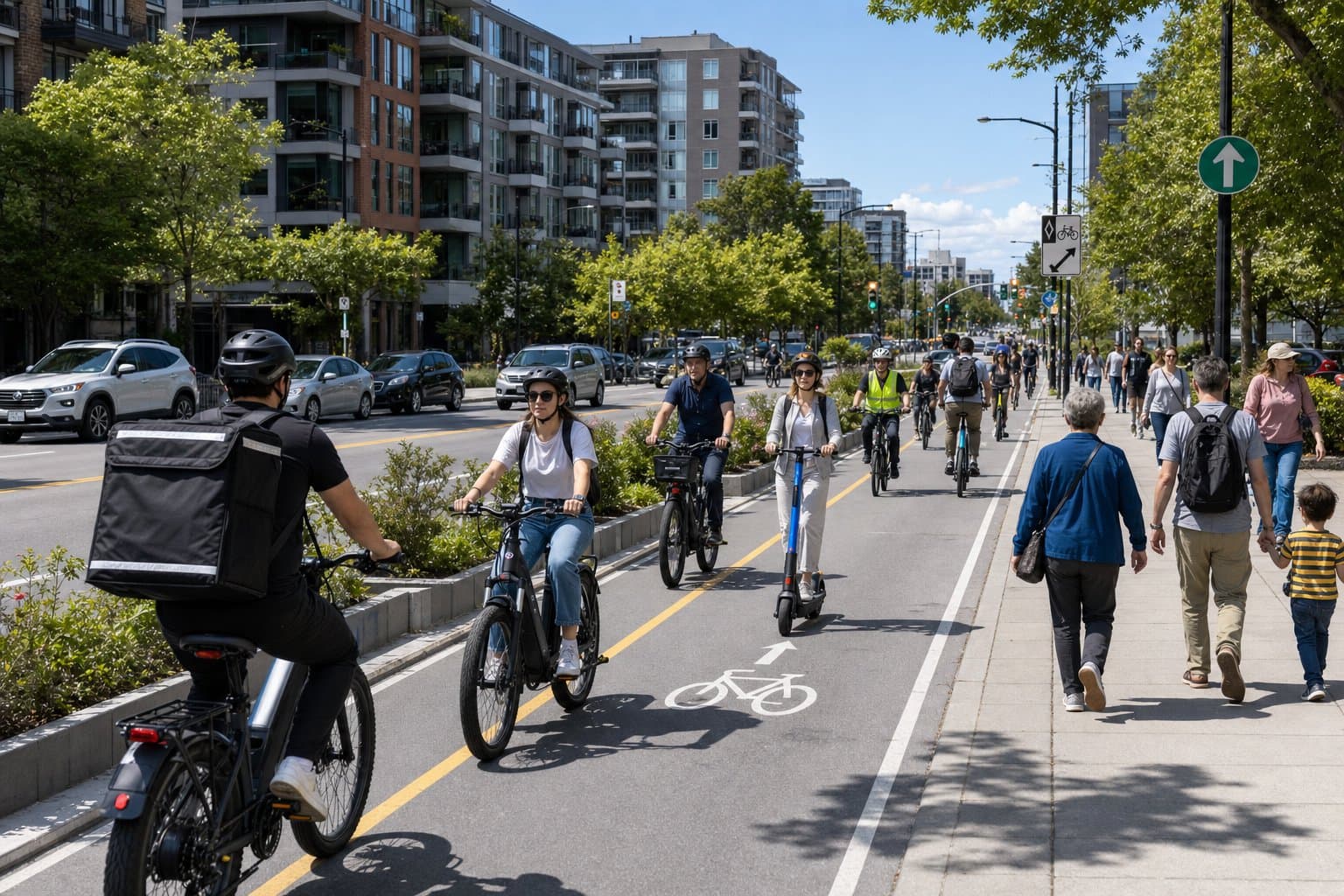
The fundamental architecture of the modern urban and suburban streetscape is undergoing a radical and rapid transformation. For over a century, the paradigm of surface transportation was strictly bifurcated and easily understood: paved roads were engineered for motor vehicles weighing several thousand pounds, while elevated sidewalks were reserved for pedestrians moving at an average speed of three miles per hour. Today, that binary system has been permanently disrupted by the explosion of micromobility. Electric bicycles (e-bikes), shared electric standing scooters, and electrified delivery mopeds have flooded global cities, occupying a gray area of transportation infrastructure that was never designed to accommodate them. These devices operate at speeds ranging from 15 to over 28 miles per hour, utilizing electric motors that are virtually silent, and carrying a mass that fundamentally alters the physics of a collision.
The timely gap in transportation safety discourse lies exactly in this chaotic middle ground. While traditional pedestrian and bicyclist safety has been heavily documented for decades, the unique characteristics of high-speed micromobility—specifically the speed mismatch between devices and pedestrians, the surge in gig-economy delivery riders, sidewalk conflicts, and the escalating tension at the curbside—require immediate and comprehensive analysis. Communities across the nation are grappling with unprecedented challenges that push the limits of existing traffic laws. Everyday drivers are suddenly sharing narrow lanes with 70-pound electric vehicles traveling at neighborhood speed limits. Safety-conscious parents are navigating the grim realities of teenagers riding unregulated, high-powered electric motorcycles in residential subdivisions. Concurrently, neighborhood watch advocates and tech-forward vehicle owners are seeking innovative ways to maintain community safety and accountability in an era where thousands of motorized vehicles operate daily without license plates, registration, or standardized insurance.
This exhaustive report serves to analyze the rise of micromobility conflict. By deconstructing the physics of speed and weight, evaluating real-world legislative responses from California to New York, and exploring the granular data behind urban accident statistics, a clear framework emerges for understanding and mitigating the friction between cars, e-bikes, scooters, and pedestrians. Furthermore, it explores how community-driven safety platforms are stepping in to bridge the accountability gap created by the anonymity of micromobility devices.
Decoding the E-Bike and Scooter Ecosystem
To fully understand the current infrastructural conflict, it is necessary to first categorize the specific vehicles causing it. The term "e-bike" is often erroneously utilized by the public and media as a catch-all phrase for any two-wheeled electrified vehicle. In reality, a strict three-class system governs the legal definition of electric bicycles in most of the United States, dictating where the vehicles can ride, who is legally permitted to ride them, and exactly how fast they can travel with motor assistance. However, the proliferation of out-of-class vehicles—often colloquially called e-motos or electric mopeds—has severely complicated local enforcement and public perception.
The current classification system is predicated on the physical mechanism of the motor's activation and its maximum legally assisted speed.

| Vehicle Class | Motor Activation Method | Maximum Assisted Speed | Ideal Use Case & Environment | Regulatory Nuances |
|---|---|---|---|---|
| Class 1 E-Bike | Pedal-Assist Only (No Throttle) | 20 mph | Recreational trails, bike paths, and urban commuting. | Generally treated identically to traditional bicycles. Allowed on most multi-use paths. No minimum age limit in most states. |
| Class 2 E-Bike | Pedal-Assist & Independent Throttle | 20 mph | Riders requiring physical assistance, cargo hauling, stop-and-go urban traffic. | Allowed in street lanes and most bike paths. The throttle allows propulsion entirely without pedaling, increasing battery drain. |
| Class 3 E-Bike | Pedal-Assist Only (or Throttle limited to 20 mph, Assist to 28 mph) | 28 mph | Long-distance commuting, high-speed road riding, sharing lanes with motor vehicles. | Often strictly restricted from off-road trails and multi-use paths. Minimum age requirement (often 16) and mandatory helmet laws universally apply. |
| Shared E-Scooters | Standing Throttle | 10 to 20 mph (Municipality Dependent) | First-mile/last-mile urban transit, short-distance commuting. | Highly regulated by local municipal caps. Often banned from sidewalks, yet frequently ridden there due to perceived street danger. |
| Out-of-Class (E-Motos/Mopeds) | Throttle and Pedal-Assist | 30+ mph | High-speed transit, commercial food delivery services. | Legally classified as mopeds or motorcycles by state law. Require a valid driver's license, registration, and DOT-approved helmets. Prohibited on sidewalks and bike lanes. |
The nuance within these classifications represents the origin point for primary infrastructural conflict. A Class 3 e-bike traveling at its maximum assisted speed of 28 mph is moving at approximately 41 feet per second. In a dense urban environment or a quiet residential subdivision, this speed vastly outpaces the natural flow of traditional analog pedal cyclists, who typically average between 10 and 14 mph. This discrepancy fundamentally breaks the visual expectations and conditioned reaction times of both motor vehicle drivers and pedestrians, especially at complex intersections that are already high-risk, as explained in modern intersection safety guides.
Furthermore, the introduction of shared standing e-scooters in 2017 introduced an entirely different dimension to this ecosystem. Standing e-scooters possess a distinct physical profile; they are lightweight, feature exceptionally small wheels that are highly susceptible to minor infrastructure defects like potholes or uneven paving stones, and are frequently rented by inexperienced, transient users. The overarching micromobility ecosystem is therefore no longer a monolith. It has evolved into a highly fragmented landscape of varying weights, extreme speed differentials, and wildly inconsistent rider skill levels, all forced into rigid, legacy infrastructure that was never fundamentally designed to accommodate them.
The Physics of the Conflict: Speed Mismatch and Stopping Distances
The friction observed between motor vehicles, micromobility users, and pedestrians is primarily governed by the unforgiving laws of physics. The most critical factor contributing to collisions, near-misses, and community outrage is the severe public underestimation of the stopping distances required for heavy, high-speed electric bicycles compared to traditional analog bicycles.
Kinetic Energy and Weight Disparity
A traditional analog bicycle generally weighs between 20 and 30 pounds. An e-bike, laden with a dense lithium-ion battery pack, a reinforced heavy-duty frame, and a copper-wound electric motor, typically weighs between 50 and 80 pounds. When a rider is added to the vehicle, the total mass moving through a residential street or a designated bike lane is highly significant. Kinetic energy increases linearly with mass but increases exponentially with speed. Therefore, a 70-pound Class 3 e-bike traveling at 28 mph carries exponentially more destructive kinetic energy than a 30-pound analog bicycle traveling at 12 mph.
When a collision occurs between an e-bike and an unprotected pedestrian, the resulting bodily trauma is severe. Medical data recorded from major trauma centers indicates that high-speed e-bike injuries more closely resemble motorcycle accidents than traditional bicycle scrapes. These collisions result in elevated rates of skull fractures, concussions with loss of consciousness, and severe blunt force trauma for both the rider and the pedestrian struck. The disparity is equally stark when comparing e-bikes to standard motor vehicles. While a modern car or light truck utilizes massive hydraulic braking systems capable of arresting thousands of pounds of momentum, micromobility devices rely on much smaller mechanical or hydraulic disc brakes that can quickly become overwhelmed by the combination of high speed and heavy battery weight. Furthermore, bicycle repair professionals frequently note that the accelerated wear on e-bike brake pads—sometimes requiring replacement every 4,000 miles—indicates the immense friction and heat generated when attempting to stop these vehicles.
The Harsh Reality of Stopping Distances
Braking a two-wheeled vehicle is not an instantaneous event. The total stopping distance for an e-bike or scooter is a combination of two distinct factors: the reaction distance and the physical braking distance. Reaction distance is the space traveled while the rider cognitively perceives a threat, makes a decision, and physically engages the brake levers. Braking distance is the physical distance required for the vehicle to halt once the brake pads contact the rotors, heavily influenced by tire grip, road surface, and rider skill.
Research from cycling safety advocates and controlled trials indicates that an average rider requires approximately 2.5 seconds to recognize an emergency hazard and apply the brakes. The implications of this physiological delay at high micromobility speeds are staggering:
| Traveling Speed | Velocity in Feet per Second | Reaction Distance Traveled (2.5 seconds) | Estimated Total Emergency Stopping Distance (Dry Pavement) |
|---|---|---|---|
| 10 mph | 14.7 ft/sec | 37 feet | ~45 - 50 feet |
| 20 mph (Class 1 & 2) | 29.3 ft/sec | 73 feet | ~98 - 108 feet (Approx. 25-35 feet of physical braking) |
| 25 mph | 36.7 ft/sec | 92 feet | ~130 - 150 feet |
| 28 mph (Class 3) | 41.0 ft/sec | 102 feet | ~150 - 200 feet |
At 28 mph, an e-bike rider will travel over 100 feet—which equates to one-third the entire length of an American football field—before their fingers even manage to squeeze the brake levers. Once the brakes are firmly applied, depending heavily on the rider's braking skill (such as utilizing the recommended 70% front brake and 30% rear brake distribution for maximum stopping power), the type of brakes equipped, and the road surface, it can take up to an additional 100 feet to come to a complete physical stop. If a rider panics and only uses the rear brake, or locks the wheels causing a skid, the stopping distance is increased by 26 to 35 percent, drastically elevating the risk of a fatal crash.
This undeniable physical reality dictates the core danger of the speed mismatch on shared roads. When a pedestrian steps off a curb to cross a street, or a driver pulls out of a blind driveway, their brain visually calculates the approach of a bicycle based on decades of historical conditioning. They inherently assume the bicycle is moving at roughly 12 mph and possesses the ability to stop within 15 feet. When that approaching vehicle is actually a Class 3 e-bike moving at 28 mph that requires nearly 200 feet to stop, a collision becomes mathematically unavoidable. Simply doubling the speed of an e-bike effectively quadruples the physical distance required to bring it to a safe halt. For drivers, understanding these limits and improving night-time visibility at crossings—as covered in depth in night safety and intersection design guides—is essential.
The Sidewalk Dilemma: A Profound Regulatory Paradox
In response to rising citizen complaints and localized safety concerns, municipal governments across the country have eagerly attempted to regulate micromobility speeds. However, extensive observational research conducted by the Insurance Institute for Highway Safety (IIHS) has uncovered a profound and troubling regulatory paradox: policies specifically designed to protect riders and control speeds often inadvertently endanger the most vulnerable road users—pedestrians.
The Unintended Consequences of Speed Limiters
Many cities have aggressively turned to mandatory speed limiters for shared commercial e-scooters to address public outcry. To deeply understand the real-world effect of these different maximum speed policies, IIHS researchers conducted a comprehensive comparative study observing the behavior of 2,004 e-scooter riders in two distinct environments: Austin, Texas, which caps shared e-scooter speeds at a generous 20 mph, and Washington, D.C., which strictly enforces a maximum cap of 10 mph—one of the lowest limits in the United States.
The findings revealed a direct, causal, and somewhat counterintuitive relationship between maximum legal speed and the prevalence of sidewalk riding. In urban environments where dedicated, protected bike lanes were unavailable, e-scooter riders in Washington, D.C. were 44 percent more likely to ride on the pedestrian sidewalk compared to riders in Austin. Even in the central business district of Washington, D.C., where riding on the sidewalk is strictly and explicitly prohibited by law, two-thirds of observed e-scooter users brazenly chose to ride on the sidewalks rather than the street.
The underlying behavioral economics and self-preservation instincts driving this decision are highly logical from the rider's perspective. At 20 mph, an e-scooter rider feels a moderate level of comfort blending with urban vehicular traffic, as the speed differential between the scooter and a car traveling 30 mph is manageable. However, at a forcibly capped speed of 10 mph, the speed mismatch between the scooter and motor vehicles creates an intolerable perception of immediate danger for the exposed rider. To escape the terrifying kinetic threat of multi-ton cars rapidly approaching from behind, riders instinctively retreat to the elevated safety of the sidewalk. In doing so, they directly transfer the kinetic threat from themselves onto unprotected pedestrians.
Injury Demographics and Infrastructure Hazards
The IIHS studies further highlight the complex nuances of micromobility injuries, painting a picture that challenges conventional wisdom. While sidewalk riding is highly controversial and widely condemned by pedestrian advocates, the statistical data suggests it is incredibly effective at preventing fatal motor vehicle collisions. Traditional bicyclists, who primarily ride in the street, are three times more likely to be hit by a motor vehicle than e-scooter riders, who largely stick to sidewalks. In fact, moving motor vehicles accounted for only 13 percent of emergency room injuries to e-scooter riders, compared to a staggering 40 percent for traditional bicyclists.
Nearly three out of five e-scooter injuries occur directly on the sidewalk. However, the vast majority of these injuries are self-inflicted—caused by the rider striking potholes, uneven pavement cracks, or other physical infrastructure like curbs or signposts. Because of their tiny wheel diameter and upright riding position, e-scooter riders are twice as likely as bicyclists to be injured by poor road conditions. Compounding this danger is a severe lack of protective gear; hospital data reveals that only 2 percent of injured e-scooter riders reported wearing a helmet, compared to 66 percent of injured bicyclists. Furthermore, almost 40 percent of the injured e-scooter riders were hurt during their very first ride, highlighting the danger of inexperienced users accessing high-speed devices on demand.
The Vulnerability of Pedestrians
While riders may escape cars by utilizing the sidewalk, the proliferation of heavy e-bikes and scooters in pedestrian zones drastically increases the vulnerability of those on foot. Pedestrians globally view e-scooter operations as highly annoying, with half of surveyed riders admitting to experiencing a near-miss, often involving another road user. According to extensive data from the AAA Foundation for Traffic Safety, the relationship between a vehicle's impact speed and a pedestrian's risk of severe injury or death is steep, linear, and unforgiving.
The average risk of severe injury for a pedestrian struck by a moving vehicle reaches 10 percent at an impact speed of just 16 mph. At 23 mph, the risk of severe injury climbs to 25 percent, and the risk of outright death reaches 10 percent. At 31 mph, a pedestrian faces a 50 percent chance of severe injury, and at 42 mph, a 50 percent chance of fatality. European road safety data reinforces these grim statistics, showing that the probability of fatal injury for a pedestrian jumps from 5 percent at 32 km/h (roughly 20 mph) to 45 percent at 48 km/h (roughly 30 mph).
While passenger cars and high-front-end pickup trucks undoubtedly cause the vast majority of fatal pedestrian strikes on the roadways, the mass and speed of an e-bike traveling at 20 mph on a crowded sidewalk presents a severe, unmitigated threat to vulnerable populations, particularly children, the elderly, and the disabled. Single micromobility crashes—defined as incidents not involving motor vehicles but rather pedestrians, infrastructure, or other micromobility devices—are steadily rising. In some European datasets studying urban areas, these crashes have risen from 16.9 percent of all incidents in 2016 to over 26.5 percent in 2020, with approximately 10 percent of these single micromobility crashes resulting in severe injuries or fatalities.
Curbside Conflict: The Gig Economy and Delivery E-Bikes
The micromobility conflict cannot be fully understood without closely examining the underlying socioeconomic forces currently driving it. The exponential explosion of on-demand food and goods delivery—facilitated by ubiquitous applications like DoorDash, UberEats, and Grubhub—has created a massive, highly visible workforce of commercial e-bike riders. This paradigm shift has transformed the physical curbside into a highly contested operational zone.
The Algorithm Versus the Infrastructure
Delivery workers are generally compensated per successful delivery, not per hour worked. Consequently, the algorithmic design of these modern delivery applications actively and relentlessly incentivizes high speed, extreme route efficiency, and constant forward motion. For a gig-economy worker, time spent waiting at a red light, yielding to pedestrians at a crosswalk, or detouring multiple blocks to find a legally protected bike lane represents a direct and tangible loss of personal income. This harsh economic reality inherently drives the exact street behaviors that deeply frustrate drivers and terrify pedestrians: riding against the flow of vehicular traffic, weaving unpredictably between cars, ignoring traffic signals, and utilizing sidewalks as high-speed, obstacle-free expressways.
Cities are currently scrambling to address this highly specific facet of the transportation conflict. In densely populated Hoboken, New Jersey, the surge of commercial e-bikes zipping up and down pedestrian sidewalks prompted the Mayor to establish a specialized Vision Zero task force aimed at crafting equitable, legal, and manageable solutions specifically for e-bike deliveries. Highlighting the severity of the issue, Hoboken City Councilman Paul Presinzano took a part-time job as an undercover UberEats delivery rider to personally understand the myriad challenges these workers face on the streets. Proposals from the council included requiring delivery riders to pass basic safety tests to prove they understand the rules of the road and mandating the use of high-visibility safety vests.
However, local pedestrian safety advocates logically point out that the root cause is fundamentally a lack of dedicated commercial infrastructure. When designated curbside loading zones are constantly occupied by illegally double-parked delivery cars and rideshare vehicles, commercial cyclists are physically forced out of the street and onto the sidewalks simply to complete their delivery routes. This infrastructural failure forces a highly dangerous mixing of commercial activity with pedestrian leisure. This frustration is palpable in major urban centers; community forums in Philadelphia are rife with complaints from residents regarding delivery drivers speeding down narrow residential sidewalks without warning, leading to terrifying near-misses with pedestrians and pets.

The Battery Safety Crisis and Municipal Interventions
The commercial reliance on e-bikes has also triggered severe secondary safety crises, most notably the devastating epidemic of lithium-ion battery fires. To maximize their delivery range and minimize upfront vehicle costs, many delivery workers have historically utilized uncertified, cheaply manufactured e-bikes and highly volatile aftermarket batteries.
In a robust response to this specific danger, New York City has aggressively targeted the commercial micromobility sector. The NYC Department of Transportation (DOT) launched an innovative E-Bike Trade-In Program, allowing eligible, verifiable food delivery workers to trade in uncertified, unregistered mobility devices—such as the ubiquitous Arrow Model 9 and Model 10 e-bikes—in exchange for brand-new, safely certified e-bikes and batteries at absolutely no cost. By physically ensuring that the devices operating on the street legally meet UL 2849 standards (for e-bikes) and UL 2271 standards (for batteries), the city aims to eliminate the catastrophic structural fires that have tragically plagued residential apartment buildings.
Furthermore, to combat the daily curbside chaos, New York City Mayor Eric Adams established the pioneering Department of Sustainable Delivery (DSD). Supported by significant funding in the city budget to hire up to 45 new unarmed peace officers, this department is exclusively tasked with enforcing commercial cycling laws, addressing illegal parking behaviors that endanger cyclists, and ensuring businesses face strict repercussions for unsafe street behavior. Crucially, the legislation targets the root of the problem by proposing to hold major delivery app companies directly accountable, granting the city the authority to revoke delivery apps' operating licenses if they are found to be actively incentivizing reckless e-bike riding through the enforcement of unreasonably fast delivery times. Positive models for gig-worker integration also exist; San Francisco successfully piloted a program that provided gig delivery workers with free e-bikes and extensive safety training through the SF Bicycle Coalition, shifting deliveries away from massive motor vehicles while supporting worker earnings safely.
Legislative Frontlines: The California Youth Crisis
The regulatory response to the micromobility crisis is highly localized, resulting in a fragmented patchwork of laws that vary drastically from state to state, and even city to city. While New York battles commercial delivery issues, the frontlines in California focus on a very different demographic.
Orange County: A Pediatric Trauma Explosion
In the affluent suburban neighborhoods and coastal municipalities of Southern California, e-bikes have rapidly replaced the traditional bicycle as the primary mode of transportation for teenagers and adolescents. The easy accessibility of high-powered, throttle-operated electric motorbikes to completely unlicensed minors has led to a catastrophic, documented spike in pediatric trauma. For families thinking about what their kids should drive, these trends should sit alongside broader guidance on keeping teens safe in their first vehicles.
At the Children’s Hospital of Orange County (CHOC), the emergency room recorded a solitary e-bike-related trauma patient in the entire year of 2021. By 2022, that number increased to 38. In 2023, it rose to 61. In 2024, the hospital saw 125 cases, and in 2025, an astonishing 201 trauma patients were admitted with severe e-bike injuries. Medical professionals loudly note the core issue: children are operating incredibly heavy vehicles that perform exactly like combustion motorcycles, yet they lack the physical maturity, the mandated safety training, the legal licensure, and the basic understanding of traffic laws required to survive mixing with motor vehicles on the road.
The legal response to this crisis has been unprecedented and severe. The Orange County District Attorney's Office officially launched the "RIDE SAFELY" unit, a highly specialized prosecution team staffed by experts from Juvenile Justice and Family Protection divisions, dedicated entirely to investigating and prosecuting e-bike and e-motorcycle offenses. Moving far beyond issuing simple traffic citations to minors, prosecutors have taken the aggressive step of holding parents criminally liable for the vehicles they purchase for their children. In one tragic landmark case in Lake Forest, California, a mother was formally charged with involuntary manslaughter and felony child endangerment after her 14-year-old son, riding an illegal, high-powered e-motorcycle, fatally struck an 81-year-old pedestrian. In another severe case in Yorba Linda, a father faced up to six years in state prison after his 12-year-old son ran a red light on an illegally modified e-motorcycle capable of reaching 60 mph, resulting in critical injuries to the child.
Local coastal municipalities have also enacted exceptionally strict localized bans to protect pedestrian leisure spaces. Huntington Beach implemented a strict 10 mph speed limit on its heavily trafficked Beach Bicycle and Pedestrian Path, which aggressively drops to 5 mph when pedestrians are actively present. San Clemente instituted total, year-round bans on all classes of e-bikes on its popular 2.3-mile Beach Trail to protect walkers. Newport Beach banned all bikes and scooters entirely from the beach sand and enacted an 8 mph speed limit on its boardwalks, supplemented by intelligent youth diversion programs that waive fines if the offending child and their parent complete a Saturday safety course taught by the police department. At the state level, the California Attorney General issued a formal consumer alert unequivocally clarifying that any two-wheeled vehicle exceeding 28 mph with pedal assist, or 20 mph on throttle alone, is legally classified as a moped or motorcycle and absolutely cannot be legally operated by minors without a proper driver's license—a move that successfully prompted major retailers like Amazon to halt the sale of illegal, high-speed e-bikes within the state.
The New York City Commercial Mandate
Conversely, the legislative conflict in New York City is driven not by teenagers, but by extreme urban density, commercial delivery demands, and the sharing of extremely limited, highly contested street space. In a major and highly publicized policy shift, the Adams administration implemented a strict citywide speed limit of 15 miles per hour applicable to all e-bikes, e-scooters, and pedal-assist commercial bicycles.
This 15 mph blanket cap directly aligns with international road safety best practices—closely mirroring the European Union's widely adopted 25 kilometers-per-hour limit for e-bikes operating in dedicated bike lanes. The policy fundamentally aims to mitigate the massive speed mismatch currently occurring inside protected bike lanes, reducing the kinetic severity of collisions between heavy commercial e-bikes and traditional, slower-moving pedal cyclists or vulnerable pedestrians crossing the street. The enforcement strategy for this new limit relies heavily on a structured "prioritize education before enforcement" approach. The city is actively utilizing deployed digital speed signs along major cycling corridors to deter speeding, updating physical street signage, and pushing safety messaging via translated notifications to reach the diverse, multi-lingual app delivery workforce. The ultimate goal is behavior modification, ensuring that moving vehicles traveling at higher speeds remain in standard vehicular traffic lanes, leaving sidewalks and bike lanes safe for slower transit.
Technology and Community Accountability: The Systemic Solution
The defining, systemic difficulty of regulating the entire micromobility ecosystem is the profound lack of universal identification. Unlike standard motor vehicles, e-bikes and stand-up scooters do not possess license plates or visible registration tags. When an e-bike rider runs a red light, severely strikes a pedestrian in a crosswalk, or scrapes the side of a parked vehicle, automated traffic cameras are rendered entirely useless, and law enforcement has absolutely no traditional mechanism to track or identify the offender. This pervasive anonymity breeds a dangerous culture of impunity on the streets, frustrating drivers and endangering communities.
While massive municipalities struggle with drafting legislation and deploying unarmed peace officers, agile technological solutions driven by modern community safety platforms are rapidly emerging to fill this critical accountability void. Platforms that focus heavily on driver-to-driver communication and active community mobilization—such as Carszy—represent a vital, necessary shift in exactly how modern neighborhoods protect themselves. By utilizing standard vehicle license plates as secure, unique identifiers, these advanced platforms allow everyday drivers to seamlessly connect, communicate, and flag dangerous behavior observed on the road.
The application of such technology is highly relevant and urgently necessary to combat the micromobility conflict. When high-speed, unregistered e-motos or reckless mopeds cause severe accidents and flee the scene, community-driven alert systems, like the VOIS™ (Vehicle of Interest Search) network, empower neighborhood watch advocates, protective parents, and local drivers to mobilize in real-time. By securely crowdsourcing the location of vehicles involved in critical hit-and-runs or aggressive driving incidents, interconnected communities can drastically reduce law enforcement response times and establish a localized, highly visible culture of accountability. These same tools are invaluable after more traditional collisions too, complementing checklists like the fender bender survival guides many drivers now rely on.
Furthermore, the integration of Human Media™—a philosophical shift focusing social networks away from passive digital consumption toward real-world, localized safety impact—provides safety-conscious parents and daily commuters with highly actionable, real-time data regarding dangerous intersections, frequent traffic law violators, and hazardous road conditions. Utilizing privacy-focused, U.S.-based servers ensures that this vital community vigilance remains entirely secure, successfully deterring aggressive driving and reckless micromobility usage without ever resorting to invasive surveillance state tactics. With seamless Android and iOS app integration, these platforms provide an immediate mechanism for drivers to warn each other of localized threats, creating an invisible, protective web over local neighborhoods.
Designing the Future Urban Streetscape
Legislation, specialized prosecution units, and advanced community accountability networks are ultimately reactionary measures. The ultimate, long-term proactive solution to the micromobility conflict lies in physical infrastructure. The legacy physical design of American streets must evolve to safely accommodate an entirely new class of vehicles that clearly belong neither on the elevated pedestrian sidewalk nor in the high-speed automotive fast lane.
Leading transportation authorities and progressive urban design firms strongly advocate for the immediate implementation of high-quality infrastructure that logically segregates traffic by speed and mass, rather than merely by vehicle type.
- Implementation of Wider Protected Bike Lanes: Traditional five-foot painted bike lanes are demonstrably and dangerously inadequate for modern, multimodal traffic. They simply do not physically allow faster, 28 mph e-bikes to safely pass slower, 12 mph analog bicycles without swerving into motor vehicle traffic. Expanding these bike lanes to 10 or 12 feet in width—a standard already successfully seen internationally on major corridors like Dronnig Louises Bro in Copenhagen and increasingly implemented on avenues like 10th Avenue in Manhattan—provides the necessary spatial width to prevent localized collisions and drastically reduce the rider frustration that ultimately drives e-bikes onto pedestrian sidewalks.
- Development of Smart Mobility Lanes (SMLs): Modeled closely after highly successful bicycle streets in the Netherlands and Germany, Smart Mobility Lanes are specialized neighborhood corridors designed primarily for slow-speed, mixed micromobility. By utilizing physical traffic calming measures to aggressively restrict motor vehicle volume and speed, these lanes safely integrate traditional bicycles, cargo e-bikes, and e-scooters, completely removing the temptation for them to utilize pedestrian sidewalks.
- Creation of Dedicated Curbside Loading Zones: To permanently resolve the intense commercial delivery conflict, cities must urgently convert adjacent, street-side vehicle parking into dedicated, heavily enforced loading zones for commercial delivery vehicles. This crucial change prevents the dangerous double-parking of cars, keeps protected bike lanes clear for micromobility transit, and allows commercial e-bikes to seamlessly access restaurants and dense residential buildings without ever encroaching on safe pedestrian space. These kinds of “street-level fixes” echo the low-cost intersection and curb changes outlined in broader traffic violence reduction playbooks.
Conclusion
The rapid, unprecedented proliferation of e-bikes, scooters, and electrified mopeds represents the most significant shift in urban and suburban transportation since the mass adoption of the automobile over a century ago. However, this sudden transition has generated severe friction across the country, manifesting in skyrocketing pediatric trauma center admissions, chaotic curbside environments, and deeply confusing legislative paradoxes. The fundamental conflict is deeply rooted in an unavoidable kinetic mismatch: heavy vehicles possessing the weight and speed capabilities of motorcycles operating relentlessly within legacy infrastructure designed solely for walking and leisurely pedaling.
Addressing this multi-faceted crisis requires a highly coordinated approach. It demands the rigorous, unyielding enforcement of clear vehicle classifications, holding both the parents of offending minors and massive commercial delivery corporations legally and financially accountable for the vehicles they authorize on the road. It requires municipal urban planners to aggressively redesign the physical streetscape, substantially widening bike lanes to safely accommodate varying speeds and keeping heavy electric vehicles strictly off pedestrian sidewalks. Finally, it relies heavily on the profound power of community vigilance and modern technology. By adopting advanced safety networks and driver-to-driver communication platforms, neighborhoods can successfully strip away the dangerous anonymity that fuels reckless driving and riding. The streets are a shared ecosystem, and surviving this complex new era of transportation requires every motor vehicle driver, micromobility rider, and pedestrian to relentlessly prioritize situational awareness, respect the laws of physics, and foster a culture of mutual, technological accountability. Readers are strongly encouraged to download the app to stay connected, utilizing cutting-edge tools like License Plate Messaging to actively report hazards and maintain the security of their local communities. For families thinking long-term, pairing these tools with smarter choices around vehicles—like using a safety-first approach to leasing, buying, or financing cars in 2026—can build an even stronger safety net.
Frequently Asked Questions (FAQ)
What is the exact legal difference between a Class 1, Class 2, and Class 3 e-bike? Class 1 e-bikes provide electrical motor assistance only when the rider is actively pedaling, with a top assisted speed strictly capped at 20 mph. Class 2 e-bikes feature an independent throttle that can propel the heavy bike without any pedaling required, also capped at 20 mph. Class 3 e-bikes provide pedal-assist up to a much higher 28 mph and are frequently restricted from multi-use trails due to their dangerous high-speed capabilities. Any two-wheeled electric vehicle exceeding 28 mph, or operating via throttle over 20 mph, is legally classified by most states as a moped or motorcycle and absolutely requires a valid driver's license and registration. Parents looking at these options for teens should weigh them against guidance in dedicated teen driver safety resources so kids aren’t effectively handed a motorcycle without training.
Why do local cities and municipalities desperately want to ban e-scooters and e-bikes from sidewalks? A modern e-bike or commercial scooter can easily weigh between 50 and 80 pounds due to heavy battery packs. When traveling at common speeds of 15 to 20 mph, they require significantly longer stopping distances than traditional lightweight bicycles. If a heavy, fast-moving e-bike physically strikes a pedestrian, the kinetic energy transferred can cause severe blunt force trauma, devastating skull fractures, and even death. Sidewalks are fundamentally engineered for pedestrians moving at 3 mph, making high-speed micromobility inherently, mathematically dangerous in those confined spaces.
If standing e-scooters are legally banned from sidewalks, why do so many people still ride them there? Extensive research indicates a strong behavioral regulatory paradox regarding speed limits. When municipalities strictly limit e-scooter speeds to 10 mph in an attempt to protect pedestrians, riders feel incredibly unsafe sharing the road with multi-ton motor vehicles traveling 30 to 40 mph. Without the presence of physically protected bike lanes, riders naturally flee the severe kinetic danger of the street by riding on the elevated sidewalk, inadvertently transferring the exact same kinetic risk directly to vulnerable pedestrians.
Exactly how long does it take an e-bike to come to a complete stop in an emergency? Total stopping distance is a physical combination of human reaction time and mechanical braking power. At 28 mph, a rider will travel approximately 100 feet in the 2.5 seconds it takes the human brain to perceive a threat and physically pull the brake levers. Once the brakes are finally applied, it can take an additional 50 to 100 feet to come to a complete physical stop, depending on tire grip and brake quality. Therefore, a heavy e-bike traveling at 28 mph may require up to 200 feet (which is more than half the length of a football field) to safely halt. Wet roads, worn tires, and poor visibility—conditions that also lead to hydroplaning and other loss-of-control crashes—only make those distances worse.
How can local communities successfully combat reckless e-bike and scooter riding when the devices don't have standard license plates? The profound lack of license plates on micromobility devices makes automated enforcement (like municipal speed cameras) entirely ineffective. Communities are actively turning to robust local legislation—such as the targeted prosecution of parents who allow minors to ride illegal e-motos—and aggressively leveraging modern technology. Utilizing advanced driver-to-driver communication and dedicated community safety platforms enables residents to securely report hit-and-runs, mobilize local neighborhood watches, and maintain vital real-time awareness of dangerous intersections and reckless vehicle behavior, restoring accountability to the streets. Pairing these tools with smarter everyday habits—like maintaining a well-stocked glovebox and emergency kit, as outlined in modern glovebox and legal checklists—helps drivers respond calmly and effectively when incidents do happen.