The Big Vehicle Blind Zone Problem: What Drivers of SUVs and Trucks Need to Know
The Unseen Crisis on Modern Intersections and Driveways
The modern automotive landscape presents a striking and deadly paradox. For the occupants seated inside the climate-controlled, technologically advanced cabin of a contemporary sport utility vehicle (SUV) or light pickup truck, driving has arguably never been safer. Advanced airbag systems, reinforced roof structures, sophisticated crumple zones, and high-strength steel cages create a virtual fortress of protection against collisions. However, for those existing outside that metal and glass enclosure—pedestrians, bicyclists, small children playing in driveways, and neighborhood pets—the roads and parking lots have grown increasingly, almost inexplicably, perilous. Central to this escalating, national danger is a physical byproduct of modern vehicle architecture: the massive, expanding blind zone.
Data collected by federal agencies and safety organizations illustrates a grim, undeniable, and steep trajectory. Pedestrian deaths on American roadways have soared by an alarming 78 percent since reaching a historic low in 2009, currently accounting for more than 7,300 crash fatalities annually. Over that exact same timeframe, the physical composition of the average neighborhood driveway, school drop-off zone, and public parking lot has fundamentally transformed. In 2009, pickup trucks, SUVs, and vans accounted for roughly 47 percent of all new vehicle sales in the United States; today, these light trucks represent more than three-quarters of the entire new vehicle market. Compact SUVs alone now constitute the largest single segment of the U.S. automotive market.
This sweeping shift in consumer preference toward taller, heavier, and blockier vehicles has drastically altered the national crash picture. Motorists piloting these massive vehicles are operating heavy machinery equipped with front and side blind zones that are radically larger than those of previous generations. These vast areas of obscured vision routinely hide vulnerable road users from a driver’s line of sight, leading to devastating, low-speed collisions during what should be routine maneuvers—like turning left at a suburban intersection, navigating a crosswalk, or simply pulling out of a residential driveway to start the morning commute.
For everyday drivers, safety-conscious parents, community watch advocates, and tech-forward vehicle owners, understanding the mechanics, statistics, and physical realities of these blind zones is no longer optional. It is a critical necessity for neighborhood security. The question is not just how vehicles have changed, but how drivers and communities can adapt to protect the most vulnerable among us.
The Evolution of Vehicle Architecture and the Growth of Blind Zones
To fully grasp the magnitude of the modern blind zone problem, one must first examine exactly how vehicle design has evolved over the past two and a half decades. The aesthetic and structural shifts in automotive manufacturing have not occurred in a vacuum; they are the result of a complex interplay between consumer demand for larger vehicles, increasingly stringent federal regulations for occupant safety, and aggressive automotive marketing campaigns that equate size with security. If you’re weighing what to drive next, that same mix of safety, size, and tech is central to any smart vehicle acquisition decision in 2026.
A 25-Year Trajectory of Declining Outward Visibility
A groundbreaking, collaborative study conducted by researchers from the United States Department of Transportation’s Volpe Center and the Insurance Institute for Highway Safety (IIHS) provides a highly detailed, quantitative look at exactly how much visibility drivers have lost over the years. To measure this invisible threat, researchers had to invent a completely new way of mapping what a driver can and cannot see. They developed an innovative "markerless perspective transformation method," replacing antiquated testing approaches that relied on an elaborate, error-prone system of manual grid lines or traffic cones positioned around a vehicle.
By placing a specialized 360-degree camera exactly where an average driver’s head rests inside the cabin, proprietary software can now calculate the precise occluded and visible areas at ground level within a forward 180-degree arc around the driver. The study focused heavily on the 10-meter (approximately 33 feet) radius directly in front of the vehicle. This specific distance was not chosen at random; it represents a common stopping distance at 10 miles per hour—the exact low-speed, high-density environment where blind zone crashes most frequently occur, such as school zones, residential streets, and parking garages.
Researchers systematically mapped the blind zones of 17 individual vehicles, representing every major redesign cycle from 1997 to 2023 for six of the most popular vehicles on the American market: the Chevrolet Suburban, Ford F-150, Honda Accord, Honda CR-V, Jeep Grand Cherokee, and Toyota Camry. This 25-year longitudinal analysis perfectly overlays a period where pedestrian and bicyclist fatalities on U.S. roads soared by 37 percent and 42 percent, respectively.
The findings paint a deeply concerning picture of declining situational awareness for the operators of popular SUVs and trucks. Over multiple redesign cycles, forward visibility within a critical 10-meter radius fell by as much as 58 percent for the SUVs evaluated.

| Vehicle Model | Model Year | Forward Visibility (10-meter radius) | Model Year | Forward Visibility (10-meter radius) | Total Visibility Decline |
|---|---|---|---|---|---|
| Honda CR-V | 1997 | 68% | 2022 | 28% | -40% |
| Chevrolet Suburban | 2000 | 56% | 2023 | 28% | -28% |
| Ford F-150 | 1997 | 43% | 2015 | 36% | -7% |
| Toyota Camry | 2007 | 61% | 2023 | 57% | -4% (Within margin of error) |
| Honda Accord | 2003 | 65% | 2023 | 60% | -5% (Within margin of error) |
Data sourced from Volpe Center and IIHS longitudinal analysis mapping the forward 180-degree arc. Note: The Jeep Grand Cherokee was included in the cohort of three SUVs that collectively saw visibility declines of up to 58 percent over the studied period.
When analyzing the data, the starkest contrasts emerge within the SUV category. Drivers of a first-generation 1997 Honda CR-V enjoyed a relatively clear view of 68 percent of the ground-level area directly in front of their vehicle. By 2022, as the CR-V grew in size, height, and bulk, that visibility had plummeted to just 28 percent. This means that nearly three-quarters of the immediate forward environment is completely invisible to the modern CR-V driver. Similarly, the Chevrolet Suburban—long a staple of the American family—saw its forward visibility cut exactly in half, dropping from 56 percent in the year 2000 to an alarming 28 percent by 2023.
The Ford F-150 presents a uniquely hazardous profile. While its close-proximity visibility declined by a seemingly modest 17 percent overall during its redesign cycles (ending at just 36 percent unobstructed visibility in 2015), this is largely because the earliest models already possessed massive, inherent blind zones. A 1997 F-150 already blocked 57 percent of the forward view; decades of redesigns only made a bad situation worse. In stark contrast, lower-riding passenger cars like the Honda Accord and Toyota Camry maintained relatively stable and superior outward visibility over the exact same quarter-century, experiencing only minor decreases that fell within the study's margin of error.
The inescapable conclusion of the IIHS and Volpe Center research is that as the proportion of SUVs in the U.S. fleet grew substantially over the last two decades, the sheer ability of drivers to see what is directly in front of them has systematically degraded. That helps explain why, even as advanced safety tech spreads, overall traffic violence and intersection harm remain stubbornly high.
The Architecture of Obstruction: A-Pillars, Tall Hoods, and Bulky Mirrors
What specific structural and engineering changes have stolen this vital visibility from the driver's seat? The loss of the driver's visual field is driven by a convergence of three distinct design trends: taller, blunt-nosed front hoods, increasingly thick A-pillars, and bulky side-view mirrors.
The A-Pillar Dilemma
The thickening of the A-pillar—the vertical structural supports that frame the left and right sides of the windshield and connect the roof to the body of the car—is a direct, albeit unintended, consequence of improved occupant safety regulations. In the early 2000s, federal safety standards for vehicle roof crush strength were significantly increased to better protect drivers and passengers from fatal head and neck injuries during severe rollover crashes.
To comply with these vital mandates, automotive engineers were forced to widen the A-pillars to support the increasingly heavy frames of SUVs and trucks. As a Subaru spokesperson noted, safety standards required vehicles to improve the strength of these pillars, meaning that the smaller the glass you make, the stronger the roof becomes, but it comes at a severe sacrifice to outward visibility. While this design mandate successfully achieved its goal of preventing roofs from collapsing during a rollover, it simultaneously created wide, opaque columns of blind space at the critical front left and right corners of the vehicle. For a commuter trying to navigate a busy intersection, these thick pillars act like vertical blinders, completely erasing entire segments of the roadway.
The Rise of the Blunt-Nosed Hood
Compounding the thick A-pillars is the modern aesthetic and marketing preference for high, blunt-nosed hoods. Over the last decade, automakers realized that consumers psychologically associate tall, aggressive, wall-like front fascias with ruggedness, dominance, and personal safety. Consequently, hood heights expanded rapidly upward and outward.
This creates a geometric wedge of invisible space directly in front of the front bumper. Instead of a hood that slopes downward toward the road, allowing the driver's line of sight to trace the pavement close to the vehicle, a tall, flat hood pushes the nearest visible point on the ground dozens of feet away. "There’s no functional benefit to these massive, blocky fronts," stated Wen Hu, IIHS Senior Research Transportation Engineer, noting that manufacturers could make vehicles much less dangerous simply by lowering the front end and angling the grille to create a sloped profile. For families choosing their first car for a new driver, understanding these design tradeoffs is as critical as any other teen driver safety strategy.
Bulky Mirrors and High Seating
Finally, the massive side-view mirrors required to see around these elongated, widened truck and SUV bodies add yet another layer of visual obstruction at the driver's peripheral corners. When you combine a high seating position (which makes it harder to see smaller objects near the ground), a towering hood, thick structural pillars, and massive side mirrors, the resulting architecture severely narrows the operator's real-time environmental awareness.
The Deadly Mathematics of the Left Turn
While a vehicle's blind zone poses substantial risks in all driving scenarios, it reaches its maximum lethal potential during left-hand turns at signalized intersections. By analyzing nearly 4,500 police-reported pedestrian crashes across seven distinct states, IIHS researchers uncovered a highly specific and deadly correlation: large driver-side blind zones were associated with a staggering 70 percent increase in the risk of left-turn crashes with pedestrians when compared to vehicles with small blind zones.
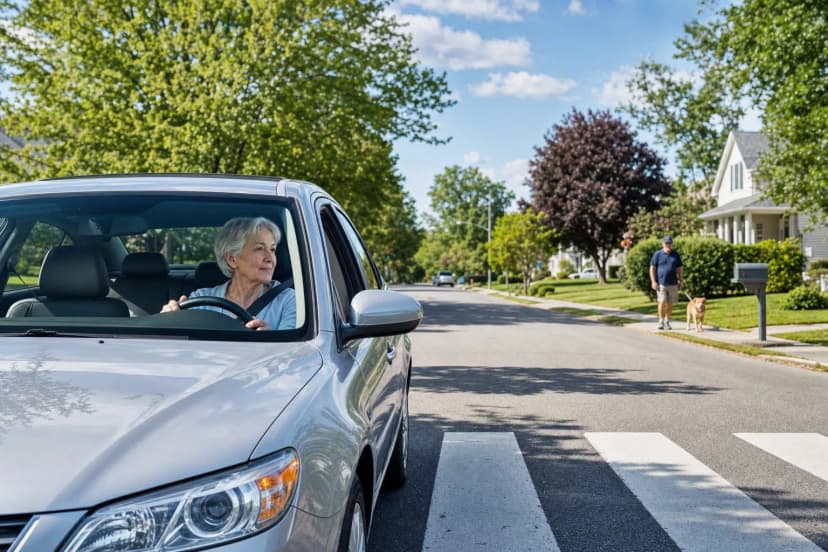
The mechanics of this risk are deeply rooted in the physical kinematics of a turning vehicle interacting with a moving pedestrian. When a driver prepares to execute a left turn, their eyes naturally track toward their intended path. Simultaneously, a pedestrian may be stepping off the curb into the crosswalk, moving in the same general direction as the turning vehicle. Because the vehicle is rotating through the turn, the thick, slanted left A-pillar and the bulky side mirror sweep through the driver's field of vision at the exact same angular velocity as the pedestrian crossing the street. In this synchronized, tragic motion, the pedestrian falls perfectly into the moving shadow of the A-pillar and vanishes completely from sight.

"When a driver’s view is partially blocked, it’s easy for a person in the crosswalk to disappear from sight," explained Wen Hu. "That’s exactly the kind of situation that leads to turning crashes."
The IIHS analysis quantified specific architectural dimensions that exacerbate this danger:
- Critical Scanning Area Obstruction: The average driver-side blind zone blocks approximately 27 percent of the critical scanning area to the left and front of the vehicle for a driver of average height (standing 5-foot-9). For drivers with shorter statures, the risk magnifies exponentially; a 4-foot-11 driver loses 33 percent of their critical scanning area behind the vehicle's architecture. A blind zone that blocks more than 30 percent of this critical area directly triggers that 70 percent increase in left-turn pedestrian crash risk.
- Narrow Field of View: The angle of the windshield plays a pivotal role. A narrow view angle between the A-pillars (measuring 85 degrees or less) positions the driver-side blind zone more directly into the forward path of the moving vehicle, increasing the left-turn pedestrian crash risk by 51 percent. The average windshield in the study provided an 88-degree field of view.
- Forward Visibility Range: If the nearest ground-level visible point directly in front of the vehicle stretches more than 30 feet away, more of the overarching blind zone sits directly in the driver’s immediate path, raising the left-turn crash risk by 37 percent. On average, the nearest visible ground point is 26 feet ahead for taller drivers and 30 feet ahead for shorter drivers.
These are not hypothetical risks; they are absolute mathematical realities dictated by the laws of geometry and optics. A commuter can execute a left turn with standard, reasonable caution, scanning the road diligently, yet still strike a pedestrian simply because the architecture of the vehicle mathematically erased the human being from their optical field. For drivers who want to go deeper on safer turns, lighting, and intersection design, many of the same risk patterns show up in broader nighttime safety and intersection design research.
Furthermore, when these larger vehicles do strike a pedestrian or cyclist, the outcomes are vastly more severe. The taller, blunt front ends of SUVs and pickups tend to strike victims higher on the body—impacting vital organs, the torso, and the head, rather than the legs—greatly increasing the likelihood of fatal trauma.
The Frontover Epidemic: When the Driveway Becomes a Danger Zone
While left-turn intersection crashes represent a major hazard on public roadways, an equally insidious threat exists mere feet from our residential front doors: the "frontover" collision. For the protective parent and the community watch advocate, this is the most terrifying manifestation of the blind zone problem.
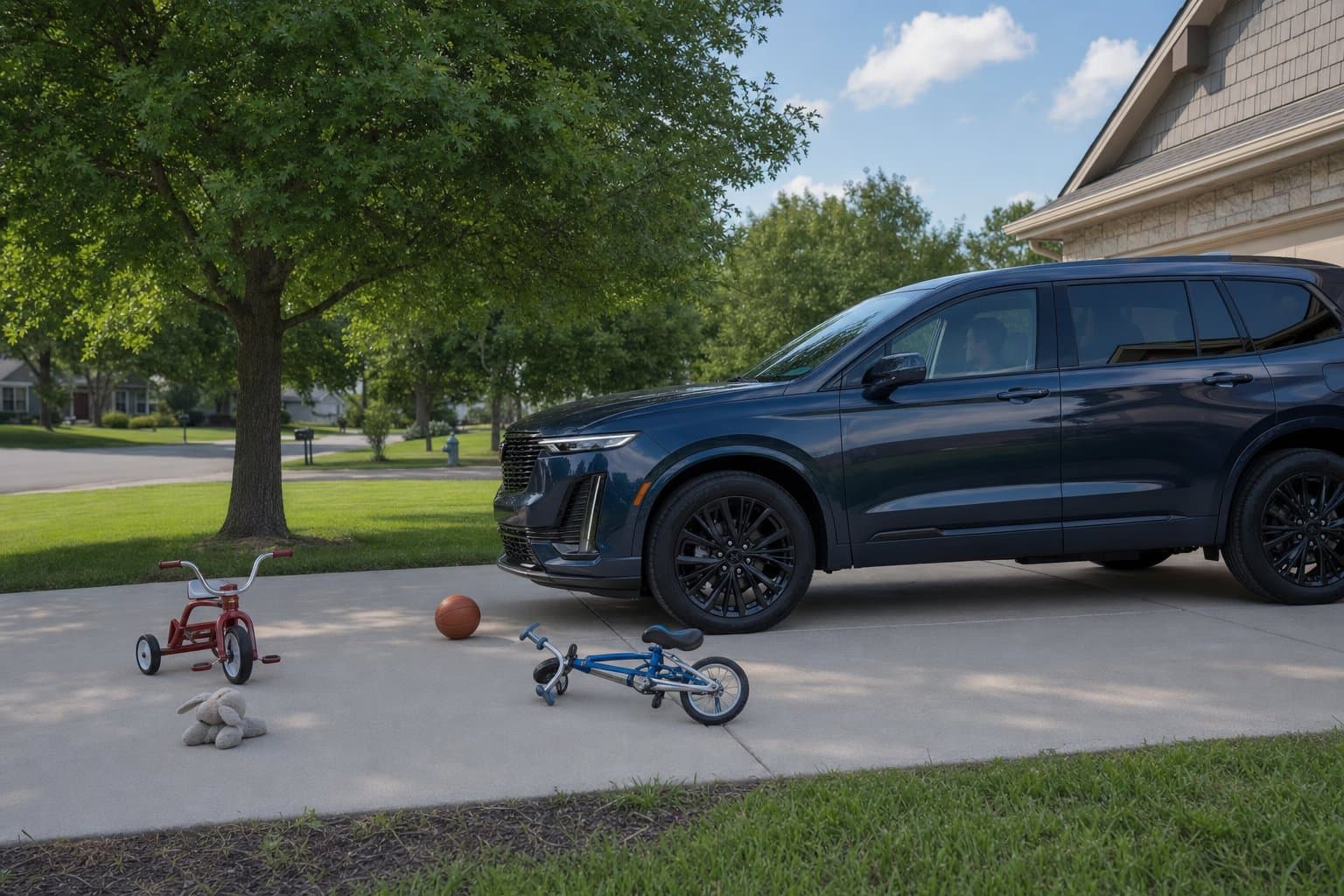
A frontover is defined as a non-roadway, low-speed crash in which a forward-moving driver strikes a person or object located squarely in their vehicle’s front blind zone. Because these incidents largely occur on private property—such as home driveways, apartment parking lots, and commercial garages—they frequently evade standard federal traffic fatality tracking databases, creating a silent epidemic that lacks the public awareness of highway collisions. Yet, available data from the National Safety Council and the National Highway Traffic Safety Administration (NHTSA) indicates that in 2021, 543 individuals outside of vehicles were killed by forward-moving vehicles in non-roadway settings, with another 13,643 suffering serious injuries.
The disproportionate victims of these driveway tragedies are small children. A child's short stature makes them particularly vulnerable to disappearing entirely within the forward void created by tall grilles and high hoods. Data compiled by advocacy organizations reveals a devastating reality: 82 percent of child pedestrian fatalities and 78 percent of child bicyclist fatalities in single-vehicle crashes occur when the child is struck by the front of the vehicle. Consequently, 75 percent of all frontover fatalities involve vans, trucks, or SUVs.
Consumer Reports testing has vividly demonstrated the sheer scale of these forward blind zones. In comprehensive, real-world field tests, analysts discovered that the front blind zone of a modern full-size pickup truck can extend up to an astonishing 15 to 16 feet ahead of the front bumper. To contextualize this massive distance, a 15-foot blind zone is large enough to completely obscure an entire line of ten seated preschool children from the driver’s line of sight.
The blind zone of a modern full-size pickup is often 11 feet longer than that of a standard sedan, and 7 feet longer than the average SUV. When a vehicle sits higher off the ground, the angle of visibility degrades, making it nearly impossible for a driver to see small children or pets located near the bumper. In wet weather, those long blind zones combine with longer stopping distances and hydroplaning risks, turning even slow-speed driveways and neighborhood streets into truly dangerous spaces.
The psychological toll of these accidents is staggering, rippling through families and communities. Every frontover death serves as a devastating reminder that a child can vanish from sight in seconds, often while a loving parent or caregiver is seated directly behind the wheel, entirely unaware of the danger. The driveway, traditionally considered a safe threshold between the security of the home and the outside world, has been unwittingly transformed into a high-risk zone solely due to the geometric proportions of modern consumer vehicles.
The Economics of Visibility: Safety as a Standard Versus a Luxury
Given the clear, empirical data outlining the lethal dangers of massive blind zones, one might assume that automotive manufacturers are rushing to install technological solutions across their entire vehicle lineups. Advancements in automotive safety technology—such as 360-degree camera systems, forward-facing ultrasonic sensors, and active Blind Spot Warning (BSW) systems—possess the proven capability to dramatically mitigate the risks posed by vehicle blind zones. However, the automotive industry has largely treated these life-saving technologies as premium commodities rather than baseline necessities.
An in-depth analysis by Consumer Reports, titled "A Blind Spot in Safety," investigated the cost and availability of Blind Spot Warning systems in the 14 most popular passenger vehicles weighing 4,000 pounds or more (which account for 26 percent of all non-commercial U.S. vehicle sales). The findings exposed a deeply troubling industry practice that commodifies safety.
The analysis revealed that Blind Spot Warning technology is included as a standard feature on the lowest trim levels of only three out of the 14 analyzed heavy models. Even more concerning, none of the top five best-selling auto brands offer this life-saving feature as standard across all their trim levels. Instead, manufacturers consistently bundle these crucial safety sensors into expensive, upgraded "technology," "convenience," or "luxury" packages. If a consumer wished to equip one of these top five base models with Blind Spot Warning, they would be forced to pay an average premium of approximately $1,600.
This economic barrier creates a dangerous two-tiered system of road safety. The ability to electronically detect a child in a crosswalk, a cyclist in a blind spot, or a toddler in a driveway is functionally restricted to consumers with higher disposable incomes who can afford premium trim packages.
Safety advocates, consumer protection agencies, and transportation analysts vigorously argue that fundamental visibility aids must not be treated as optional conveniences—akin to heated leather seats, premium audio systems, or a panoramic sunroof. In the view of Consumer Reports, technologies like blind spot warning, rear cross-traffic warning, and automatic crash notification should come standard on all new vehicles, across all trims, without requiring consumers to pay extra. On larger, heavier vehicles where the physical blind zones are vast and the potential for catastrophic injury is vastly magnified, these electronic safety nets are not luxuries; they are essential compensations for poor outward visibility.
Legislative Horizons: The STOP Frontovers Act
The legislative and regulatory landscape has historically been incredibly slow to react to shifting vehicle geometries. Back in 2008, Congress recognized a similar crisis occurring at the rear of vehicles and mandated that NHTSA establish rear visibility standards to combat a rising tide of backover accidents. This successful regulation ultimately led to the mandatory inclusion of backup cameras in all new passenger vehicles, saving countless lives. However, nearly two decades later, no parallel federal law exists to regulate front or side visibility, leaving a gaping loophole that has allowed frontover and left-turn fatalities to skyrocket.
Recognizing this regulatory vacuum, United States Senators Richard Blumenthal (D-CT) and Edward J. Markey (D-MA) introduced critical, landmark legislation known as the Standards to Prevent (STOP) Frontovers Act. Endorsed by major consumer and automotive safety organizations—including Kids and Car Safety, the Center for Auto Safety, Safe Kids Worldwide, and Consumer Reports—this comprehensive bill represents the most significant federal effort to date aimed at curbing the blind zone epidemic.
The STOP Frontovers Act relies on a multi-pronged approach to force industry-wide accountability and structural change:
- Mandating Standard Technology: The legislation directs NHTSA to issue a new Federal Motor Vehicle Safety Standard (FMVSS). This standard would definitively require all newly manufactured vehicles to be equipped with standard technology—such as front-facing cameras, ultrasonic sensors, or radar—that explicitly enables drivers to detect and rapidly respond to objects, children, and pedestrians located in front of and around their vehicles.
- Strict Rulemaking Timelines: To prevent bureaucratic delays from costing more lives, the bill outlines a rigid timeline, mandating that NHTSA initiate the formal rulemaking process within one year of the bill's passage and issue a finalized FMVSS exactly one year later.
- Standardizing the Terminology: In a crucial step for data fidelity and research, the bill requires NHTSA to formally and standardly define the term "frontover." Currently, without a standardized definition, these crashes are heavily underreported, miscategorized, or simply dismissed as tragic anomalies.
- Data Collection Modernization: The legislation directs the agency to thoroughly update its Non-Traffic Surveillance data systems to accurately count frontover injuries and fatalities occurring off public roadways (like private driveways and parking lots), ensuring the true scope of the problem is visible to policymakers, researchers, and the public.
As Senator Blumenthal noted when introducing the legislation: "Investigations have shown repeatedly that the massive front blind zones on modern SUVs and trucks can extend up to 16 feet, completely obscuring a small child from a driver's view. By requiring standard detection technology, clearly defining frontovers, and forcing accountability, we can finally close this deadly loophole and save children's lives. Safety cannot be treated as a luxury limited to people who can afford it."
Advocacy groups emphasize that the technology required to eliminate frontover tragedies is already completely developed and readily available. The only missing component is the regulatory enforcement to ensure it is installed universally, regardless of the vehicle's price point. Until those rules catch up, families can still take practical steps—from improving their glovebox preparedness and documentation to choosing safer parking habits—to shrink their personal risk.
Empowering the Community: Real-Time Safety with Carszy
While federal legislation like the STOP Frontovers Act weaves its way through the slow, complex machinery of congressional committees and agency rulemaking, communities remain vulnerable on the ground today. Even if the law were passed tomorrow, the millions of architectural behemoths currently dominating the roads will remain in circulation for decades. Therefore, mitigating the blind zone crisis requires an immediate combination of driver behavioral changes, community mobilization, and the deployment of real-time communication platforms.
Everyday drivers must adopt specific, highly intentional behavioral adaptations to account for their vehicle's reduced visibility. This includes drastically reducing speeds during left turns to allow more time for the A-pillar's moving shadow to shift across the visual field, physically leaning forward and backward in the driver's seat to peer around thick structural pillars before entering a crosswalk, and making it a habit to reverse into parking spaces and driveways whenever possible to avoid forward-moving blind zone hazards upon departure. These habits sit alongside other core defensive-driving routines, like reading dashboard warning lights correctly and reacting early when your vehicle signals that something is wrong.
Beyond individual driver adjustments, modern software and community-driven safety platforms offer a powerful, immediate secondary layer of defense. A community safety platform like Carszy exemplifies how technology can bridge the gap left by automotive hardware flaws and sluggish regulations. By shifting the paradigm of connectivity away from passive, scrolling "Social Media" and toward an action-oriented framework of "Human Media™," communities can actively mobilize to protect vulnerable road users in real-time.
For the Protective Parent, the Commuter, and the Neighborhood Watch Lead, several distinct technological features uniquely empower neighborhoods to combat blind zone dangers directly:
- Direct License Plate Messaging: Imagine a scenario where a massive F-150 or Chevrolet Suburban is idling in a driveway, and a neighbor spots a small child or a dog wandering directly into the vehicle's 15-foot front blind zone. The driver, sitting high up in the cab, is completely oblivious. Using secure, privacy-focused License Plate Messaging, that neighbor can instantly text or call the vehicle's operator using only their license plate number as a unique identifier. This provides a rapid, life-saving alert ("Stop! There is a child right in front of your bumper") before the vehicle ever rolls forward.
- Vehicle of Interest Search (VOIS™): Given the massive blind zones on modern trucks, drivers sometimes strike pedestrians, cyclists, or property without immediately realizing an impact has occurred, leading to unintentional hit-and-runs. Alternatively, malicious actors may flee a scene. A community-driven alert system like VOIS™ allows witnesses to rapidly crowd-source the location of vehicles involved in critical incidents—such as abductions, trafficking, or hit-and-runs. This dramatically reduces law enforcement response times and ensures strict accountability on local roads.
- Privacy and Real-World Impact: Unlike traditional social networks that monetize user data, platforms focused on Human Media operate on secure, US-based servers, prioritizing privacy while shifting the focus entirely to real-world impact. By leveraging geolocation safety features and community networking, residents can report dangerous driving, road rage, or even map high-risk intersections where left-turn visibility is notoriously poor, promoting broader awareness and encouraging heightened caution among local drivers.
When drivers are interconnected through a platform designed purely for community safety, the inherent architectural dangers of modern vehicles are actively mitigated by hundreds of watchful eyes. You are no longer driving alone in a silo; you are part of a mobilized safety network.
Future Engineering: Redesigning for Vulnerable Road Users
While retrofitting communities with communication tools is vital, the ultimate responsibility for solving the blind zone crisis lies with automotive engineers and manufacturers. Automakers are not entirely without options when it comes to structural redesigns. While rolling back roof strength standards is impossible and unsafe, engineering alternatives exist that do not compromise occupant protection while dramatically improving outward visibility.
Transportation engineers assert that manufacturers can dramatically decrease the danger to pedestrians simply by lowering the front end of the hood and angling the grille to create a sloped, aerodynamic profile, much like the designs seen in the 1990s and early 2000s. As safety experts have repeatedly noted, there is absolutely no functional or mechanical benefit to the massive, blocky front ends dominating today's market; they are purely stylistic choices that carry deadly, real-world consequences. Pairing more forgiving vehicle shapes with better emergency readiness—like having a proper roadside kit and plan in place—gives drivers a much stronger overall road-ready safety foundation.
Furthermore, advancements in active safety systems must be prioritized and refined. Current Pedestrian Automatic Emergency Braking (PAEB) systems, which use forward-facing cameras and radar to automatically stop the car if a collision is imminent, could be explicitly calibrated to function more reliably while the vehicle is actively turning, specifically scanning the crosswalk trajectory rather than just straight-ahead paths.
Automakers can also expand the use of standard side-view camera arrays that project a live, wide-angle video feed directly onto the dashboard or instrument cluster, effectively eliminating the A-pillar blind spot and providing visibility that thick steel prevents. Finally, for the inevitable collisions that still occur despite visibility aids, the development and deployment of vehicle hood airbags—which deploy over the windshield and A-pillars upon impact—could cushion the blow, significantly reducing the likelihood of severe head and torso trauma for pedestrians and cyclists.
Conclusion: Next Steps for the Safety-Conscious Driver
The rapid expansion of vehicle blind zones represents a distinct, severe, and growing threat to modern road safety. Over the past 25 years, the pursuit of larger, taller, and heavier consumer vehicles has geometrically erased vital lines of sight, leaving drivers with massive blind zones capable of hiding entire groups of children, pedestrians, and cyclists. Whether it is the 70 percent increased risk of striking a pedestrian during a routine left turn at an intersection, or the devastating reality of frontover collisions in residential driveways, the consequences of this architectural evolution are being paid in human lives.
Addressing this crisis requires a holistic, multi-layered approach. It demands sweeping, uncompromising legislative action, such as the passage of the STOP Frontovers Act, to mandate that life-saving cameras and sensors become baseline standard equipment rather than luxury upgrades reserved for the wealthy. It requires automotive manufacturers to fundamentally rethink aesthetic design choices that prioritize aggression and blocky styling over visibility and pedestrian safety.
Most importantly, it requires everyday drivers to acknowledge the physical limitations of their vehicles, adapt their driving habits accordingly, and leverage the power of community. By combining heightened physical awareness behind the wheel with the power of community-driven communication platforms, motorists can reclaim the safety of their neighborhoods. Downloading an app designed for secure, driver-to-driver alerts transforms isolated, blind vehicles into a cohesive, aware safety network, ensuring that no hazard goes unseen and no driver remains uninformed. When a community mobilizes around shared safety and real-time communication, the entire driving landscape shifts for the better. For EV owners, blending these habits with smart charging etiquette and curbside awareness also cuts down on risky conflicts in crowded lots and near chargers.
Download the Carszy app today to stay connected, report hazards, and help keep your neighborhood safe. And remember, if a crash or near-miss does happen, following a calm, step-by-step post-crash protocol protects both your safety and your rights while you push for safer streets.
Frequently Asked Question
Why do modern SUVs and trucks have larger blind zones than older models?
The dramatic increase in vehicle blind zones over the last two decades is primarily driven by three converging factors: stringent rollover safety regulations, shifts in consumer aesthetic preferences, and the overall scaling up of vehicle dimensions. To meet stricter federal mandates for roof crush strength designed to protect occupants during severe rollovers, automotive engineers were forced to significantly thicken the "A-pillars" (the structural frames on either side of the windshield). This inadvertently created wide visual obstructions at the driver's forward corners, contributing to a sharp increase in left-turn pedestrian crashes. Simultaneously, consumer demand for vehicles that project a rugged, commanding presence has led automakers to design much higher, blockier, and longer front hoods. When combined with the massive side-view mirrors required to navigate these wider vehicles, the driver's outward visibility is severely compromised, creating massive front blind zones that can stretch up to 15 or 16 feet directly in front of the vehicle—enough space to hide small children entirely from view. For a broader look at how today’s streets, tech, and vehicle designs interact, it helps to see blind zones as one part of a much bigger “smart cars, dumb streets” problem.
Recommended Reading
- Vehicles with big blind zones spell danger to pedestrians during left turns
- https://www.iihs.org/news/detail/new-iihs-measurement-technique-points-to-growth-in-vehicle-blind-zones
- https://www.blumenthal.senate.gov/newsroom/press/release/blumenthal-and-markey-introduce-legislation-to-prevent-frontover-child-deaths