Mastering Mountain Driving: Managing Brakes, Handling Switchbacks, and Surviving Brake Fade on Steep Descents
The experience of navigating a mountain pass often oscillates between awe-inspiring scenery and intense psychological tension. For the everyday driver, the commuter navigating canyon routes, or the safety-conscious parent with a vehicle full of passengers, a steep mountain downgrade introduces mechanical stresses that simply do not exist on flat suburban infrastructure. When descending a six-percent grade for miles on end, a vehicle's braking system is subjected to extreme thermal loads. The sudden, acrid smell of burning friction material or the terrifying sensation of a brake pedal turning soft can instantly transform a scenic drive into a critical emergency.
Addressing these challenges requires a comprehensive understanding of vehicular physics, mechanical maintenance, and proper driving techniques. This report delivers an exhaustive analysis of mountain and steep-grade driving, focusing on brake management, switchback navigation, the mechanics of brake fade, and the real-world applications of modern community safety technologies like those developed by Carszy. By embracing a transparent, comprehensive approach to driver education, this document addresses the most pressing questions motorists face when tackling treacherous terrain and complements broader safety strategies like roadside breakdown protocol on highways and other high-risk environments.

The Physics of Descending: Kinetic Energy and Thermodynamics
To understand why modern braking systems fail on mountain roads, one must first understand the fundamental physics of how a vehicle decelerates. Braking systems operate by transforming a vehicle's kinetic energy—its forward motion—into thermal energy, or heat, through the application of mechanical friction.
When a driver applies pressure to the brake pedal, that mechanical force is multiplied by a brake booster and transmitted through hydraulic brake fluid. This pressurized fluid forces the brake calipers to squeeze the brake pads against the spinning brake rotors (or drums, in older systems). The resulting friction slows the wheels, but it generates an enormous amount of heat in the process. To illustrate the sheer volume of energy involved, a 3,500-pound passenger car traveling at 60 mph possesses enough kinetic energy to keep a standard 100-watt light bulb illuminated for an hour and a half.
While all components at the wheel assembly—the calipers, the brake pads, and the rotors—absorb this thermal energy, the majority of the heat is transferred directly into the cast-iron rotors. These rotors are specifically designed to dissipate this heat into the surrounding atmosphere via convection cooling, a process often aided by internal ventilation fins cast directly into the metal disc. However, convection cooling requires time and turbulent airflow. During a long, steep descent, gravity acts as a continuous accelerant. If a driver constantly applies the brakes to fight the pull of gravity, the system generates heat far faster than it can be dissipated into the atmosphere. The brakes get steadily hotter, rapidly approaching the thermal limits of their materials, which inevitably leads to a dangerous condition known as brake fade.
Furthermore, kinetic energy increases with the square of the vehicle's speed. Consequently, stopping from higher speeds or carrying heavier loads exponentially increases the thermal burden on the braking system. For example, slowing down a heavy-duty commercial truck weighing 80,000 pounds, or a passenger SUV towing a heavy travel trailer, requires significantly more clamping force and generates proportionally more heat. Understanding this mathematical reality is the first step in recognizing why standard driving habits are wholly insufficient for mountain descents and why choosing the right vehicle and equipment—much like you would when you decide whether to lease, buy, or finance a car in 2026—directly affects your safety on steep grades.
The Anatomy of Brake Fade: Friction vs. Fluid
Brake fade is defined as the reduction or complete loss of stopping power that occurs after repeated or sustained application of the brakes, particularly in high-load conditions like steep mountain downgrades. Drivers experience brake fade primarily through the brake pedal, which requires progressively more physical effort from the driver's leg to achieve the same deceleration rate. If the condition is allowed to worsen, the vehicle will not stop, regardless of how much physical pressure is applied to the pedal.
Brake fade generally manifests in two distinct mechanical failures: friction fade (pad fade) and fluid fade (vapor lock).
Friction Fade (Pad Fade)
Friction fade occurs when the brake pads exceed their maximum designed operating temperature. Brake pads are manufactured from various friction compounds, typically categorized as organic, semi-metallic, or ceramic.
- Organic Pads: Often used for general city commuting, these pads are quieter and produce less visible brake dust. However, they have a significantly lower heat tolerance and are highly susceptible to fading during aggressive mountain driving or heavy towing.
- Semi-Metallic Pads: These compounds contain metal shavings and provide a firmer pedal feel along with higher heat resistance, making them better suited for heavy loads. The tradeoff is that they generate more brake dust and wear down the rotors faster.
- Ceramic Pads: These offer excellent high-temperature performance and fade resistance, making them ideal for sports cars or vehicles frequently driven on steep, technical terrain. They require more heat to reach their optimal friction coefficient and are the most expensive option.
When any brake pad exceeds its thermal threshold—often soaring above 1,000 degrees Fahrenheit—the binding resins within the friction material begin to break down, melt, and vaporize. This rapid chemical breakdown creates a microscopic layer of hot gas between the brake pad and the rotor, effectively acting as a high-pressure lubricant. The driver will feel a hard brake pedal, but the vehicle will fail to slow down because the pads can no longer physically grip the rotors.
Fluid Fade (Vapor Lock)
Fluid fade is often more sudden and far more terrifying than friction fade. If the brake calipers become scorchingly hot, that extreme thermal energy is transferred directly into the hydraulic brake fluid residing within the caliper piston chamber.
Brake fluid is hygroscopic, meaning it naturally absorbs moisture from the atmosphere over time. Even in a sealed system, microscopic amounts of water infiltrate the fluid through microscopic pores in the rubber brake hoses. As the water content in the fluid increases, the fluid's boiling point decreases dramatically.
The Department of Transportation (DOT) classifies brake fluids based on their boiling points:
- DOT 3 Brake Fluid: The most common factory fluid installed in passenger cars. DOT 3 has a dry boiling point (new fluid with zero moisture) of approximately 401°F (205°C). However, its wet boiling point (after absorbing standard amounts of moisture over a few years) drops to roughly 284°F (140°C).
- DOT 4 Brake Fluid: Often used in performance, European, or heavy-towing applications, DOT 4 features a higher dry boiling point of about 446°F (230°C) and a wet boiling point of 311°F (155°C).
When the temperature of the overheated calipers exceeds the boiling point of the contaminated fluid, the moisture within the fluid boils and introduces vapor bubbles directly into the hydraulic lines. This is a catastrophic mechanical failure. Because liquid is incompressible but gas is highly compressible, stepping on the brake pedal merely compresses the vapor bubbles instead of squeezing the brake pads against the rotor. The driver experiences this as a complete pedal collapse, where the brake pedal sinks entirely to the floorboard with zero hydraulic resistance and zero stopping power.
| Brake Fluid Type | Dry Boiling Point (New) | Wet Boiling Point (Degraded) | Primary Application |
|---|---|---|---|
| DOT 3 | 401°F (205°C) | 284°F (140°C) | Standard passenger vehicles, light commuting |
| DOT 4 | 446°F (230°C) | 311°F (155°C) | Performance vehicles, towing, mountain driving |
| DOT 5.1 | 500°F (260°C) | 356°F (180°C) | High-performance, extreme duty applications |
Sensory Feedback: Identifying Imminent Brake Failure
Safety-conscious drivers must remain vigilant for the early warning signs of imminent brake failure. The human senses provide critical feedback during a mountain descent long before a catastrophic loss of control occurs.
- Olfactory Cues (Smell): A sharp, acrid smell resembling burning rubber, singed hair, or chemical resin strongly indicates that the brake pads are overheating and beginning to off-gas. This is often the first indicator that the braking system is being overworked.
- Tactile Cues (Pedal Feel): A spongy, squishy, or fading brake pedal that travels further to the floor than usual is a primary indicator of boiling brake fluid. Conversely, a pedal that feels abnormally hard but yields no deceleration indicates friction fade.
- Kinesthetic Cues (Vibrations): A steering wheel shudder or severe pedal pulsation during braking often indicates warped rotors caused by extreme heat cycling and uneven pad deposits.
- Auditory Cues (Sound): Squealing or metallic grinding noises suggest that the friction material has worn down entirely, leading to metal-on-metal contact between the backing plate and the rotor.
If any of these signs appear on a mountain descent, the safest and only acceptable protocol is to utilize the next available turnout to pull over. The driver should place the vehicle in park, leave the engine running to allow the water pump to circulate engine coolant, and let the braking system air-cool for 20 to 30 minutes before testing the pedal pressure and proceeding. Continuing to drive when the brakes are smoking or fading guarantees an eventual loss of control. Recognizing these warning lights and sounds early pairs naturally with understanding what your dashboard warning lights are telling you in 2026 so you can act before a minor issue turns into a crisis.
The Science of Speed Management: Snubbing vs. Riding
The most critical factor in preventing brake fade is operator technique. Decades ago, driver education courses taught motorists to maintain light, constant pressure on the brake pedal to control speed down a hill. This technique, known as "controlled braking" or "riding the brakes," is highly dangerous and fundamentally flawed when applied to steep, multi-mile mountain grades.
The outdated theory behind riding the brakes is that heat builds up gradually, supposedly preventing sudden thermal shock. However, on a long grade, continuous friction means the brake components are constantly generating thermal energy without any opportunity to cool down. This relentless thermal loading quickly overwhelms the rotors' ability to dissipate heat through convection, inevitably leading to overheating, off-gassing, and total failure.
The "Snubbing" Technique
The universally accepted standard for downhill braking, utilized by commercial truck drivers and highly recommended for passenger vehicles and RVs, is the "snubbing" technique (also referred to as stab braking). Snubbing relies on intermittent, firm brake applications interspersed with periods of coasting, which allows the rotors crucial time to shed heat.
To execute the snubbing technique properly, a driver must follow a disciplined, cyclical process:
- Establish a Target Speed: Before the descent begins, determine a safe maximum speed for the grade (e.g., 40 mph).
- Allow Speed to Build: Let gravity naturally accelerate the vehicle up to the target speed (40 mph).
- Apply Brakes Firmly: Once the target speed is reached, press the brake pedal firmly and smoothly to scrub off approximately 5 mph of speed in about 3 to 5 seconds, bringing the vehicle down to 35 mph.
- Release and Cool: Completely release the brake pedal. Allow the vehicle to coast back up to the 40 mph target speed. During this coasting period, the rotors are spinning freely, creating turbulent airflow that dissipates built-up heat.
- Repeat: Repeat this specific cycle for the entire duration of the downgrade.
If the driver finds that the vehicle accelerates back to the maximum safe speed too quickly, requiring a snubbing application every few seconds, the selected gear is too high, and the vehicle is traveling too fast for the gravitational conditions. The time between snubs is the exact mechanism that prevents brake fade; if that time is eliminated, the brakes will overheat.
| Braking Method | Execution Strategy | Heat Generation Profile | Efficacy on Steep Grades |
|---|---|---|---|
| Riding Brakes (Controlled) | Light, continuous pedal pressure | Continuous, culminating in rapid thermal overload | Highly dangerous; guarantees friction and fluid fade |
| Snubbing (Stab Braking) | Firm 5 mph speed reductions, followed by total release | Intermittent; allows vital convection cooling during release | Highly Recommended; preserves brake system integrity |
| Engine Braking | Downshifting to lower gears to use drivetrain resistance | Zero friction heat; safely causes engine RPMs to rise | Essential; serves as the primary speed control mechanism |
Drivetrain Dynamics: Engine Braking and Gear Selection
Snubbing should never be the primary method of speed control; rather, it should supplement the mechanical resistance provided by the vehicle's drivetrain. Before cresting a mountain pass and beginning a descent, drivers must actively downshift into a lower gear. A widely accepted rule of thumb dictates descending a hill in the same gear that was required to climb it, as the gravitational forces acting on the vehicle's mass remain constant.
For vehicles equipped with automatic transmissions, this involves moving the gear selector from standard "Drive" to a specific lower gear (such as 3, 2, or L), or engaging steering-wheel-mounted paddle shifters. Modern trucks and SUVs frequently feature a dedicated "Tow/Haul" mode or an Electronic Hill Descent Control system. When activated, these systems alter the transmission's shift mapping, automatically and aggressively downshifting the transmission to utilize engine compression braking whenever the driver lifts off the accelerator.
Engine braking creates internal vacuum resistance within the engine block, utilizing the heavy, rotating mass of the drivetrain to hold the vehicle back against the force of gravity. When executed correctly, the engine speed (RPMs) will rise significantly, and the engine will sound much louder than usual. This is mechanically normal and entirely safe, provided the RPMs remain below the vehicle's designated redline. By allowing the engine to manage the vast majority of the gravitational force, the friction brakes are preserved strictly for the intermittent snubbing maneuver and unforeseen emergency stops.
For commercial drivers operating heavy vehicles, the engine brake (often referred to colloquially as a "Jake Brake") alters the engine's exhaust valves to create massive resistance, essentially turning the diesel engine into a giant air compressor. Commercial drivers are taught that they should be able to descend a grade at a speed that allows them to use only the engine brake—with zero service brake applications—to maintain a safe descent speed.
Technical Terrain: Switchbacks, Trailers, and Weight Transfer
Mountain driving involves more than just straight, high-speed descents; it frequently features tightly coiled hairpin turns known as switchbacks. Navigating these highly technical sections requires a nuanced understanding of vehicle weight transfer, tire grip, and chassis balance.
A remarkably common and dangerous error made by inexperienced mountain drivers is braking during a curve. When a vehicle applies the brakes, the vehicle's mass transfers dramatically to the front axle, severely unloading the rear tires. If the vehicle is simultaneously turning, the lateral G-forces combined with this forward weight transfer can catastrophically upset the chassis balance. This physics phenomenon pushes the front tires beyond their threshold of grip, resulting in an understeer skid, or causes the lightened rear end to swing outward in an oversteer slide.
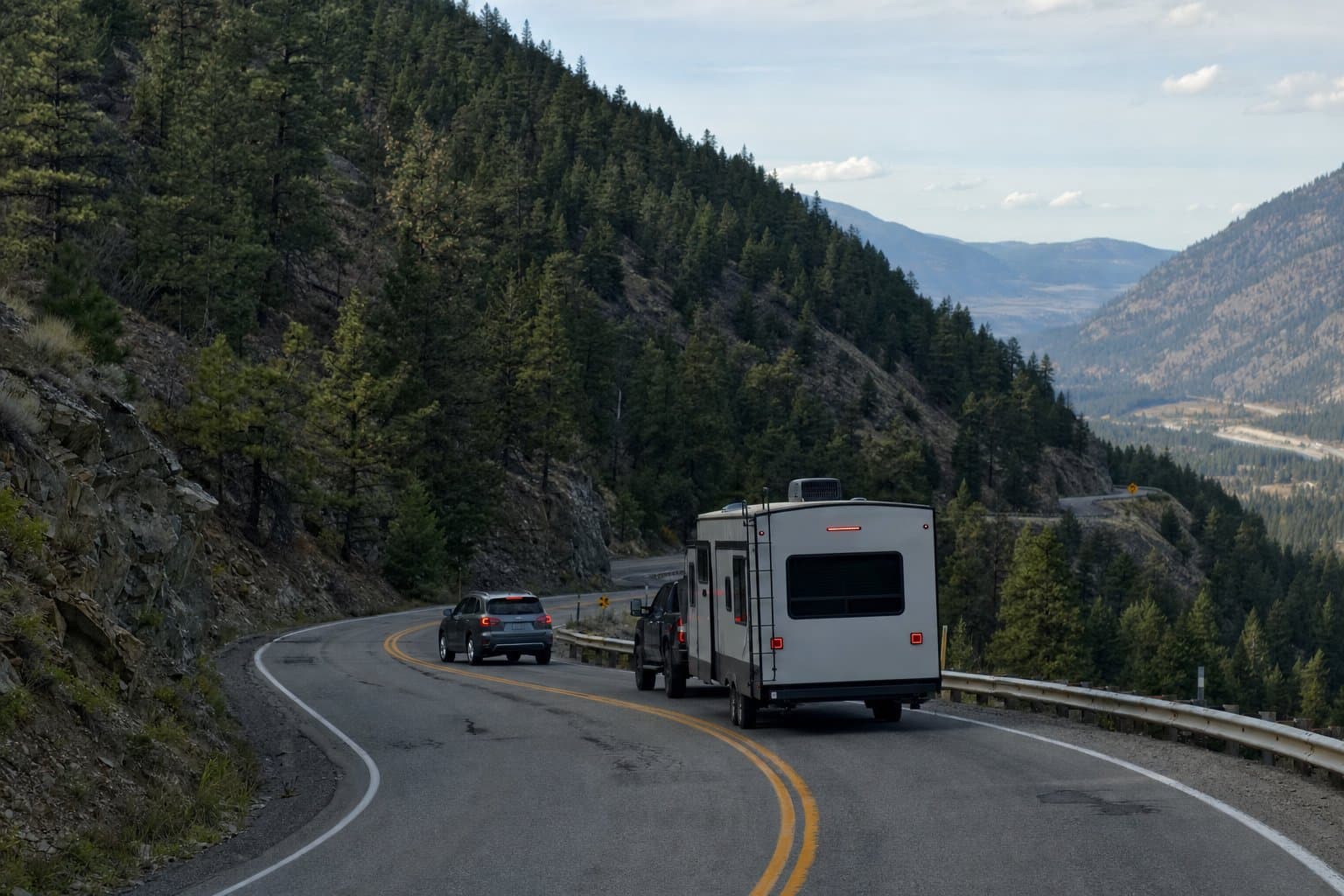
The correct strategy for navigating a switchback—especially for heavy vehicles, vehicles towing loads, or passenger cars operating on loose gravel—is strict speed management before entering the curve. Drivers must complete all necessary braking in a straight line before turning the steering wheel. The vehicle should enter the curve at a sufficiently low speed (often 15 mph or less for tight mountain hairpins), coast smoothly through the apex of the turn, and gently accelerate out to shift the weight back to the rear wheels. On tight, low-visibility curves and intersections, this same discipline around speed and visibility echoes the importance of being predictable instead of “nice” at intersections so that other road users can accurately read your movements.
Supporting Your Tires
Your tires are the only parts of the vehicle actually touching the road, and on steep grades and gravel switchbacks, their condition is the difference between grip and a slide. Before tackling mountain terrain, inspect tread depth, look for bulges or cuts, and confirm pressures are set for your load and altitude. For a deeper dive into keeping that hand-sized patch of rubber working for you, not against you, see the comprehensive guide to tire safety, blowout prevention, and smart maintenance.
The Complexities of Towing
For drivers towing heavy travel trailers, off-grid campers, or fifth wheels, the integration of the trailer's braking system is a matter of life and death. Modern tow vehicles are equipped with electric trailer brake controllers featuring a "gain" setting, which dictates how aggressively the trailer brakes apply in tandem with the tow vehicle's brakes.
If the gain is set too low, the trailer's mass will forcefully push the tow vehicle downhill every time the brakes are applied, severely overtaxing the truck's front rotors and inducing rapid brake fade. Conversely, setting the gain too high on steep, loose gravel switchbacks can cause the trailer tires to lock up and slide laterally, risking a jackknife situation where the trailer folds into the side of the tow vehicle. Trailer operators must actively adjust their gain settings based on the steepness and surface conditions of the descent, manually dialing the gain down slightly when transitioning from paved highways to steep dirt tracks.
Runaway Truck Ramps: Engineering the Ultimate Failsafe
Despite proper driving technique, meticulous maintenance, and strict adherence to safety protocols, mechanical failures can still occur. According to the National Highway Traffic Safety Administration (NHTSA) National Motor Vehicle Crash Causation Survey, approximately two percent of all car accidents are caused by brake failure. While this percentage seems low globally, brake failure incidents are heavily concentrated in mountainous terrain. The Federal Motor Carrier Safety Administration (FMCSA) notes that up to 30 percent of trucking accidents on steep mountain roads are caused by brake failure.
When an 80,000-pound commercial truck—or a heavy passenger SUV—suffers total brake failure on a 6% downgrade, it transforms into an unguided kinetic missile. To mitigate these catastrophic events and save lives, highway engineers began installing runaway truck ramps (also known as truck escape ramps or TERs) in the 1960s.
Currently, there are nearly 200 runaway truck ramps located across the United States, predominantly in mountainous western regions. The placement of these ramps is determined by specific Department of Transportation (DOT) criteria, including localized accident rates, the length and percentage of the grade, commercial traffic volume, and the presence of dangerous infrastructure (like towns, intersections, or sharp bends) at the bottom of the hill.

Types of Escape Ramps
Runaway ramps rely on extreme friction and gravity to safely arrest the kinetic energy of out-of-control vehicles. They are typically situated to the right side of the roadway and are clearly marked with advance warning signs. The primary engineering designs include:
- Gravel Arrester Beds: The most common design, these ramps are filled with deep, uncompacted gravel or sand. Engineering studies have proven that rounded riverbed gravel is highly effective, as the tires sink rapidly into the aggregate. The sheer drag force of the deep gravel creates rapid deceleration, stopping the vehicle safely.
- Gravity (Uphill) Ramps: These utilize a sharply inclined path built into the mountainside. The vehicle's forward momentum is defeated by gravity as it climbs the steep slope, allowing it to safely roll to a halt.
- Cable Arrestor Systems: Used in areas with limited geographic footprints, these stretch a series of aircraft cables across the ramp, fitted with energy absorbers mounted to concrete walls to catch and decelerate the vehicle, similar to systems used on aircraft carriers.
| Ramp Type | Stopping Mechanism | Primary Location | Environmental Footprint |
|---|---|---|---|
| Gravel Arrester Bed | Deep aggregate drag / friction | Long downgrades with ample roadside space | Large |
| Gravity Ramp | Upward slope against gravity | Mountain passes with steep adjacent hillsides | Moderate |
| Cable Arrestor System | Mechanical kinetic absorption | Constrained geographies, cliff edges | Small |
The Psychological Barrier: Can Passenger Cars Use Them?
A frequent and highly dangerous misconception is that runaway ramps are exclusively reserved for heavy-duty commercial vehicles. In truth, any driver experiencing brake failure—including those in passenger cars, SUVs, pickup trucks, or RVs—can and absolutely should utilize a runaway ramp.
Entering a ramp is a violent, chaotic, and terrifying experience. The vehicle often impacts the arrester bed at speeds exceeding 80 mph. The deep aggregate acts like quicksand, resulting in massive, abrupt deceleration, flying rock, and a thick cloud of dust. The vehicle's suspension, steering components, and undercarriage may suffer severe damage, and extraction requires specialized heavy-duty wreckers equipped with heavy winches, which can cost thousands of dollars in tow fees.
However, the cost of property damage and extraction is a microscopic price compared to the alternative. Alarmingly, an estimated 95% of commercial truck driving schools do not adequately teach runaway ramp usage, leaving drivers psychologically unprepared for the violence of the maneuver. Hesitation or pride often prevents drivers from utilizing the ramp, as they desperately hope they can somehow ride out the descent.
Physics dictates otherwise. When a vehicle lacks brakes on a downgrade, it will continually accelerate until it impacts another vehicle, a rock wall, or plummets over a cliff edge. Using the ramp, while destructive to the vehicle, is a controlled crash landing explicitly engineered by the state to save lives. Furthermore, state agencies, such as the California DOT, do not charge a fee, penalty, or fine for the legitimate emergency use of an escape ramp, although the driver remains responsible for the subsequent private towing and repair costs.
The Data of Disaster: Analyzing California's Deadliest Mountain Passes
The theoretical risks of mountain driving are tragically realized on specific stretches of pavement every year. In California, which boasts some of the most dramatic and challenging topographies in the nation, steep gradients and complex road geometries contribute to thousands of severe accidents. In 2023 alone, the California Office of Traffic Safety (OTS) recorded 4,061 traffic fatalities statewide, a slight decrease from previous years but still an alarming figure. Speeding and vehicular control loss remain major factors, with speeding-related fatalities accounting for 32% (1,303 deaths) of all motor vehicle fatalities in the state.
When analyzing highway data, two specific mountainous routes consistently rank among the most dangerous for both passenger vehicles and motorcyclists, earning notorious reputations among safety advocates, emergency responders, and highway patrol officers.
Ortega Highway (State Route 74)
State Route 74, widely known as the Ortega Highway, connects San Juan Capistrano in Orange County to Lake Elsinore in Riverside County. The highway serves a dual purpose: it acts as a crucial east-west commuter route, and it functions as a highly popular scenic weekend destination, carving its way through the rugged Cleveland National Forest.
The Ortega Highway is characterized by long, winding mountain passes, severely limited sight visibility, blind curves, and a total lack of physical center dividers across much of its 21-mile Riverside County segment. The road was originally engineered with two lanes, each 31 feet wide, designed for vehicle speeds of 25 to 40 mph with maximum grades of 6%. The reality of modern traffic, however, often sees vehicles traveling much faster than the historic design limits.
For motorcyclists and commuter vehicles alike, the risks are astronomical. Between 2019 and 2023, the Ortega Highway recorded 30 fatal and serious-injury motorcycle crashes on just its Riverside section alone, earning it the grim, localized moniker "The Bloody Ortega." Its per-mile death rate regularly exceeds that of other scenic corridors in the state. Mechanical failures, such as brake fade on the steep descents toward Lake Elsinore, combined with impatient drivers making highly illegal and unsafe passes on blind curves, result in frequent head-on collisions and run-off-road tragedies. These patterns mirror broader intersection and curve risks across California, where drivers often fail to see motorcyclists in time at intersections and merge points.
Angeles Crest Highway (State Route 2)
Further north, the Angeles Crest Highway (SR-2) snakes through the San Gabriel Mountains in Los Angeles County. Stretching 66 miles from the suburban stoplights of La Cañada Flintridge northeast to State Route 138 near Wrightwood, the road is a mid-century engineering marvel. It features massive cuts blasted through deep granite and tunnels bored directly through the mountainside. The highway climbs relentlessly from roughly 1,500 feet to a towering summit at Dawson Saddle (7,903 feet), making it one of the highest paved routes in Southern California.
Despite its undeniable scenic beauty, Angeles Crest is incredibly treacherous. It features steep grades of up to 6.5%, sharp switchbacks, and massive drop-offs that often lack adequate guardrails. From 2019 to 2023, there were 88 fatal and serious-injury motorcycle crashes along the corridor, making it a focal point for California Highway Patrol enforcement. For heavy trucks and passenger cars, the continuous, high-altitude downhill grades are utterly unforgiving on braking systems.
A tragic and highly publicized example of the highway's danger occurred in 2009 when a commercial truck lost its brakes while descending a steep grade on the Angeles Crest Highway into La Cañada Flintridge. The runaway truck careened through an intersection at the bottom of the grade, striking several passenger vehicles and crashing into a strip mall, resulting in the fatalities of a 12-year-old girl and her father. The incident underscored the devastating, far-reaching consequences of mountain brake failure and ultimately led to legislative action banning large commercial trucks on that specific segment of SR-2. More recently, a fatal crash involving a high-speed Ferrari exiting a tunnel and striking a concrete barrier, resulting in a post-collision fire, further highlighted the lethal combination of speed, technical curves, and unforgiving infrastructure.
The Evolution of Road Safety: Connectivity and Accountability
Historically, the isolation of mountain roads compounded their physical dangers. If a driver observed another vehicle on a mountain pass suffering from an imminent mechanical failure—such as heavily smoking trailer brakes, a glowing undercarriage, or a dangerously loose cargo load—their options for intervention were dangerously limited. Honking the horn, flashing headlights, or aggressively tailgating to get the driver's attention is almost universally misinterpreted as aggressive behavior, leading to dangerous road rage rather than gratitude.
This critical communication gap highlights the vital role of modern, community-driven safety platforms like Carszy. Positioned at the intersection of neighborhood watch advocacy and tech-forward communication, platforms like this shift the paradigm from isolated, individual driving to connected, proactive community safety.
By utilizing License Plate Messaging, drivers can securely and anonymously contact one another using only a vehicle's license plate number as the identifier. In the context of mountain driving, a commuter traveling safely behind an RV on the steep descent of the Ortega Highway can send a direct alert: "Your trailer brakes are smoking heavily. Use the next turnout before you lose your brakes." This real-time, driver-to-driver intervention eliminates the dangerous ambiguity of honking and provides actionable safety information before friction fade turns into total fluid failure. The same approach can prevent tragedy in dense urban traffic when a distracted driver glances down for just a moment—understanding how even a two-second glance at an in-car screen can be deadly makes these instant, precise alerts even more valuable.
Furthermore, remote mountain roads like the Angeles Crest Highway often suffer from massive cellular dead zones and lack commercial infrastructure entirely—there are no gas stations, service centers, or strip malls for up to 66 miles. In these desolate, high-altitude environments, hit-and-run incidents, reckless driving behaviors, and abducted vehicles can easily disappear. Through advanced features like VOIS™ (Vehicle of Interest Search), communities can mobilize to identify and report dangerous driving or locate vehicles involved in critical incidents. This drastically reduces law enforcement response times and promotes strict accountability on perilous routes. And as micromobility devices like e-bikes and scooters push further into shared spaces near these corridors, similar connected tools can help communities manage new risks described in the analysis of micromobility collisions and curbside harm.
This represents the foundational concept of Human Media™—a deliberate shift away from the vanity metrics of traditional "Social Media" toward leveraging connectivity for tangible, real-world community impact and neighborhood security. With privacy-focused, US-based servers and geolocation safety features, drivers are empowered to protect one another in environments where emergency services are miles away and seconds dictate survival.
Frequently Asked Questions
Q: I was driving down a steep grade and my brake pedal suddenly went straight to the floor without slowing the car. What happened, and what do I do? A: This is a classic, highly dangerous symptom of fluid fade (often referred to as vapor lock in the braking system). The extreme heat generated by your brake pads transferred into the brake calipers, causing the moisture-contaminated brake fluid to literally boil. Because the fluid turned into a compressible gas, the hydraulic pressure in the system failed, and the pedal sank to the floor. If this happens, immediately take your foot off the gas, aggressively downshift your vehicle into the lowest possible gear to maximize engine braking, and desperately look for a runaway truck ramp or an upward-sloping dirt embankment to scrub off speed safely. Once stopped, you must let the vehicle sit until the system cools entirely. You cannot continue driving; you must have the brake fluid flushed and replaced with high-quality DOT 3 or DOT 4 fluid by a professional before operating the vehicle again.
Q: Is it true that I shouldn't use my brakes continuously while going downhill? A: Yes, it is a fundamental rule of mountain driving. Maintaining light, continuous pressure on the brake pedal (riding the brakes) constantly traps heat within the brake rotors and pads without giving them a chance to cool via convection. On a long descent, this heat builds exponentially until the brakes fail. Instead, you must use the "snubbing" technique. Shift into a lower gear, let the vehicle reach a safe maximum speed (e.g., 40 mph), brake firmly for a few seconds to drop your speed by 5 mph, and then completely release the brake pedal. This release period allows the spinning rotors to catch cool air and safely dissipate the heat before the next application. Practicing this method on gentler hills and around modern roundabouts that demand precise speed control can build your confidence before you tackle serious mountain passes.
Q: If I'm driving a standard family SUV and my brakes fail, am I legally allowed to use a runaway truck ramp? A: Absolutely. Runaway truck ramps are designed as emergency lifesavers for any vehicle experiencing an uncontrollable descent due to brake failure, including passenger cars, SUVs, and RVs. Do not hesitate to use them due to fear of damaging your vehicle or incurring a towing bill. Hitting the deep gravel arrester bed will cause sudden, violent deceleration and likely damage the undercarriage and suspension of your SUV, but it is vastly preferable to plummeting off a mountain road or colliding head-on with another vehicle at 80 mph.
Conclusion & Next Steps
Mountain driving commands profound respect. The physical demands placed on a vehicle's braking system during a steep, prolonged descent are immense, and the margin for error is razor-thin. By understanding the underlying physics of friction and fluid fade, actively managing speed through engine braking and the disciplined snubbing technique, and recognizing the lifelines provided by runaway truck ramps, drivers can navigate the most treacherous switchbacks safely.
However, mechanical knowledge is only half the equation. True road safety relies on a community of attentive, connected drivers looking out for one another. When traditional communication fails on isolated mountain passes, technology bridges the gap. Embracing platforms that facilitate direct, secure driver-to-driver alerts ensures that a critical warning about smoking brakes can be delivered clearly, instantly, and safely. The same mindset—combining smart tech, careful planning, and community awareness—also underpins safer EV travel, from managing range on remote routes to practicing good charger etiquette to avoid conflict at crowded fast-charging stations.
Next Steps:
Stay connected and actively protect your community on the road. Download the Carszy app today to access secure License Plate Messaging, participate in the VOIS™ network, and join a growing movement dedicated to accountable, cooperative road safety.