Roundabouts Confuse Everyone: Infrastructure Dynamics, Safety Performance, and Navigational Mastery
The rapid proliferation of modern roundabouts across the United States transportation network represents one of the most significant shifts in modern civil engineering. While municipal planners and transportation authorities favor these circular intersections for their safety and operational efficiencies, a notable portion of the driving public experiences anxiety, confusion, and frustration when encountering them. This friction highlights a critical gap in driver education regarding right-of-way rules, lane selection, and spatial navigation within circular designs.
By analyzing the underlying geometric principles, empirical safety data, and legal frameworks governing roundabouts, motorists can transition from hesitation to systematic navigational mastery. This report delivers a data-driven analysis of modern roundabout dynamics, safety mechanics, legal parameters, and best practices for vehicle operators, and it connects to broader questions about vehicle safety and traffic violence at intersections.
The Architectural Paradigm Shift of Intersection Design
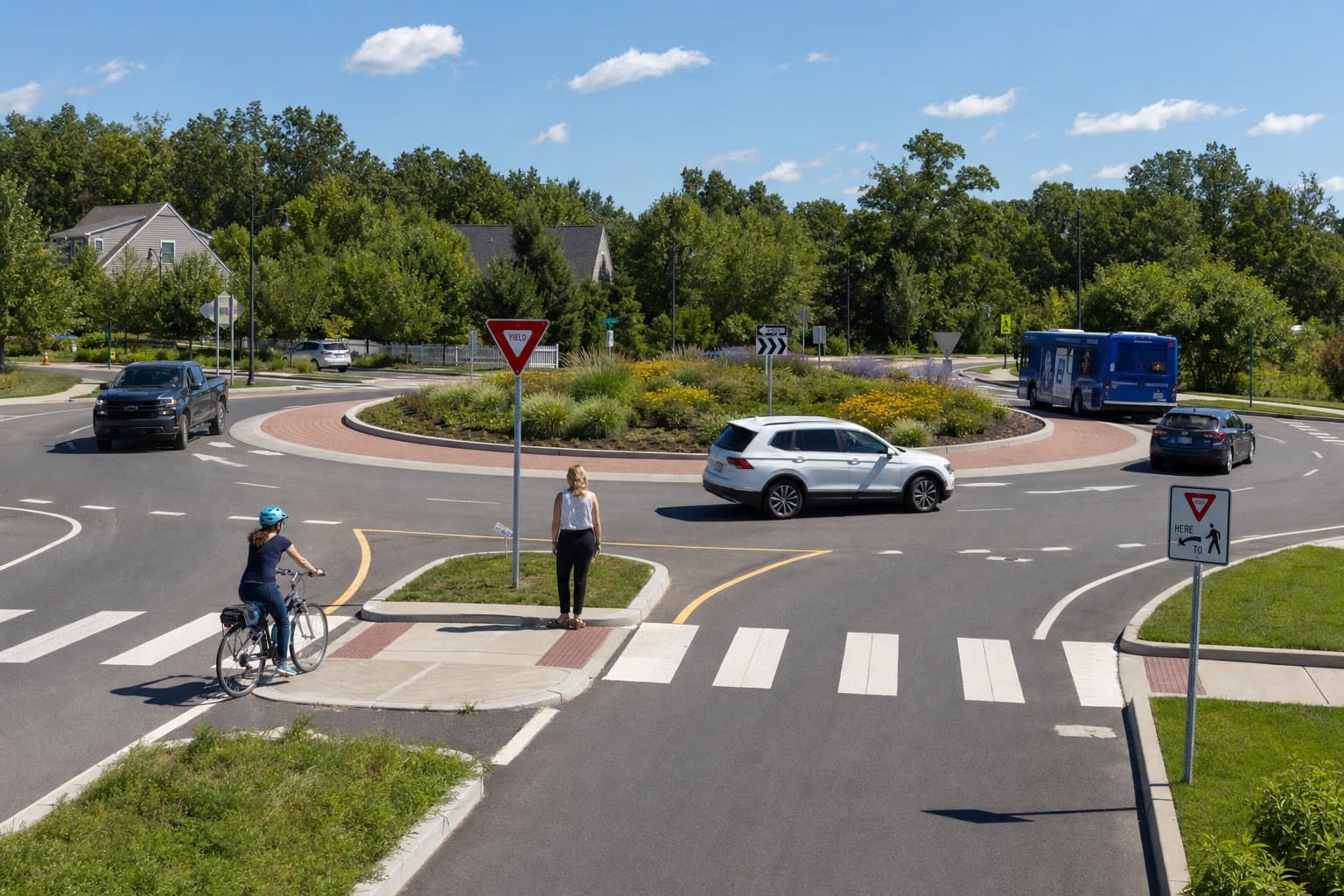
To understand the mechanics of a modern roundabout, one must first distinguish it from older, high-speed rotaries or small neighborhood traffic circles. Modern roundabouts are highly engineered intersections defined by three distinct physical parameters: counterclockwise traffic flow, entry-yield control, and tight geometric curvature designed to keep travel speeds low, typically between 15 and 25 mph.
Conflict Points and Geometric Safety Control
The primary structural benefit of a modern roundabout is the radical reduction of “conflict points”—defined as any location where the paths of two or more road users cross, merge, or diverge.
Traditional four-leg, stop-controlled or signalized intersections contain 32 vehicle-to-vehicle conflict points and 16 pedestrian conflict points. The presence of left-turning movements across oncoming traffic lanes creates high exposure to severe, high-speed broadside (T-bone) and head-on collisions. These are the same high-risk patterns discussed in depth in our guide on why predictability comes first in intersection safety.
Conversely, by forcing all traffic to travel in a unidirectional, counterclockwise path, crossing movements are entirely eliminated. A single-lane modern roundabout contains only 8 vehicle-to-vehicle conflict points and 8 pedestrian conflict points.
The physical geometry of the splitter islands at each approach and the central island in the middle forces approaching motorists to decelerate and deflect into a gentle curve. This structural constraint ensures that any collisions that do occur are typically low-angle, low-speed sideswipes or rear-end impacts rather than fatal broadside crashes.

| Intersection Feature | Traditional Controlled Intersections | Modern Roundabouts |
|---|---|---|
| Vehicle Conflict Points | 32 potential conflict points | 8 potential conflict points |
| Pedestrian Conflict Points | 16 crossing conflict zones | 8 crossing conflict zones |
| Primary Crash Threat | High-speed T-bone and head-on collisions | Low-speed sideswipes and rear-end collisions |
| Average Traffic Speed | Highly variable (0 to 45+ mph depending on signals) | Consistently low (15 to 25 mph) |
| Entry Control Mechanism | Green/Red signals or mandatory STOP signs | Yield-at-entry control |
| Primary Traffic Direction | Multi-directional crossing paths | Unidirectional, counterclockwise flow |
Environmental and Economic Lifespan Metrics
Beyond physical safety, roundabouts present substantial environmental and financial benefits. Because entering vehicles are only required to yield to circulating traffic rather than coming to a mandatory stop when the intersection is clear, overall traffic delay and stop-and-go queuing are significantly reduced. This continuous flow prevents unnecessary idling, reducing fuel consumption and vehicle emissions.
Additionally, because roundabouts do not require electronic signal equipment, municipalities save thousands of dollars annually in electricity costs, signal maintenance, and the emergency repairs often necessitated by power outages or physical damage to traffic lights.
Empirical Proof of Safety and Operational Performance
Decades of research compiled by the Federal Highway Administration (FHWA) and the Insurance Institute for Highway Safety (IIHS) confirm that roundabouts are one of the most effective physical countermeasures for intersection-related deaths and injuries.
| Safety and Operational Metric | Reported Statistical Change Following Roundabout Conversion |
|---|---|
| Fatal and Injury Crash Reduction (All Intersections) | 78% to 82% reduction |
| Fatal and Incapacitating Injury Crash Reduction | 90% reduction |
| Overall Crash Frequency Reduction | 35% to 48% reduction |
| Pedestrian Crash Reduction | 40% to 75% reduction |
| High-Speed Rural Intersection Injury Crashes | 85% reduction |
| Overall Traffic Delay Reduction | 20% to 89% reduction in average vehicle delay |
| Vehicle Stop Frequency Reduction | 56% reduction in complete vehicle stops |
The drastic reduction in injury and fatality rates holds true across diverse geographies. Converting rural, high-speed intersections (speed limits of 40 mph or higher) to roundabouts yields an 85% reduction in injury crashes. Furthermore, national projections estimate that if merely 10% of the signalized intersections in the United States were converted to modern roundabouts, more than 50,000 crashes—including approximately 289 fatal crashes and 32,000 injury crashes—would be prevented annually.
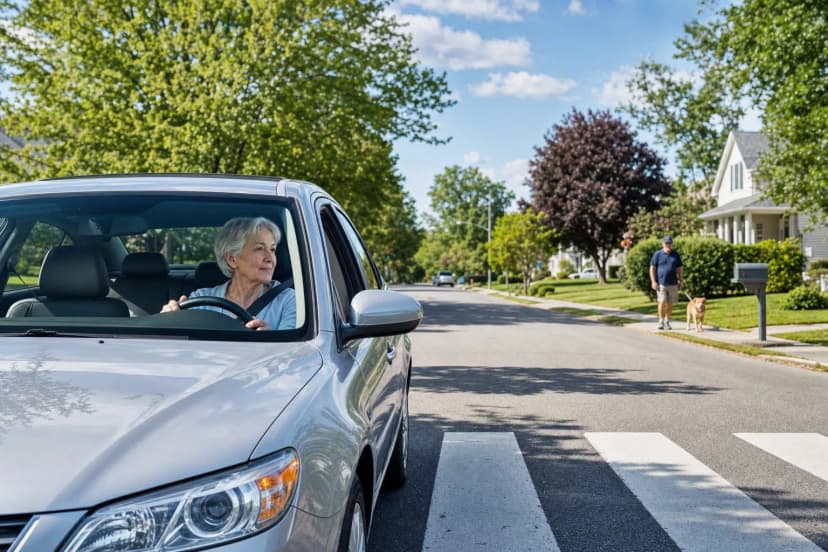
The safety benefits are also clear for older drivers, who are disproportionately involved in multi-vehicle intersection crashes. Because roundabouts eliminate the need to judge complex gaps in high-speed, cross-street traffic or make hurried left turns, the physical and cognitive demands on senior motorists are greatly reduced. These same principles benefit vulnerable riders too; when you add motorcycles into the mix, understanding how drivers “see” and react at intersections becomes even more critical, as explored in our article on reducing motorcycle fatalities at intersections.
Systematic Navigational Mechanics for Drivers
Unfamiliarity with roundabout mechanics often leads to erratic behaviors, such as stopping inside the circle or failing to yield on entry. To navigate these intersections with confidence, drivers must follow a simple, step-by-step set of rules.
Standard Entry and Circulatory Mechanics
The foundational rule of any roundabout is that circulating traffic—vehicles already within the circular roadway—holds the right of way. Approaching motorists must slow down to the posted advisory speed limit and look to their left prior to entering. The vehicle must yield to all circulating vehicles, bicyclists, and pedestrians crossing the entry lane.
When a safe gap in the counterclockwise flow of traffic presents itself, the driver merges smoothly to the right into the circular roadway. Once inside, the vehicle has the right of way over entering vehicles. Motorists must maintain a continuous, low-speed flow, keeping a safe distance from other vehicles, and should avoid coming to a complete stop or attempting to pass another vehicle within the circle. This kind of calm, eyes-up driving also reduces the urge to sneak in a risky screen check or “quick” glance at in-car tech; for a deeper dive into that risk, see our explainer on the danger of the two-second glance at car screens.

Multi-Lane Lane Selection Protocols
Multi-lane roundabouts introduce an additional layer of complexity, requiring motorists to treat the approach lanes exactly like a traditional multi-lane intersection. Drivers must pre-select their lane before entering the roundabout based on their intended exit destination. Lane changes inside the circulatory roadway are highly dangerous and strictly prohibited.
| Intended Destination | Pre-Entry Lane Choice | Action Inside Roundabout | Exit Behavior |
|---|---|---|---|
| Right Turn (First Exit) | Right-hand lane only | Enter right; remain on the outer perimeter | Exit directly into the right-hand lane |
| Straight-Through (Second Exit) | Either lane (follow local signage) | Maintain the selected lane; do not drift or change lanes | Exit directly into the corresponding lane |
| Left Turn (Third Exit) | Left-hand lane only | Circulate along the inner ring of the central island | Signal right and exit into the left lane |
| U-Turn (Complete Loop) | Left-hand lane only | Complete a 360-degree loop around the central island | Signal right prior to taking the designated exit |
If a driver inadvertently selects the wrong lane or misses an exit, they must not stop, brake suddenly, or attempt to reverse. The correct procedure is to simply continue circulating counterclockwise around the central island until the desired exit is reached again. This same “don’t panic, keep moving predictably” mindset is essential any time your vehicle has a problem in motion; if that problem forces you to stop beyond a roundabout, you’ll want to follow a clear roadside plan like the one in our roadside survival and breakdown safety playbook.
Signaling Dynamics and Regulatory Codes
Signal requirements in roundabouts are often a major source of driver confusion and legal debate. Under general vehicle statutes, such as California Vehicle Code Section 22108, any intention to turn right or left must be signaled continuously during the last 100 feet traveled before the turn.
However, applying this rule literally in a roundabout can mislead other drivers. For instance, activating a left turn signal when entering a roundabout can lead waiting motorists to believe the driver intends to turn left against the flow of traffic.
To ensure clarity and predictability, the accepted modern protocol dictates:
- Upon Approach: Do not use a turn signal if planning to go straight. If planning to take the immediate first exit (right turn), activate the right-hand turn signal upon approach.
- While Circulating: Maintain lane position without signaling, or use a left-hand signal if circulating past multiple exits to communicate the intent to remain in the circle.
- Upon Exiting: Activate the right-hand turn signal immediately after passing the exit prior to the intended exit. This provides clear, real-time communication to vehicles waiting to enter at that next approach, allowing them to merge without unnecessary delays.
Managing Specialized Vehicles and Vulnerable Road Users
A safe roundabout environment requires motorists to expand their awareness beyond passenger cars and adapt to specialized road users.
Heavy Freight and Oversized Vehicles
Due to their long wheelbase, semi-trucks, buses, and trailers cannot negotiate the tight turning radii of a roundabout within a single lane. To accommodate these oversized loads, civil engineers construct a “truck apron”—a low, mountable concrete ring surrounding the central island.
The apron is designed with a rolled curb, allowing the rear wheels of large commercial vehicles to ride up onto the concrete to successfully complete the turn.
Passenger vehicle operators must avoid driving directly next to large trucks inside a roundabout. Under traffic codes, commercial vehicles are permitted to straddle or occupy both lanes of a multi-lane roundabout to ensure sufficient clearance. Motorists must remain behind these large vehicles and never attempt to pass them.
Emergency Vehicle Priority Procedures
Encountering an emergency vehicle (such as an ambulance, fire engine, or police cruiser) with active sirens and lights requires precise execution to avoid gridlock:
- Prior to Entry: If a motorist has not yet entered the roundabout, they must pull over to the right-hand shoulder before entering and allow the emergency vehicle to pass.
- Within the Roundabout: If a motorist is already circulating inside the roundabout, they must not stop inside the circular roadway. Stopping blocks the passage of the emergency vehicle and creates a high risk of a collision. Instead, the driver must continue circulating to their desired exit, clear the roundabout completely, and then immediately pull over to the right to allow the emergency vehicle to bypass.
Pedestrian and Bicycle Integration
The design of modern roundabouts inherently prioritizes the safety of non-motorized users. Pedestrians navigate roundabouts via perimeter sidewalks and crosswalks positioned at least one car length back from the yield line.
The splitter islands serve as a safe refuge, allowing pedestrians to cross only one direction of traffic at a time. Motorists must always yield to pedestrians and cyclists within marked crosswalks at both the entry and exit points.
Bicyclists have two distinct options for navigating a roundabout:
- As a Vehicle: Experienced cyclists may merge into the center of the travel lane prior to entry and circulate through the roundabout like a motor vehicle, maintaining lane position and using hand signals to indicate their exit.
- As a Pedestrian: Less confident cyclists may exit the roadway via transition ramps, utilizing the sidewalk network and crossing at pedestrian crosswalks while walking their bicycles.
Many of these choices echo broader shifts in how we share space with scooters, e-bikes, and other micromobility devices in busy corridors. For a bigger-picture look at curbside and sidewalk conflicts around modern vehicles and small electric devices, see our analysis of micromobility collisions and pedestrian risk.
Modern Safety Networks and Tech-Enabled Road Accountability
While physical infrastructure and strict legal codes establish the foundation for road safety, the human element remains the most volatile variable. The transition phase during which a community adapts to new roundabout installations is often plagued by minor collisions, near-misses, and road rage stemming from driver confusion. In these environments, traditional traffic enforcement cannot monitor every failure to yield or improper lane change.
The integration of community-driven safety platforms, such as Carszy, plays a vital role in easing the friction of modern intersection transitions [cite: Carszy Context]. By utilizing license plates as unique, secure identifiers, Carszy enables motorists to securely communicate and resolve on-road safety hazards [cite: Carszy Context]. This layer of peer-to-peer connection turns everyday drivers into extra “eyes on the road,” complementing formal enforcement and design fixes described in our guide to enhancing night safety and intersection design.
In a roundabout setting, where signaling errors or vehicle hazards (such as an open trunk or unsecured load) can disrupt continuous flow, real-time License Plate Messaging allows trailing drivers to notify others securely [cite: Carszy Context, 12, 45].
Furthermore, in the event of minor collisions or hit-and-runs—common during a community’s adaptation period—the platform’s Vehicle of Interest Search (VOIS™) enables crowd-sourced alerts to assist law enforcement, while its Human Media™ model prioritizes real-world road accountability over passive social media sharing [cite: Carszy Context, 11, 16]. This transition from passive observation to active, community-driven communication empowers neighbors, protective parents, and commuters to collectively enforce safety standards [cite: Carszy Context]. Similar tools can also help when you’re buying, selling, or tracking vehicles in the broader marketplace, as outlined in our guide to detecting and avoiding vehicle fraud.
Conclusions
The modern roundabout is a triumph of safety engineering, physically preventing the high-speed crossing maneuvers that cause fatal broadside collisions. While navigating these circular systems can initially feel counterintuitive, achieving mastery is simple when drivers commit to three universal rules: slow down upon approach, yield to all circulating traffic on the left, and pre-select the appropriate lane based on the final destination.
Through continuous driver education, adherence to legal signaling protocols, and the adoption of modern peer-to-peer safety platforms, communities can eliminate intersection fatalities while creating a cooperative, stress-free driving environment [cite: Carszy Context, 11, 32]. For families sending teen drivers through complex intersections and roundabouts for the first time, pairing this knowledge with smart vehicle and tech choices—like those described in our guide to keeping teens safe in their first car—can build a strong safety net around new drivers.
To foster real-time community safety and highway accountability, motorists are encouraged to download peer-to-peer connectivity platforms like the Carszy app, available for Android and iOS integration [cite: Carszy Context].
Supporting Articles
- California Driver Handbook
- Roundabouts in the United States (PDF)
- Office of Safety's Roundabouts webpage
Frequently Asked Questions
Why do some multi-lane roundabouts experience a temporary increase in minor accidents after installation, and how is fault legally determined in these collisions?
When a traditional signalized or stop-controlled intersection is converted to a multi-lane roundabout, data shows that minor, property-damage-only (PDO) collisions, such as low-speed sideswipes and rear-end bumper contacts, can initially increase by 10% to 35%. This transient spike is driven by driver unfamiliarity, cognitive confusion, and three specific navigational errors:
- Failing to yield to circulating vehicles on entry.
- Attempting sudden lane changes inside the circular roadway rather than circulating to correct a missed exit.
- Pre-selecting the incorrect lane on approach.
However, as communities adapt to the geometry over time, multi-lane roundabout collision rates decrease by an average of 9% annually, and the odds of a collision resulting in an injury drop by nearly 33% per year.
In terms of legal liability, states like California operate under comparative fault rules, meaning responsibility can be apportioned between multiple parties based on the specific evidence of the crash. Under standard vehicle codes (such as California Vehicle Code Section 21803), the primary liability for a roundabout collision typically falls on the entering driver if they failed to yield to a circulating vehicle that constituted an “immediate hazard.”
However, if the circulating vehicle was traveling at an unsafe speed, changed lanes unlawfully within the circle, or failed to signal an exit, contributing to the collision, fault may be shared. Collecting concrete evidence, such as witness accounts, dashcam footage, and real-time driver-to-driver alerts, is highly critical in resolving these disputes.