First Rain of the Season: Why Roads Are Slickest After a Long Dry Spell
The arrival of the first significant rainstorm following a long Southern California dry spell is a highly anticipated meteorological event. For months, the region experiences relentless sunshine, bone-dry conditions, and the steady hum of millions of vehicles traveling across the expansive concrete and asphalt arteries of Los Angeles, Orange County, and San Diego. When the clouds finally break, the unmistakable, earthy scent of petrichor signals a welcome shift in the seasons. However, for the daily commuter, the neighborhood watch advocate, and the protective parent navigating the freeway system, this highly anticipated weather event quietly ushers in the most dangerous driving window of the entire year.
What appears to be a harmless, light drizzle instantly converts the region's roadways into low-friction hazard zones that rival the dangers of black ice. The transformation is invisible, immediate, and mathematically catastrophic for overall traffic safety. Understanding the exact chemical and physical mechanisms behind this phenomenon, how it fundamentally alters vehicle control dynamics, and how tech-forward community platforms like Carszy are revolutionizing how motorists protect one another during these chaotic weather events is essential for every driver on the road. If you also drive in wildfire season or mountain terrain, pairing this knowledge with the guidance in our wildfire evacuation driving guide and mountain descent safety overview can further reduce your overall risk.
This comprehensive report explores the complex chemistry of road surface emulsions, analyzes decades of traffic safety data, details the mechanics of modern automotive safety systems, and provides actionable, real-world strategies for navigating the treacherous first rain of the season.
The Chemistry of the First Shower: Formation of the Invisible Emulsion
To comprehend why the first rain of the season is dramatically more dangerous than a torrential mid-winter downpour, one must deeply examine the microscopic landscape of the pavement during Southern California's prolonged, arid summers.
The Accumulation of Urban Automotive Contaminants
For upwards of two hundred consecutive days without significant precipitation, the micro-texture of the region's asphalt acts as a vast, porous sponge. Every day, millions of passenger cars, commercial trucks, and mass transit buses deposit microscopic amounts of various automotive fluids and mechanical debris onto the roadway. This continuous, invisible accumulation includes:
- Crankcase motor oil and heavy mechanical lubricants.
- Transmission fluid, power steering fluid, and antifreeze.
- Unburned gasoline and diesel fuel residue.
- Synthetic tire rubber particles and metallic brake dust.
During dry weeks and months, this complex cocktail of chemicals remains embedded deep within the peaks and valleys of the asphalt's aggregate surface. Because the road retains its sharp, abrasive grit at the microscopic level, modern pneumatic tires are able to key into the surface. This mechanical interlocking maintains a high coefficient of friction, generally measured at approximately 0.75 to 0.85 on dry pavement, allowing vehicles to corner, accelerate, and brake with predictable stability.
The Activation Phase: Water as a Chemical Lifting Agent
When the first light rain or autumn drizzle finally falls, a complex chemical and physical reaction takes place on the surface of the highway. Because petroleum-based substances—such as motor oil and diesel fuel—are inherently less dense than water, they do not dissolve or wash away immediately upon contact with moisture. Instead, the initial water droplets seep into the microscopic crevices of the asphalt, physically lifting the embedded oil, grease, and rubber particles to the surface via capillary action and fluid density displacement.
This lifting action creates a highly dispersed, microscopic suspension known as a micro-emulsion. In physical chemistry, a micro-emulsion is an isotropic, thermodynamically stable, and highly dispersed system formed by two mutually immiscible liquids—in this case, the oil phase from the vehicle contaminants and the water phase from the rain. The mechanical action of the tires rolling over the wet road acts as a mixing agent, facilitating the rapid emulsification of these substances.
The Formation of Shell-Core Structures
The resilience of this dangerous road film is driven by the presence of natural surfactants and chemical byproducts within the automotive fluids. These surfactants distribute themselves at the oil-water interface, significantly reducing interfacial tension. This process promotes the formation of nanosized "shell-core structures," where the oil phase acts as the inner core, surrounded by a protective layer of water and surfactant molecules. These microscopic droplets, typically ranging from 1 to 100 nanometers in size, create a continuous, soapy barrier that floats directly on top of the thin layer of rainwater.
The resulting mixture behaves identically to a highly engineered industrial lubricant. When a vehicle's tires encounter this thermodynamically stable emulsion, the road's coefficient of friction plummets instantly. The grip drops from a dry-weather rating of 0.8 down to approximately 0.30 to 0.35—a staggering 60 percent loss in traction that renders the pavement roughly as slippery as packed snow.
The Visual Deception of the Drizzle
The most treacherous aspect of the first-rain phenomenon is its visual deception. Human driving instincts are typically calibrated to visual threats. A heavy, continuous downpour looks intimidating, prompting the average commuter or protective parent to intuitively reduce their speed and increase their following distance. However, a light, gray drizzle after three dry weeks looks entirely harmless, providing zero visual warning that the physical properties of the road have fundamentally changed.
Motorists tend to carry their dry-road speed limits and dry-road following distances straight into these conditions, completely unaware that the grip beneath their tires has been slashed by more than half. This same pattern of misjudging risk shows up in other contexts too, like drivers who underestimate how long it takes to stop near large trucks with huge blind spots and braking distances.
If the precipitation continues heavily, the problem eventually solves itself through mechanical dilution. After approximately 30 to 45 minutes of a steady downpour, a sufficient volume of water flows across the road's camber to break the interfacial tension of the micro-emulsion, carrying the oily slurry away into the municipal gutters. Consequently, a road in the middle of a continuous rainstorm is genuinely safer and far more predictable than that exact same road during the first ten to fifteen minutes of a light shower.
The Statistical Reality: Quantifying the Danger in Southern California
While the physics of oily micro-emulsions apply universally to paved roads across the globe, the unique climatological patterns of Southern California exacerbate the danger to unprecedented levels. The length of a dry spell directly correlates to the total volume of accumulated oil, and very few major metropolitan areas experience longer continuous dry spells than the Los Angeles, Orange County, and San Diego basins.
The UC Berkeley Traffic Safety Analysis
To quantify the exact relationship between precipitation, dry spells, and traffic fatalities, researchers have conducted extensive statistical modeling. A landmark study conducted by Daniel Eisenberg, a researcher at the University of California, Berkeley’s School of Public Health, analyzed over one million fatal crashes across 48 states to determine how weather patterns influence roadway safety.
Eisenberg utilized weather data from the National Climatic Data Center and traffic crash records from the National Highway Traffic Safety Administration (NHTSA), examining fatal crashes from 1975 through 2000. The findings revealed a counterintuitive truth: while a consistently rainy month actually decreases the overall fatal crash rate—because constant rain keeps roads washed clean and forces drivers to maintain slower speeds—the danger on any specific rainy day spikes dramatically based on the length of the dry spell immediately preceding it.
Specifically, the study found that in any given month, an additional 10 centimeters of overall rain is linked with a 3.7 percent decrease in the fatal crash rate. However, when analyzing daily accident data, the risk matrix inverted. The study found that if an area experiences rain just two days after a previous shower, the risk of a deadly accident increases by 3.7 percent. The risk compounds exponentially as the dry spell lengthens. If the dry spell extends to 21 days, the risk of a fatal accident jumps by 9.2 percent—roughly two and a half times the risk of a short two-day dry spell.
Furthermore, Eisenberg's analysis of 36.4 million nonfatal crashes from 1990 to 1999 revealed that precipitation has an even larger impact on nonfatal collisions, such as fender benders and injury crashes. For any given day, each centimeter of precipitation increases the risk of fatal crashes by about 1 percent, but the risk for nonfatal crashes surges by 11 percent. Drivers who slow down slightly when the weather is bad may not slow down enough to avoid a crash entirely, but they at least reduce the severity of the collision, converting a potential fatality into a property damage event.
When applying this data to Southern California—where dry spells routinely stretch from April through November, far exceeding the 21-day maximum analyzed in the baseline study—the statistical risk multiplier becomes staggering.
The 570 Percent Surge in Regional Accidents
The transition from a dry summer to a wet autumn in the Los Angeles basin consistently triggers a massive surge in traffic collisions. When the first major Pacific front or "Sky River" atmospheric storm hits the region, the resulting chaos is heavily documented by emergency responders and highway safety officials.
During the onset of the first significant rainy period of the season, the California Highway Patrol (CHP) has recorded a massive 570 percent increase in traffic accidents across Los Angeles County compared to a normal dry day. On a standard, dry afternoon, the CHP might record an average of 376 crash service calls. During a comparable first-rain event, that number can easily spike to over 820 calls within a matter of hours, leading to gridlocked freeways, overwhelmed emergency response systems, and highly dangerous conditions for stranded motorists. These strained resources mirror what communities see during other high-risk periods, such as major impaired-driving enforcement nights in California.
The city's specific geography further compounds the risk. The Los Angeles basin acts as a topographical bowl, trapping water in low-lying corridors. Furthermore, concrete streets and heavily engineered freeway systems offer virtually no water absorption. Burn-scar areas from recent summer wildfires shed mud, ash, and rocks directly onto the roadways, creating debris flows that interact with the oily emulsion to form an even more treacherous driving surface.

The Physics of Friction and Stopping Distance Dynamics
To fully grasp the severe danger posed by the first rain of the season, it is necessary to examine how this oily emulsion affects a vehicle's stopping distance. The ability to halt a moving vehicle is governed by the laws of kinetic energy, the coefficient of friction, and the physiological reaction time of the human operating the machinery.
Stopping distance is not a single metric; it is a calculation comprising three distinct phases:
- Perception Distance: The time and distance required for the driver's brain to recognize a hazard on the road (average of 1.5 seconds, or 71 feet at 65 mph).
- Reaction Distance: The time and distance required for the driver's foot to move from the accelerator to the brake pedal (average of 1.5 seconds, or 71 feet at 65 mph).
- Braking Distance: The physical distance the vehicle travels while the brakes are fully engaged, dissipating the vehicle's kinetic energy through heat and friction.
When a passenger vehicle travels at 60 miles per hour on dry, optimal pavement, an alert driver with high-quality tires requires approximately 240 feet to come to a complete, controlled stop. On wet pavement—particularly pavement coated in the highly lubricated, first-rain oil emulsion—that physical braking distance expands dramatically.
| Speed (MPH) | Average Stopping Distance (Dry Road) | Average Stopping Distance (Wet/Oily Road) | Total Stopping Distance Increase |
|---|---|---|---|
| 20 mph | 40 feet | 60 feet | 1.5x longer |
| 40 mph | 120 feet | 200 feet | 1.6x longer |
| 60 mph | 240 feet | 420 feet | 1.75x longer |
| 80 mph | 400 feet | 720 feet | 1.8x longer |
This massive expansion in required stopping distance is the primary mechanical reason why rear-end collisions multiply exponentially during the first hour of autumn rain. A commuter who safely maintains a standard three-second following distance in August will find that exact same spatial gap disastrously inadequate in November. A vehicle traveling at 65 mph requires approximately 525 feet of actual brake application to stop on wet roads. When the vehicle in front suddenly halts, the trailing vehicle simply runs out of physical space, regardless of the driver's reaction time.
Furthermore, the weight of the load heavily influences braking dynamics. Commercial vehicles and heavy trucks require significantly more stopping distance than passenger cars. Interestingly, an empty commercial truck requires a greater stopping distance than a fully loaded truck, as the lack of weight reduces the downward force on the tires, resulting in less traction and a higher likelihood of the wheels locking up and bouncing over the oily surface.
Automotive Safety Systems: ABS, TPMS, and Tire Dynamics
Modern vehicles are equipped with an array of highly advanced electronic safety systems designed to assist the driver during emergency maneuvers. However, under the specific conditions of a first-rain oil emulsion, the effectiveness of these systems can be severely compromised, and in some cases, they can behave counterintuitively.
The Paradox of the Anti-Lock Braking System (ABS)
The Anti-lock Braking System (ABS) is a standard automobile safety feature designed to prevent the wheels from locking up (ceasing rotation) during hard braking, thereby allowing the driver to maintain steering control and avoid an uncontrolled skid. ABS operates using the principles of threshold braking and cadence braking, utilizing an Electronic Control Unit (ECU) and wheel speed sensors to monitor the rotational speed of each individual wheel.
When the ECU detects that a wheel is decelerating too rapidly and is about to lock up, it commands a hydraulic valve to rapidly reduce and reapply the brake line pressure to that specific wheel—pulsing the brakes much faster than any human driver could manage.
While ABS is a brilliant technological advancement that generally offers improved vehicle control and decreases stopping distances on dry surfaces, it encounters a severe paradox on loose gravel, snow, or roads coated in a viscous oil emulsion. On an oily film, the ABS sensors detect the wheels locking up almost immediately upon brake application due to the incredibly low coefficient of friction. The system responds by releasing the brake pressure earlier and more frequently to keep the wheels rotating.
Because the ABS is constantly releasing the brakes to prevent a skid on the slippery emulsion, the vehicle stays steerable, but the physical stopping distance grows dramatically. Drivers must understand that ABS manages the grip that currently exists; it cannot manufacture traction out of thin air. If the brake pedal begins to shudder or vibrate violently during a wet-weather stop, drivers should maintain firm, continuous pressure on the pedal and use the steering wheel to guide the vehicle into a safe lane or shoulder—they must never pump the brakes manually, as this defeats the electronic system.
Tire Pressure Monitoring Systems (TPMS) and Wet Weather Safety
The contact patch of a tire—the physical area of rubber touching the road—is the vehicle's only connection to the pavement. The efficiency of this contact patch is entirely dependent on proper tire inflation. Under-inflated tires create excessive rolling resistance, run hotter, and, crucially, suffer from a severely altered footprint that prevents the tire's grooves from effectively channeling water away from the center of the tread. This dramatically increases the risk of hydroplaning and extends braking distances on wet roads.
To combat the epidemic of under-inflated tires, the NHTSA instituted Federal Motor Vehicle Safety Standard No. 138, requiring the installation of Tire Pressure Monitoring Systems (TPMS) on all passenger cars, multipurpose passenger vehicles, trucks, and buses with a gross vehicle weight rating of 10,000 pounds or less.
The automotive industry utilizes two basic types of TPMS:
- Direct TPMS: Utilizes a physical pressure sensor located inside each tire, providing highly accurate, real-time pressure readings directly to the vehicle's dashboard.
- Indirect TPMS: Does not have physical pressure sensors. Instead, it relies on the wheel speed sensors within the ABS to detect and compare differences in the rotational speed of the wheels. Because a tire with low pressure has a slightly smaller diameter, it must rotate faster than a properly inflated tire to cover the same distance.
The regulatory standard dictates that the TPMS must warn the driver when the pressure in one or more tires falls 25 percent or more below the manufacturer's recommended cold inflation pressure. While this system saves lives, tech-savvy drivers must recognize that a tire can be 20 percent under-inflated—significantly compromising its ability to evacuate water and grip an oily road—without triggering a dashboard warning light. Regular, manual tire pressure checks remain a critical component of wet weather preparation.
The Science of Tire Siping and Hydroplaning Mitigation
Tire manufacturers engineer complex tread patterns to provide adequate water escape passages, allowing the rubber blocks to cut through surface water and maintain contact with the asphalt. The NHTSA and local laws require a minimum tread depth of 2/32 of an inch, though safety experts heavily recommend replacing tires well before they reach this legal absolute minimum, as water evacuation capabilities degrade exponentially as the tire wears down.
Beyond deep grooves, the most effective mechanical defense against viscous hydroplaning on emulsion-coated roads is a technology known as "siping." Sipes are hundreds of tiny, razor-thin slits cut directly into the rubber tread blocks of the tire. When the tire rolls and the weight of the vehicle compresses the tread against the road, these sipes physically open up, creating thousands of sharp, microscopic edges.
These sharp edges act like miniature squeegees, penetrating and slicing through the lubricating film of oil and water. This squeegee action channels the emulsion away from the contact patch, minimizing and often entirely eliminating the phenomenon of hydroplaning. Furthermore, because the sipes allow the tread blocks to flex, they help dissipate heat, allowing the tires to run cooler and increasing overall tire lifespan by 15 to 20 percent, making them highly cost-effective for fleet operators and everyday commuters alike.
High-Risk Zones: Where the Emulsion Collects
The oily emulsion generated during the first rain does not spread evenly across the roadway. The buildup is heavily concentrated in specific geographical micro-environments where vehicles are most likely to stand still, crawl with engines idling, or execute sharp maneuvers. Recognizing these high-risk zones allows proactive drivers to adjust their speed and handling long before traction is lost.

Intersections, Traffic Lights, and Roundabouts
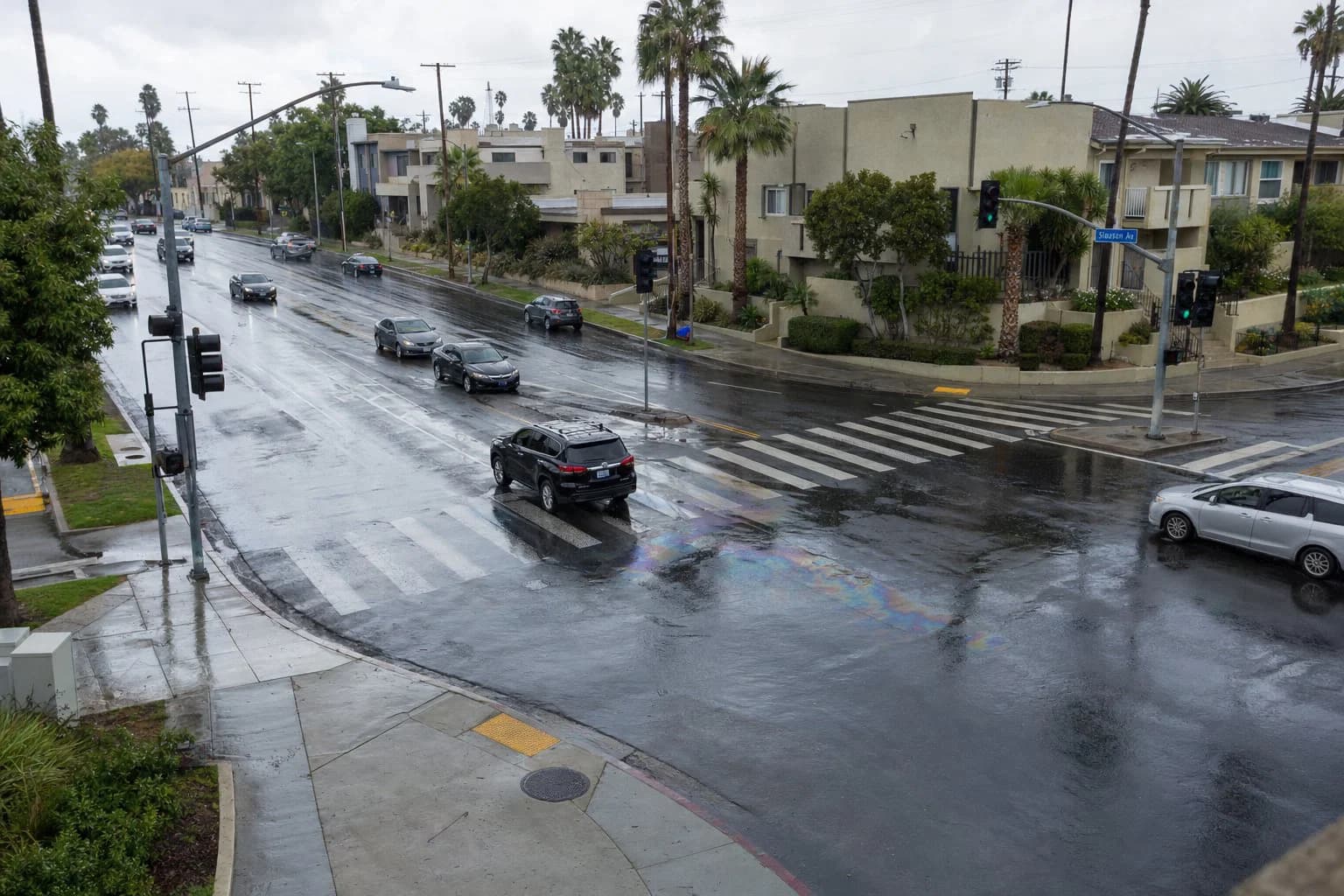
The most severe accumulations of motor oil, brake fluid, and power steering fluid occur on the immediate approaches to red lights, stop signs, and the give-way lines at roundabouts. Vehicles sit idling in these locations for extended periods, dripping fluids directly into the center of the lane. When the first rain hits, these intersections transform into frictionless hazards. Drivers attempting to brake normally for a yellow light often find their vehicle gliding effortlessly over the emulsion, sliding completely through the intersection while the ABS pulses violently. If you regularly navigate complex circular junctions, many of the same principles about lane choice and low-speed control are covered in our guide on driving modern roundabouts safely.
Painted Road Markings and Municipal Infrastructure
Standard highway asphalt possesses a rough micro-texture that helps channel water away from the tire contact patch. However, painted road markings, thermoplastic crosswalk lines, and directional arrows possess virtually no surface texture. The moment these painted surfaces become wet, their friction coefficient drops near zero. A motorcycle or passenger vehicle that places a drive wheel on a painted limit line during a turn or hard acceleration can experience an instantaneous and highly unpredictable loss of traction.
Similarly, steel manhole covers, expansion joints on bridges, and embedded tram rails go properly slippery the exact moment they are exposed to moisture, acting as localized ice patches amidst the asphalt. For riders, this visual deception is similar to how drivers often "don’t see" motorcycles at intersections, a problem explored in depth in our piece on reducing motorcycle intersection fatalities.
Commercial Transit Hubs and Toll Plazas
Heavy commercial vehicles, freight trucks, and mass transit buses drop significantly higher volumes of diesel fuel and heavy industrial lubricants than standard passenger cars. Consequently, designated bus lanes, municipal bus stops, and the exit lanes from commercial filling stations are heavily saturated with these petroleum chemicals. Toll booth approaches, where thousands of vehicles idle daily, are also notorious for severe, localized oil accumulation.
The Role of Tech and Community in Storm Safety
When traffic accidents spike by 570 percent during a Southern California storm, the traditional municipal safety net is stretched far beyond its operational limits. California Highway Patrol dispatchers, local emergency medical services, and regional tow truck operators become rapidly overwhelmed, leading to substantially delayed response times for non-injury collisions, disabled vehicles, and roadway hazards.
This systemic overload highlights the vital importance of community-driven safety networks. The modern vehicle owner is no longer solely reliant on municipal infrastructure; advanced technology now empowers drivers to protect one another in real-time. This is the foundational philosophy behind Carszy, a comprehensive driver-to-driver communication and community safety platform designed to bridge the gap during chaotic travel conditions. The same network approach that helps during first rains can also improve outcomes in everyday breakdowns, much like the protocols described in our roadside survival and breakdown safety playbook.
License Plate Messaging: The Ultimate Preventative Tool
During a sudden seasonal downpour, visibility drops drastically due to heavy rain, road spray, and overcast skies. Yet, countless motorists—accustomed to months of bright sunshine—forget to manually activate their headlights, rendering their silver or gray vehicles virtually invisible in the freeway spray. In the past, other drivers could only honk their horns or flash their high beams in frustration, hoping the offending driver understood the signal.
With Carszy's License Plate Messaging technology, the dynamic shifts entirely toward proactive communication. A passenger in a trailing vehicle can securely and anonymously send a text message or initiate a secure call to the offending vehicle using only its license plate number as a unique identifier. A quick, polite "lights off" or "tailgate open" alert delivered through the US-based, privacy-focused platform can instantly resolve a massive safety hazard before an accident occurs. This peer-to-peer accountability is a cornerstone of proactive road safety, allowing the community to self-regulate without waiting for law enforcement intervention.
VOIS™ (Vehicle of Interest Search) and Hit-and-Run Mitigation
The unfortunate reality of wet-weather driving in densely populated metropolitan areas is a sharp increase in hit-and-run incidents. The combination of slick roads, panic braking, and reduced visibility inevitably leads to minor collisions where an at-fault driver panics and flees the scene. In the chaos of a storm, law enforcement response times are understandably delayed, prioritizing severe injury crashes and allowing the fleeing vehicle to escape the immediate area.
The VOIS™ (Vehicle of Interest Search) feature addresses this systemic vulnerability by rapidly mobilizing the community. If a hit-and-run occurs in the rain, the community-driven alert system can be activated by witnesses or victims. Nearby drivers, neighborhood watch advocates, and commuters equipped with the app are immediately notified to look out for the specific vehicle make, model, and license plate. This real-time, geolocation-based safety feature effectively turns thousands of everyday drivers into a synchronized, vigilant network, drastically reducing the time it takes to locate vehicles involved in critical incidents and ensuring accountability on slick roads.
Human Media™: Real-World Impact Over Social Doomscrolling
While traditional social media platforms thrive on passive consumption and the viral sharing of disaster footage, the Human Media™ approach fosters real-world intervention and measurable impact. Instead of passively recording dangerous driving, road rage, or reckless speeding in the rain to post online later, safety-conscious parents and tech-savvy drivers utilize the platform to report reckless behavior immediately.
When a driver is weaving through traffic at 80 mph on an oil-slicked highway, reporting that license plate creates a localized footprint of accountability. This proactive approach keeps communities safe by addressing dangerous driving behaviors long before they culminate in a multi-car pileup, shifting the culture of the road from isolated frustration to active, collaborative protection. The same mindset is critical when dealing with drivers who are distracted by in-car screens; for more on that risk, see our explainer on why even a two-second glance away from the road can be deadly.
Actionable Safety Protocols for the First Rain
Understanding the physics of the road and utilizing community tech platforms are vital components of modern driving, but avoiding a collision ultimately comes down to the physical operation of the vehicle. The National Highway Traffic Safety Administration (NHTSA), the California Highway Patrol, and defensive driving experts provide strict, actionable guidelines for navigating the first rain after a dry spell.
1. The Mandatory Deactivation of Cruise Control
Under no circumstances should adaptive or standard cruise control be utilized during wet weather, particularly during the first hours of a storm. If a vehicle hits a patch of deep water or an oil emulsion and begins to hydroplane, the drive wheels lose contact with the road and spin freely. The cruise control system interprets this sudden spike in wheel RPM or the loss of forward momentum as a need for more engine power to maintain the set speed.
The system will aggressively open the throttle. When the tires suddenly regain traction on the other side of the puddle or oil slick, the vehicle will lurch violently forward, almost guaranteeing a catastrophic, high-speed spinout. Drivers must maintain total manual control over the accelerator to feel the road's feedback.
2. Doubling the Following Distance
Because the required stopping distance on an oily, wet road expands from 240 feet to over 420 feet at highway speeds, the standard three-second following distance is mathematically insufficient to prevent a collision. Safety experts, including the NHTSA, strictly recommend increasing the following gap to a minimum of five to six seconds during the first hour of rainfall.
This extended buffer provides the necessary perception and reaction time for the driver to recognize a hazard, and it allows the vehicle the physical space required to decelerate smoothly without triggering a panic stop or engaging the ABS on a low-friction surface.
3. Managing Hydroplaning Dynamics
Hydroplaning—specifically dynamic hydroplaning—occurs when a vehicle encounters a volume of standing water greater than the tire treads can rapidly displace. The water builds up in front of the tire, physically pushing the front wheels off the ground and causing the vehicle to surf on a thin liquid film. This terrifying loss of control can occur at speeds as low as 35 mph, especially if the tires are worn or under-inflated.
If a vehicle begins to hydroplane, the correct mechanical response is counterintuitive to human panic. The driver must calmly ease their foot off the accelerator, keep the steering wheel pointed perfectly straight, and wait for the vehicle to naturally decelerate until the tires cut through the water and regain contact with the pavement. Braking abruptly or turning the steering wheel while surfing on water will cause the car to snap into a violent, uncontrollable skid the exact moment the tires touch the abrasive asphalt again.
4. Avoiding Deep Water and Flood Zones
The California Governor's Office of Emergency Services (Cal OES) and the CDC report that the most common type of flood-related drowning occurs when a vehicle is deliberately driven into hazardous flood water. Drivers frequently underestimate the sheer kinetic power of rushing water. It takes only 12 inches of rushing water to carry away most passenger cars, and just two feet of rushing water can carry away heavy duty pickup trucks and SUVs.
When navigating Southern California roads during an intense storm, if a driver encounters a flooded intersection, standing water of unknown depth, or physical barriers blocking the road, the only safe action is to turn around. Attempting to forge through deep water not only risks hydroplaning but can also result in catastrophic engine failure if water is ingested into the air intake system. These choices about when to move and when to wait are closely related to the timing decisions discussed in our wildfire evacuation strategies for drivers.
Fostering a Culture of Roadway Empathy and Preparedness
The first rain of the season in Southern California does not have to be synonymous with bent fenders, skyrocketing insurance premiums, and gridlocked interstates. By understanding the rigorous chemical realities of oil-slicked asphalt, respecting the physics of reduced friction, and acknowledging the statistical dangers unique to long dry spells, motorists can drastically reduce their individual risk profile.
More importantly, the integration of community-focused technology fundamentally shifts the paradigm of roadway travel from isolated, individual survival to collective, networked security. When drivers possess the modern tools to anonymously alert one another to safety hazards, coordinate effortlessly with neighborhood watches during critical incidents, and report severe infractions in real-time, the roadway transforms into a collaborative environment built on mutual accountability.
Southern California's sudden seasonal shifts demand a higher caliber of driver awareness and technological adoption. As the clouds gather over the basin and the first drops of rain begin to lift months of accumulated oil to the surface, the safest communities are those that stay informed, increase their following distances, ensure their tires are properly maintained, and actively look out for one another. Families teaching young drivers can weave this mindset into broader coaching, alongside the structured guidance found in our resource on coaching teen drivers calmly and safely.
Safety-conscious drivers, protective parents, neighborhood watch advocates, and daily commuters are highly encouraged to download the Carszy app today. By doing so, they stay connected to their local environment, maintain vital roadway accountability, and actively participate in building a safer, more communicative, and highly responsive driving culture for everyone on the road. For an even wider look at how uninsured drivers, AI claims, and community tools like Carszy shape your financial risk after a crash, see our overview of 2026 auto insurance and community safety trends.
Recommended Reading on Wet Weather Safety
- NHTSA Guidelines for Driving in Severe Weather
- Safe Driving Tips for Wet Roads and Hydroplaning Mitigation
- Understanding Tire Braking Distance and Friction Dynamics
Frequently Asked Question
Why are roads slickest right after a long dry spell during the first rain?
During periods of extended dry weather, millions of vehicles continuously deposit microscopic amounts of engine oil, transmission fluid, diesel fuel, and synthetic tire rubber onto the road's surface. These slippery substances embed themselves deeply in the porous texture of the asphalt. When the first rain finally falls, the water—which is physically denser than the petroleum-based fluids—seeps into the asphalt and lifts these accumulated oils to the surface. This creates a highly lubricated, soapy micro-emulsion that floats directly between the vehicle's tires and the pavement, drastically reducing the road's coefficient of friction. This oily film makes the road behave like slick ice for the first 10 to 15 minutes of a shower, significantly increasing the required stopping distance. Only after 30 to 45 minutes of a steady, heavy downpour is this dangerous layer finally washed away into the municipal gutters, restoring standard wet-weather traction to the roadway.