The Physics of the Highway: Decoding Semi-Truck No-Zones, Underride Risks, and the Dangers of Tailgating
The open highway presents a unique and inherently dangerous environment where traditional passenger vehicles routinely share the asphalt with commercial leviathans. For safety-conscious parents, daily commuters, and community watch advocates, understanding the complex dynamics between these vastly different vehicles is a critical component of neighborhood security and road safety. The mechanical limitations and physical laws that govern a standard sedan simply do not apply to an eighteen-wheeler. When a passenger vehicle tailgates a semi-truck, lingers in a blind spot, or aggressively cuts into a commercial driver's braking cushion, the resulting physics equation frequently ends in catastrophic failure.
To navigate these shared spaces safely, it is essential to decode the scientific realities of commercial trucking. This exhaustive analysis explores the mechanical constraints of heavy vehicles, the lethal threat of underride crashes, the aerodynamic truths behind the myth of drafting, and the ways in which modern technology and community-driven platforms like Carszy are mobilizing to create safer, more accountable roadways.
The Mathematics of Mass: Weight Disparity on the Highway
The fundamental danger of interacting with commercial motor vehicles (CMVs) lies in the extreme disparity in mass. According to the Federal Highway Administration, a fully loaded commercial truck can weigh up to 80,000 pounds, whereas a traditional passenger vehicle averages roughly 4,000 pounds. This means a loaded semi-truck is 20 to 30 times heavier than the cars surrounding it.
In the realm of physics, kinetic energy is calculated using the formula E_k = 1{2}mv^2, where m represents mass and v represents velocity. Because the mass of a commercial truck is exponentially greater than that of a passenger car, the energy it carries at standard highway speeds is immense. Dissipating that energy requires significantly more time, distance, and mechanical force. This structural reality dictates how commercial vehicles accelerate, handle, and most importantly, brake. When a collision occurs, this vast kinetic energy is transferred to the lighter vehicle, often resulting in severe intrusion into the passenger compartment and catastrophic injuries.
An analysis of the Federal Motor Carrier Safety Administration (FMCSA) Large Truck and Bus Crash Facts reveals the sobering consequences of this mass disparity. In 2022 alone, 6,050 large trucks and buses were involved in fatal crashes, representing a 2-percent increase from the previous year. Of the 5,837 large trucks involved in fatal crashes in 2022, 73 percent recorded a "collision with vehicle in transport" as the most harmful event.
| Year | Large Trucks Involved in Fatal Crashes | Large Trucks Involved in Injury Crashes | Large Trucks Involved in Towaway Crashes |
|---|---|---|---|
| 2019 | 4,805 | 60,744 | 110,256 |
| 2021 | 5,700 | 60,375 | 116,468 |
| 2022 | 5,837 | 58,992 | 117,641 |
Data sourced from the FMCSA Motor Carrier Management Information System (MCMIS) and Large Truck and Bus Crash Facts.
A critical pre-crash event for 63 percent of the large trucks in these fatal collisions was another vehicle, person, animal, or object encroaching into the truck's lane. This statistic underscores a fatal misunderstanding of highway physics among the general motoring public: everyday drivers frequently place themselves in the path of kinetic energy that cannot be stopped in time. For parents of new drivers, pairing this data with structured coaching from resources like Keys to Calm: Teaching Teens to Drive Without Panic can close that dangerous knowledge gap before a teen ever merges onto the freeway.

The Anatomy of a Commercial Stop: Deciphering Braking Distances
The FMCSA considers long stopping distances to be one of the top three safety challenges for large trucks and buses. A driver's intuition, honed by operating hydraulic-braked passenger cars, is entirely inadequate for predicting how a semi-truck will behave during an emergency deceleration, especially on steep grades where drivers should also understand safe descent techniques, like those outlined in Mountain Driving Safety Tips for Descents and Brake Use.
The Four Phases of Commercial Braking
Bringing an 80,000-pound vehicle to a halt from 65 miles per hour (mph) is not an instantaneous event; it is a complex, multi-stage mechanical and physiological process. The total stopping distance of a commercial truck is calculated by combining four distinct factors: Perception Distance, Reaction Distance, Brake Lag Distance, and Braking Distance.
- Perception Distance: This represents the distance the vehicle travels from the exact moment a hazard becomes visible to the moment the driver's brain recognizes the need to stop. For an alert driver, this cognitive processing takes roughly 0.75 to 1.5 seconds. At 65 mph, a vehicle is traveling 95 feet per second. Therefore, the vehicle travels approximately 72 to 143 feet before the driver even comprehends the danger.
- Reaction Distance: Once the hazard is perceived, the brain must signal the physical body to move the foot from the accelerator to the brake pedal. This physical reaction adds another 0.75 to 1.5 seconds, equating to an additional 72 to 108 feet traveled at 65 mph.
- Brake Lag Distance: This is a mechanical delay entirely unique to heavy commercial vehicles. Unlike passenger cars equipped with hydraulic brakes that engage instantly, semi-trucks utilize pneumatic air brake systems. It takes time for compressed air to flow through the lines and physically actuate the braking components.
- Braking Distance: This is the physical distance required for the foundation brakes to dissipate the vehicle's kinetic energy into heat and bring the tires to a complete stop once fully engaged.
The Lethal Reality of Air Brake Lag
The distinction between hydraulic and air brakes is frequently a matter of life and death on the highway. Passenger cars utilize a closed loop of hydraulic fluid; when the brake pedal is depressed, the fluid instantly compresses the brake pads against the rotors. Commercial trucks, however, rely on a complex sequence of pneumatic pressure.
When a commercial driver applies the brakes, air moves into a brake chamber through a series of hoses, forcing out a pushrod. This pushrod engages a slack adjuster, which turns a camshaft. The turning of the camshaft twists an S-cam, which finally forces the brake linings into contact with the brake drum. This intricate mechanical ballet takes approximately 0.5 to 1.0 seconds to execute.
At highway speeds of 55 mph, this half-second of air brake lag means the truck travels an additional 32 to 44 feet before the brakes even begin to apply friction to the wheels. At 65 mph, the lag distance increases to between 44 and 66 feet. In emergency braking situations where every tenth of a second dictates whether a collision occurs, this mechanical delay is a massive operational hurdle.
| Speed (mph) | Vehicle Type | Weight (lbs) | Estimated Stopping Distance (Dry Pavement) |
|---|---|---|---|
| 65 mph | Passenger Car | 4,000 lbs | ~316 feet |
| 65 mph | Empty Semi-Truck | 35,000 lbs | ~370 feet |
| 65 mph | Half-Loaded Semi | 57,500 lbs | ~450 feet |
| 65 mph | Fully Loaded Semi | 80,000 lbs | ~525 feet |
| 65 mph | Overweight Semi | 90,000+ lbs | 600+ feet |
Data sourced from the Federal Motor Carrier Safety Administration and commercial driving academies.
Under ideal conditions, a fully loaded 80,000-pound commercial truck traveling at 65 mph requires a minimum of 525 feet to come to a complete stop. This distance spans nearly two full football fields and is roughly 60 percent longer than the 316 feet required for a standard passenger vehicle to stop from the exact same speed.
Furthermore, stopping distance increases exponentially with speed, not linearly. Doubling the speed requires four times the distance to stop. When adverse weather conditions are introduced, the physics become even more precarious. Wet roads reduce a truck's braking traction by 25 to 40 percent, pushing the stopping distance of a loaded rig well beyond 700 feet. Poor brake maintenance, such as worn tires, misaligned slack adjusters, or compromised air reservoirs, can easily double these distances, turning a manageable stop into an unavoidable catastrophe. Federal inspections consistently reveal that over 32 percent of crash-involved large trucks possess brake system violations, highlighting the fragility of these pneumatic systems and echoing the broader need for drivers to respect maintenance and tire health, just as they should in their own vehicles by following guidance like Hand-Sized Heroes: The Ultimate Guide to Tire Safety.
The Drafting Delusion: Aerodynamics, Fuel Savings, and Fatal Risks
A persistent myth among highway commuters, recreational vehicle (RV) owners, and hyper-miling enthusiasts is the practice of "drafting"—tailgating closely behind a commercial semi-truck to reduce wind resistance and improve fuel economy. While the physics of aerodynamic drag reduction are scientifically valid, the real-world application of drafting on public highways is a mathematically guaranteed recipe for disaster.
The Science of the Slipstream
At highway speeds, aerodynamic drag consumes more than half of a heavy truck's total energy output. As a massive, box-shaped vehicle punches a hole through the atmosphere, it creates a high-pressure zone at its front and leaves a turbulent, low-pressure wake trailing behind its rear doors. The drag on a heavy vehicle is predominantly pressure drag, driven by these blunt front and rear surfaces, rather than the friction drag that acts along the sides.
When a passenger vehicle or an RV enters this low-pressure wake, it acts as an aerodynamic fairing for the truck, smoothing out the turbulent airflow. Studies have shown that trailing a box truck closely can yield measurable fuel efficiency gains. Academic research utilizing a 10.7-meter box truck trailing another identical truck found that maintaining a distance of 3.1 times the vehicle length resulted in a 7.4% to 8.0% increase in fuel economy, corresponding to an 8% to 10% reduction in the drag coefficient.
The Fatal Flaw in Drafting
However, to achieve a meaningful 10 percent improvement in fuel economy, a passenger vehicle must position itself within 20 to 50 feet of the commercial truck's rear bumper. At 65 mph, a vehicle is traveling roughly 95 feet per second. Tailgating at a distance of 40 feet leaves the trailing driver with less than half a second to perceive, react, and brake if the commercial truck encounters an emergency.
Because human reaction time combined with mechanical brake engagement averages between 1.5 and 2.0 seconds, drafting mathematically eliminates the trailing driver's ability to stop in time. If the commercial truck applies its brakes, the drafting vehicle will invariably collide with the rear of the trailer at highway speeds. The United States Fire Administration considers trailing distances of 3.1 and 4.7 times the vehicle length to be explicitly unsafe for this precise reason.
Beyond the absolute lack of stopping distance, the turbulent wake immediately behind a semi-truck generates severe wind buffeting and crosswinds. For vehicles towing travel trailers or operating RVs, this low-pressure pocket can induce aggressive trailer sway, sudden lurches, or even temporary wheel lift. Additionally, drafting completely obstructs the driver's forward visibility, hiding upcoming traffic slowdowns, construction zones, and road debris. Commercial tires frequently suffer blowouts, sending massive chunks of heavy rubber tread (often referred to as "road gators") flying backward. At a distance of 40 feet, a drafting vehicle has zero opportunity to evade this debris, which can easily shatter a windshield and cause an immediate loss of control—especially if the driver is already distracted by in-car screens or apps, a risk explored in depth in The Danger of the Two-Second Glance: Risks and Solutions.
Decoding the No-Zone: Commercial Blind Spots
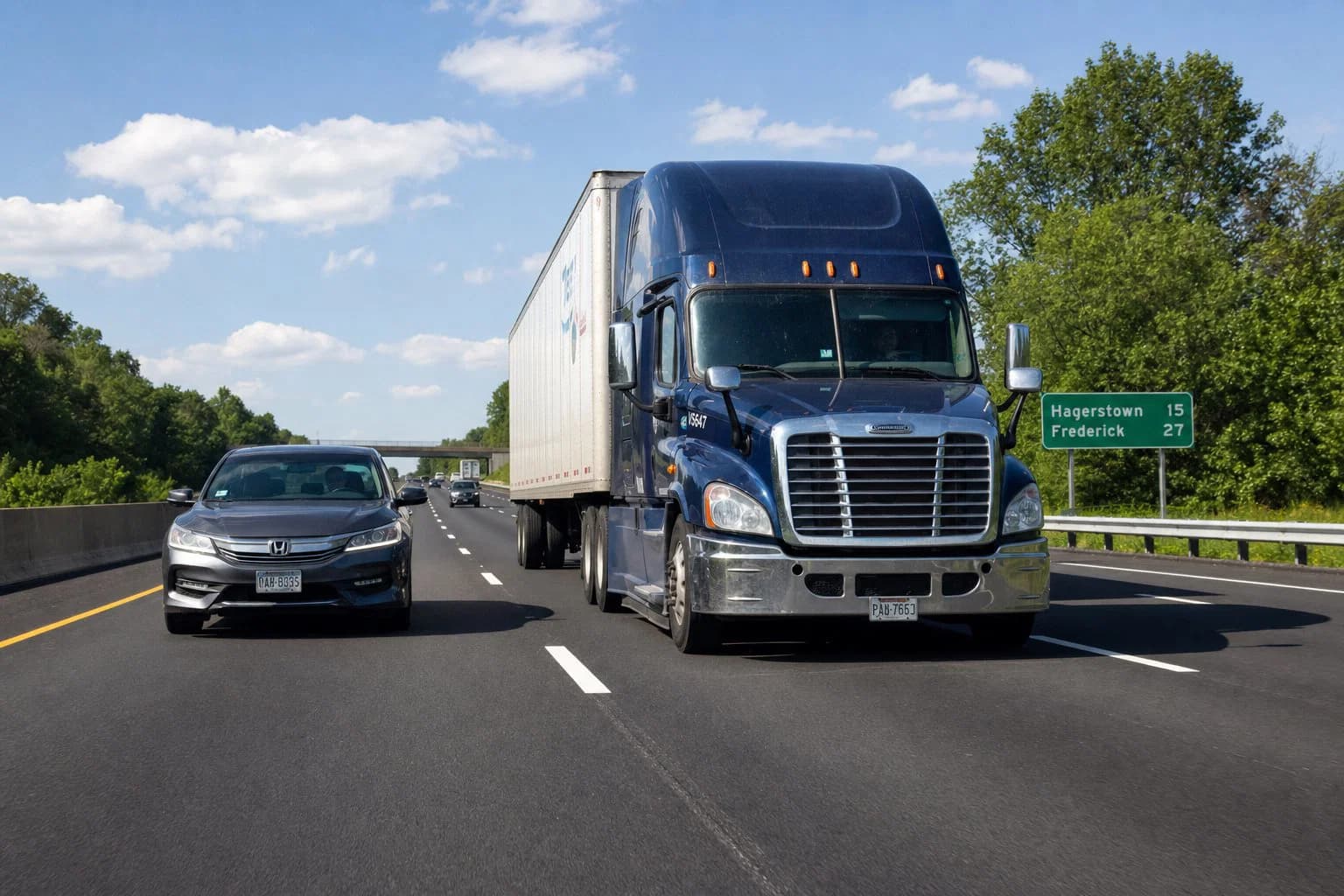
The immense size of commercial trucks creates equally immense blind spots, known in the industry as "No-Zones." The FMCSA actively educates the public to stay out of these areas, as one-third of all crashes between large trucks and passenger cars take place within them. A passenger car can completely disappear from a truck driver's view if it lingers in one of these four critical areas.

- The Rear No-Zone: Directly behind the trailer. Because semi-trucks lack interior rear-view mirrors, a driver tailgating a truck is entirely invisible to the commercial operator.
- The Front No-Zone: The area immediately in front of the truck's cab. This zone can extend up to 20 feet forward. Because truck cabs are elevated, a small passenger car driving too closely in front of the bumper is hidden beneath the driver's line of sight over the hood.
- The Right-Side No-Zone: The largest and most dangerous blind spot. It extends from the truck's right-side mirror back across three lanes of traffic and runs the entire length of the trailer. Passing a commercial truck on the right is exceptionally hazardous due to this massive visual deficit.
- The Left-Side No-Zone: Extending backward from the driver's side mirror to about mid-trailer. While smaller than the right side, it still easily conceals a standard passenger car.
The Physics of the "Kill Zone"
A common scenario that leads to fatal collisions involves passenger cars aggressively cutting into the space directly in front of a moving semi-truck. Professional truck drivers are trained to leave a massive, empty gap between their rig and the vehicle ahead—often aiming for a 6-to-15 second following distance.
To an impatient passenger car driver, this gap looks like an invitation to merge or change lanes. To the truck driver, it is a carefully calculated survival space—an active braking cushion required to safely halt their 80,000-pound momentum. When a passenger car abruptly merges into this space and applies its brakes, it instantly steals the truck's perception, reaction, and air brake lag distances. The physics dictate that if traffic halts suddenly, the truck physically cannot stop, and the merging car will be crushed from behind. Inadequate surveillance by drivers maneuvering around these zones was cited in 14 percent of large-truck crashes in the Large Truck Crash Causation Study (LTCCS). The same problem shows up at busy intersections where drivers “wave through” others and create hidden conflicts—something explored further in Why Predictability Comes First in Intersection Safety.
The Underride Epidemic: Structural Defenses and Crash Testing
When the physics of a highway collision fail the passenger vehicle, the structural design of the commercial trailer serves as the final line of defense against an "underride" crash. An underride crash occurs when a smaller passenger vehicle collides with a commercial truck and slides entirely or partially underneath the chassis of the trailer.
Because commercial trailers ride significantly higher off the ground than passenger car bumpers, the initial point of impact in an underride crash bypasses the car's advanced crumple zones, front bumpers, and airbag sensors. Instead, the rigid steel bed of the trailer shears directly into the car's windshield and A-pillars, slicing through the passenger compartment (the "greenhouse"). This routinely results in decapitation, traumatic brain injuries, or fatal crushing forces.
Rear Underride Guards and the TOUGHGUARD Standard
To mitigate this horrific outcome, federal regulations have long required tractor-trailers to be equipped with rear impact guards (frequently called Mansfield bars). However, investigations and crash tests conducted by the Insurance Institute for Highway Safety (IIHS) throughout the early 2000s revealed that guards meeting federal minimum safety standards frequently buckled, bent, or completely sheared off during relatively low-speed impacts, failing to prevent deadly underride.
In response to these lethal inadequacies, the IIHS established the TOUGHGUARD award to incentivize trailer manufacturers to engineer vastly superior rear guards. The IIHS evaluates trailers by crashing a midsize passenger car into the rear of a parked trailer at 35 mph in three distinct, progressively difficult test configurations:
| IIHS Test Configuration | Description of Impact | Difficulty Level |
|---|---|---|
| Full-Width Test | The car strikes the exact center of the rear guard head-on. | Easiest to pass; most modern guards successfully stop the car and engage its crumple zones. |
| 50% Overlap Test | Half of the car's front end strikes the guard. | Moderately difficult; tests the structural integrity away from the main center supports. |
| 30% Overlap Test | Only 30 percent of the car's width strikes the outermost corner of the trailer. | Most difficult; underride guards are structurally weakest at their outer edges, requiring massive corner reinforcement. |
Data sourced from IIHS Truck Underride Guard Ratings protocols.
The 30 percent overlap test is particularly brutal because the outermost corner of the guard must absorb the entire kinetic energy of the crashing vehicle without the benefit of direct vertical frame supports. In early testing, only the Canadian manufacturer Manac possessed a guard capable of passing the 30 percent overlap test. However, the rigorous, public-facing TOUGHGUARD program drove rapid industry-wide innovation. Today, the eight largest North American trailer manufacturers—including Great Dane, Hyundai Translead, Stoughton, Strick, Utility, Vanguard, and Wabash—produce rear guards capable of preventing underride in all three scenarios.
Despite these industry-led advancements, federal regulations lag behind the science. In June 2022, the National Highway Traffic Safety Administration (NHTSA) updated federal rules for rear underride protection, but the IIHS noted the new rules fell far short of comprehensive safety and were out of sync with safe system strategies. A major critique is that NHTSA tests guards by bolting them to a universal, indestructible testing rig, whereas IIHS tests them attached to the actual trailers. Guards that survive the federal rig test often fail in the real world because the trailer's attachment points or bolts shear off during the violence of an impact.
The Side Underride Controversy
While rear guards are mandatory, federal regulations currently do not require tractor-trailers to have underride guards on their sides. Side underride crashes are exceptionally deadly, particularly for passenger cars, bicyclists, and motorcyclists navigating intersections, merging onto highways, or passing multi-axle combinations. In 2021, there were 488 passenger vehicle occupant fatalities in crashes involving the side of a tractor-trailer.
The implementation of side underride guards has sparked significant debate between regulatory bodies and safety engineers. A preliminary cost-benefit analysis by NHTSA estimated that equipping the U.S. fleet with side guards would cost over $1 billion but would only prevent roughly 17 fatalities and 69 serious injuries per year. However, the IIHS forcefully contested this methodology, arguing that NHTSA arbitrarily excluded crashes occurring at speeds greater than 40 mph and those involving multiple vehicles. Utilizing a more comprehensive data analysis method, the IIHS projected that a side underride mandate could prevent between 159 and 217 passenger vehicle occupant fatalities annually.
In live crash testing, aftermarket side guards, such as the AngelWing produced by Airflow Deflector Inc., have proven highly effective. In IIHS testing, a midsize car striking the side of a trailer at 40 mph was successfully deflected, preserving the survival space of the passenger compartment and demonstrating that side underride prevention is structurally viable at highway speeds.
Active Safety Systems and Regulatory Horizons
While structural guards mitigate the severity of a crash after the physics have failed, the ultimate goal of the automotive industry is crash avoidance. The commercial trucking industry is currently undergoing a technological revolution, deploying active safety systems designed to electronically compensate for the massive physics deficit inherent in heavy vehicles.
Automatic Emergency Braking (AEB)
The most critical advancement in heavy vehicle safety is Automatic Emergency Braking (AEB). An AEB system utilizes forward-facing radar, LiDAR, and camera sensors to constantly monitor the roadway ahead. If the system detects an imminent crash and the commercial driver fails to react in time, the AEB system automatically applies the vehicle's air brakes, or supplements the driver's braking force to maximize deceleration.
By completely removing the 1.5-second human perception and reaction time from the stopping distance equation, AEB systems dramatically reduce the severity of rear-end collisions. Under the mandates of the Bipartisan Infrastructure Law, the Department of Transportation is moving rapidly to require AEB systems on heavy commercial vehicles. In 2023, NHTSA and FMCSA issued a Notice of Proposed Rulemaking (NPRM 2023-13622) that would adopt a new Federal Motor Vehicle Safety Standard to require AEB on vehicles with a gross weight rating over 10,000 pounds.
Electronic Stability Control (ESC) and Anti-Lock Brakes (ABS)
Alongside AEB, Electronic Stability Control (ESC) and Anti-Lock Braking Systems (ABS) are fundamentally altering commercial crash physics. ABS prevents the wheels from locking up during a panic stop. On wet or icy roads, ABS allows the driver to maintain steering control while braking heavily, reducing the risk of a catastrophic jackknife incident by 50 percent. Since 1997, ABS has been required on new tractors, reducing heavy truck crash risks by an estimated 65 percent.
ESC systems take this a step further by using sensors to detect when a truck is losing lateral stability or is at risk of rolling over. The system selectively applies brakes to individual wheels and dethrottles the engine to bring the vehicle back in line. ESC has been mandated on all new truck tractors and buses since 2019, with the potential to prevent up to 56 percent of untripped rollovers. The 2023 AEB proposed rules also seek to ensure all heavy vehicles are equipped with functional ESC systems operating seamlessly alongside the automatic braking hardware.
Community Mobilization: The Role of Driver-to-Driver Platforms
While federal agencies dictate hardware mandates and commercial fleets invest millions in automation and radar arrays, the missing link in highway safety has historically been the immediate communication between the commercial operator and the everyday passenger vehicle. Recognizing a hazardous situation—like a smoking tire or an open cargo door—is only half the battle; mobilizing a response is where community action becomes essential.
This gap is where privacy-focused, driver-to-driver communication networks are revolutionizing road safety and neighborhood security. Platforms designed to connect the driving community, such as Carszy, leverage unique identifiers—specifically, license plates—to facilitate real-time safety interventions without compromising personal data.
Transforming the License Plate into a Safety Tool
Through License Plate Messaging, drivers utilizing the Carszy platform can securely text or call the owner of a vehicle using only the plate number, completely bypassing the need to exchange personal phone numbers. This creates an immediate feedback loop on the highway. If a commercial driver notices a passenger vehicle driving at night with its taillights off, or a passenger car spots a severely under-inflated tire on a commercial trailer, an alert can be sent instantaneously. Correcting these minor oversights before they result in a 700-foot braking emergency or a high-speed tire blowout is the essence of proactive community safety. The same kind of real-time alerting can keep stranded drivers safer during breakdowns, complementing step-by-step roadside protocols like those detailed in Roadside Survival: New Safety Strategies for Drivers in 2026.
Human Media™ and VOIS™
This approach shifts the paradigm from traditional, distraction-heavy "Social Media" to what is termed Human Media™—technology focused on tangible, real-world impact. By empowering everyday drivers to report dangerous behavior, erratic lane changes, or aggressive tailgating in real-time, communities build a culture of accountability that forces both passenger and commercial drivers to respect the physics of the road.
In more extreme scenarios, such as hit-and-runs, suspected human trafficking, or localized abductions, community networks deploy systems like VOIS™ (Vehicle of Interest Search). This community-driven alert system crowdsources the location of vehicles involved in critical incidents, effectively turning a network of safety-conscious commuters into a highly mobilized neighborhood watch. Utilizing US-based servers and robust geolocation features, these tools drastically reduce the response times of law enforcement while maintaining strict privacy standards, proving that technology can bridge the gap between heavy industry and civilian safety.
Actionable Highway Protocols for Everyday Drivers
Understanding the physics of an 80,000-pound truck and the technology designed to stop it must translate into practical driving habits. Safety-conscious drivers should adopt the following protocols to minimize their risk when sharing the road with CMVs:
- Implement the 6-Second Rule: The standard 3-second following distance taught in basic driver's education is intended exclusively for passenger cars. When following a loaded commercial truck, drivers should maintain a minimum 6-second following distance to allow for adequate sightlines and evasive maneuvers.
- Never Linger in the No-Zone: When passing a commercial truck, drivers should execute the maneuver safely and efficiently on the left side. Never match the truck's speed while driving in the adjacent lane, as this traps the car in the driver's blind spot for extended periods. Teaching this habit early, especially when choosing and setting rules for a young driver's first vehicle, goes hand-in-hand with planning from guides like Smart Strategies to Keep Teens Safe in Their First Car.
- Do Not Cut the Braking Cushion: When merging in front of a semi-truck, a driver must ensure they can see the entire front cab of the truck in their rear-view mirror before changing lanes. Never merge and immediately apply the brakes, as this steals the truck's required stopping distance.
- Anticipate Grade Changes: A truck's immense mass makes it accelerate much faster going downhill and lose speed rapidly when climbing an incline. Passenger vehicles should anticipate these speed differentials and adjust their following distances accordingly, recognizing that a trucker may be using engine compression braking (downshifting) to manage downhill speeds rather than riding their air brakes, which can lead to brake fade. On long mountain passes, pairing these habits with smart brake use and escape-ramp awareness, as emphasized in Emergency Brake Failures: Rapid Response & Community Action, can be lifesaving.
Frequently Asked Questions
Can drafting behind a semi-truck safely save fuel? No. While tailgating a semi-truck at distances of less than 50 feet can theoretically reduce aerodynamic pressure drag and improve fuel economy by roughly 10 percent, it is exceptionally dangerous and mathematically guarantees a collision if the truck brakes suddenly. The human reaction time combined with a passenger car's braking distance far exceeds the physical space available when drafting. Furthermore, the turbulent wake behind the truck can cause severe trailer sway for towing vehicles, and drafting exposes the trailing car to lethal road debris, such as massive chunks of rubber from tire blowouts.
How long does it actually take an 80,000-pound truck to stop? Under ideal conditions on dry pavement, a fully loaded 80,000-pound commercial truck traveling at 65 mph requires approximately 525 feet to come to a complete stop. This distance consists of the driver's perception time, physical reaction time, the mechanical lag of the air brake system, and the actual braking distance. In wet or icy conditions, this stopping distance can easily exceed 700 feet, emphasizing the need for massive following distances.
What makes air brakes different from hydraulic brakes? Passenger cars use hydraulic brakes, which utilize pressurized fluid to instantly apply stopping force when the pedal is pressed. Commercial trucks use pneumatic air brakes, which rely on compressed air traveling through a series of lines, valves, and mechanical linkages (like S-cams and slack adjusters) to apply the brakes. This pneumatic process creates a mechanical "brake lag" of 0.5 to 1.0 seconds. At highway speeds, a truck will travel anywhere from 32 to 66 feet before the air brakes even begin to slow the vehicle down. This is one reason drivers should never ignore flashing dashboard warnings or ABS lights in their own cars either; understanding and acting on in-vehicle alerts, as covered in Decoding Dashboard Lights for Safer Driving in 2026, is a simple way to prevent small issues from becoming major hazards near heavy trucks.
Conclusion
The intersection of a 4,000-pound passenger vehicle and an 80,000-pound commercial truck is governed by unforgiving laws of physics. Kinetic energy, momentum, aerodynamic drag, and mechanical brake lag dictate that heavy vehicles simply cannot react, maneuver, or stop with the agility of a traditional sedan. The lethal reality of underride crashes and the vast expanse of commercial blind spots mean that a single lapse in judgment—whether it is aggressively cutting into a truck's braking cushion or attempting to save fuel by drafting—can trigger an unavoidable tragedy.
While federal regulations push for stronger structural defenses like TOUGHGUARD-rated underride barriers, and automated systems like Automatic Emergency Braking begin to mitigate the human limitations of reaction time, safety on the highway ultimately requires a cooperative ecosystem. Passenger vehicle operators must respect the operational limitations of commercial trucks, acknowledging that physics always wins in a collision.
Achieving a zero-fatality highway environment is a shared responsibility. By understanding the mechanical realities of the road and embracing real-time communication tools, commuters can actively protect themselves and their neighborhoods. Safety-conscious drivers are encouraged to leverage platforms like Carszy to stay connected, hold fellow drivers accountable, and ensure that a minor oversight on the highway never escalates into a catastrophic physics equation. The same mindset applies beyond the highway, from EV range planning and charger etiquette to intersection habits and micromobility around sidewalks, as explored across the broader safety series on Carszy, including topics like Range Anxiety, Decoded: How to Drive Farther with Confidence.