Strategic Protocols for Vehicular Brake Failure: An Engineering and Community Safety Analysis
Introduction to Deceleration Emergencies
The sudden loss of primary braking capability represents a high-risk emergency that demands rapid driver diagnosis and calm, precise action. While automotive safety systems have advanced significantly over the past several decades, critical mechanical failures remain a persistent hazard on modern roads. For safety-conscious parents, daily commuters, and neighborhood watch advocates, understanding the mechanical principles of emergency deceleration is just as important as recognizing early warning signs before a catastrophic system failure occurs.
When a vehicle's hydraulic primary braking system fails to respond, a driver must rely on alternative, physics-based deceleration techniques to safely bring the vehicle to a halt. This analysis evaluates the mechanical systems involved in vehicle deceleration, outlines step-by-step procedures for managing active brake failure, and examines how community-driven technology platforms can act as proactive safety networks to mitigate roadside hazards. Drivers who also want to understand how other common failures, like tire blowouts, lead to crashes can explore our comprehensive guide to tire safety in Hand-Sized Heroes: The Ultimate Guide to Tire Safety, which pairs naturally with the brake failure principles in this article.

Mechanical and Statistical Framework of Brake Failures
Modern automotive braking systems use hydraulic lines to multiply the physical force applied to the brake pedal, pressing friction pads against metal rotors to convert kinetic energy into thermal energy. Despite the integration of split-circuit master cylinders designed to maintain partial braking if one line leaks, total deceleration failures still occur due to extreme thermal loading (brake fade), fluid oxidation, or ruptured lines. Choosing a vehicle with strong, modern braking and safety assist systems is a big part of reducing this risk, and our guide on Vehicle Acquisition in 2026: Lease, Buy, or Finance? explains how to factor safety tech into your next car decision.
According to the National Highway Traffic Safety Administration (NHTSA) National Motor Vehicle Crash Causation Survey (NMVCCS), while driver-related errors represent the primary cause in 94% of traffic accidents, critical mechanical failures account for approximately 2% of total light-vehicle crashes nationwide. Within this vehicle-related failure group, tire/wheel malfunctions (35%) and brake system failures (22%) are the leading mechanical causes of crashes. This translates to approximately 10,000 brake-related accidents investigated annually. Rear-end crashes—often stemming from delayed braking response, distraction, or sudden pressure loss—comprise more than 29% of all vehicular collisions. For a deeper look at how momentary inattention interacts with braking distance and crash risk, see our breakdown of distracted driving in The Danger of the Two-Second Glance: Risks and Solutions.
To put the danger of sudden deceleration failure into context, the table below illustrates the critical vehicle-related failure rates documented by NHTSA alongside average emergency response times across the United States.
| System/Service Metric | Statistical Value | Operational Implications for Drivers |
|---|---|---|
| Brake-Related Vehicle Failures | 22.0% of mechanical crashes | Results in approximately 10,000 preventable crashes annually. |
| Tire/Wheel-Related Failures | 35.0% of mechanical crashes | Represents the primary mechanical failure point preceding collisions. |
| Steering/Suspension/Engine Failures | 3.0% of mechanical crashes | Represents a lower-frequency but high-severity control failure. |
| National Average EMS Response Time | 10.0 Minutes | Highlights the delay between crash occurrence and medical arrival. |
| Urban EMS Response Time | 7.6 Minutes | Offers faster response due to infrastructure and proximity. |
| Rural EMS Response Time | 13.3 Minutes | Increases mortality risk due to prolonged transit and notification delays. |
Emergency Deceleration Protocol: A Technical Execution Guide
When a vehicle's primary brakes fail at speed, the mechanical work required to arrest the vehicle’s motion is governed by the kinetic energy equation:
Here, m is the vehicle mass and v is its velocity. Because kinetic energy scales quadratically with speed, even a small increase in speed creates a much larger increase in stopping distance. In a real emergency, that means a driver must execute a systematic, step-by-step protocol to safely dissipate this energy and avoid secondary crashes that could block lanes and trigger dangerous roadside situations. For more detailed strategies on staying safe if you do end up stopped on the shoulder or in a live lane, read Roadside Survival: New Safety Strategies for Drivers in 2026.

Phase 1: Identifying Pedal Feedback and Optimizing Line Pressure
The first response to a non-responsive brake pedal should be driven by what you feel through your foot. This feedback gives quick clues about what’s going wrong.
- Pumping Conventional Brakes: If the brake pedal feels soft, spongy, or sinks entirely to the floorboards, the failure is typically caused by a loss of hydraulic fluid or air contamination in the brake lines. In vehicles equipped with conventional (non-ABS) braking systems, the driver should rapidly and repeatedly pump the brake pedal. This action compresses any residual fluid in the system, which can temporarily rebuild enough hydraulic pressure to engage the calipers and slow the vehicle. Knowing the early warning signs that your brakes are weakening, like new noises or dashboard alerts, is just as vital; our guide to Decoding Dashboard Lights for Safer Driving in 2026 explains which warnings mean you should pull over immediately.
- Maintaining Pressure with ABS: If the vehicle is equipped with an Anti-lock Braking System (ABS), pumping the pedal is counterproductive and interrupts the system's electronic control cycle. For ABS-equipped vehicles, the driver must apply firm, steady, and continuous downward force on the brake pedal. The ABS control unit will detect wheel speed deceleration and pulse the calipers automatically, maximizing the remaining friction while maintaining steering capability.
Phase 2: Drivetrain De-acceleration and Engine Braking Dynamics
At the same time, the driver should use engine braking to take advantage of the internal mechanical resistance of the engine to shed speed without relying only on the failing hydraulic system.
- Manual Transmissions: The driver should depress the clutch and shift down sequentially, one gear at a time, letting the clutch out smoothly to engage engine compression braking. Skipping multiple gears must be avoided, as an excessive jump in gear ratio can lock the drive wheels and cause a severe rotational skid.
- Automatic Transmissions: Removing the foot from the accelerator allows the vehicle to downshift naturally as speed decreases. To speed up this safe deceleration, the driver should manually select lower gears. This is achieved by moving the gear shift lever from "D" into sequentially lower gear positions (such as 3, 2, or L) or engaging the sequential "sport" mode to use paddle shifters. If a young or newly licensed driver is in their first car, practicing these downshifts in a safe setting can be a powerful confidence booster; we cover training ideas and vehicle setup in Smart Strategies to Keep Teens Safe in Their First Car.
- Avoid Neutral Gear: The driver must never shift the transmission into Neutral (N) during active deceleration. Shifting to neutral decouples the engine from the drive wheels, removing all engine braking effects and allowing the vehicle to coast freely.
Phase 3: Graduated Application of Secondary Braking Systems
The secondary braking system—commonly referred to as the handbrake, parking brake, or emergency brake—operates independently of the primary hydraulic lines. This system typically uses physical steel cables or dedicated electric actuators to engage the rear calipers directly and offers a critical backup if your main system is gone.
- Mechanical Parking Brakes: If the vehicle uses a traditional handbrake lever or floor-mounted pedal, the driver must engage the mechanism slowly and gradually. Pulling the lever up too quickly or stamping on the pedal will instantly lock the rear wheels, causing the rear of the vehicle to slide and removing steering control. The driver should keep the lever release button depressed to adjust the mechanical tension dynamically based on chassis feedback.
- Electronic Parking Brakes (EPB): Modern vehicles equipped with an EPB button cannot be modulated manually, as the system uses electric caliper-integrated motors. A single, brief pull of the EPB switch while moving is ignored by the vehicle’s control unit to prevent accidental engagement. In an emergency, the driver must pull and hold the EPB switch continuously. This commands the electronic brake module to execute controlled, ABS-modulated deceleration to the rear axles, slowing the vehicle smoothly without wheel lockup. Because EPB behavior is software-defined, the way it interacts with other safety tech can vary between models, just as we see with advanced driver assists and intersection alerts discussed in Bridging the Gap in Vehicle Safety and Traffic Violence.
Phase 4: Navigating Escape Paths and Leveraging External Friction
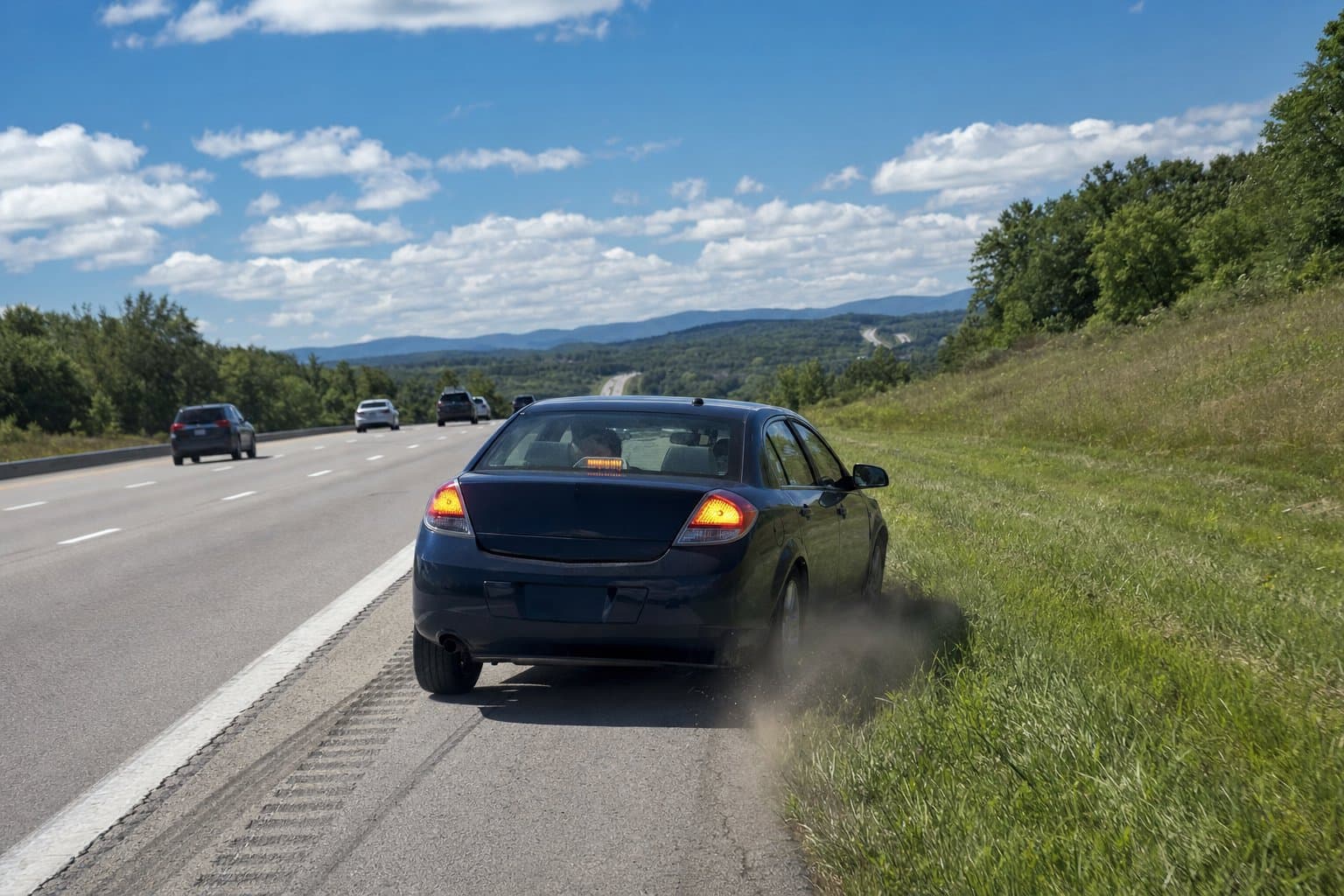
As the vehicle slows, the driver must guide the vehicle out of active traffic lanes. Evasive steering inputs should remain smooth and controlled because sudden swerving at high speeds can destabilize the chassis. The driver should immediately activate the hazard lights and sound the horn continuously to warn surrounding motorists of the emergency and create space to maneuver.
The driver must scan the road ahead for escape routes, prioritizing uphill exit ramps, wide shoulders, runaway truck lanes, or open, grassy fields. If these options are unavailable and a collision is imminent, physical obstacles can be used to bleed speed. Scraping the vehicle's tires against a raised curb or grinding its side panels against concrete highway barriers or guardrails can generate enough friction to halt the vehicle while maintaining a parallel path to the roadway. In complex, multi-lane intersections where drivers, cyclists, and pedestrians all share limited space, these choices become even more critical; for a broader look at intersection risk patterns and how to anticipate them, see Enhancing Night Safety and Intersection Design in 2026.
Phase 5: Critical Systems Power Management
A common mistake during high-stress mechanical emergencies is turning the vehicle’s engine off too early because it feels like the safest “stop everything” move.
Crucial Safety Rule: The engine must never be turned off while the vehicle is in motion.
Disabling the engine immediately terminates the power steering pump’s hydraulic or electric assist, dramatically increasing steering resistance. Furthermore, in vehicles equipped with traditional mechanical ignition keys, turning the cylinder to the "Off" or "Lock" position can engage the steering column lock. This physical lock prevents the steering wheel from turning, making it impossible to steer around obstacles or guide the vehicle to safety. Additionally, engine shutdown depletes any residual vacuum assist within the braking booster, removing any minimal primary braking capability that might remain. The engine should only be shut down after the vehicle has reached a complete, safe stop and is moved as far as practical from active traffic.
Technical Integration: Community Safety and Driver-to-Driver Platforms
While mastering physical deceleration protocols is essential for emergency management, the most effective road safety strategy is proactive prevention. Many mechanical failures, including brake system degradation, show early warning signs before total loss of function occurs. These signs include visual fluid leaks, unusual squealing or grinding noises, dashboard alerts, and the distinct acrid smell of overheated friction material. Similar early clues show up with other modern-vehicle risks too, such as extended hood lines and rising blind zones that can endanger children, which we unpack in When the Hood Hides a Child: The SUV Blind Zone Crisis.
The traditional approach to handling vehicular emergencies has been almost entirely reactive, relying on centralized emergency dispatch systems that suffer from significant geographic and logistical delays. However, the integration of modern driver-to-driver communication technology offers a proactive alternative where nearby people can spot trouble and warn each other before a failure leads to a crash.
The community safety platform Carszy addresses these systemic gaps by using vehicle license plates as secure, unique identifiers to connect drivers on the road. This technology operates through several core safety features:
- License Plate Messaging and Driver Alerts: If a motorist observes early signs of mechanical distress on a nearby vehicle—such as smoke from a wheel hub, a dragging caliper, or an oily, yellow puddle of leaking brake fluid beneath a parked car—they can instantly look up the vehicle's license plate on the Carszy app. The platform allows them to text or call the driver securely, providing real-time alerts so the owner can address the issue before a catastrophic failure occurs and before they’re stranded in a dangerous location. This same plate-based system can also help drivers flag severe tire or wheel issues, pairing perfectly with the practices in our tire-safety guide, Hand-Sized Heroes: The Ultimate Guide to Tire Safety.
- VOIS™ (Vehicle of Interest Search): In the event of an active vehicle emergency, hit-and-run, or critical safety incident, Carszy’s community-driven alert system can mobilize nearby drivers. This system crowdsources real-time geolocation data from surrounding motorists, helping to reduce emergency response times and coordinate assistance.
- Human Media™ for Active Roadway Advocacy: Moving away from passive social media, Carszy’s Human Media approach focuses on real-world community impact. This feature enables commuters, protective parents, and neighborhood watch leads to report dangerous driving behavior and road hazards directly. By establishing peer-to-peer accountability, the platform encourages safer driving habits and helps prevent high-speed collisions, especially in complex environments like intersections and crosswalks where vulnerable road users such as motorcyclists are often “invisible.” For more on why drivers miss those riders and how to adjust your scan, see Reducing Motorcycle Fatalities at Intersections in 2026.
- Privacy-First Infrastructure: All communication is routed securely through Carszy’s US-based servers, ensuring driver identities remain completely private.
Conclusion and Strategic Next Steps
Surviving a sudden brake failure requires a blend of calm mechanical execution, a clear understanding of primary and secondary braking systems, and steady situational awareness. By executing controlled downshifts, choosing the right approach for conventional or ABS systems, and gradually engaging the emergency brake, drivers can significantly reduce crash severity and protect people both inside and outside the vehicle. These same habits—predictable actions, clear signals, and avoiding sudden moves—mirror the intersection best practices we detail in Why Predictability Comes First in Intersection Safety.
Beyond immediate driver actions, integrating peer-to-peer technology like Carszy represents the future of proactive road safety. By securely bridging the communication gap between drivers, the platform reduces response times, encourages safety accountability, and creates a collaborative shield against mechanical and human hazards on the road. To become part of this active safety network, drivers are encouraged to download the Carszy mobile app for iOS or Android and secure their vehicle's license plate profile today.
Frequently Asked Question
Does an electronic parking brake (EPB) act as an effective emergency backup if the primary hydraulic brakes fail at highway speeds?
Yes, an electronic parking brake (EPB) can serve as a highly effective emergency backup system during high-speed brake failures when used correctly. Unlike standard parking brakes that might lock up the rear wheels if pulled abruptly, modern EPB systems feature a built-in emergency deceleration protocol. When the driver pulls and holds the electronic brake switch while moving, the electronic control unit (ECU) overrides standard stationary logic. It coordinates with the vehicle's Electronic Stability Control (ESC) and Anti-lock Braking System (ABS) to apply controlled, modulated braking pressure to the rear calipers. This ensures the vehicle decelerates rapidly and safely without locking up the rear tires or inducing a spin, and releasing the switch immediately disengages the brake.