How to Sell a Car Safely: Pricing, Screening, and Avoiding Scams in the Modern Peer-to-Peer Market
The peer-to-peer (P2P) used vehicle market represents a highly lucrative economic ecosystem, allowing consumers to bypass traditional dealership margins and capture a significantly higher financial premium for their automotive assets. However, this financial arbitrage is inherently counterbalanced by severe asymmetric risks. The modern private auto sale exposes the seller to highly organized financial fraud rings, sophisticated physical security threats, and complex, long-tail legal liabilities. As digital marketplaces have expanded the reach and efficiency of the average consumer, they have concurrently provided unprecedented access for malicious actors seeking to exploit vulnerabilities in the transaction lifecycle.
Addressing the overarching challenge of how to safely navigate pricing strategies, buyer screening protocols, payment fraud avoidance, test drive security, and state-level document execution requires a systematic, defense-in-depth approach. This exhaustive analysis deconstructs the critical methodologies required to execute a secure private vehicle transaction. By analyzing macroeconomic auto theft trends, physical security protocols, the integration of modern community safety technologies, and rigorous regulatory compliance frameworks, this report provides a comprehensive blueprint for neutralizing the risks inherent in the modern automotive sale.
The Macroeconomic and Statistical Landscape of Auto Theft and Organized Fraud
Understanding the threat environment of a private vehicle sale necessitates a thorough analysis of broader national auto theft and automotive fraud statistics. The period between 2019 and 2023 witnessed a historic, sustained surge in vehicular crime, driven by global supply chain shortages, the escalating value of used automotive parts, and the rapid proliferation of digital P2P fraud networks.
National Auto Theft Trends and Statistical Baselines
According to comprehensive data compiled from the National Insurance Crime Bureau (NICB) and the Federal Bureau of Investigation's (FBI) Uniform Crime Reporting Program (NIBRS), motor vehicle theft in the United States increased by 28 percent from 2019 to 2023. The nationwide rate of motor vehicle theft incidents rose dramatically from 199.4 incidents per 100,000 people to 283.5 incidents during this highly volatile period. This surge fundamentally altered the risk calculus for individuals engaging in the private transfer of high-value assets, transforming what was once a routine transaction into a high-risk endeavor.
However, coordinated nationwide prevention efforts by law enforcement agencies, auto manufacturers, and regulatory bodies yielded significant results in 2024. The total number of stolen vehicles dropped to an estimated 850,708—a 16.7 percent decrease from the previous year, marking the largest singular annual decrease in vehicle thefts in forty years. Despite this encouraging decline, the absolute volume of vehicular theft remains profoundly high, with one vehicle stolen approximately every 48 seconds in the United States.
| Reporting Year | Estimated Total Vehicle Thefts | Percentage Change (Year-over-Year) |
|---|---|---|
| 2020 | 880,595 | + 9.9% |
| 2021 | 932,329 | + 5.9% |
| 2022 | 1,008,756 | + 8.2% |
| 2023 | 1,020,729 | + 1.2% |
| 2024 | 850,708 | - 16.7% |
Data derived from the National Insurance Crime Bureau (NICB) Vehicle Theft Trend Data and FBI Uniform Crime Reporting.
Regional Variations and Targeted Assets
The risk profile of a private sale is heavily influenced by geography and demographic density. Certain regions experience vastly disproportionate rates of vehicular crime. The state of California consistently reports the highest aggregate volume of auto thefts, alongside exceptionally high per-capita theft rates in New Mexico, Colorado, and the District of Columbia.
| National Rank | Metropolitan Statistical Area (MSA) | Auto Theft Rate (per 100,000 inhabitants) |
|---|---|---|
| 1 | Pueblo, Colorado | 1,086.44 |
| 2 | Bakersfield, California | 1,072.36 |
| 3 | Denver-Aurora-Lakewood, Colorado | 1,062.67 |
| 4 | Memphis, Tennessee-Mississippi-Arkansas | 845.68 |
| 5 | Portland-Vancouver-Hillsboro, Oregon-Washington | 796.94 |
Data represents the top five U.S. MSAs by motor vehicle theft rate based on U.S. Census Population Estimates and NICB data.
Furthermore, specific vehicle models inherently attract distinct threat vectors. While older, high-volume models (such as late 1990s and early 2000s sedans) are frequently targeted for their lack of advanced electronic immobilizer technology and the high secondary market value of their stripped components, late-model vehicles are increasingly targeted by sophisticated fraud rings utilizing key-cloning technology and synthetic identity fraud. To understand how these risks fit into the much larger picture of traffic violence and vehicle design, many sellers also review research on bridging the gap in vehicle safety and traffic violence before listing a car.
The Proliferation of Organized Digital Fraud Rings
The threat to the modern private seller extends far beyond the opportunistic, traditional thief looking for an unlocked door or a running engine in a parking lot. Highly organized criminal syndicates now actively monitor digital classifieds and online P2P marketplaces specifically to target individuals selling vehicles.
For example, the Puget Sound Auto Theft Task Force and the Grays Harbor Sheriff's Office recently identified and dismantled a complex, multi-layered operation across Western Washington. In this scheme, fraudsters actively manipulated vehicles during the pre-purchase mechanical inspection process, intentionally creating phantom mechanical failures to force through aggressive, lowball financial offers, resulting in severe financial losses for dozens of civilian victims.
Similarly, between 2023 and 2025, a St. Louis-based criminal syndicate orchestrated a massive $1.7 million cashier’s check scam targeting private car sellers across the broader Midwest region. By utilizing flawlessly forged cashier's checks bearing legitimate, highly recognizable bank logos, the syndicate "purchased" dozens of vehicles from unsuspecting private citizens, immediately resold the assets for untraceable cash, and vanished before the traditional banking system could uncover the underlying fraud. These case studies underscore the critical, non-negotiable need for sellers to implement rigorous screening and financial verification protocols.
Strategic Valuation, Market Positioning, and Pre-Market Preparation
The defense against predatory buyers begins well before the vehicle is physically listed for public consumption. The strategic valuation of the asset, the preparation of the documentation, and the subsequent communication protocols serve as the foundational psychological barrier against fraudulent actors.
Optimal Pricing Mechanics and the Psychology of the Market
Establishing a fair, data-driven, and highly accurate asking price is paramount. Sellers are strongly advised to utilize aggregated, industry-standard valuation tools, such as Kelley Blue Book (KBB), Edmunds, or independent car shopping services, to determine a realistic private-party value based on the vehicle's exact make, model year, total mileage, internal condition, and specific geographic location.
The psychology of pricing plays a vital, often understated role in determining the demographics of the responding buyers. Vehicles that are priced significantly below the established market value will instantaneously attract high volumes of "flippers"—professional, unlicensed individuals who seek to purchase vehicles rapidly at a severe discount and resell them for an immediate profit. These individuals, often referred to as "curbstoners," bargain aggressively, utilize high-pressure tactics, and frequently engage in illegal "title jumping" (refusing to formally register the car in their own name) to avoid paying state taxes and DMV registration fees, leaving the original seller legally exposed.
Conversely, vehicles priced aggressively above the market average will languish on digital marketplaces, causing profound seller fatigue. When a seller becomes fatigued, frustrated, and desperate to conclude the transaction, they are exponentially more likely to ignore obvious red flags, bypass security protocols, and fall victim to complex payment scams or dangerous physical encounters. If you are selling a vehicle that may become a teen’s first car, also consider how your pricing and disclosure of safety features will affect families focused on smart strategies to keep teens safe in their first car.
Pre-Market Asset Preparation
Legitimate buyers understand that purchasing a used vehicle involves inherent mechanical risk. To attract high-quality buyers and deter low-effort scammers, the seller must prepare the asset meticulously. This involves compiling a comprehensive dossier of the vehicle's history, including all available maintenance records, historical repair invoices, and an independent vehicle history report (such as a Carfax or AutoCheck report).
Providing this transparency upfront demonstrates to the buyer that the seller is organized, diligent, and unlikely to be easily manipulated by false claims of mechanical failure during the negotiation phase. Furthermore, ensuring the vehicle is thoroughly cleaned and cleared of all personal effects, documents containing sensitive personal identifying information (PII), and garage door openers prevents opportunistic identity theft or subsequent residential burglaries if a test drive goes awry. As you empty the cabin and glovebox, use it as a chance to rebuild it with only the essentials recommended in a survival and legal glovebox checklist so you stay ready for emergencies right up until the day of sale.
Digital Vetting, Behavioral Profiling, and Communication Protocols
Once the vehicle is officially listed on a digital marketplace, the seller must immediately shift into an investigative, highly defensive posture. The preliminary interactions dictate the safety and trajectory of the entire subsequent physical process.
The Necessity of Voice Communication
The modern digital ecosystem relies heavily on asynchronous text messaging and email. However, relying solely on text-based communication exposes the seller to automated bot networks, international scam syndicates, and highly practiced fraud scripts.
Experts universally suggest that sellers must insist on speaking to the most serious prospective buyers over a live phone call before ever scheduling a physical test drive or revealing the vehicle's precise location. Transitioning the conversation to a live voice call allows the seller to actively screen the individual, assess their tone, and gauge their legitimate knowledge of the vehicle. During this conversation, the seller should ask highly specific, open-ended questions regarding the buyer's intended use of the vehicle, their daily commute, their timeline for purchasing, and how their financing is lined up.
Identifying Coercive Tactics and Scam Narratives
Legitimate buyers exhibit standard, predictable consumer behaviors: they ask detailed questions about the vehicle's condition, request to review maintenance records, and typically desire a pre-purchase mechanical inspection by an independent technician.
Fraudulent actors, conversely, utilize high-pressure urgency tactics designed to bypass logical scrutiny. The seller must be highly vigilant in identifying the following behavioral red flags:
- The Remote Seller/Military Deployment Narrative: Scammers frequently claim they are actively deployed in the military, working overseas on a specialized contract, or dealing with a sudden, tragic family emergency. This fabricated narrative conveniently explains why the buyer cannot inspect the car in person, why they cannot speak on the phone, and why they must utilize complex, third-party payment or shipping arrangements.
- Immediate Acceptance: Fraudsters will often agree to the full asking price instantly, without any attempt to negotiate or ask standard mechanical questions, in order to rapidly lock the seller into the fraudulent payment sequence.
- Third-Party Shipping Agents: The insistence that a specialized "shipping agent" or "mover" will collect the vehicle on their behalf is a universal hallmark of the overpayment and escrow fraud topologies.
Establishing Transactional Boundaries
The preliminary phone screening phase is the precise moment for the seller to establish the rigid structural boundaries of the physical transaction. The seller must firmly, politely articulate that they will absolutely require a valid, government-issued driver's license prior to any test drive, that the transaction will occur at a specific, monitored public location (such as a police station), and that only verified, highly secure payment methods will be accepted. Any resistance, anger, or aggressive pushback to these standard, reasonable parameters is an immediate, definitive indicator of a compromised transaction, and the seller should terminate contact immediately.
Deconstructing Financial Fraud: Complex Payment Topologies
The point of financial exchange represents the absolute apex of vulnerability in the private vehicle sale lifecycle. As digital banking infrastructure has evolved, so too have the highly sophisticated methodologies utilized by syndicates to exploit the system's clearing times, administrative blind spots, and consumer trust. The two most prevalent and financially devastating crimes targeting private vehicle sellers are the Counterfeit Check Overpayment Scam and the Fraudulent Escrow Deception.
The Anatomy of the Counterfeit Check Overpayment Scam
Despite the widespread advent of contactless payments and digital wallets, traditional paper checks remain a significant, highly exploited vector for high-value transaction fraud. The Federal Trade Commission (FTC), the Federal Deposit Insurance Corporation (FDIC), and state consumer protection agencies continuously issue urgent warnings regarding the mechanics of the check overpayment scam.
This scam exploits a fundamental misunderstanding of federal banking regulations—specifically, the temporal delay between a bank technically crediting a consumer's account and the actual, verified clearing of the underlying funds from the issuing institution. The methodology is remarkably consistent and devastatingly effective:
- The Bait: The fraudulent buyer agrees to the purchase price remotely and remits payment via a seemingly legitimate cashier's check, certified bank check, or money order.
- The Overpayment: The check arrives, but it is drafted for an amount significantly higher than the agreed-upon selling price.
- The Fabrication: The buyer fabricates an urgent excuse for the overpayment. They may claim it was a clerical error by their bank, or, more commonly, that the excess funds are required to pay a designated third-party "shipping agent" who will arrive to transport the vehicle.
- The Extraction: The buyer frantically instructs the seller to deposit the check into their personal bank account and immediately wire the excess funds back to them or directly to the fictitious shipping agent via an irreversible method, such as a wire transfer, prepaid gift cards, or cryptocurrency.
Under current federal banking regulations, financial institutions must generally make deposited funds from official checks available to the account holder within a matter of days. The seller logs into their online banking portal, sees the funds reflected in their "available balance," and logically assumes the check has officially cleared and the funds are secure. Operating under this false assumption, they subsequently wire the excess funds to the scammer and hand over the vehicle title and keys.
Days or even weeks later, the counterfeit nature of the original check is finally discovered by the issuing banking institution. The bank immediately reverses the deposit, entirely erasing the funds from the seller's account. The seller is left completely, legally liable for the entire lost amount they wired away, in addition to suffering the total loss of the physical vehicle.
Strategic Countermeasures: Sellers must categorically refuse to accept any check written for an amount exceeding the exact purchase price, regardless of the narrative provided. If a cashier's check must be utilized for a high-value transaction, the seller should insist that the physical transaction take place directly inside the issuing bank's local branch. This allows the bank teller to instantly verify the instrument's authenticity against the drawing account in real-time, effectively neutralizing the threat of forgery. For sellers who have recently bought the car themselves, reviewing a 2026 guide to detecting and avoiding vehicle fraud can help spot forged paperwork and title problems before they cascade into your own sale.
The Fraudulent Escrow Deception
For high-value, cross-state, or remote transactions, the concept of a digital escrow service—a neutral, highly regulated third party that securely holds financial funds until the buyer physically receives, inspects, and approves the vehicle—is theoretically sound and widely recommended. However, the growing consumer reliance on escrow has birthed a massive sub-industry of highly sophisticated digital fraud.
In the escrow deception topology, the fraudulent buyer insists that the transaction be handled through an escrow service, explicitly citing a desire for "mutual protection" and safety. The buyer will then proactively provide the seller with a direct hyperlink to a specific escrow website they claim to prefer using.
These websites are meticulous, highly convincing counterfeits. They are professionally designed to mimic legitimate financial institutions, utilizing stolen corporate logos, fabricated customer service chat portals, and official-sounding URLs that closely resemble authorized entities (e.g., securevehicleescrow.com or autotransfer-escrow.net).
Once the seller registers an account on the fraudulent platform, they receive an official-looking notification stating that the buyer has fully deposited the funds. The platform then explicitly instructs the seller to transfer the vehicle title and hand over the keys to a coordinated transport service, assuring the seller that the funds are safely locked and will be released upon delivery. In reality, the entire platform is completely controlled by the criminal syndicate, and no actual funds exist. Once the vehicle is physically surrendered, the website is rapidly dismantled, the "customer service" numbers are disconnected, and the asset is stolen.
In variations targeting buyers, the fake platform will instruct the buyer to wire funds directly to a bank account, often telling them to write a specific "transaction ID" in the memo line, bypassing the creation of an actual secure digital wallet.
Strategic Countermeasures: The absolute, fundamental rule of utilizing escrow in a private sale is that the platform must be independently selected, meticulously researched, and verified by the parties. Neither party should ever, under any circumstances, click a hyperlink provided by the other party.
Legitimate escrow services operating within the United States are heavily regulated financial entities that must possess state-issued financial licenses (such as direct oversight by the California Department of Financial Protection and Innovation). Sellers and buyers must independently verify the service's licensing status through official state regulatory databases and navigate directly to established, industry-standard platforms (such as Escrow.com) through a search engine, rather than trusting external hyperlinks. Furthermore, legitimate services utilize highly secure account portals and will never request direct wire transfers utilizing "transaction IDs" in the memo line.
The Limitations of Peer-to-Peer (P2P) Payment Applications
While P2P touchless payment applications (e.g., Zelle, Venmo, CashApp, PayPal) have revolutionized micro-transactions and daily commerce, their application in high-value automotive sales is highly limited and potentially perilous.
Most of these digital platforms impose strict daily, weekly, or monthly rolling transaction limits that fall well below the average cost of a modern used vehicle, making them structurally unviable for concluding a single large sale. More critically, the official terms of service for many popular P2P applications explicitly state that their buyer/seller protection policies strictly exclude the sale of motor vehicles. If a transaction is subsequently disputed, or if the funds were initially sent from a compromised, stolen, or hacked linked bank account, the legitimate seller may face irreversible chargebacks, losing both the funds and the vehicle with zero recourse from the platform.
| Payment Method | Risk Profile | Recommended Security Protocol |
|---|---|---|
| Cash | Low Risk (if handled securely) | Conduct exchange inside a bank to utilize currency counters and detect counterfeit bills. |
| Cashier's Check / Bank Draft | High Risk (Subject to forgery) | Only accept if the transaction occurs physically inside the issuing bank's local branch for real-time verification. |
| P2P Apps (Venmo, Zelle, CashApp) | High Risk | Not recommended for high-value auto sales due to transaction limits and lack of vehicular protection policies. |
| Escrow Service | Low Risk (if verified) | Independently verify state licensing; never use links provided by the buyer; utilize trusted industry platforms. |
| Personal Check | Extreme Risk | Never accept personal checks for vehicle sales. |
Table 1: Comparative risk analysis of payment topologies in private vehicle sales.

Because the wrong choice at this stage can undo all your hard work, many sellers cross-check their own payment plan against step-by-step crash response and documentation guides, like those used after minor collisions in a fender-bender survival playbook, to make sure they keep records of every transfer and communication.
Physical Security Protocols and Crime Prevention Through Environmental Design
The exhaustive digital and financial vetting of a buyer must ultimately culminate in a physical interaction. The test drive, the final inspection, and the subsequent exchange of keys and highly sensitive documentation present significant vectors for physical violence, auto theft, and armed carjacking. Neutralizing these severe physical threats requires strict adherence to environmental design principles and highly structured, inflexible operational protocols.
Crime Prevention Through Environmental Design (CPTED)
The specific location chosen for the physical meeting is the single most critical variable in the physical safety equation. Law enforcement agencies increasingly advocate for the rigorous application of Crime Prevention Through Environmental Design (CPTED)—a multidisciplinary, architectural approach to deterring criminal behavior through the manipulation of the built environment. CPTED relies on four core principles: Natural Surveillance, Access Control, Territorial Reinforcement, and Maintenance.
A private residence or home driveway catastrophically fails all basic CPTED requirements for a secure transaction. Inviting an unvetted stranger to a private home exposes the seller and their family to immediate physical risk. Furthermore, it provides the potentially malicious actor with the exact geographic location of the high-value asset, enabling future theft attempts under the cover of darkness if the initial sale does not occur. Similarly, abandoned parking lots, isolated commercial zones, or poorly lit retail areas lack the required Natural Surveillance necessary to deter a coordinated attack.
The Expansion of Municipal Safe Exchange Zones
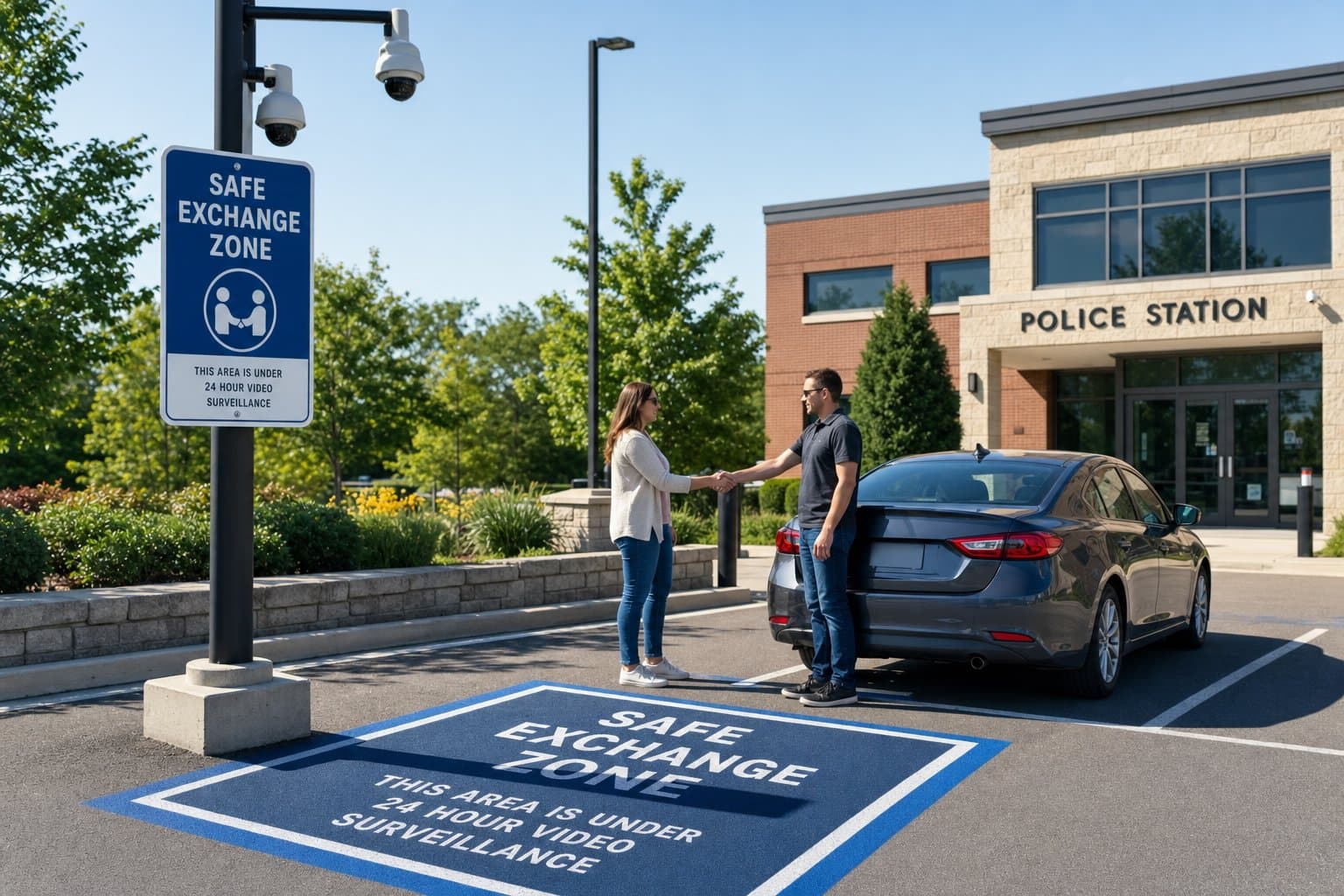
To actively facilitate secure e-commerce and private property transactions, hundreds of municipal police departments across the United States have established designated "Safe Exchange Zones," "E-Commerce Zones," or "SafeTrade Stations".
These specific zones represent the optimal, flawless application of CPTED principles. They are purposefully engineered to provide the public with a secure environment to conduct high-risk transactions.
- Buena Park Police Department (California): Maintains designated parking spaces strictly marked with reflective lines directly adjacent to a major, high-traffic boulevard. This area is intensely lit and under continuous, 24-hour high-definition video surveillance to deter potential scammers.
- West Orange Police Department (New Jersey): Facilitates a highly structured program, providing specific lit areas under 24-hour video surveillance. Crucially, they also allow citizens to utilize the physical interior lobby of the police headquarters and substations during standard business hours (8:30 a.m. to 4:30 p.m.) for maximum security.
- Irvine Police Department (California): Maintains a designated "E-Commerce Zone" in the primary Civic Center parking lot. The area is explicitly marked with signage to provide residents with a monitored location to complete online transactions, accompanied by specific departmental guidelines on secure protocols.
- Santa Ana Police Department (California): Offers an E-Commerce Exchange Zone directly on the front steps of the headquarters, monitored by cameras, while also welcoming the public to utilize the interior lobby during business hours to finalize paperwork.
While municipal municipalities explicitly state that sworn police personnel will not actively broker, officially witness, or guarantee the legal legitimacy of the transaction itself, the mere presence of continuous, high-definition surveillance and the immediate proximity to armed law enforcement serves as an overwhelming, insurmountable psychological deterrent to organized criminals and opportunistic thieves. The empirical data and anecdotal reports indicate that malicious actors will almost universally abandon a transaction immediately if the seller strictly mandates meeting at a police headquarters.
Executing the Secure Test Drive Protocol
Once a highly secure location has been established, the seller must maintain absolute, uncompromising control over the physical asset during the test drive phase. The National Insurance Crime Bureau (NICB) repeatedly highlights that a massive percentage of vehicle thefts occur simply when keys are left in the ignition of an unattended, running vehicle, or when a thief simply drives away during an unregulated exchange.
The following rigorous protocols represent the baseline requirements for conducting a secure test drive:
- Mandatory Documentation Verification: The seller must explicitly demand to physically inspect the prospective buyer's valid driver's license prior to granting them physical access to the vehicle. The seller should take a clear photograph of the license and text it to a family member or friend prior to entering the vehicle. If the buyer refuses to present a license, the transaction must be instantly aborted.
- The Secondary Personnel Rule: The seller should never, under any circumstances, engage in the transaction or the test drive alone. The physical presence of a trusted secondary adult fundamentally alters the psychological power dynamic of the encounter and significantly reduces the statistical probability of a physical altercation, intimidation tactic, or carjacking.
- Absolute Asset Control: The seller must personally occupy the front passenger seat of the vehicle during the absolute entirety of the test drive. Keys or electronic fobs should never be handed over while the seller is standing outside the vehicle.
- Geographic Constraints and Routing: The test drive route should be pre-planned by the seller, brief in duration, and strictly restricted to highly populated, well-lit, and heavily trafficked surface streets. Sellers must categorically refuse anomalous requests by the buyer to divert the route to secondary locations, industrial parks, dark residential neighborhoods, or to visit "a friend's mechanic".

These habits also protect you if something goes wrong nearby during the meeting. In busy areas and around complex intersections, the same principles that keep you safe while selling—clear routes, visibility, and documentation—also line up with proven crash-prevention strategies used to reduce traffic violence with roundabouts and safe tech.
Technological Integrations: The Paradigm Shift in Community Safety
While static environmental design and municipal Safe Exchange Zones provide a highly effective localized layer of security, emerging digital technologies are fundamentally redefining the entire landscape of community safety and vehicular accountability. The transition from passive digital observation to active, decentralized community vigilance is rapidly bridging the critical gap between individual vulnerability and law enforcement response capabilities.
A primary example of this profound technological evolution is the conceptual shift from traditional, highly toxic "Social Media" toward what is increasingly termed "Human Media"—platforms specifically engineered to translate digital connectivity into tangible, real-world, localized impact. Decentralized, driver-to-driver communication networks are establishing entirely new paradigms for road safety, neighborhood security, and active community watch initiatives.
License Plate Messaging and Dynamic Accountability
Innovative platforms, such as Carszy, have pioneered highly secure communication infrastructures by utilizing state-issued vehicle license plates as unique, inherently anonymous digital identifiers. This cutting-edge technology permits drivers to securely text or call other individuals on the road without ever exchanging compromising personal data, such as private cellular phone numbers, physical residential addresses, or full legal names. By routing all communications through highly secure, privacy-focused, US-based server architectures, these systems enable instantaneous peer-to-peer safety alerts.
In the context of the broader automotive and community ecosystem, this capability allows everyday citizens to instantly notify one another of immediate safety hazards. This ranges from a helpful alert regarding a dormant vehicle with its headlights left on in a parking lot, to a critical, life-saving notification regarding an animal or child trapped in a dangerously hot car. Furthermore, it creates a powerful mechanism for real-time social accountability, allowing communities to accurately report highly erratic driving behaviors, aggressive road rage incidents, or suspected intoxicated drivers, thereby preemptively neutralizing active threats before catastrophic, fatal accidents occur on public roadways. These tools also complement traditional defensive driving skills taught in guides on reducing road collisions in extreme weather and at dangerous intersections, giving you both better habits and better ways to warn others.
VOIS™ and the Disruption of Organized Vehicular Crime
The most profound, wide-reaching application of this technology lies in its unique ability to exponentially augment traditional law enforcement through decentralized, real-time community mobilization. The implementation of proprietary systems like the Vehicle of Interest Search (VOIS™) transforms the everyday commuter, the tech-savvy driver, and the neighborhood watch advocate into a cohesive, highly responsive sensor network.
When critical, time-sensitive incidents occur—such as child abductions triggering Amber Alerts, human trafficking operations, or felony hit-and-runs—time is the single most critical variable determining survivability and suspect apprehension. Traditional broadcast methodologies (such as highway digital signs or localized news alerts) often suffer from a severe diffusion of responsibility and significant lag times. A community-driven alert system leverages hyper-accurate geolocation safety features and immediate mobile push notifications to instantly turn thousands of localized drivers into active, vigilant observers.
By distributing the exact parameters, make, model, and plate configuration of a suspect vehicle instantly to individuals in the immediate geographic vicinity of the crime, these platforms drastically reduce law enforcement response times. They effectively eliminate the geographic anonymity upon which vehicular criminals, hit-and-run drivers, and auto theft rings rely.
For the highly safety-conscious Protective Parent, the daily Commuter, or the Neighborhood Watch Lead, integrating these advanced digital applications provides an indispensable, proactive layer of security. It successfully shifts the overall paradigm from isolated individual vulnerability to a state of collective, highly active, community-enforced resilience. In some regions, these same community tools are also being used to flag repeat dangerous driving near schools and parks, reinforcing evidence-based policies aimed at protecting kids in school zones.
Regulatory Compliance and the Execution of State Documentation
Assuming the buyer has been thoroughly and successfully vetted, the financial payment has been rigorously authenticated, and the physical test drive concluded safely without incident, the seller faces the final, and arguably most legally perilous phase of the transaction: the formal, administrative transfer of ownership. Failure to execute the bureaucratic requirements meticulously and flawlessly leaves the seller exposed to devastating civil liabilities, municipal fines, and potential criminal inquiries long after the vehicle has physically departed their possession.
The regulatory environment varies heavily by jurisdiction across the United States, but the State of California, through the California Department of Motor Vehicles (DMV), provides the most rigorous, comprehensive, and legally binding benchmark for analyzing the required document execution protocols.
Title Transfer Mechanics and the Chain of Ownership
The absolute foundational document of the entire automotive transaction is the Certificate of Title, commonly referred to as the "pink slip." The legal, binding transfer of the asset strictly requires the seller (and all registered owners actively listed on the document) to formally sign the designated release section on the front of the title document.
If the physical Certificate of Title has been lost, stolen, or catastrophically damaged over the years, the transaction can theoretically still proceed, but it requires highly specific supplementary documentation. In California, the seller must execute an official Application for Replacement or Transfer of Title (REG 227 form). Furthermore, if the individual facilitating the physical sale of the vehicle is not the primary registered individual explicitly listed on the title document, a formal, signed Bill of Sale—legally connecting the listed owner, the active seller, and the ultimate buyer—is an absolute legal necessity to prevent future allegations of auto theft or unauthorized asset transfer.
| Mandatory Document Requirement | Legal Purpose and Application |
|---|---|
| Certificate of Title | Primary legal document proving and permanently transferring legal ownership. |
| Application for Replacement (REG 227) | Utilized only if the original title document is physically missing, damaged, or illegible. |
| Bill of Sale | Required to establish a chain of custody if the seller is not the sole named individual on the title. |
| Smog Certification | Proof of state emissions compliance, valid strictly for 90 days prior to the date of sale. |
| Odometer Disclosure (REG 262) | Federal requirement for disclosing actual mileage; required on specialized security paper if title lacks a compliant section. |
Table 2: Baseline documentation and administrative requirements utilizing the rigorous California DMV framework.
When you complete these documents, treat them with the same care you would after a serious road incident: double-check every field, keep copies, and store them where you can find them quickly. This habit mirrors the recordkeeping recommended in bystander and near-miss guides, which are designed to create effective safety strategies after near-miss collisions and real crashes alike.
Odometer Disclosure Regulations and the Federal MAP-21 Mandate
The precise, legally binding documentation of the vehicle's exact mileage is not merely a bureaucratic state formality; it is a strict federal requirement designed explicitly to combat the highly lucrative and widespread crime of odometer fraud (colloquially known within the industry as "busting miles" or "clocking"). Odometer fraud artificially and illegally inflates the financial value of a used vehicle and hides potentially catastrophic, life-threatening mechanical wear from the unsuspecting buyer.
Historically, federal regulations only required formal odometer disclosures for vehicles that were less than ten years old. However, recognizing that the average age of the U.S. vehicle fleet had expanded significantly to nearly twelve years, the National Highway Traffic Safety Administration (NHTSA) finalized a critical, wide-reaching rule change under the Moving Ahead for Progress in the 21st Century Act (MAP-21).
This federal mandate, implemented to protect an aging vehicle fleet, dictates that any vehicle manufactured in the Model Year 2011 or newer is now subject to an extended 20-year odometer disclosure requirement. Consequently, sellers of 2011 vehicles must continue to formally disclose odometer readings during sales until the year 2031.
In jurisdictions possessing strict enforcement protocols like California, if the primary title document does not contain an adequate, federally compliant line for this exact disclosure, or if the original title is missing entirely, the seller and buyer must mutually execute a specialized Vehicle/Vessel Transfer and Reassignment Form (REG 262). Critically, the REG 262 form is not available for standard digital download on the DMV portal; it must be physically obtained directly from a DMV field office or licensed agent because it is strictly printed on specialized, anti-counterfeit security paper to ensure absolute compliance with federal odometer fraud statutes. The form must be completed carefully in permanent ink (not pencil), signed under penalty of perjury, and must accurately reflect whether the stated mileage is the actual mileage, exceeds mechanical limits, or represents a known, severe discrepancy.
State Environmental Regulations: The Smog Certification Burden
State-level environmental mandates impose significant additional logistical and financial burdens directly on the seller. In California, the legal onus is entirely on the seller to provide the buyer with a valid, passing smog certification that has been officially issued within the preceding 90 days of the transaction.
There are strict, highly specific exemptions to this environmental rule: vehicles older than the 1975 model year, and vehicles manufactured within the most recent four model years, are legally exempt from the pre-sale inspection requirement (though buyers of vehicles less than four years old must pay a distinct administrative smog transfer fee upon registration). Furthermore, intra-family asset transfers (specifically between legal spouses, domestic partners, siblings, parents, or children) are generally exempt, provided the vehicle was previously correctly titled in the family member's name.
A critical legal nuance exists for vehicles that catastrophically fail their emissions testing. A seller may still legally offload a non-compliant, failing vehicle, but only if they explicitly and formally disclose the failure to the buyer in writing, and conduct the entire transaction strictly "as-is." If a seller fails to provide a valid certificate and attempts to actively conceal the emissions failure, the buyer maintains the absolute legal right to entirely rescind the sale, return the vehicle, and demand full financial restitution in civil court.
Severing Long-Tail Liability: The Notice of Transfer
The single most consequential administrative action a seller must take occurs immediately after the funds have cleared and the keys have been permanently exchanged. When a vehicle drives away with the new buyer, it is essentially a 4,000-pound kinetic legal liability. If the new, potentially unvetted buyer commits a hit-and-run, utilizes the vehicle in the commission of a violent felony, accrues exorbitant electronic toll evasions, or simply accumulates thousands of dollars in municipal parking citations, law enforcement agencies and aggressive collection firms will automatically default to pursuing the registered owner on file in the state database.
To immediately sever this immense liability, the seller must proactively notify the state regulatory authority that the asset has changed hands. In California, this specific legal mechanism is codified as the Notice of Transfer and Release of Liability (NRL).
The DMV strictly mandates that the seller file this formal notice within five calendar days of the exact date of sale. The digital or physical submission requires highly specific data points extracted during the transaction:
- The vehicle's exact license plate configuration and full Vehicle Identification Number (VIN).
- The new owner's full legal name and current physical address.
- The exact, verified odometer reading as of the date of the transfer.
- The precise, legal date of the financial transaction.
Successfully submitting this document instantly updates the master state database, officially shielding the seller from devastating future civil litigation, financial judgments, and unwarranted criminal inquiries resulting from the new buyer's subsequent reckless or illegal actions.
As you close out the paperwork and hand over the keys, remember that your safety responsibilities continue on the road in your next vehicle as well. If that next car is electric, learning to manage range anxiety and long-distance planning will help you stay confident and avoid risky last-minute charging decisions that can put you in unsafe situations.
Future Outlook: The Evolution of the Private Auto Ecosystem
The landscape of the private vehicle sale is currently undergoing a massive, rapid metamorphosis. Over the next decade, the convergence of robust digital identity verification, blockchain-backed administrative titling systems, and decentralized, app-based community surveillance will profoundly alter the methodologies outlined in this extensive report.
The integration of state-sponsored digital driver's licenses and fully electronic odometer disclosures (as heavily incentivized by recent NHTSA regulatory pushes) will eventually render the antiquated paper "pink slip" obsolete, effectively closing the massive loopholes currently exploited by title jumpers and counterfeit check syndicates. Simultaneously, the continued mass proliferation of advanced community safety platforms leveraging License Plate Messaging and VOIS technology will permanently strip away the geographic anonymity that organized auto theft rings currently rely upon to operate. As vehicles themselves become highly connected digital nodes in a broader community safety ecosystem, the friction associated with verifying the legitimacy of both the physical asset and the human buyer will theoretically approach zero.
Until this robust digital infrastructure is fully realized and universally adopted, however, the heavy burden of security rests entirely on the shoulders of the individual consumer. The substantial financial premiums achieved in the private marketplace are a direct, proportional compensation for the intense labor of risk mitigation. By operating with the meticulous discipline of a financial underwriter, the situational awareness of a physical security professional, and the digital tools of a modern community advocate, the consumer can safely and profitably navigate the complex, often treacherous topography of the modern peer-to-peer automotive market. These same habits—planning routes, documenting conditions, and thinking about how your choices affect others—are also central to broader road-safety frameworks like being road ready as a modern driver every day, not just on the day you sell a car.
Frequently Asked Question: How can a consumer sell a private vehicle safely without falling victim to payment scams or physical risks?
To safely execute a private auto sale, the seller must strictly adhere to a comprehensive, defense-in-depth protocol. First, ensure highly accurate market valuation to deter predatory "flippers," and conduct extensive voice-based phone screenings to establish behavioral baselines and identify "remote seller" red flags. To avoid total financial devastation, the seller must categorically reject all overpayment scenarios involving cashier's checks, and only utilize escrow services that have been independently researched and verified against state financial regulatory databases. Mitigate severe physical risk by mandating that the test drive occurs at a monitored police department E-Commerce/Safe Exchange Zone, explicitly requires the visual verification of a government-issued driver's license, and is accompanied by a trusted secondary individual. Finally, the seller must execute all required federal odometer disclosures and immediately file a Notice of Transfer and Release of Liability with the state regulatory authority to permanently sever all future civil and criminal liabilities. To further augment community vigilance and ensure broader neighborhood safety long after the sale is concluded, modern drivers are encouraged to download decentralized community safety platforms to stay connected, report erratic behavior, and maintain dynamic accountability across the entire transportation ecosystem.
- (https://www.kbb.com/car-advice/steps-to-help-protect-yourself-when-selling-a-car/)
- Car Escrow for Private Party Purchases: Avoiding Fraud
- (https://www.dmv.ca.gov/portal/vehicle-registration/titles/title-transfers-and-changes/notice-of-transfer-and-release-of-liability-nrl/)