Navigating the Complexities of Child Passenger Safety: Seatbelts, LATCH Errors, and the Rear-Seat Safety Gap
The Reality of Road Safety for the Most Vulnerable Passengers
The modern motor vehicle is an absolute marvel of technology and engineering, equipped with radar arrays, autonomous emergency braking, and advanced crumple zones. Yet, despite these technological leaps, motor vehicle crashes remain a leading cause of death and injury for children and adolescents. The disparity between highly engineered vehicle safety systems and real-world outcomes often stems from a singular, persistent variable: human error. Navigating the labyrinth of child passenger safety—from understanding the Lower Anchors and Tethers for CHildren (LATCH) system to identifying the exact anatomical moment a child is ready for an adult seatbelt—requires a nuanced understanding of vehicle biomechanics, shifting federal regulations, and evolving automotive design.
Compounding these internal safety challenges is the external driving environment. Rising rates of distracted driving, aggressive maneuvers, and road rage create a volatile ecosystem where collisions are increasingly severe and frequent. Within this environment, a paradigm shift is occurring. Organizations and platforms like Carszy are pioneering community-driven safety ecosystems, utilizing technologies such as License Plate Messaging and Vehicle of Interest Search (VOIS™) to foster driver-to-driver communication. By transforming the roadway into a connected neighborhood watch—often referred to as Human Media™—communities can proactively address erratic driving and mobilize during critical incidents, thereby mitigating the external risks that put vehicle occupants to the ultimate test.
This exhaustive report analyzes the current state of child passenger safety, detailing the pervasive installation errors associated with LATCH, the alarming safety disparities emerging in vehicle rear seats, the legislative and biomechanical markers for transitioning a child to a booster seat, and the broader societal impacts of connected community safety.
The LATCH System: Intended Simplicity vs. Real-World Misuse
In 2002, the National Highway Traffic Safety Administration (NHTSA) mandated the LATCH system across nearly all new vehicles under Federal Motor Vehicle Safety Standard (FMVSS) 225. The objective was straightforward: bypass the vehicle's seatbelt entirely to secure a child restraint system (CRS) directly to the vehicle's chassis using standardized lower anchor bars and top tether anchors. This standard aimed to eliminate the routing errors, locking clip confusion, and tension issues that plagued seatbelt installations for decades.
However, over two decades later, the LATCH system has not achieved the foolproof simplicity it initially promised. Observational studies consistently demonstrate alarmingly high rates of misuse.
Pervasive Installation Errors and Biomechanical Risks
Despite the best intentions of safety-conscious caregivers, data from the National Child Restraint Use Special Study (NCRUSS) revealed that 46 percent of all car seats and booster seats exhibit at least one major installation or use error capable of significantly reducing the seat's effectiveness in a crash. For specific seat types, the misuse rates are even more pronounced: 61 percent for forward-facing seats and 49 percent for rear-facing infant seats.
The most common LATCH and harness errors include:

Loose Installation (Lateral Movement): Best practice dictates that a car seat should move no more than one inch side-to-side or front-to-back at the belt path. NCRUSS data indicates that loose installation—where movement exceeds two inches—is one of the most frequent critical errors. In a crash event, a loose base allows the seat to rotate or pitch, transferring severe kinetic energy directly to the child's vulnerable neck and spine.
Harness Slack: A loose harness is universally considered a critical misuse. Sled testing demonstrates that harness slack significantly increases the risk of the child's head making contact with the vehicle interior, or in extreme cases, allows the child to be ejected from the restraint shell entirely.
Incorrect Base Angle: Particularly critical for infants under one year old, an incorrect recline angle (often less than or equal to 30 degrees instead of the required 45 degrees) can cause a newborn's disproportionately heavy head to flop forward. This posture can potentially occlude the infant's airway, leading to positional asphyxiation.
Top Tether Omission: The top tether is a vital component of the LATCH system for forward-facing seats, designed to prevent forward head excursion (the distance the head travels during impact). Despite its biomechanical importance, observational surveys show that 55 percent of lower attachment non-users and 61 percent of tether non-users fail to utilize these anchors due to a lack of knowledge regarding their location or importance. Furthermore, studies indicate that even when tether anchors are used in challenging vehicles like pickup trucks, they are often routed incorrectly, with only a 9 percent correct usage rate noted in some specific vehicular studies.
| Error Type | Prevalence in Forward-Facing Seats | Primary Biomechanical Risk in a Collision |
|---|---|---|
| Loose Installation | High (31.3% multiple errors) | Excessive lateral and forward rotation; potential structural failure of the restraint. |
| Harness Slack | High | Increased head excursion; severe risk of partial or full ejection from the CRS. |
| Tether Omission | Very High (up to 82.5% unused) | Severe forward head excursion; increased risk of skull fracture against front seatbacks. |
| Incorrect Belt Path | Moderate | Improper load distribution resulting in CRS detachment or catastrophic failure. |
The 65-Pound Combined Weight Limit Explained
A widespread point of confusion regarding LATCH involves its maximum weight capacity. When FMVSS 225 was drafted, the average child safety seat weighed approximately 15 pounds, and internal harnesses rarely accommodated children over 40 pounds. Consequently, the lower anchors were engineered and tested by NHTSA to withstand a combined load (child plus car seat) of 65 pounds.
Today, the hardware landscape has shifted dramatically. Modern car seats feature heavy steel-reinforced frames and advanced side-impact shielding, frequently weighing between 25 and 30 pounds. Additionally, harnesses now regularly accommodate children weighing up to 65 pounds. Because the baseline anchor strength requirement in vehicles has not increased, NHTSA issued a clarification and subsequent rule change in 2014, requiring car seat manufacturers to display a clear warning label regarding weight limits.
The rule explicitly states that caregivers must cease using the lower anchors and switch to a vehicle seatbelt installation when the combined weight of the child and the car seat reaches 65 pounds.
If a convertible car seat weighs 25 pounds, the child can only weigh 40 pounds before the lower anchors are no longer legally or structurally deemed safe for use. Once this threshold is crossed, the vehicle's seatbelt must be used to secure the base. However, safety experts and crash test data emphasize that the top tether must continue to be used in conjunction with the seatbelt for all forward-facing installations, regardless of the child's weight, as it drastically reduces head excursion and limits the forward pitching of the seat.
The Rear-Seat Safety Gap: Are Back Seats Falling Behind?
While child passenger safety heavily relies on the correct use of restraint systems, the structural safety of the vehicle's rear seating environment is equally critical. For decades, the rear seat was universally acknowledged as the safest location in a vehicle for occupants of any age. However, recent rigorous analysis by the Insurance Institute for Highway Safety (IIHS) has uncovered a disturbing trend: the front seats have become so technologically advanced that the rear seats are now lagging dangerously behind.
The Evolution of the Moderate Overlap Front Crash Test
In 2022, the IIHS updated its longstanding moderate overlap front crash test—which simulates a 40 mph offset collision between two vehicles of similar weight—to include a highly instrumented rear-seat dummy. This dummy represents a small woman or a 12-year-old child, populations that typically occupy the second row. The dummy features sensors in the head, neck, chest, legs, and feet, along with a specialized pressure mat on the chest to measure belt-tension forces.
The findings from this updated test protocol have forced an industry reckoning. Research indicates that in newer vehicles, the risk of a fatal injury is now higher for belted occupants in the second row than for those in the front. This is not because rear seats have become inherently more dangerous over time, but because front seats have benefited from decades of rigorous testing, resulting in the integration of advanced airbags, crash-tensioning seatbelts (pretensioners), and sophisticated load limiters.
Pretensioners, Load Limiters, and the Risk of Submarining
The mechanics of advanced seatbelts explain this safety gap clearly. In a severe frontal collision, a pretensioner uses a small pyrotechnic charge to instantly retract the seatbelt webbing, pulling the occupant firmly against the seatback before the vehicle's rapid deceleration throws them forward. Milliseconds later, a load limiter activates, allowing the belt to spool out a highly controlled amount of webbing. This precise release prevents the seatbelt from exerting fatal, localized pressure against the occupant's chest, ribs, and internal organs.
While these technologies are standard in the front row, a 2022 analysis found that only about 50 percent of rear seatbelts were equipped with pretensioners and load limiters. The absence of these features leads to two distinct biomechanical failures during a crash:
Chest Compression: Without load limiters, the rear seatbelt locks rigidly upon impact. The kinetic energy of the crash is absorbed entirely by the occupant's chest against the unyielding belt, resulting in severe rib fractures and pulmonary contusions.
Submarining: Without pretensioners to keep the pelvis anchored firmly to the seat cushion, the violent deceleration forces cause the occupant's lower body to slide forward beneath the lap belt. The belt, which should rest safely on the strong pelvic bones, rides up into the soft tissue of the abdomen, causing catastrophic internal hemorrhaging and spinal cord injuries.
Industry Response and Testing Outcomes
The updated IIHS metrics highlight stark differences across vehicle classes. In tests of large pickups, vehicles such as the Ford F-150, Ram 1500, and Chevrolet Silverado received "poor" ratings for rear-seat safety due to excessive submarining and dangerously high belt forces. Conversely, several midsize luxury SUVs, including the Lincoln Aviator, Mercedes-Benz GLE-Class, and Volvo XC60, earned "good" ratings by providing solid protection for the second-row dummy.
To push the automotive industry forward, the IIHS has made an "acceptable" or "good" rating in the updated moderate overlap front test a strict requirement to earn the coveted Top Safety Pick and Top Safety Pick+ awards for the 2025 model year. This regulatory pressure is anticipated to accelerate the deployment of advanced seatbelts and rear-seat airbags across all vehicle classes.
The Booster Seat Transition: Timing, Biomechanics, and the Law
One of the most perilous phases in a child's passenger safety journey is the premature transition from a five-point harness to a booster seat, and subsequently, from a booster seat to an adult seatbelt. The adult seatbelt is designed for a 165-pound, 5-foot-9-inch male occupant. When a child is placed in an adult seatbelt prematurely, the geometry of the belt fails to align with their developing skeletal structure.
The Biomechanics of Booster Seats
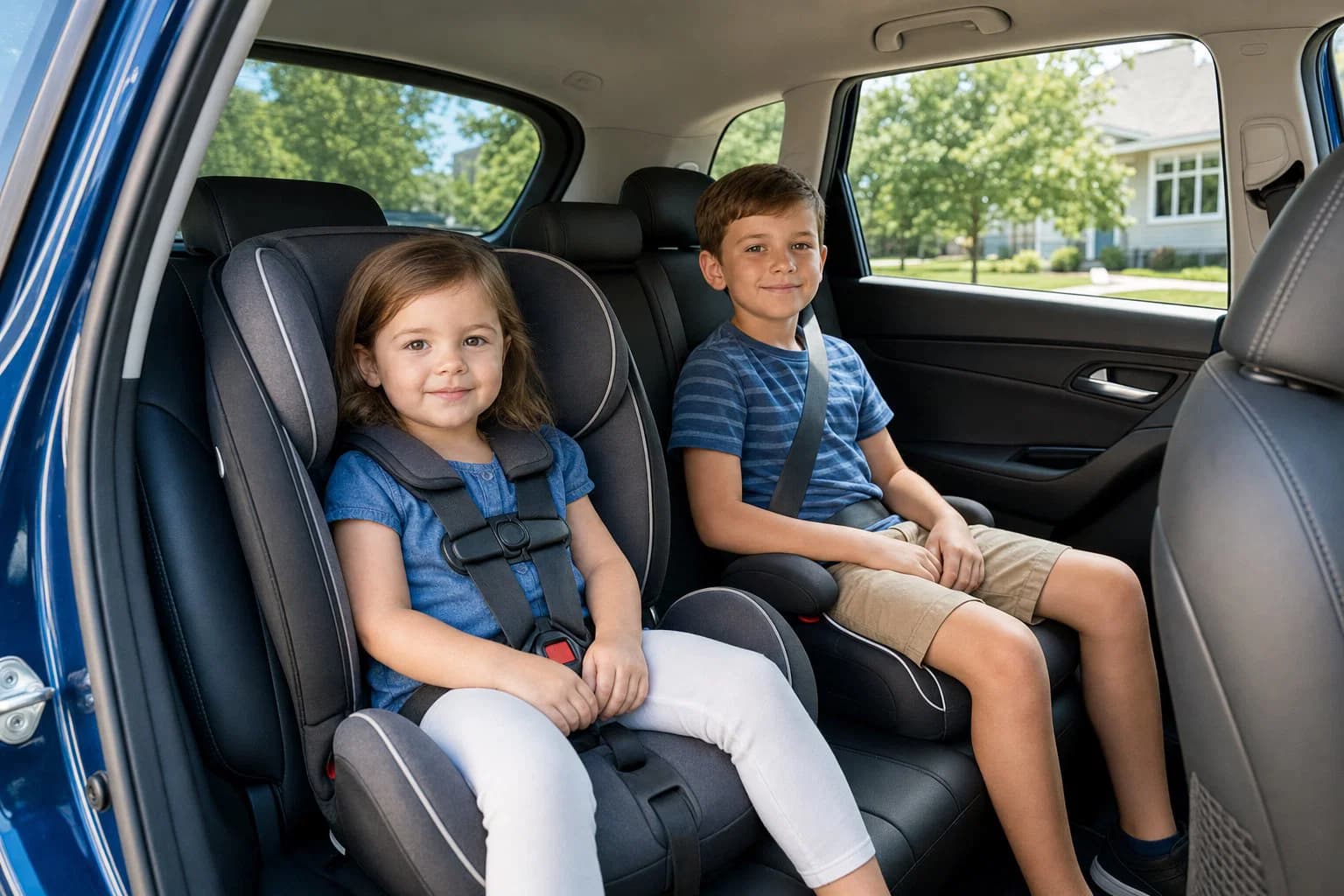
A belt-positioning booster seat does not inherently restrain the child; rather, it elevates the child so that the vehicle's standard seatbelt functions correctly. The lap belt must sit low and tight across the upper thighs and hips—not the soft stomach. The shoulder belt must cross the center of the chest and collarbone—not the neck or face.

Crash data clearly indicates that booster seats reduce the risk of serious injury by 45 percent for children aged 4 to 8 when compared to seatbelt use alone. Despite this, premature graduation remains a widespread issue. A child who uses an adult seatbelt too early is at immense risk for "Seatbelt Syndrome"—a specific pattern of severe abdominal and spinal cord injuries caused by the lap belt acting as a fulcrum against the soft abdomen during the violent deceleration of a crash.
Legislative Shifts: California AB 435 and the 5-Step Test
State laws regarding child passenger safety have historically been based on age, weight, or height minimums, which often fail to account for a child's specific anatomical proportions in different vehicles. Currently, California Vehicle Code Section 27360 requires children under 8 to be secured in a child passenger restraint system, and mandates rear-facing systems for children under 2 unless they exceed 40 pounds or 40 inches.
However, a landmark piece of legislation, California Assembly Bill 435, is poised to alter this landscape significantly. Taking effect on January 1, 2027, AB 435 replaces the vague definition of "properly restrained" with the strict anatomical requirements of the "5-Step Test" for children ages 8 through 15.
Under this new standard, a child is only legally and safely permitted to ride without a booster seat if they pass all five of the following criteria in the specific vehicle they are riding in:
Back Placement: The child must be able to sit with their back completely flat against the vehicle's seatback.
Knee Bend: The child's knees must naturally bend over the front edge of the auto seat cushion without slouching forward.
Shoulder Belt Fit: The shoulder strap must cross snugly over the middle of the chest and collarbone, without riding up onto the neck or slipping off the shoulder.
Lap Belt Fit: The lap belt must stay low and tight across the upper thighs or hips, never riding up onto the stomach.
Endurance: The child must be able to comfortably maintain this correct seating posture for the duration of the entire trip.
This legislation represents a critical shift from chronological age to physiological fit, acknowledging that many children do not achieve the necessary physical dimensions (typically around 4 feet 9 inches) to safely use an adult seatbelt until they are 10 to 12 years old. Parents choosing a first vehicle for their teenager can further strengthen this protection by pairing proper belt fit with a safer starter car and advanced safety features, as outlined in Smart Strategies to Keep Teens Safe in Their First Car.
Impending Federal Standards: FMVSS 213a and 213b
The regulatory framework governing child restraint systems is undergoing its most significant overhaul in decades. Effective December 5, 2026, the NHTSA will fully implement FMVSS 213a and FMVSS 213b, introducing rigorous new testing parameters that will alter the engineering, design, and marketing of car seats nationwide.
The Introduction of Side-Impact Testing (FMVSS 213a)
Historically, car seats in the United States were only federally mandated to pass frontal sled tests. However, side-impact collisions—often referred to as T-bone crashes—are particularly deadly because the occupant compartment is separated from the intruding vehicle by only a door structure and glass, lacking the substantial crumple zones found in the front and rear of the vehicle.
FMVSS 213a mandates standardized side-impact testing for all car seats designed for children up to 40 pounds and 43.3 inches. The test utilizes a sled mounted to an acceleration track, simulating a 30 mph intersection collision involving an intruding door structure striking a small vehicle like a Nissan Sentra. The testing employs advanced anthropomorphic test devices (ATDs), such as the Q3s dummy, which accurately measure lateral forces.
To pass, the restraint system must comprehensively manage crash forces, strictly limit chest deflection, successfully contain the child dummy's head within the side wings of the seat, and prevent any contact with the simulated intruding door. This mandate will fundamentally change car seat engineering, resulting in enhanced energy-absorbing foam, deeper side wings, and sturdier structural shells.
Updated Frontal Testing and Weight Thresholds (FMVSS 213b)
Concurrently, FMVSS 213b modernizes the frontal crash test parameters. For decades, the testing bench utilized by the NHTSA was modeled after the geometry of a 1974 Chevrolet Impala—featuring plush bench seating and lap-only belts that bear little resemblance to the highly contoured, firm seating of modern vehicles. FMVSS 213b updates this standard seat assembly to accurately reflect contemporary vehicle interiors.
Furthermore, FMVSS 213b alters minimum weight categorizations to encourage extended rear-facing and prolonged harness use:
Forward-Facing Minimum: The minimum weight rating for a forward-facing seat will increase from 20 pounds to 26.5 pounds, effectively forcing manufacturers and caregivers to keep children rear-facing longer, which biomechanics prove is vastly safer for spinal development.
Booster Seat Minimum: The minimum weight for a booster seat will increase from 30 pounds to 40 pounds, mitigating the risk of premature transition out of five-point harnesses.
| Regulatory Standard | Compliance Date | Key Mandates and Structural Changes |
|---|---|---|
| FMVSS 213a | December 5, 2026 | Mandates side-impact (T-bone) sled testing. Head containment and energy absorption metrics are strictly enforced for seats up to 40 lbs. |
| FMVSS 213b | December 5, 2026 | Updates frontal test bench to reflect modern vehicle geometry. Raises forward-facing minimum weight to 26.5 lbs; raises booster minimum weight to 40 lbs. |
| CA AB 435 | January 1, 2027 | Replaces age-based seatbelt graduation laws with the strict anatomical requirements of the 5-Step Test for children ages 8 to 15. |
The Economic Burden and the Role of Certified Professionals
The pursuit of absolute safety carries profound economic implications. The Centers for Disease Control and Prevention (CDC) estimates that motor vehicle crash-related deaths in the United States result in over $41 billion in medical and work-loss costs annually. For children and teenagers specifically, the economic burden of crash-related fatalities is estimated at nearly $856 million per year. Furthermore, non-fatal injury hospitalizations for child and teen occupants account for an additional $1.38 billion in direct medical costs.
Investing in proper child restraint systems, adhering strictly to LATCH weight limits, and utilizing the 5-Step Test for booster transitions yields an extraordinary return on investment for society. Economic models demonstrate that the break-even point for child safety seat design improvements and community misuse reduction programs is remarkably low—only $121 per year per child seat in use, compared to the astronomical costs of pediatric trauma care resulting from improper restraint.
To combat misuse, organizations like Safe Kids Worldwide administer the National Child Passenger Safety Certification Training Program. At the end of 2019, there were over 43,000 certified Child Passenger Safety Technicians (CPSTs) across the country. These professionals conduct community education and one-on-one car seat checks, providing hands-on assistance to caregivers to ensure the correct selection, installation, and harnessing of child restraint systems. Engaging with a CPST remains one of the most effective strategies to eliminate the 46 percent misuse rate seen in the NCRUSS data and complements broader teen and family driving policies such as those outlined in Keys to Calm: Teaching Teens to Drive Without Panic.
The External Threat: Road Rage, Distraction, and Hot Cars
While internal restraints, advanced airbags, and strict legislative frameworks dictate occupant survivability during a crash, these mechanisms are entirely reactive. They offer protection only after a failure in the driving environment has occurred. A comprehensive approach to road safety must therefore address the external behavioral threats that trigger these collisions.
The statistics surrounding driver behavior point to an increasingly perilous environment. In 2024, distracted driving claimed 3,208 lives, representing a persistent hazard driven largely by smartphone usage, text messaging, and in-vehicle infotainment systems. Distraction is multifaceted, involving visual, manual, and cognitive components, meaning a driver looking at a screen is effectively driving blind. Many of the same attention failures that put kids at risk in the back seat also raise risks for vulnerable road users like motorcyclists and cyclists, as explored in The Danger of the Two-Second Glance: Risks and Solutions.
Simultaneously, aggressive driving and road rage have escalated into a public health crisis. Recent data indicates that a staggering 96 percent of drivers witnessed an act of road rage within the past six months, and aggressive driving behaviors—such as speeding, tailgating, and improper lane changes—contribute to 66 percent of all traffic fatalities. Over a seven-year period, more than 12,000 injuries and 218 murders were directly attributed to road rage incidents.
Furthermore, the vehicle itself can become a localized hazard when stationary. Tragic incidents involving children or pets suffering from vehicular heatstroke ("hot car" deaths) are entirely preventable. NHTSA reports that over 700 children died from vehicular heatstroke between 1998 and 2016, with 54 percent of these incidents occurring because a caregiver forgot the child in the vehicle. In just ten minutes, the interior temperature of a car can rise by 20 degrees, reaching lethal levels rapidly. Keeping a well-prepared vehicle—down to what you store in your glovebox—also supports better decision-making in these high-stress situations, as outlined in What’s in Your Glovebox? The Survival and Legal Checklist.
Connected Community Safety: The Paradigm Shift to Human Media™
The modern roadway suffers from a distinct lack of communication. When drivers are insulated within their steel and glass environments, their ability to interact with one another is reduced to horns, light flashes, or aggressive gestures—methods that lack bandwidth, often cause confusion, and frequently escalate into road rage. The anonymity of the vehicle creates a sense of detachment, empowering individuals to act with a disregard for others that they would never display face-to-face.
This communication vacuum is being effectively filled by innovative technological platforms like Carszy, which shifts the paradigm from traditional "Social Media" to "Human Media™"—a community-driven network focused on real-world impact, accountability, and neighborhood security.
By utilizing License Plate Messaging, the platform allows individuals to securely text or call other vehicle owners using their license plate as a unique identifier. This technology serves as a critical de-escalation and safety tool. If a community member notices a vehicle driving erratically, a brake light burned out, or most urgently, a dog or child left in a hot car, they can instantly alert the owner or the broader community without direct physical confrontation.
Additionally, the implementation of VOIS™ (Vehicle of Interest Search) mobilizes the connected community in real-time. In the event of an Amber Alert, a hit-and-run, or human trafficking suspicions, the platform decentralizes the neighborhood watch, allowing everyday commuters to assist law enforcement by locating vehicles of interest rapidly. This localized, real-time connectivity reduces emergency response times and fosters a culture of accountability on the road, directly combating the dangerous anonymity that fuels reckless driving and road rage. These same connected tools can reinforce safer habits during high-risk trips—like mountain descents, rural drives, or late-night travel—where strategies from guides such as Mountain Driving Safety Tips for Descents and Brake Use also come into play.
Synthesis and Next Steps for Road Safety
The landscape of child passenger safety is vastly more complex than simply purchasing a highly-rated car seat. It demands a rigorous understanding of the vehicle's internal biomechanics, strict adherence to the mathematical weight limits of the LATCH system, and a physiological assessment of the child prior to discarding the booster seat.
Simultaneously, the automotive industry must continue to bridge the rear-seat safety gap by universally applying pretensioners and load limiters to second-row seating to prevent submarining and chest compression. Yet, internal safety mechanisms are only half of the equation. Mitigating the external threats of distracted driving, road rage, and parking-lot negligence requires a connected, vigilant community.
To take immediate action toward safer roads and neighborhoods:
- Audit Child Restraints: Caregivers must verify a child's weight against the 65-pound combined LATCH limit, immediately transitioning to a seatbelt and top-tether installation if the limit is exceeded.
- Apply the 5-Step Test: Older children should be assessed in every specific vehicle they ride in, ensuring they meet the stringent anatomical requirements before allowing them to use an adult seatbelt alone.
- Engage with a CPST: Utilize resources from Safe Kids Worldwide to find a local, certified technician to verify that car seats are installed without critical errors like harness slack or incorrect recline angles.
- Join the Community Network: Tech-savvy drivers and neighborhood watch advocates are encouraged to download the Carszy app to stay connected, utilizing License Plate Messaging to report dangerous driving, alert neighbors to vulnerable dependents in hot cars, and mobilize alongside the VOIS™ network to keep communities secure. When roadside breakdowns or flat tires happen with kids in the back seat, pairing these tools with the step-by-step playbook in Roadside Survival: New Safety Strategies for Drivers in 2026 adds another layer of protection.
Frequently Asked Questions
When exactly should a child move from a 5-point harness to a booster seat, and from a booster to an adult seatbelt? A child should remain in a 5-point harness until they reach the maximum height or weight limit specified by the car seat manufacturer. Modern seats often accommodate up to 65 pounds in a harness. Transitioning to a booster seat should only occur when the child has physically outgrown the harness. The transition from a booster seat to an adult seatbelt must be dictated by physiological fit, not age. A child is ready for an adult seatbelt only when they pass the "5-Step Test": they can sit with their back flat against the seat, their knees bend naturally at the seat edge, the shoulder belt crosses the center of the collarbone, the lap belt rests low on the hips and thighs, and they can comfortably maintain this posture for the entire trip. For families navigating this phase with new teen drivers, pairing proper belt fit with calm coaching, as described in Keys to Calm: Teaching Teens to Drive Without Panic, can make those early miles much safer.
What are the most common LATCH installation errors to look out for? The most frequent critical errors involve excessive slack. A seat installed via LATCH should not move more than one inch side-to-side or front-to-back at the belt path. Another critical error is failing to use the top tether on forward-facing seats, which is essential for preventing severe head excursion in a crash. Finally, caregivers often unknowingly exceed the LATCH weight limit, which mandates that the combined weight of the child and the car seat must not exceed 65 pounds. For households that also rely on bikes, scooters, or small EVs for school runs, it’s worth remembering that correct restraint use is just one part of a bigger safety picture that includes curbside and sidewalk behavior, as explored in When Sidewalks Fight Back: The Micromobility Collision.