Fall Back, Slow Down: Why Crashes Spike After the Clocks Change
The golden hour of the afternoon commute is officially behind us. As daylight saving time (DST) ends on Sunday, November 1, millions of us will participate in a bizarre, biannual ritual: we turn back our clocks, celebrate the promise of a so-called "extra hour" of sleep, and inadvertently plunge our evening commutes into absolute darkness. For the protective parent picking up kids from soccer practice, the dedicated commuter navigating endless highway traffic, and the neighborhood watch lead keeping an eye on local streets, this transition is far more than a minor calendar event. It is one of the most dangerous periods of the year to be on the road.
As an automotive safety advocate and tech journalist, I have spent years analyzing the intersection of human behavior, vehicle technology, and roadway safety. The data surrounding the end of daylight saving time is staggering. While we often treat the "fall back" time change as a cozy transition into winter, federal crash data, sleep science, and urban planning statistics reveal a hidden crisis. The sudden shift forces an exhausted, biologically confused population to navigate high-volume traffic in rapidly deteriorating light conditions.
You might be asking: Why do crashes spike so dramatically after the clocks change?
The answer is a perfect storm of circadian disruption, the physics of ambient light loss, blinding sun glare, active wildlife, and the limitations of modern automotive technology. We are trading a sunlit drive home for a twilight obstacle course. In this comprehensive report, we are going to unpack exactly what happens to our bodies and our roads when the clocks change, how modern vehicle tech is both helping and hurting us, and how we can use community-driven tools to protect ourselves and our neighborhoods.
The Statistical Reality: Trading Mornings for Midnight
Traffic safety analysts often view the biannual time change as a massive, naturally occurring experiment on the American driver. While the spring shift—which notoriously steals an hour of sleep—is linked to an immediate 6% spike in fatal motor vehicle crashes, the autumn shift presents a completely different, yet equally deadly, set of variables.
When our clocks fall back, the inherent risk of roadway accidents does not simply vanish; it fundamentally shifts its timeline and demographic.
By moving daylight out of the evening and into the early morning, the morning commute becomes marginally safer, leading to a temporary reduction in early-day collisions. However, the evening commute—already the most congested time of day—absorbs a massive influx of risk. The sudden onset of darkness during peak rush hour (typically between 4:00 PM and 6:00 PM) catches millions of drivers entirely off guard.
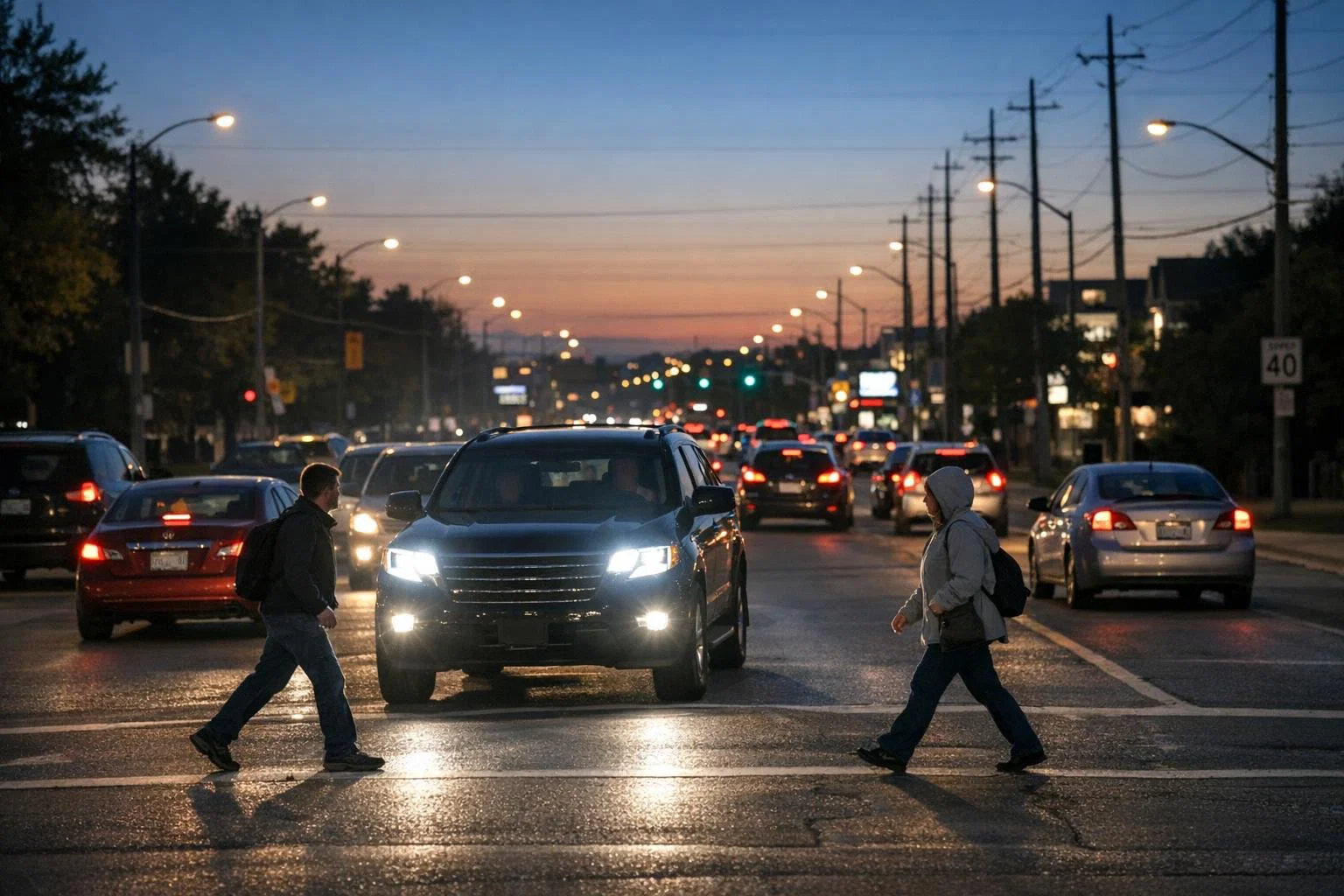
According to exhaustive analyses of the National Highway Traffic Safety Administration (NHTSA) Fatality Analysis Reporting System (FARS), fatal pedestrian and bicyclist crashes jump by 13% in the weeks following the autumn time change. This occurs because the highest volume of both vehicular and pedestrian traffic—workers heading home, children returning from after-school activities, and individuals running errands—suddenly takes place in diminished visibility.

| Metric | Spring Forward (Start of DST) | Fall Back (End of DST) | Source |
| Overall Fatal Crash Risk | Increases by 6% | Risk shifts from morning to evening | |
| Motor Vehicle Occupant Deaths | Increases by 12% | Decreases by 7.1% | |
| Pedestrian & Cyclist Deaths | Decreases by 24% | Increases by 13% | |
| Deer-Vehicle Collisions | Baseline seasonal rate | Increases by 16% |
The deeper insight drawn from this data is how the autumn time change radically transforms the demographic nature of nighttime driving. Ordinarily, late-night driving is dominated by a specific subset of the population, such as commercial truck drivers, third-shift workers, or those returning from late-night socializing. But when the sun sets before 5:00 PM, the "nighttime" driving demographic suddenly includes exhausted 9-to-5 office workers, newly licensed teenage drivers, and aging populations who might normally restrict their driving to daylight hours due to vision limitations. This massive influx of drivers who are unaccustomed to navigating in the dark exponentially multiplies the risk of severe collisions across the board.
The Pedestrian Peril: A Crisis in the Shadows
The most vulnerable populations during the end of daylight saving time are not those safely strapped inside steel cages; they are the people walking and biking outside of them. Pedestrian deaths have surged by more than 80% since reaching an all-time low in 2009, and the time change plays a critical, undeniable role in this ongoing crisis.
Human eyes require significant time to adjust to fading light. The twilight period—that dim, hazy window of dusk—is notoriously difficult for depth perception and contrast sensitivity. When the clocks fall back, pedestrians who normally walk home in the bright daylight are suddenly thrust into this twilight zone. Crash data indicates that evening pedestrian deaths increase by 3.5 times from October to November.

The Physics of Visibility and Stopping Distance
A fundamental, deadly disconnect exists between how fast a vehicle is traveling and how far its headlights can actually illuminate. A standard vehicle's low-beam headlights typically illuminate the road for about 160 to 250 feet. However, a vehicle traveling at a modest 40 miles per hour requires approximately 190 feet to come to a complete, emergency stop. By the time a driver spots a pedestrian crossing in the dark, they may already be past the physical point of no return.
This physics problem is heavily compounded by the fact that nearly 76% of all pedestrian fatalities occur in the dark. The sudden shift of the evening commute into darkness removes the protective buffer of daylight from the exact hours when the most pedestrians are navigating urban arterials and residential streets.
Furthermore, pedestrians often overestimate their own visibility—a dangerous cognitive bias. An individual wearing a dark winter coat often assumes that because they can clearly see an approaching vehicle's glaring headlights, the driver can also see them. In reality, the driver is likely looking into a void of darkness, occasionally blinded by oncoming traffic, rendering the pedestrian virtually invisible until the moment of impact. The Insurance Institute for Highway Safety (IIHS) notes that time changes result in a net decrease of 26 fatal pedestrian crashes in the spring, but this is inverted in the fall, proving that ambient light is the ultimate deciding factor in pedestrian survival.
| Pedestrian Crash Factor | Statistical Impact | Context | Source |
| Darkness Fatalities | 76% of all pedestrian deaths | Occurs mostly away from intersections | |
| Post-Time Change Spike | 13% increase in fatalities | Peaks in the November evening commute | |
| October to November Shift | 3.5x increase in evening deaths | Immediate result of DST ending |
Biological Backlash: Circadian Disruption and the "Mini Jet-Lag"
It is a remarkably common misconception that "falling back" and gaining an hour of sleep leaves the population refreshed, alert, and ready to tackle the day. In reality, chronobiologists and sleep experts warn that the shift disrupts the human circadian rhythm, causing a societal "mini jet-lag" that wreaks havoc on our cognitive functions.
The human body's sleep-wake cycle is heavily regulated by environmental light exposure. When sunset suddenly arrives an hour earlier, the brain begins producing melatonin—the hormone responsible for inducing sleep—prematurely. This biochemical reaction leaves drivers experiencing severe afternoon and early evening fatigue exactly when they need maximum cognitive function to navigate gridlocked rush hour traffic. Conversely, the earlier sunrise can cause individuals to wake up long before their alarms, before they have achieved a full night's rest, leading to an accumulation of sleep debt over the transition week.
The Epidemic of Drowsy Driving
Drowsy driving is a far greater threat than official government statistics suggest. While databases like FARS often underreport drowsy driving because there is no biological test for fatigue (unlike a breathalyzer or blood test for alcohol), sleep science experts argue that the impairment is nearly identical.
The AAA Foundation for Traffic Safety has released extensively documented research showing that sleep deprivation impacts drivers through several distinct, highly dangerous mechanisms:
- Reduced Alertness: Losing even one hour of sleep diminishes the brain's ability to scan the environment and react to hazards quickly. Reaction times slow down significantly, turning a near-miss into a fatal collision.
- Impaired Judgment: A lack of sleep heavily degrades the prefrontal cortex's ability to make safe, split-second decisions. Drivers deprived of four or more hours of sleep exhibit impairment levels analogous to a Blood Alcohol Concentration (BAC) over the legal limit.
- Hazardous Micro-Sleeps: Extreme fatigue induces momentary lapses in consciousness lasting anywhere from a fraction of a second to several seconds. During a three-second micro-sleep at 60 mph, a vehicle will travel the length of a football field entirely uncontrolled.
The transition away from daylight saving time triggers these biological vulnerabilities simultaneously across the entire driving population. The result is a compounding of risks: darker roads require faster reaction times and sharper vision, yet the driving population is operating with dulled reflexes, clouded judgment, and heavy eyelids. When millions of commuters are biologically programmed to be winding down for the evening, but are instead navigating 70 mph highway traffic in the dark, the spike in accidents becomes a mathematical certainty.
If you want to better understand how fatigue and other impairments affect drivers year-round, explore our guide on addressing impaired driving and community safety.
The Technological Review: The Arms Race of Automotive Illumination
As a tech reviewer, I spend a lot of time looking at how modern vehicle features impact our daily lives. As darkness encroaches earlier in the day, we rely entirely on our vehicle's lighting systems to get us home safely. However, modern automotive lighting introduces its own set of unique, modern hazards during the time change, creating an environment filled with blinding glare, confusing dashboard interfaces, and invisible vehicles.
The LED Arms Race and "Revenge Glare"
In recent years, the automotive industry has rapidly transitioned from traditional, warmer halogen bulbs to intensely bright, blue-tinted LED headlights. While LEDs theoretically provide better, crisper illumination for the driver, they are frequently blinding oncoming traffic. This issue is intensely exacerbated by the rising popularity of tall SUVs and heavy-duty pickup trucks. The headlights of a lifted truck sit perfectly at the eye level of a commuter in a smaller, low-profile sedan.
When a commuter, already fatigued from circadian disruption, is repeatedly struck by the blinding glare of oncoming LEDs, their pupils constantly constrict and dilate. This causes severe eye fatigue and temporary night blindness. This dynamic often leads to a highly dangerous psychological reaction on the road known as "revenge glare."
When a driver feels they have been blinded by an oncoming vehicle's high beams (even if it is just a misaligned low beam on a tall, modern truck), they may retaliate out of frustration by flashing their own high beams. This road-rage-adjacent behavior creates a dual-blindness scenario where two vehicles are hurtling toward each other at a combined speed of 100 mph while both drivers are visually incapacitated. It is a catastrophic failure of roadway etiquette and safety.
The Bureaucratic Lag in Smart Lighting
Why are our headlights so blinding? The issue stems from outdated federal regulations. For decades, the Federal Motor Vehicle Safety Standards (FMVSS 108) lagged severely behind European (ECE) regulations. While European drivers have enjoyed Adaptive Driving Beam (ADB) or "matrix" headlights—which use sensors to actively block out the specific pixels of light that would blind an oncoming driver while keeping the rest of the road illuminated—the US only recently permitted this technology in 2022 following the Bipartisan Infrastructure Law. Because of this regulatory delay, millions of cars on American roads feature outdated, non-adaptive LED blasters that contribute heavily to nighttime accidents.
The Dashboard Illusion and "Phantom Vehicles"
Another technological hazard that peaks after the time change involves automated dashboard lighting. Modern vehicle dashboards are essentially massive, perpetually illuminated digital screens. In previous decades, a dark, unlit analog dashboard served as an immediate, unmistakable visual cue to a driver that their headlights were off. Today, drivers surrounded by glowing infotainment screens and brightly lit digital gauges frequently assume their headlights are engaged when they are not.
Furthermore, many modern vehicles feature Daytime Running Lights (DRLs). These cast a weak beam forward to increase daytime visibility, but crucially, they fail to illuminate the vehicle's rear taillights. As a result, our November highways are plagued by "phantom vehicles"—cars driving in total darkness with no rear illumination whatsoever. For a driver approaching from behind at 70 mph, a dark grey phantom vehicle blends perfectly into the asphalt, leading to catastrophic rear-end collisions.
To build broader night-driving confidence, especially at complex intersections and multi-lane junctions, it also helps to understand how modern designs work. Our explainer on modern roundabouts and safer navigation can deepen that skill set.
Environmental Hazards: Sun Glare and the Wildlife Threat
Beyond human biological factors and technology, the end of daylight saving time alters the raw environmental landscape of the commute. Two of the most prominent environmental hazards are the shifting angle of the sun and the biological rhythms of local wildlife.
The Blinding Dusk Commute
In the weeks immediately following the time change, the evening commute aligns perfectly with sunset in many regions. This creates acute sun glare, particularly for those driving westbound toward the setting sun. Sun glare is notoriously dangerous; it washes out traffic signals, obscures the brake lights of the cars ahead, and renders pedestrians crossing intersections entirely invisible.
When drivers are blinded by glare, a frightening psychological phenomenon occurs: many instinctively maintain their speed despite having near-zero visibility, hoping the glare will pass in a split second. This mismatch between maintained speed and actual visibility results in severe rear-end collisions. When the sun finally dips below the horizon, the sudden transition to darkness leaves drivers' pupils struggling to dilate, causing temporary night blindness just as the heaviest volume of traffic hits the roads.
Glare and low-traction conditions can be just as dangerous when the weather shifts. For example, during the first storms after long dry spells, crash risk jumps sharply; see our guide on first-rain road safety in Southern California for how light, drizzle-like rain can turn roads slick at the exact time visibility is already poor.
The Autumn Rut and the 16% Deer Collision Spike
The end of daylight saving time perfectly coincides with another biological phenomenon: the autumn rut, or deer mating season. During this time, deer activity increases by up to 50%. Deer are crepuscular creatures, meaning their biological clocks dictate that they are most active at dawn and dusk.
When our human clocks fall back, the peak of our commuting hours overlaps precisely with the peak of deer movement. Consequently, deer-vehicle collisions spike by an astonishing 16% in the week following the shift to standard time. Studies published in Current Biology suggest that nearly 10% of all deer-vehicle crashes for the entire year occur in the two short weeks surrounding the autumn time change.
These collisions are catastrophic. In the United States, an estimated 2.1 million deer-vehicle collisions occur annually, resulting in roughly 440 human fatalities, 59,000 injuries, and over $10 billion in economic damages. Researchers note that deer collisions are 14 times more frequent in the two hours after sunset than in the two hours prior. The sudden shift of the evening commute into this high-risk, post-sunset window dramatically increases the likelihood of a high-speed animal strike. Eliminating the time change to permanent DST could prevent an estimated 36,550 deer deaths and 33 human deaths each year.
Regional Road Risks: A Case Study of Orange County
The impact of the time change is heavily influenced by geography, infrastructure, and local traffic patterns. To truly understand the localized, compounding effects of the time change, we can look at high-density suburban environments like Orange County, California.
In Orange County, which witnessed a staggering 17,734 injury or fatal collisions in a single recent year, the traffic infrastructure creates a perfect storm for post-time-change accidents. The region features sprawling multilane arterials, complex freeway interchanges, and heavy tourist traffic blending with hurried local commuters.
Local crash data indicates that the hazard window between 3:00 PM and 6:00 PM sees the highest volume of daily crashes, driven by driver impatience, heavy congestion, and sun glare. Following the end of daylight saving time, this exact high-volume window is plunged into darkness. Wide arterials and intersections—such as Beach Boulevard and Edinger Avenue in Huntington Beach, or Harbor Boulevard and La Palma Avenue in Anaheim—which already see notoriously high crash rates, become exceptionally dangerous. Drivers rushing home struggle to spot crossing pedestrians against the chaotic backdrop of commercial neon lights, oncoming LED glare, and heavy traffic.
Coastal regions like Orange County face an added environmental hazard in the fall: evening marine layer fog. The combination of early darkness, blinding LED headlights reflecting off the dense fog, and the heavy 5:00 PM traffic volume creates an environment where localized visibility drops to near zero. The mismatch between the posted speed limit and the actual, real-world visibility conditions inevitably results in massive multi-car pileups on freeways like the 405 and the 55. This local data mirrors a national reality: when infrastructure complexity meets sudden darkness, the crash rates inevitably soar.
Drivers who share these crowded roads with large trucks also face unique risks when visibility drops. For a deeper look at safe spacing and blind zones around big rigs, see our breakdown of why tailgating a semi is so dangerous.
Engineering Safety: How Carszy Empowers the Community
As federal regulations and infrastructure improvements lag woefully behind the immediate realities of the road, modern safety solutions require a decentralized, community-driven approach. We can't always wait for city planners to install better streetlights, and we can't wait for automakers to universally adopt anti-glare technology. This is where advanced driver-to-driver communication networks fundamentally alter the safety landscape.
The Carszy platform represents a vital paradigm shift from traditional "Social Media" to what is termed Human Media™—leveraging technology for real-world, localized impact to keep our neighborhoods and highways safe. By utilizing license plates as unique identifiers, the privacy-focused platform creates an anonymous, secure communication network between vehicles. This technology is uniquely positioned to mitigate the specific hazards that spike after the end of daylight saving time.
Real-Time Alerts for Immediate Hazards
Remember the "phantom vehicle" problem we discussed earlier? The one where a driver is navigating the dark highway with a glowing dashboard but no taillights? This problem cannot be solved by aggressively honking or flashing your high beams, which often triggers road rage, confusion, or "revenge glare."
With License Plate Messaging, a commuter can securely send an alert directly to the specific license plate of the dark vehicle, notifying the driver instantly that their lights are off. This simple, non-confrontational communication can easily prevent a fatal rear-end collision on a dark, high-speed highway.
Similarly, if a driver is swerving out of their lane due to the extreme fatigue associated with circadian disruption, a fellow motorist can use the platform to issue a wake-up warning or alert local neighborhood watch groups to a potentially dangerous driver in a residential area.
These same tools can also help when a vehicle breaks down in a dangerous spot. For more step-by-step guidance on staying visible and avoiding secondary crashes, see our roadside survival and breakdown safety playbook.
Mobilizing Against Hit-and-Runs with VOIS™
The 13% spike in pedestrian fatalities during the darker evening commutes brings a tragic secondary consequence: a sharp rise in hit-and-run incidents. The cover of early darkness often emboldens impaired, uninsured, or panicked drivers to flee the scene of an accident rather than taking responsibility.
Carszy's VOIS™ (Vehicle of Interest Search) acts as a real-time community mobilization tool. If a vehicle strikes a pedestrian or a cyclist and flees into the dark, witnesses can immediately flag the license plate through the platform. This crowdsourced alert system dramatically reduces law enforcement response times and blankets the community with thousands of extra eyes. For Neighborhood Watch Leads, community advocates, and protective parents, this feature transforms the local community into a highly responsive safety net, ensuring accountability even when the sun goes down.
Fostering Accountability on the Road
The psychological shift that occurs in the dark often leads to more aggressive, risk-taking behaviors. Anonymity breeds recklessness; people drive differently when they feel they cannot be seen. By establishing a system where every license plate connects to a broader community accountability network, the platform strips away the dangerous anonymity of the dark commute. Knowing that dangerous driving, aggressive tailgating, or road rage can be instantly reported to a local network encourages drivers to slow down, double-check crosswalks, and adhere to safer driving practices during the treacherous winter months.
Community accountability also plays a role in other high-risk situations, such as collisions involving uninsured motorists and AI-driven claims, where shared information can help victims protect both their safety and finances.
Actionable Defenses: The Tech-Savvy Driver's Guide to the Time Change
While systemic issues require long-term infrastructure and technological changes, individuals can take immediate, actionable steps to protect themselves and their families during the transition back to standard time. Here is what every commuter, parent, and driver needs to do.
1. Optimize Sleep Hygiene and Circadian Health
To combat the "mini jet-lag" of the time change, preparation must begin days before the clocks fall back. You cannot simply tough out biological fatigue.
- Incremental Adjustments: Gradually shift your sleep and wake times by 15 minutes a day leading up to the transition. This eases the shock to your circadian rhythm.
- Strategic Light Exposure: Maximize your morning light exposure by opening the blinds immediately upon waking to signal to the brain that the day has begun. Conversely, limit blue light from screens in the evening to allow natural melatonin production to occur.
- Acknowledge the Fatigue: If extreme exhaustion sets in during the afternoon commute, pull over in a safe, well-lit area and take a 20-minute power nap rather than attempting to push through the fatigue. Drowsy driving is functionally equivalent to drunk driving.
2. Vehicle Maintenance for Maximum Visibility
A dark, glare-filled commute requires a vehicle to be in optimal condition. You need every photon of light working in your favor.
- De-Grime the Windshield: The inside of a windshield accumulates a thin, invisible film of off-gassed dashboard plastics and environmental grime. When hit by oncoming headlights or low-angle sun glare, this film scatters the light, causing total visual white-outs. Cleaning the interior glass meticulously with a microfiber cloth is a crucial, often overlooked autumn maintenance task.
- Headlight Restoration and Aiming: Clouded, yellowed, and oxidized headlight housings drastically reduce your light output while scattering the remaining light into the eyes of oncoming drivers. Restore the plastic housings and ensure your headlights are aimed at the correct downward angle. This prevents reduced visibility and mitigates the dangers of revenge glare.
- Verify Taillight Function: Do not trust your automatic sensors implicitly. Manually verify that your taillights activate when your dashboard is illuminated.
3. Tactical Defensive Driving Adjustments
Operating a vehicle in the dark requires a fundamentally different tactical approach than driving in broad daylight.
- Reduce Speed to Match Visibility: If your headlights only illuminate 200 feet of the road, driving at speeds that require 300 feet to stop means you are effectively driving blind. Speeds must be reduced to ensure your stopping distance falls squarely within your illuminated zone.
- Look to the Right: When confronted with blinding oncoming LED headlights, do not stare into the light. Avert your gaze to the solid white line on the right side of the road, using your peripheral vision to track the oncoming car until it passes.
- Scan for Eye Shine: To prevent devastating deer collisions, drivers must actively scan the woodline and ditches for the reflective green or yellow eye shine of wildlife, rather than just staring at the pavement directly ahead.
Many of these tactics also apply when you are merging, changing lanes, or dealing with short on-ramps in the dark. If freeway entries make you nervous, especially at night, our guide on short freeway ramps and safe merging offers more detailed strategies.
4. Pedestrian and Cyclist Defensive Strategies
If you are outside of a vehicle, you must assume you are entirely invisible to drivers during the evening commute.
- High-Visibility Gear: Wearing reflective materials on moving joints (ankles, knees, and wrists) helps drivers recognize the human form in motion, vastly improving reaction times compared to static reflective vests on the torso.
- Eye Contact is Mandatory: Pedestrians should never step into a crosswalk unless they have made explicit, undeniable eye contact with the driver of the approaching vehicle. Assuming a vehicle will stop simply because a crosswalk is painted on the asphalt is a fatal miscalculation in the dark.
Families shuttling kids to evening practices or events should also pay close attention to how children are secured in the car and how they exit near traffic. For more detail on protecting young passengers, see our overview of child passenger safety and back-seat risks.
Conclusion
The end of daylight saving time is much more than a minor calendar event; it is a critical vulnerability window for public safety. The sudden, jarring shift of the high-volume evening commute into total darkness, combined with the biological disruption of the human circadian rhythm, creates an environment ripe for catastrophic accidents. Pedestrians face an immediate 13% spike in fatal crash risks, while the roads become flooded with drowsy drivers, blinding LED glare, phantom vehicles, and highly active wildlife.
Understanding these hidden dangers is the vital first step toward mitigating them. By proactively adapting our driving habits, optimizing our vehicle lighting, and maintaining strict sleep hygiene, these seasonal risks can be significantly reduced. Furthermore, leveraging community-driven technology allows citizens to bridge the safety gap where traditional infrastructure and regulations fall short. In the dark, a connected community is a safe community.
As the clocks fall back this November, the mandate for every driver, parent, and community watch advocate is abundantly clear: fall back, slow down, turn on your full headlights, and look out for one another.
Take the next step in community road safety: Download the Carszy app today to join a network of proactive drivers. Whether you are securely alerting a commuter that their taillights are out, or helping locate a vehicle involved in a dangerous hit-and-run via VOIS™, the power to keep our roads safe is now directly in the hands of the community.
Frequently Asked Questions (FAQ)
Does Daylight Saving Time actually cause car accidents?
Yes. An extensive body of peer-reviewed research confirms a direct, undeniable correlation between the biannual time change and a spike in traffic accidents. While the spring transition causes a 6% increase in fatal crashes due to acute sleep deprivation and the loss of an hour of rest, the autumn transition (ending DST) shifts the primary danger to the evening commute. The sudden onset of darkness during peak rush hour causes a 13% spike in fatal pedestrian and cyclist crashes, as well as an incredible 16% increase in deer-vehicle collisions. The combination of reduced visibility, sun glare, and disrupted sleep rhythms makes the week following the time change exceptionally hazardous for all road users.