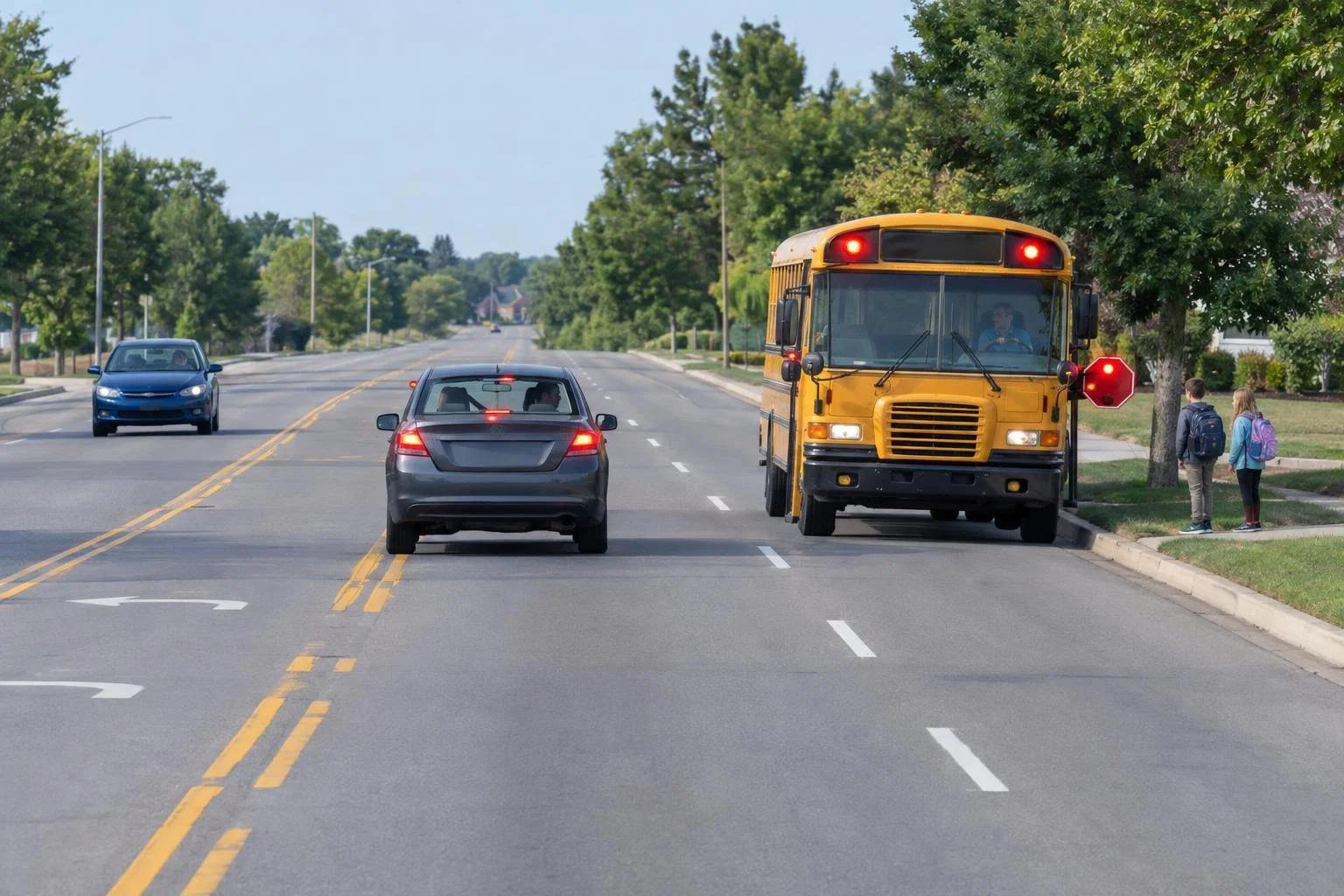
On one school day in 2025–2026, 101,334 school bus drivers in 39 states and the District of Columbia counted the cars that passed their stopped buses, and they recorded 56,024. Those drivers were about 26.2% of the national workforce.
Most drivers could tell you that a bus with flashing red lights means stop. The mistakes come from the details: when the amber lights matter, what counts as a divided road, how far back to stay, and what a ticket costs once the fine, the points and the insurance renewal are added up. We cover each of those below, and what we would do first on the road.
How Many Drivers Still Pass Stopped Buses
The National Association of State Directors of Pupil Transportation Services (NASDPTS) runs the annual count. Its 14th survey was released on July 21, 2026, at the National School Transportation Association convention in Denver, Colorado. The drivers log violations on one operational day, and the organization scales the result up to the whole national fleet.
That scaling produced roughly 213,800 illegal passings every school day. Over a 180-day school year, the projection is 38.4 million violations. That is down 2.3% from the 39.3 million projected for 2024–2025 and nearly 15% below the 45.2 million estimated for 2023–2024. NASDPTS credits heightened awareness and enforcement for the drop, and NASDPTS President Mike Stier said that 38.4 million illegal passings is still entirely too many.
| School year | Projected annual violations | Change from prior year |
| 2023–2024 | 45.2 million | Baseline |
| 2024–2025 | 39.3 million | About 13% lower |
| 2025–2026 | 38.4 million | 2.3% lower |
When, Where and From Which Side
The pattern in the 2026 survey is more specific than "everywhere, all day." Afternoon routes produced 28,596 of the day's violations, or 51%. Morning routes had 25,707 (nearly 46%), and midday routes had 1,721 (just over 3%).
Nearly 64% of illegal passings came from the front of the bus, and the rest approached from behind. Four states, Florida, California, Georgia and Texas, accounted for about 60% of all reported incidents.
One number deserves attention from anyone who thinks passing on the right is a clever way around a stopped bus. The survey found 3.45% of passings happened on the right side, the highest rate since the survey began. The pre-pandemic average (2019 and earlier) was 2.15%, and the post-pandemic average is 3.11%. The right side is the curb side, where children board and get off.
The Human Cost
The National Highway Traffic Safety Administration (NHTSA) reports that 77 school-age pedestrians were killed in school-transportation-related crashes from 2015 through 2024, and 55% of them were children aged 5 to 10. A study of 2001–2003 data on school bus-related injuries treated in emergency departments (McGeehan et al., 2006) found that 23.8% of those injuries occurred as children were going to or from the bus.
A September 2026 survey by the Governors Highway Safety Association (GHSA) found that 46% of parents whose children ride a school bus said their child had a "close call" involving dangerous driving near a bus or in a school zone. The same survey found 91% of parents support automated stop-arm cameras to penalize drivers who pass stopped buses.
Why Drivers Do It
NHTSA's national survey in November 2024 asked drivers why they think motorists pass stopped buses. The top answer was that drivers "do not care" (30.5%), followed by being "in a hurry" (25.5%), "not knowing the law" (24.3%) and being "distracted" (12.2%).
Our reading is that a driver who passes is more often choosing to than failing to understand, since only about a quarter of respondents blamed ignorance. That reading is ours, not the survey's. It does not make confusion irrelevant, though. Some road layouts, covered below, are hard to read even for a driver who wants to comply. If you have ever hesitated at a five-lane road with a bus on the far side, you have met one.
What the Amber and Red Lights Tell You
A yellow school bus uses two stages of lights. The amber lights start flashing first, as a warning that the bus is about to slow and stop to load or unload children. In a speed zone of 35 miles per hour or less, they come on at least 100 feet before the stop. In a faster zone, they come on at least 300 feet before it.

The law requires drivers who see flashing amber lights to prepare to stop. Amber does not require a full stop, but it is your cue to take your foot off the gas and check your mirror. The warning can be short. One Georgia driver who contested a camera ticket, Hughley, said the yellow lights flashed for barely a second before the stop-arm came out and that "the bus was still rolling". Whether that holds up in his case is a matter for the officials who reviewed it. For other drivers, it is a reason to treat amber as a signal to slow rather than to speed through.
When the bus stops and its doors open, the amber lights go off. The red lights begin flashing as the stop-arm swings out, and many buses also lower a front pedestrian crossing gate. Red lights and an extended arm create the legal boundary: every driver the law covers must stop.
When You Can Go Again
You stay stopped until the stop-arm retracts, the red lights go off and the children have cleared the road. In some states the bus driver may also signal traffic to move on. Do not rely on the bus pulling away as your only cue, and do not edge forward while a child is still crossing.
How Far Back to Stop
The required gap differs by state. Minnesota requires at least 20 feet from a bus displaying flashing red lights. Pennsylvania requires at least 10 feet. Other jurisdictions set the distance at 30 feet.
We would not memorize three numbers. Stopping a full car-length or more farther back than your state's minimum costs you a few seconds, and it keeps you inside the rule whichever state you are driving in.
The Minnesota Loophole and Why Red Means Stop Now
The wording of a stop law can matter in court. In State v. Waln, the Minnesota Court of Appeals overturned a conviction for passing a school bus. It held that the statute required the stop-arm to be fully "extended" before a driver had a legal duty to halt. That left a gap between the moment the red lights began flashing and the moment the arm reached full extension, when a driver could pass without breaking the statute as written.
Minnesota closed the gap. The Legislature amended Statute 169.444, Governor Tim Walz signed the change, and it took effect on March 28, 2026. A vehicle must now stop at least 20 feet away the moment the bus displays flashing red lights, and may not move until the lights stop flashing, whatever position the arm is in.
This case should end any plan of timing the arm. The safe rule is that red lights flashing means you stop, and you do not wait to see whether the arm is out.
The Bus That Does Not Have Red Lights
Not every school-owned bus carries the equipment. Multi-Function School Activity Buses (MFSABs) are federally regulated and built with school bus crash protection, but they are manufactured without flashing red lights or stop-arms. Schools typically use them for field trips and athletic events, where loading from a moving lane of traffic is not part of the job. Because they lack the signals, drivers are not legally required to stop for a stopped MFSAB the way they must for a standard yellow route bus.
The practical point for drivers is that the red lights and the arm trigger the stop. Passengers still step off an activity bus, though, so slow down and leave room around it.
When You Must Stop: Rear, Front and Divided Roads
If you come up behind a stopped school bus with its red lights flashing and arm out, you stop. All 50 states, the District of Columbia, Guam, Puerto Rico and the U.S. Virgin Islands have laws in force that make passing from the rear illegal.
The front is where the laws split. A 2024 NHTSA review of state laws, directed by Section 24110(a) of the Infrastructure Investment and Jobs Act (enacted November 15, 2021), found that 42 states require drivers approaching from the front to stop on an undivided highway. On a divided highway, most states exempt opposing traffic, but the definition of "divided" varies a good deal by state, which produces driver confusion and uneven enforcement.
| State | When opposing traffic does not have to stop |
| Pennsylvania, Texas, Florida, Hawaii | Only if a physical barrier divides the road |
| Alaska | If the separated roadway has two or more lanes in each direction |
| Washington | If the road has three or more marked lanes, with or without a physical barrier |
| Georgia | No exemption for a road with four or more lanes and a center turn lane. Traffic from both directions must stop |
In Pennsylvania, Texas, Florida and Hawaii, a physical barrier means a concrete median, a raised curb, guide rails, a wall, a fence, or at least five feet of unpaved, grassy separation. Painted lines do not qualify. If none of those is present, opposing traffic must stop.
The Center Turn Lane Problem
The two-way left-turn lane is where drivers most often guess wrong. In Georgia, a road with four or more lanes and a center turn lane requires traffic from both directions to stop. Several other jurisdictions treat a center turn lane as enough of a divider to exempt opposing traffic.
Transportation planners have noticed. At a January 13, 2026, City Council meeting in Warren, Michigan, an infrastructure review said center turn lanes improve traffic flow and left-turn visibility but create local confusion about school bus stop laws, and that the city needs targeted education.
Our advice is to stop whenever you cannot say for certain that a physical barrier or a state-specific exemption applies. A wait of 30 seconds costs far less than a ticket, and the only drivers who can use the exemption confidently are those who know the local rule. If you drive across state lines, the rule you know from home may not be the rule where you are.
What a Ticket Costs, State by State
Penalties run from a $50 base fine in Nevada to state jail felonies in Texas and Missouri. The table lists first-offense figures for ten states, including Illinois' change that starts January 1, 2027. Laws change, so check your state's current statute before relying on any figure here.
| State | First-offense fine | License points | Suspension |
| Texas | $500 to $1,250 | 2 (3 if a collision) | At 6 points in 3 years |
| New York | $250 to $400, plus $88 to $93 surcharge | 5 | At 11 points in 24 months |
| Georgia | $1,000 minimum | 6 | Automatic 6 months if under 21 and at 4 points |
| Illinois (from Jan. 1, 2027) | $300, officer or camera | None | Mandatory on officer citation |
| Pennsylvania | $250 ($300 by camera) | 5 | Automatic 60 days |
| North Carolina | $500 minimum, plus $190 court costs | 5 (8 for a CDL) | Two-year revocation if you strike a person |
| California | $150 base, $695 minimum fine | 1 NOTS point | 1 year after three violations in three years |
| Missouri | $500 to $1,000 | 5 | At 8 points in 18 months |
| Connecticut | $450 | 4 | Not stated |
| Nevada | $50 base, $100 to $175 total | 4 | Not stated |
Texas
In Texas, passing a stopped bus is a misdemeanor under Transportation Code §545.066, with a first-offense base fine of $500 to $1,250. Later offenses carry base fines up to $2,000 and possible jail time. If the violation causes serious bodily injury, it becomes a state jail felony with 180 days to 2 years in state jail and a fine up to $10,000.
Court costs add roughly $102 to $150 on top of the fine. Counting insurance increases and legal help, the all-in cost in Texas runs from $1,500 to over $5,000. The conviction adds 2 points, or 3 if a collision occurred, and the points stay on the record for 36 months. Six points in 3 years triggers a suspension and an SR-22 filing. The form itself costs $15 to $25 to file, but it can raise the underlying policy by 50% to 80%, and it must be kept for 2 years from reinstatement.
Eligible Texas drivers can take a state-certified Driving Safety Course once every 12 months to avoid points. That requires a plea of guilty or nolo contendere and a $144 fee ($10 for the course plus $134 in court costs). Commercial driver's license holders cannot use the option.
New York
New York prosecutes under Vehicle and Traffic Law 1174. Fines climb with repeat offenses: $250 to $400 for a first, $600 to $750 for a second within 3 years, and $750 to $1,000 for a third within 3 years. A mandatory surcharge of $88 to $93 is added to each. The conviction carries 5 points.
Five points is one short of the threshold for the separate Driver Responsibility Assessment. The state bills it when a driver reaches 6 points within 18 months. The base is $100 a year for three years ($300 total), plus $25 a year ($75 total) for every point above 6. One extra minor ticket in that window, such as a 2-point out-of-state violation that transfers through the Driver License Compact, is enough to trigger the $300.
Rules that took effect on February 16, 2026, extended the lookback for automatic suspension. Eleven or more points in 24 months now triggers it, where the earlier lookback was 18 months. Camera tickets differ from officer tickets. A camera notice is billed to the vehicle owner and carries no points on the driver's record, while an officer-issued ticket carries the fines, points and suspension exposure.
Georgia and Addy's Law
Georgia rewrote its law through House Bill 409, known as "Addy's Law," which took effect July 1, 2024. It is named for 8-year-old Adalynn "Addy" Pierce, who was fatally struck by a vehicle that illegally passed her school bus while she was boarding.
The offense is now a "high and aggravated misdemeanor" with a minimum fine of $1,000, replacing the previous $250 mailed-citation penalty. Jail time can run up to 12 months, and defendants do not get the standard two-for-one credit for time served. A conviction adds 6 points.
Georgia's point thresholds bite quickly. A driver under 21 who reaches 4 points faces an automatic 6-month suspension. A driver over 21 who reaches 15 points in 24 months faces a 1-year suspension. For a young driver, one conviction therefore means a suspension on its own.

The law also requires school districts to equip buses with stop-arm cameras. A first camera ticket carries no license points, but police must notify the owner's insurance carrier of a second or later camera violation. Districts must also reassess routes where students cross roads with speed limits of 40 miles per hour or higher.
Illinois
Illinois passed House Bill 3175 (Public Act 104-0587) unanimously in both chambers. It takes effect on January 1, 2027, so it is not yet in force as of today, November 10, 2026. Camera-issued civil penalties rise from $150 to $300 for a first offense and from $500 to $1,000 for a second or later one, with an extra $100 if the penalty is not paid on time.
The law also adds an evidence rule. If a bus camera captures both the stop-arm and an electronic signal, the law presumes the bus was loading or unloading children, and the driver must show otherwise.
Officer-issued citations carry the same $300 and $1,000 amounts but amount to a criminal conviction. They bring no points in Illinois, but they trigger a mandatory license suspension, and courts cannot offer supervision. Paying an officer-issued ticket online counts as a guilty plea and locks in the suspension. A driver who gets one should talk to a lawyer before sending any payment.
Pennsylvania
Under 75 Pa.C.S. § 1370, a conviction costs $250, 5 points and an automatic 60-day suspension. If a stop-arm camera caught the violation, the fine is $300. Pennsylvania's "Operation Safe Stop" in October 2025 involved 89 law enforcement agencies and 14 school districts, who documented 196 drivers breaking the law, up from 188 the year before. Courts convicted 404 drivers of the offense during 2025, up 14.7% from 352 in 2024.
North Carolina
North Carolina treats a standard violation under General Statute 20-217 as a Class 1 misdemeanor with a mandatory minimum fine of $500 plus $190 in court costs. If the driver strikes a person, it becomes a Class I felony with a minimum fine of $1,250 and a mandatory two-year license revocation. The conviction adds 5 license points, or 8 on a commercial driver's license.
Many North Carolina drivers use a "Prayer for Judgment Continued" to accept responsibility without taking the penalties of a conviction. The state does not allow one for school bus violations.
California
California's Vehicle Code § 22454 sets base fines of $150 for a first offense, $150 to $250 for a second and $250 to $500 for a third within 12 months. Mandatory state penalty assessments and county surcharges push the minimum fine for a first offense to $695. The actual cost of a second offense is $850 to $950, and a third is upwards of $1,000. The first conviction adds 1 point under the state's Negligent Operator Treatment System, which stays on the record for 36 to 39 months. Three violations within three years brings a mandatory one-year suspension.
Missouri
Missouri's Senate Bill 1421 took effect on August 28, 2026. Before it, a violation did not automatically bring points. Now a driver who fails to stop gets 5 points, and 8 points in 18 months triggers a suspension, according to the Missouri Department of Revenue.
Fines scale with history. A first offense is $500 to $1,000. A second within five years is $1,000 to $2,000 and a 90-day suspension. A third or later within five years is $1,500 to $3,000 and a 180-day suspension. Courts cannot suspend the fines. If a child is physically injured, the offense becomes a Class E felony with up to four years in prison. If the child suffers serious physical injury, it is a Class D felony with up to seven years. Both can carry fines up to $10,000.
Florida, Connecticut and Nevada
Florida's Cameron Mayhew Act (HB 1239) took effect July 1, 2017. It followed the death of 16-year-old Cameron Mayhew on June 1, 2016, as he crossed the road to board a bus. The driver in that case got a six-month license suspension and a $1,000 fine. Under the act, passing a bus and causing serious bodily harm or death carries a $1,500 fine, a one-year suspension and 120 hours of community service at a trauma center.
Connecticut's C.G.S. § 14-279 sets a $450 fine and 4 DMV points for a first offense. Later convictions run $500 to $1,000 and can include up to 30 days in prison. In Nevada, the base fine is typically $50, and court fees bring the total to $100 to $175, with 4 license points.
Across the Border
Canadian penalties can be harsher for dangerous passes. On September 9, 2026, Ontario Provincial Police stopped a 17-year-old driver from Saint-Philippe, Quebec, after he passed two stopped school buses at 133 km/h in an 80 km/h zone on Highway 63 near Balsam Creek, in wet conditions. He was charged with stunt driving, with an automatic 30-day license suspension and a 14-day vehicle impoundment. On March 3, 2026, OPP charged a 74-year-old driver in St. Clair Township with failing to stop for a school bus. A conviction carries fines up to $2,000 and six demerit points.
The Cost Beyond the Fine: Insurance and Records
The fine is often the smaller bill. Insurers classify passing a stopped school bus as a "major moving violation". That puts it in the same tier as reckless driving, street racing and driving 31 or more miles per hour over the limit. When the policy renews, the carrier pulls the Motor Vehicle Report and applies the surcharge.
In Texas and New York, the surcharge typically raises the premium by 20% to 35%. The increase applies to the whole policy, covering liability, collision and comprehensive, not liability alone. In North Carolina, the four insurance points assessed for the violation bring an 80% premium increase that lasts five years.
California shows how a single point can hit the premium. The point costs a driver the state-mandated 20% "Good Driver" discount, and a 12% baseline risk surcharge applies on top. For a Californian paying an average $2,599 for full coverage in 2024, that comes to roughly $832 more per year, or nearly $2,500 over three years.
Your Record and Your Insurer Keep Different Calendars
In states such as Texas and Pennsylvania, points come off the driving record three years after conviction. Insurers do not follow that clock. They apply their own lookback, often up to five years for major violations, and it runs from the conviction date, not from the point status. A driver who sees the points disappear may still be paying for the ticket two years later.
Some carriers sell violation forgiveness as an endorsement, at $40 to $80 a year. It may waive the first surcharge if the driver kept continuous coverage for three to five years before the violation. Consider adding it before a ticket, not after, because it only helps a driver who has a clean history to protect. For broader planning around breakdowns and secondary crash risks, see our roadside safety guide.
Camera Tickets and Officer Tickets Are Different Problems
Police cannot follow tens of thousands of bus routes. School districts have turned to automated stop-arm cameras, typically supplied by private vendors such as BusPatrol, Verra Mobility and AngelTrax at no upfront cost to the district. In return, the vendors take a share of the revenue from the civil citations mailed to vehicle owners.
Whether a ticket came from a camera or an officer changes what you face. In New York, camera notices are billed to the owner and carry no driver points, while officer tickets add 5 points. In Pennsylvania, the camera fine is $300 against $250 for an officer ticket, and the 5 points and 60-day suspension attach to a conviction. In Illinois from 2027, officer tickets carry a mandatory suspension that camera tickets do not. Georgia's first camera ticket has no points, but a second sends a notice to your insurer.
New Programs Are Starting Now
On April 1, 2026, Duval County Public Schools in Florida activated BusPatrol cameras across its 900-bus fleet. After a 30-day warning phase, the cameras issue $225 fines under the statute. On May 5, 2026, Cherokee County, Georgia, launched a BusPatrol system built on the $1,000 fine from Addy's Law. The district reported more than 200 violations in a single day across its fleet before launch.
What the Vendors Claim and What Audits Found
Vendors say the cameras change behavior. Verra Mobility claims citations drop about 70% over a school year where its programs operate, and AngelTrax claims year-over-year declines of up to 33%. Both say 98% of cited drivers do not commit a second recorded violation. Those are the vendors' marketing claims.
An independent audit of Montgomery County, Maryland's program in 2026 reached a different view. The county has issued over 375,000 tickets and collected $92 million in fines. The audit found no evidence the program led to fewer collisions, better public safety or fewer total violations. Citations per active camera were 36 in fiscal year 2020 and 34 in fiscal year 2025. Between fiscal years 2019 and 2024, about $40 million went to the vendor, BusPatrol, and the county kept $18.5 million. The audit said a credible safety evaluation needs collision, injury and violation-per-bus-movement data, which the vendor systems do not measure.
A 2025 University of Minnesota study that reviewed camera programs in South Carolina and Texas found that cameras help gather evidence and document violation rates, but installing them does not reduce violations by itself. Handoffs between the vendor, the school district and the police who validate citations also slow the process. Illinois' new law responds to this by requiring municipalities and counties that use cameras to analyze every two years whether the cameras improve safety and to publish the results.
For a driver, the lesson is that a camera ticket can be disputed. Two Georgia drivers contested $1,000 citations issued in late 2025. One, retired teacher Bryan Holland, cited on Lindbergh Drive, said "I'm not guilty" and that the fine would make his car a "large paperweight." The other was Hughley, quoted above. Their cases prompted internal reviews by the Atlanta and Clayton County police departments of how the vendor cameras were calibrated.
Fighting a Ticket: What Works and What It Costs
Given the insurance exposure, many drivers hire a lawyer. In New York, routine traffic tickets often start at a $300 flat fee that covers negotiations, motions and court appearances without the driver attending. In Las Vegas, a local traffic lawyer typically charges $75 to $200 for a school bus ticket. The aim is to negotiate the ticket down to a non-moving violation in exchange for a higher court fine, which avoids the 4 points and the later insurance hikes.
Defenses that come up for school bus tickets include:
- The highway was physically divided by a raised curb or concrete wall, which exempts opposing traffic.
- The bus was showing amber lights, not red, at the moment of passing.
- In camera cases, a dispute over who was driving the vehicle.
- Stopping suddenly would have caused a rear-end collision by tailgating traffic.
New York attorney James Medows says timing disputes are the most common defense, since the prosecution must prove the red lights were on and the arm was extended at the exact moment the vehicle passed. That also shows the narrow limit of a defense. Minnesota's change, discussed earlier, means that in at least one state an arm that has not fully extended no longer helps.
What We Would Do First
We would start with the habits that need no knowledge of statutes, then deal with the local rules.
- Treat amber as the moment to slow down. Amber lights give a few seconds of warning before the red. Ease off, check your mirror, and expect to stop. Speed should always let you halt within the distance you can clearly see, whatever the posted limit.
- Stop on red every time, and do not wait for the arm. After Minnesota's 2026 change, red lights are the trigger there, not the arm. Stop well back from the bus. The legal minimums are 10, 20 or 30 feet depending on the state.
- Learn your state's divided-road rule. If you drive through Georgia, remember that a road with four or more lanes and a center turn lane means everyone stops there. In Pennsylvania, Texas, Florida and Hawaii, only a physical barrier exempts opposing traffic. If you cannot tell which rule applies, stop.
- Never pass on the right. That is the side where children board and get off, and it is where the survey's highest-ever share of passings occurred.
- Check your insurance before you need to. Ask whether your carrier offers violation forgiveness, which costs $40 to $80 a year, and what its lookback window is.
- If you get a ticket, see a lawyer before paying. In Illinois from 2027, paying an officer-issued ticket online counts as a guilty plea. In several states the points and the insurance surcharge cost more than the fine.
There are a few things we would skip. We would not count on timing the stop-arm or the amber lights. We would not assume the center turn lane exempts you in a state where you have not checked. And we would not count on an unfamiliar state's exemption, because the rules differ too much from state to state.
Conclusion
The rule for drivers is stop for red lights and be ready to stop on amber. The difficulty comes from the edge cases: the divided road, the center turn lane, the bus whose amber phase was short. A ticket for getting it wrong can cost from a $50 base fine in Nevada up to a felony in Texas or Missouri, and the cost keeps going through the insurance renewal.
This week, find out your state's rule for opposing traffic on divided roads and read your insurance policy's violation-forgiveness terms. If you want to talk through what these penalties mean for a household with young or new drivers, the Carszy team is glad to help.
FAQ
Do I have to stop for a school bus coming the other way?
On an undivided highway, 42 states require drivers approaching from the front to stop. If the road is divided, most states exempt opposing traffic, but definitions differ. In Pennsylvania, Texas, Florida and Hawaii, the exemption needs a physical barrier such as a concrete median, raised curb, guide rail, wall, fence or at least five feet of unpaved grass. Alaska looks at lanes in each direction, Washington at three or more marked lanes, and Georgia requires everyone to stop on a road with four or more lanes and a center turn lane.
What do the amber lights mean?
They are a warning that the bus is about to stop to load or unload children. They typically start at least 100 feet before the stop in speed zones of 35 mph or less, and at least 300 feet before in faster zones. Drivers must prepare to stop when they see them.
When can I start driving again?
You wait until the stop-arm is retracted, the red lights are off and the children have cleared the road. In some states the bus driver may also signal traffic to proceed. In Minnesota, since March 28, 2026, you may not move until the lights stop flashing, regardless of the arm's position.
How far back must I stop?
It depends on the state. Minnesota requires 20 feet, Mississippi 10 feet, and other jurisdictions 30 feet. Staying farther back than the minimum keeps you within any of them.
Do I have to stop for a school activity bus that has no red lights?
Multi-Function School Activity Buses are built without flashing red lights or stop-arms and are generally used for field trips and athletic events. Drivers are not legally required to stop for one the way they must for a standard route bus. People still step off these buses, so slow down and keep your distance.
Do camera tickets add points?
It depends on the state. In New York, camera tickets are billed to the vehicle owner and add no points, while officer tickets add 5. In Georgia, a first camera ticket carries no points, and police must notify the owner's insurer of a second or later camera violation. In Illinois from 2027, an officer-issued conviction triggers a mandatory suspension and a camera ticket is a civil penalty.
How much will a ticket really cost?
The fine is only part of it. In Texas, with court costs, insurance increases and legal fees, the total runs from $1,500 to over $5,000. A California first offense carries a minimum fine of $695, and a single point there can add roughly $832 a year to full-coverage insurance for an average driver. Insurers treat the violation as a major moving violation, with surcharges of 20% to 35% in Texas and New York that apply across the whole policy.
Can I take a course to keep points off my record?
In Texas, eligible drivers can take a state-certified Driving Safety Course once every 12 months to avoid points. It requires a guilty or nolo contendere plea and a $144 fee, and commercial driver's license holders cannot use it. Illinois does not allow court supervision for officer-issued citations, and North Carolina does not allow a Prayer for Judgment Continued. Check your own state before you assume a course or deferral is available.
Supporting Links
- School Bus Fleet: 2026 NASDPTS survey data on illegal passing
- School Training Solutions: state school bus laws and light sequence
- NHTSA traffic safety facts on school bus passing laws
- Burke County Schools: Georgia school bus safety and Addy's Law
- TrafficTicketFine: Texas penalties for passing a stopped school bus
- Georgia Criminal Lawyer: Georgia's new school bus passing law, effective July 1, 2024