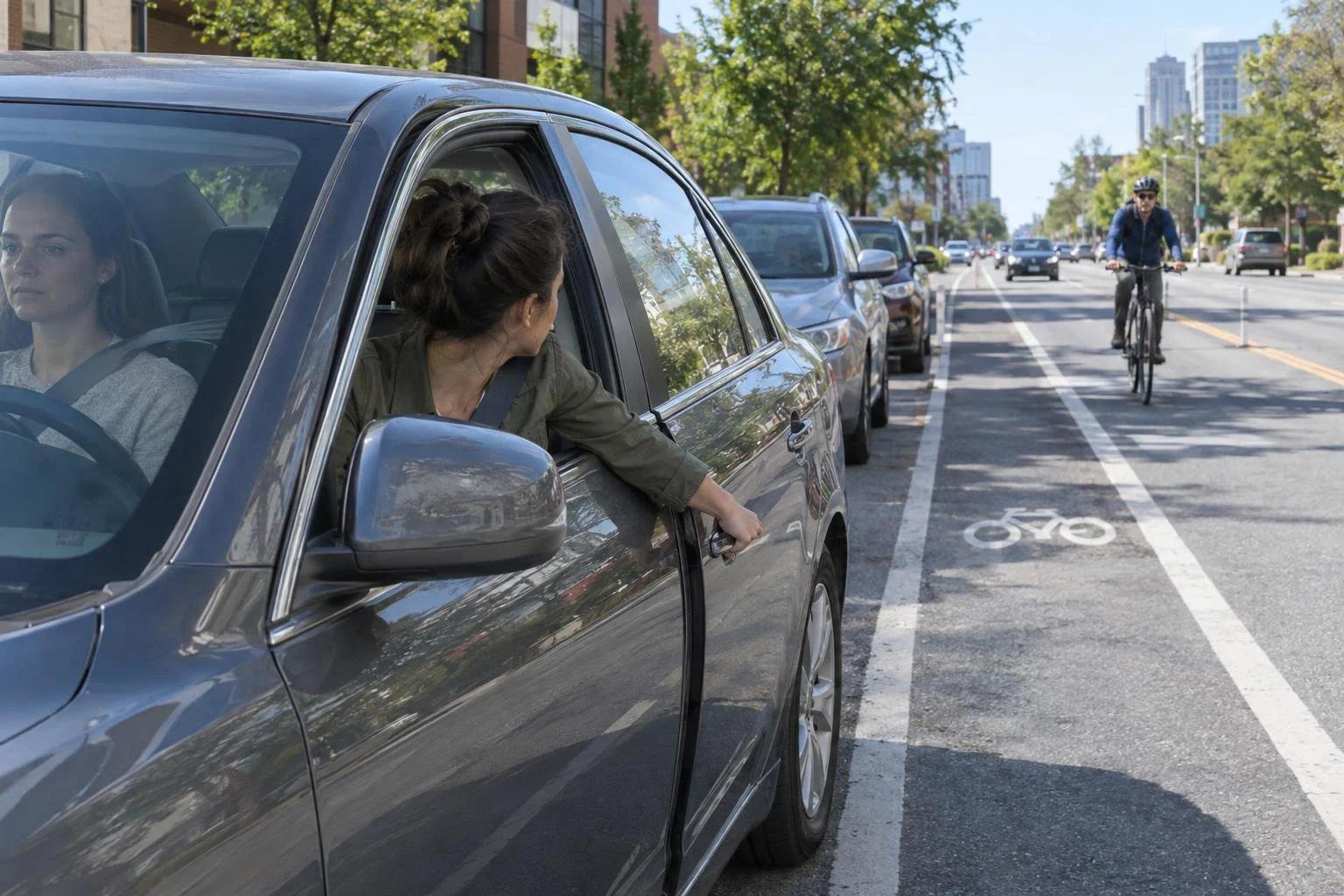
A car door opened into a bike lane is a sharp-edged barrier that appears with almost no warning, and the rider has very little time to react . Opening the door with your far hand turns your shoulders toward the traffic you are about to step into.
What Happened on Halsted Street on June 5, 2026
On June 5, 2026, Riley O'Neil, a 35-year-old Chicago Department of Transportation planner, was riding in a painted bike lane on Halsted Street in Chicago, Illinois. A car occupant opened a door into his path. O'Neil clipped the door while swerving and was thrown under the rear wheels of an oncoming semi-truck. He died.
Three weeks later, on June 27, 2026, 69-year-old cyclist Ricki Larson was struck by a driver getting out of a parked vehicle on the 1600 block of Highland Parkway in St. Paul, Minnesota. She suffered a severe head injury and was removed from life support at Regions Hospital in July 2026. The driver stayed at the scene and cooperated with the St. Paul Police Department. According to the police report, the driver was neither cited nor arrested.
These two cases show the two ways a dooring goes wrong. In one, the rider hits the door or the person behind it. In the other, the rider swerves to avoid it and ends up in the path of something heavier. Both start with a door that opened before anyone looked.
Our position is simple. The far-hand habit costs nothing, takes a few seconds to learn, and changes where your eyes point at the one moment that matters. We would learn it before buying anything or reading about anything else. It also has limits, and we cover them below, because a habit in the driver's seat does not fix a painted lane that runs through the door zone.
How a Door Becomes a Collision
When an occupant opens a door into the travel path of a cyclist, scooter rider or other vulnerable road user, the rider faces a solid edge with minimal reaction time. The physical outcomes include blunt-force trauma, impalement on the door's edge, or being vaulted over the vehicle.

Riders who see the door in time often swerve. That pushes them into the adjacent travel lane, directly in front of overtaking traffic, and adds a second collision risk on top of the first. Painted bike lanes inside the "door zone" give no physical protection. Riders in them face parked vehicles on one side and moving heavy vehicles on the other.
What the Injuries Look Like
A personal injury law site, Justin for Justice, lists the injuries it sees from these crashes. Victims frequently suffer traumatic brain injuries with memory loss and cognitive decline, regardless of helmet use. Other common injuries are broken collarbones and limbs, spinal injuries from herniated discs to partial paralysis, and road rash severe enough to need surgical debridement.
That list explains why a few seconds of checking is worth the effort. The driver or passenger gives up a moment. The rider can lose months or more.
How Often Dooring Happens
Counting dooring is hard, and the figures below use different definitions, places and years. Because of that, they cannot be compared directly. Each one shows dooring-related harm in its own place.
| Place | Period | What was counted | Figure |
| New Zealand | 2017 to 2021 | Urban crashes involving parked cars | 14,030 |
| Austria | 2020 to 2025 | Cyclists injured in dooring accidents | 1,110 |
| Montreal, Canada | 2019 to 2022 | Victims of dooring collisions | 309 |
The New Zealand number comes from a transport research paper. Those 14,030 crashes were 7.7 percent of all reported crashes in the five years. They accounted for 2.5 percent of all deaths and serious injuries, which came to 9 fatalities and 286 serious injuries. Parked-car crashes are a broader category than doors alone, so treat that row as context, not a dooring count.
In New York City, data compiled by the Department of Transportation and partner agencies show nine cyclists killed in dooring incidents from 2017 through 2021. That was 8.4 percent of all cyclist fatalities in the city over the period. Studies of Chicago and New York City have estimated an average of up to one dooring collision per day.
Most of these crashes happen at a very ordinary moment, when someone arrives and wants to get out. That is the moment the habit targets.
The Far-Hand Habit, Step by Step
The technique is called the Dutch Reach. It comes from the Netherlands, where bicycles outnumber cars four to one in cities such as Amsterdam, and more than 25 percent of all trips nationwide are made by bicycle. In that setting, checking for cyclists before getting out is a cultural norm and not a legislated maneuver.
The rule is to open the door with the hand farthest from the handle. For a left-side door, that is the right hand. For a right-side door, it is the left hand.
The Five Steps
- Reach. Cross your body and take the handle with your far hand.
- Swivel. The reach rotates your upper body and turns your eyeline out toward the adjacent lane.
- Look back. From that posture you can scan the rear-view mirror, the side-view mirror, and over your shoulder through the side window.
- Open slowly. With your arm across your body you have less leverage, so the door cannot be flung wide. Open it a narrow gap first and look again.
- Exit facing traffic. Step out in a posture that faces oncoming traffic, and move away from the travel lane.
Illinois puts the Dutch Reach into its official Rules of the Road publication under House Bill 5143. Mirrors come first in the sequence above. The reach is what makes the shoulder check happen without you deciding to do it.
Why the Reach Does the Work
Most safety advice asks you to remember to look. The Dutch Reach changes the physical position of your body so that looking happens as part of reaching. If you open a door with your near hand, your body faces forward and the cyclist is behind you. With your far hand, your body is already turned. The dangers of distracted driving make relying on memory alone especially risky.
That is why the habit is a better bet than a reminder. Reminders ask for attention at the moment you are least likely to give it, which is when you are tired, late or thinking about your destination. A posture does not rely on attention.
Passengers and Rideshare Riders
The same reach applies to passengers. California's door statute is binding on "any person," so a rideshare passenger carries the same legal duty of care as the driver. If you are in the back seat of a taxi or rideshare car on the traffic side, use your far hand and look back before the door moves.
New York City aimed its 2025/2026 "New York Twist" campaign at exactly this group. We cover it in the campaigns section below.
What the Nottingham Test Showed and What It Did Not
Until recently, neither the near-hand nor the far-hand method had been tested with human factors research before advocates began promoting it. Researchers at the University of Nottingham published a preliminary evaluation in October 2018 to address that.
The design was small. Ten participants sat in a 2001 Honda Civic and made 80 door openings, which covers 20 near-hand and 20 far-hand openings from each of the driver and passenger seats. To keep people from changing their head movements to please the researchers, they were told the study measured reaction times. Head movement was recorded with an EdTracker head-mounted device.
The result supported the idea. The far-hand reach increased the driver's field of view to the side and rear compared with the near-hand method.
The study measures head movement, not crashes. It tells us the posture improves what a person can see. It does not tell us how many collisions the habit prevents on real streets, and we have not found a figure that does. That is a reason to treat the habit as one layer among several, not a reason to skip it.
When the Reach Does Not Work for You
The Dutch Reach asks for torso rotation and shoulder flexibility. Dutch ergonomic data on older adults, compiled by researcher Johan F.M. Molenbroek and published in July 2026, covers 750 people (123 aged 20 to 30 and 623 aged 50 and over) across 79 physical, sensory, psychomotor and cognitive measures. It finds wide variation within each age group, and flexibility and force decline sharply after age 65 or 70.

In our view, that means some older occupants, and people with limits on spinal rotation or shoulder movement, may find the reach painful or impossible. If that is you, the mirror check and shoulder look still come first, even if the reach is not comfortable. Do the part of the sequence you can do, and open the door a narrow gap before opening it fully. We are giving that as practical advice. The studies we reviewed do not test it.
The Streetsblog Chicago piece titled "The Dutch Reach Is Not the Answer" makes a related point. In its account, a habit in the occupant's seat does not remove the door zone from the street. We agree, and we cover infrastructure below.
Making the Reach Automatic
Knowing the technique and doing it every time are different. Behavioral psychology defines a habit as an action triggered automatically by a contextual cue, which reduces your reliance on conscious motivation. A habit loop has three parts, a cue, a routine and a reward, an idea popularized by Charles Duhigg.
Pick a Cue You Already Have
The cue should be something you already do every time you park. Behavioral guidance gives two examples for this exact habit: turning off the ignition and unbuckling the seat belt. Anchoring a new behavior to an existing automatic one is called habit stacking.
We would choose the seat belt. You touch it on every trip, and the next movement of your arm is to the door. Let the click of the buckle be the trigger for the mirror check and the reach.
Write the If-Then Plan
Behavioral scientists recommend "implementation intentions," which are specific if-then plans, and a stable environmental context. A plan for this habit could read: "If I unbuckle my seat belt, then I check both mirrors and reach across with my right hand." Say it once out loud when you start, and use your own driver's seat for the first practice runs.
Expect About Two Months
Campaigns and habit guides often rely on the myth that a habit forms in 21 days. A 2024 review of 20 digital behavior change interventions found a median time to automaticity of 59 to 66 days. Individual results ranged from as little as 4 days to as many as 335 days.
So plan for roughly two months of conscious effort, and do not read an early miss as failure. If you forget on day 30, buckle in the plan again the next time you park.
Keep the Reward Small
The reward in the habit loop here is a safe exit and not having to spend mental effort on it later. Behavioral guidance cautions that rewards should not be overly salient, because minimizing contingency helps the behavior pass into automaticity without the reward disrupting it. In plain terms, do not build a points system. The habit pays for itself once it runs without thought.
Why Stickers and Slogans Fall Short
Cities have tried to change this behavior with messages. In 2012, New York City ran a "LOOK!" campaign that put window stickers in taxis to remind passengers to check for cyclists. Behavioral scientists note that caution campaigns rarely change ingrained or impulsive behavior, especially when people are distracted or hurrying to get out.
More recently, the NYC Taxi and Limousine Commission and the Department of Transportation ran the "New York Twist" campaign in 2025/2026. A public service video set to Chubby Checker's "Let's Twist Again" taught passengers to twist their bodies while opening doors. A mobile outreach unit called "Van Hailin" supported it.
The campaign is creative. According to OECD OPSI and Streetsblog Chicago, without protected, separated bike lanes that take the cyclist out of the door zone, education offers limited systemic protection. Evidence for reminder campaigns is thin.
For a driver deciding what to do today, the point is practical. A sticker will not build the habit. Habit-formation guidance from Goals and Progress and Behavioural Leeway, together with a 2024 review of 20 digital behavior change interventions, points to a cue, an if-then plan and about two months of practice.
What the Law Says About Your Door
The legal picture differs by state. Here is where each rule stands as of November 10, 2026.
California: A Duty to Open Only When Safe
California Vehicle Code Section 22517 is in force. It bars anyone from opening a vehicle door on the side available to moving traffic unless it is reasonably safe and can be done without interfering with traffic. It also bars leaving the door open longer than necessary to load or unload passengers. Bicycles count as moving traffic under California law.
The statute applies to "any person," so passengers bear the same duty as the driver. It places the duty on the occupant and not the approaching cyclist.
Shamshoni Law says first-offense fines range from $35 to $300. The larger exposure is civil. Under California jury instruction CACI No. 418, a jury that finds a violation caused harm can find the occupant negligent. That exposes them to damages for medical expenses, lost wages and pain and suffering, subject to reductions for comparative fault.
For a sense of scale, the law firm Sally Morin Personal Injury Lawyers announced on March 18, 2026 a $100,000 settlement for a client, a singer and model, who was thrown from a bicycle when a parked car's door opened into their path near Linden Avenue and Nowita Place in Venice, California. That is the firm's own announcement of a single case, so we would not treat it as a typical amount. It shows civil claims can run well past the fine.
Illinois and Massachusetts: The Technique in the Rulebook
Illinois enacted House Bill 5143 in August 2018, sponsored by State Representative Theresa Mah. It requires the Illinois Secretary of State to include the Dutch Reach in the official Illinois Rules of the Road publication. The law also requires bicycle safety and the Dutch Reach to be built into the state driver's license examination.
Massachusetts was the first US state to add the Dutch Reach to its driver's education curriculum. Its manual describes it as a method that forces bodily rotation, which protects cyclists and prevents doors from being torn off by overtaking traffic.
The Illinois and Massachusetts sources cited here describe teaching the technique and do not mention a fine for opening a door with the wrong hand. The legal duty to open a door safely comes from statutes such as California's.
New York: Fault Can Cut Both Ways
Under New York's 2026 tort reform, motor vehicle injury actions follow modified comparative negligence. If a cyclist is found more at fault than the combined fault of the parties being sued, for example by riding too fast or swerving outside a bike lane, they may be barred from recovering damages. Law firm Godosky & Gentile, writing in October 2026, says this makes scene evidence critical. It names traffic camera footage, door position and scrape patterns on the bicycle as examples.
For an occupant, that cuts both ways. Fault is argued over what each person did, so a documented check can matter. We would still not treat the legal angle as a reason to rely on a defense after a crash. The point of the habit is that the crash does not happen.
What Cars Can Do, and What It Costs
Automakers are building systems meant to catch what people miss. Safe Exit Assist and Safe Exit Warning detect approaching hazards and warn you, or physically hold the door, before it opens.
Examples From the 2026 Model Year
- Hyundai Santa Fe (2026). A Hyundai dealer's page says the SmartSense suite is standard on all trims, including the base SE. Its Safe Exit Assist uses rear radar, and if it detects a hazard it overrides attempts to turn off the electronic child safety lock, keeping the rear doors shut until the vehicle passes.
- Subaru Uncharted (2026). Subaru lists radar-based Safe Exit Assist and Blind Spot Monitor as standard.
- Lexus NX (2026). A Lexus dealer's page lists a Digital Latch combined with Safe Exit Assist, designed to keep the electronic door from opening until conditions are clear.
Those descriptions come from dealer and manufacturer pages, so they show what the makers say the systems do, not how often they prevent a crash.
Where the Sensors Struggle
Millimeter-wave radar is the backbone of these features, because it penetrates fog and dust better than optical cameras. It is not perfect. Heavy rain and standing water scatter the signal, reduce the effective range, and can cause misses. One test of a cycling radar product found that a vehicle in wet conditions did not register until it was much closer than the standard 175-meter range.
Ultrasonic sensors, used in low-speed parking and rear occupant alerts, have a detection range of only a few meters. They cannot detect fast-approaching cyclists. Cameras are degraded by snow, mud, ice, sun glare, darkness and fog.
In our view, that means a driver parked in a downpour is the person most likely to get a miss from the radar and the person with the most reason to do the reach and the shoulder check. Automakers also say these systems add a layer and do not replace your own awareness.
What You Pay
Driver-assistance packages vary widely in price. Older figures put Toyota Safety Sense at $300 to $500 and Lexus Safety System+ at $500 to $635, with Subaru EyeSight around $1,195 and luxury packages higher, such as BMW's Driver Assistance Plus at $4,500. In the 2026 market, many manufacturers bundle safety technology into upper trims, which adds an average of $2,000 to $5,000 to the base price, according to Car Ummah.
Repairs cost more too. AAA data cited by Kelley Blue Book puts replacement of a blind-spot radar sensor at $850 to $2,050, camera sensors at $500 to $1,100, and bumper-embedded parking sensors at $500 to $1,300. The average repair for a minor front or rear collision on an ADAS-equipped vehicle is $5,300, more than double the historical average for a vehicle without those sensors.
We would not pick a car for a door-exit feature alone. The habit costs nothing, and it works in any car you drive, rent or ride in. If you are buying a car for other reasons and the feature comes with it, treat it as a backup to the reach and not a replacement for it.
If You Ride, Stay Out of the Door Zone
Drivers and cyclists share this problem from opposite sides, and many readers do both. The Royal Society for the Prevention of Accidents (RoSPA) recommends cyclists keep at least 1.5 meters from parked cars, using the phrase "door and a bit more." RoSPA also advises scanning for recently parked vehicles, occupants visible through windows, and the sound of a door unlatching.
That advice has limits. In a narrow street with a painted lane inside the door zone, a cyclist has no physical protection from the parked cars on one side and the moving heavy vehicles on the other, which is the situation Chicago's O'Neil faced when he swerved. The rider is making a trade-off the street forced on them, which is why the occupant's habit and protected lanes both matter.
What We Would Do First
Start with the far-hand reach, because it is free, takes seconds to learn, and has direct support from a head-movement test. Tie it to the seat belt, write the if-then plan, and give it about two months, since the 2024 review put the median at 59 to 66 days.
If you ride in the back of taxis or rideshares, use it there too. California's duty covers passengers, and passengers are where the New York Twist campaign aimed.
We would not bother with a reminder sticker on its own. Evidence for such campaigns is thin, and behavioral scientists say they rarely change impulsive behavior. We also would not shop for a car mainly for exit-assist features, given the radar's weak spots in rain and the repair costs. And we would not treat the reach as a substitute for protected bike lanes, which OECD OPSI and Streetsblog Chicago point to as what takes the cyclist out of the door zone.
If you manage a fleet, run a rideshare program or train drivers and want help turning this into a rule your people follow, talk with Carszy.
Frequently Asked Questions
Which hand do I use to open the door?
Use the hand farthest from the handle. For a left-side door that is the right hand. Reach across your chest, let your body turn, check the mirrors and look over your shoulder, then open the door a narrow gap. For a right-side door, the same logic means the left hand.
Is the Dutch Reach required by law?
In Illinois, the law requires the Secretary of State to include the method in the Rules of the Road and to build it into the driver's license exam. Massachusetts teaches it in its driver's education curriculum. California's statute, as described, sets the duty to open a door only when it is reasonably safe, and does not name a hand. Check the rules where you live.
Does it actually reduce crashes?
We have not found a crash-reduction figure. The evidence is a small University of Nottingham test with ten participants and 80 door openings, which found that the far-hand reach increased the driver's field of view to the side and rear. That shows the posture helps you see. It does not count crashes prevented.
How long until I do it without thinking?
Plan on about two months. A 2024 review of 20 digital behavior change interventions found a median of 59 to 66 days, with a range from 4 to 335 days. Attach the reach to a cue you already have, such as unbuckling your seat belt, and use an if-then plan.
What if I cannot reach across my body?
Dutch data on older adults shows flexibility and force decline sharply after age 65 or 70, with wide variation between individuals. If the reach is painful, our advice is to still check both mirrors, look over your shoulder, and open the door slowly, since the posture is a way of getting those checks and not the goal itself.
Can my car's Safe Exit Assist do this for me?
Some 2026 models have it. Hyundai's Santa Fe uses rear radar and can keep rear doors shut while a vehicle passes, and the Lexus NX pairs Safe Exit Assist with a Digital Latch. Rain and standing water can scatter radar signals and cause misses, automakers say the systems do not replace your own awareness, and repairs on ADAS-equipped cars are costly.
As a cyclist, how far from parked cars should I ride?
RoSPA recommends at least 1.5 meters, "door and a bit more." It also advises scanning for recently parked vehicles, people visible in windows, and the sound of a door unlatching. Where a street gives you no room to do that, the issue is the street design, which is why Streetsblog Chicago argues for protected lanes.
Supporting Links
- oecd-opsi.org
- Streetsblog Chicago: "The Dutch Reach Is Not the Answer"
- CBS Minnesota: cyclist hit by car door dies
- Validating the Dutch Reach: a preliminary evaluation of far-hand door opening and head movements
- Habit formation techniques and the time to automaticity
- Kelley Blue Book: costs to buy, insure and repair driver-assist vehicles
- RoSPA: The Dutch Reach guidance