An estimated 20 million Americans who bought a real tree between 2015 and 2018 did not secure it properly on the way home.
This is the seasonal follow-up to our road debris post, and it covers a narrow question. How do you get a tree home without it coming off, and what do you owe if it does?
How Often Trees Ride Home Badly Tied
The same AAA survey found that 8% of tree buyers tied the tree to the roof of a vehicle with no roof rack. Millennials and Generation X were more likely to do this (11% for each group) than Baby Boomers (4%). The survey covers 2015 to 2018, so it describes habits, not this year's count.
A separate survey, cited in a guide from the Joye Law Firm, found that 44% of Americans planning to buy a live tree intend not to secure it safely. In the same survey, 16% said a tree had already fallen off their vehicle in transit. The AAA survey measures what people did, while the survey cited by the Joye Law Firm measures what they plan to do, so the two numbers should not be added together. Both point the same way.
The pattern is not only American. Aviva, a UK insurer, surveyed 2,000 people in December 2025. Eight percent of drivers had a tree come loose or slip from their vehicle, and another 7% had seen one fall from someone else's. Aviva also asked how people carry trees:
- 10% put the tree on the car roof.
- 13% drive with the boot (trunk) open.
- 9% use the sunroof.
- 8% drive with the tree sticking out of a side window.
The comfort and control numbers are worse than the carrying methods. Fifteen percent said the tree blocked their rear-view mirror, and 4% said it got in the way of the gear stick or handbrake. A load that blocks the mirror is a problem before it ever leaves the car.
Where Trees Fit in the Bigger Debris Problem
None of the national debris figures isolates Christmas trees, so treat them as the wider setting. The National Highway Traffic Safety Administration (NHTSA) data, as cited by West Virginia's highway safety office, puts unsecured cargo at nearly 17,000 injuries and more than 700 deaths a year across the United States. The AAA Foundation for Traffic Safety counted road debris as a factor in over 200,000 police-reported crashes from 2011 to 2014, with about 39,000 injuries and 500 deaths. About two-thirds of those crashes came from improperly secured items falling off a vehicle or from poor vehicle maintenance.
Many drivers picture a commercial truck shedding its load. NHTSA data says 81% of debris-related accidents involve everyday non-commercial vehicles such as SUVs, pickups and sedans. The National Safety Council also puts more than 80% of unsecured-load crashes as involving passenger vehicles, as cited on the Texas Our Driving Concern site. The vehicle in the tree-lot parking space is the typical source.
The Damage Starts on Your Own Car
Before a tree hurts anyone else, a badly tied one can hurt your car. AAA's 2018 figures put the repair bill at up to $1,500 for damage from improperly secured trees.

The AAA says the most common cause is routing twine, rope or straps through the door jambs or open windows. Closing a door on those tie-downs can permanently distort the window frame. Friction from the straps can also tear the rubber weather seals, and branches can scratch paint off the roof.
| Damage | AAA's 2018 repair estimate | How it happens |
| Surface scratches | $100 to $150 | Needles and branches rub the roof paint |
| Rubber seals on two doors | $220 to $550 | Twine or rope through the door jamb wears through the seals |
| Severely scratched roof | $500 to $1,500 | Heavy friction as the trunk moves across the roof |
These are 2018 estimates. We have no newer AAA figure, so expect a current bill to differ.
The fix for the paint is cheap. Aviva advises putting a protective cover or blanket between the tree and the roof, which keeps abrasive needles off the paint and stops sap staining the exterior or interior fabrics. Sap is the part people forget, because it comes in through the doors and the headliner, not just the roof.
The door-jamb habit deserves a rule of its own. It is the shortcut most likely to feel fine in the parking lot and cost money later. We would never route a line through a door, because the damage is permanent and the same door has to close on it.
Why a Tree Comes Off at Highway Speed
A tree on a roof acts like a sail. Wind pushes on the branches, and the straps and the friction against the roof have to hold it there. The Joye Law Firm explains the orientation problem this way: when the lighter top of the tree faces forward, the airflow lifts the smaller branches. That lift can shift the tree, damage the branches, or blow the tree off the vehicle.
The heavier trunk end is the better anchor and should point toward the front. Point it forward and the wind flows over the branches in the direction they naturally lie, instead of prying them up from the front.
A tied load can still fail. A May 2013 Work Truck Online article described a case in which a driver had tied a piece of furniture down, then accelerated on the freeway, and the force of the air made the load fly out of the vehicle. That case involved furniture, not a tree, but the mechanism applies to anything with a large flat or branching surface facing the wind. Tying something down is not the same as holding it against the load it will meet at speed.
What the Tie-Downs Have to Survive
West Virginia's Governor's Highway Safety Program gives a useful test. A load should be completely immobilized from the top, sides and rear, so it can withstand sudden braking, unexpected potholes or a collision. Wind is only one of the forces. A tree that stays put at 55 mph in a straight line may shift the first time you brake hard for stopped traffic.
That is why materials matter. Twine from the tree lot is free and convenient, and both the AAA and the Joye Law Firm recommend something stronger: nylon rope or nylon ratchet straps. In our view, a thin cord that works for a short residential street is the wrong tool for a ramp onto a freeway, and the cost of a better line is small next to the repair table above.
How to Tie a Tree Down: Our Steps
Here is the order we would follow, built from the AAA, Joye Law Firm, Aviva and West Virginia guidance.
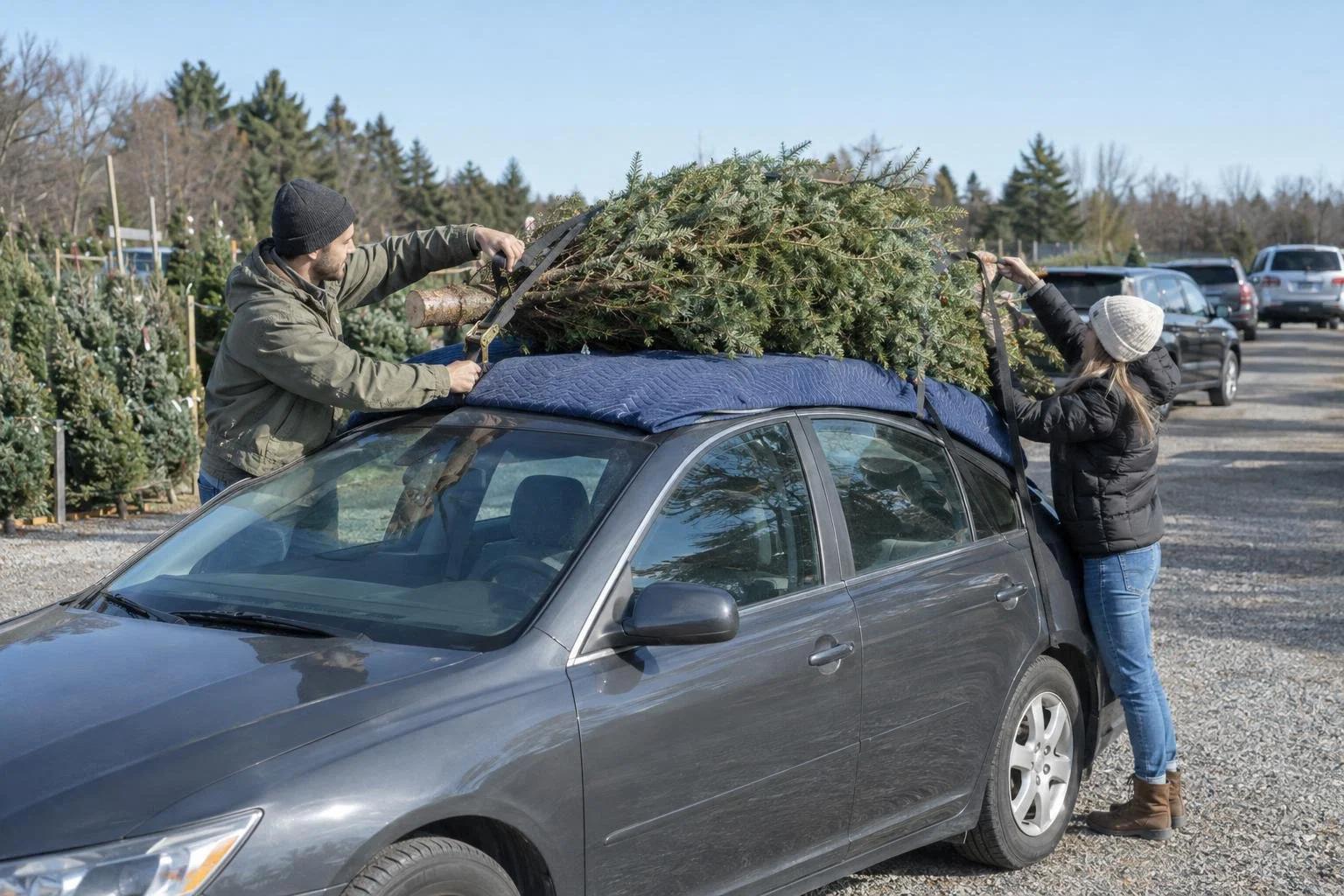
- Pick where the tree rides before you go. The AAA says the safest way to carry a tree is on a vehicle with a purpose-built roof rack. Without one, use a pickup bed, or put the tree entirely inside an SUV, van or minivan with all doors closed.
- Bring real tie-downs. Use strong nylon rope or nylon ratchet straps, and leave the lot's twine for tying up the branches or for the trash.
- Protect the roof. Lay a cover or blanket between the tree and the car, as Aviva advises.
- Put the trunk end toward the front. The heavy end leading keeps the wind from lifting the branches.
- Tie at three points. Loop the rope or strap around the trunk and anchor it to fixed tie-down points on the vehicle at the bottom (just above the lowest branches), the center and the top.
- Keep lines out of the doors and windows. This is the AAA's main warning about vehicle damage.
- Test it. Push and pull on the tree from the top, sides and rear. West Virginia's standard is a load that cannot move in any of those directions.
- Check your view. Keep a clear view through the rear window.
- Flag any overhang. If the tree extends past the rear bumper, tie a reflective flag to the end so following drivers can see it.
- Walk around the car. Look at it and ask the question West Virginia's program suggests: "Would I feel safe driving closely behind this?"
If the tree rides in a pickup bed, keep it away from the exhaust pipe and other areas that get hot, to avoid heat damage or a fire. Then pick the route. The Joye Law Firm advises driving cautiously, avoiding highways, and steering clear of streets with heavy traffic where you can.
What We Would Do First, and What We Would Skip
The first move is the vehicle decision, made at home. A tree that rides inside a van or in a truck bed has no roof to scratch and no line to fail. If you only have a car with a roof and no rack, the roof carry is where most of the risk sits, and the three-point tie and the blanket matter most.
We would skip the shortcuts in Aviva's survey list. A tree through the sunroof, out a side window, or in a trunk that cannot close is not the same as a tree tied at three points, and the mirror and gear-stick numbers show what a poorly placed tree does to the driver's control. We would also skip the free twine, for the reasons above.
We would not bother with fancy extras. The AAA, the Joye Law Firm and West Virginia's Governor's Highway Safety Program recommend strong lines, a forward trunk, three tie points and a test that the load cannot move.
When a Tree Comes Off on the Freeway: Who Pays
Attorney Mike McDivitt, quoted by MotorBiscuit, states the negligence standard in plain terms: "The driver was negligent in failing to properly secure whatever the item was that fell out". As a result, the driver whose vehicle lost the object is responsible for the damage, including injuries to the following driver or passengers.
This is the opposite of the usual rear-end rule. Normally the following driver is expected to keep a safe distance, and hitting the car ahead is almost always treated as the rear driver's fault. When an object falls from the leading vehicle, the following driver is not legally expected to notice and avoid it, which puts the fault on the driver who lost the load.
The Joye Law Firm describes two ways a driver can be held liable:
- Direct impact. The tree falls onto another vehicle or into its path and strikes it.
- Indirect impact. A following driver brakes hard or swerves to avoid the tree and hits a barrier or another motorist.

The second scenario matters because the tree never has to touch anything. A driver who swerves around a tree in the road can cause a crash that involves other cars, and the person who tied the tree is the one answering for it.
If the driver who lost the load does not notice or leaves the scene, the victim can claim under their own uninsured motorist coverage, but only if they carry that optional insurance.
What Insurers Have Handled
These claims are not hypothetical. In December 2025, Aviva's Motor Claims Manager, James Driscoll, described several Christmas tree claims the insurer had handled:
- A car's front end hit by a tree that came loose from a vehicle going the other way.
- A collision with a tree lying in the road after it fell off another car's roof.
- Extensive undercarriage damage when a driver could not avoid a fallen tree.
The second and third cases involve a tree already on the road. Anyone behind a tree-carrying car faces the same problem, and that is the driver the rules are written to protect.
What the Law Says Where You Live
Every U.S. state has a law that makes it illegal for items to fall from a vehicle on the road. A 2017 Forbes report citing the AAA found that penalties in most states ran from $10 to $5,000, with at least 16 states listing jail time and 11 setting maximum fines above $500. That summary is nine years old, so check your own state's current statute before relying on any figure.
The table covers seven states, and none of them mention Christmas trees. They all apply to any load.
| State | Rule | Penalty |
| Washington | Failing to secure a load; criminal if it causes substantial bodily harm or property damage | Fines from $50 to $5,000, with criminal charges in serious cases |
| Utah | Utah Code 72-7-409, effective May 7, 2025 | A fine of not less than $200 for a basic violation for non-commercial vehicles and not less than $500 for commercial vehicles; Class A misdemeanor if it causes a crash with serious injury or death; $500 for a second or subsequent violation within six years of a previous violation |
| West Virginia | Unsecured load that escapes a vehicle | $250 first offense; $500 second and $1,000 third within 12 months; a third can mean permit revocation and possible jail |
| Colorado | Releasing road debris | $35 to $500 if no one is hurt; a class 2 misdemeanor traffic offense, up to 90 days in jail, if someone is injured |
| Texas | Loads must be contained, secured or tarped under Transportation Code 725.021 | Up to $500 for hauling loose material such as dirt, sand or gravel without containment; operating an unsafe vehicle is a misdemeanor under Section 547.004 |
| California | Vehicle Code 24002(a) bars operating a vehicle that is unsafe or not safely loaded and presents an immediate safety hazard | An infraction, fine only |
| Illinois | 625 ILCS 5/12-603.1 and related statutes prohibit driving with an unsecured load | A petty offense, minimum fine of about $150; points on the record and higher premiums; fines in the thousands and misdemeanor charges in severe cases |
The Texas fine in that row is for loose material, and we have no tree-specific Texas fine. The point is the range. In California the answer is a fine, while in Utah and Colorado a crash with injury can be a misdemeanor.
The UK is more general. Highway Code Rule 98 says loads must be effectively secured, and failing to do so endangers other road users and goes against the Code.
The Illinois Wrinkle: It Hits Your Insurance, Too
The Illinois entry shows a cost that fines hide. Because the offense is a moving violation, it can put points on your driving record and raise your insurance premiums. A fine is paid once and the premium effect can last, so a ticket for a badly tied tree may cost more than the number printed on it.
The Case That Changed Washington's Law
In February 2004, 24-year-old Maria Federici was driving on Interstate 405 in Renton, Washington, returning from her late-night job at a Kirkland bar. A 2-by-6-foot piece of particle board from an entertainment center flew out of a rented U-Haul trailer ahead of her.
The board pierced her windshield and struck her face. She was blinded, had seven surgeries, and spent months in rehabilitation learning to swallow, talk and walk again.
The driver, a Newcastle man, received a $1,000 fine and citations for littering, failure to secure a load, driving without insurance, and driving with a suspended license. Because an unsecured load was classed as a littering offense, Federici was at first not eligible for Crime Victim's Assistance. Her mother, Robin Abel, pushed for a change, and Washington enacted "Maria's Law" in 2005.
The law makes failing to secure a load a crime when it causes substantial bodily harm or property damage, with possible jail time and fines. It also lets victims apply for Crime Victim's Assistance. Abel also worked to pass similar legislation in Alaska after a young woman there was injured.
The case involved a trailer and not a tree. It still shows how an ordinary lapse becomes a legal and personal catastrophe, and how thin the old penalty was by comparison.
How Washington Enforces It Now
In 2024, the Washington State Patrol contacted more than 5,300 motorists and issued 532 citations for unsecured vehicle loads, according to Chief John R. Batiste. Unsecured loads were responsible for 337 crashes and 32 injuries in the state that year. Washington's Department of Ecology and the state transportation department collected over 6.4 million pounds of litter in 2024, a fraction of the 26 million pounds that build up along state roads each year. Ecology Director Casey Sixkiller said nearly 40% of that litter comes from items falling or blowing out of vehicles.
The Wider Cost of Things Falling Off Cars
Most loads that fall do not end in a Maria Federici case. They end with a trooper, a contractor or a crew of workers picking something up.
In Utah, highway patrol troopers respond to an average of more than 70 calls a day about road debris, over 25,000 a year. Utah's transportation department says litter removal alone costs more than $2.9 million a year, according to the Utah Highway Safety Office fact sheet. Nationally, the same sources put road cleanup at about $11.5 billion a year, with an estimated 20% to 40% of road pollution coming from unsecured loads.
Arizona's numbers show the human end. The state recorded 1,100 debris-related crashes and nine deaths in 2022. One of them was 29-year-old Matthew Reif, killed on June 6, 2006 on the Hunt Highway when a piece of metal from an unsecured truck load pierced his windshield. His father, Paul Reif, later worked with Robin Abel on load-securement awareness.
Abel launched the "Secure Your Load" campaign in 2016. It created National Secure Your Load Day, observed each year on June 6 to honor victims like Matthew Reif.
After You Park: Two Safety Steps for the Tree Itself
Getting the tree home is only part of the job. The National Safety Council advises cutting about two inches off the bottom of a live tree's trunk to expose fresh wood for better water absorption before putting it in water. It also says to keep the tree at least three feet from heat sources such as fireplaces, radiators, vents and space heaters, and not to block doorways or exits.
The same advice covers the lights. Replace sets with cracked sockets, frayed or exposed wires or loose connections, and follow the manufacturer's limit on strands per outlet or power strip, typically no more than three.
Conclusion
The highest-value fix is the one made before you leave home. Decide how the tree will travel, bring nylon rope or ratchet straps, and lay a blanket under the tree. Point the trunk forward and tie at three points. Then shake the tree and ask whether you would want to follow that car.
If you want to talk road safety with Carszy, get in touch.
FAQ
Can I carry a tree on the roof if my car has no roof rack?
The AAA calls a vehicle with a purpose-built roof rack the safest way to carry a tree. Without a rack, it recommends a pickup bed or putting the tree inside an SUV, van or minivan with the doors closed. The 8% of buyers in the AAA survey who tied a tree to a roof without a rack took the riskiest option. If the roof is your only choice, use a blanket, three tie points and a hard shake test, and keep lines out of the doors.
Which end of the tree should face forward?
The heavy trunk end faces the front of the vehicle. If the lighter top faces forward, wind lifts the branches and can shift the tree, damage it or blow it off.
Is the twine from the tree lot good enough?
The AAA and the Joye Law Firm both recommend stronger materials, specifically strong nylon rope or nylon ratchet straps. Our view is that twine can hold a tree in a parking lot but is the wrong choice for highway wind, braking and potholes.
How many places should I tie the tree?
Three: at the bottom, just above the lowest branches, at the center, and at the top. Loop the rope or strap around the trunk and anchor it to fixed tie-down points on the vehicle. The load should not move at the top, sides or rear.
What damage can a badly tied tree do to my car?
AAA's 2018 estimates run from $100 to $150 for surface scratches, $220 to $550 for torn seals on two doors, and $500 to $1,500 for a severely scratched roof. Closing a door over tie-downs can also permanently distort the window frame. A blanket between the tree and the roof helps with scratches and sap stains.
Who is at fault if my tree falls off and a car behind me crashes?
Attorney Mike McDivitt says the driver who failed to secure the item is negligent and responsible for the damage and injuries that follow. A following driver is not expected to see and avoid an object falling from the car ahead. The Joye Law Firm adds that you can be liable whether the tree strikes another vehicle or a driver crashes while swerving or braking to avoid it.
What if a tree falls off a car ahead of me and the driver keeps going?
A victim can file a claim under their own uninsured motorist coverage, but only if they carry that optional insurance.
Can I be charged with a crime over an unsecured tree?
It depends on the state and the outcome. In Washington, failing to secure a load is a crime if it causes substantial bodily harm or property damage. Utah makes it a Class A misdemeanor if the violation causes a crash with serious injury or death, and Colorado makes it a class 2 misdemeanor traffic offense, up to 90 days in jail, if someone is injured. In California the violation is an infraction punishable by a fine only.
Supporting Links
- AAA figures on Christmas tree damage and unsecured trees
- Aviva: secure your Christmas tree before hitting the road
- West Virginia highway safety: secure your load
- MotorBiscuit: what happens when a tree flies off a car roof
- Washington State Patrol: Secure Your Load campaign returns
- Utah Highway Safety Office: Secure Your Load 2026 fact sheet