The Ultimate Guide to Road Debris and Unsecured Loads: The Preventable Hazard Plaguing Highways
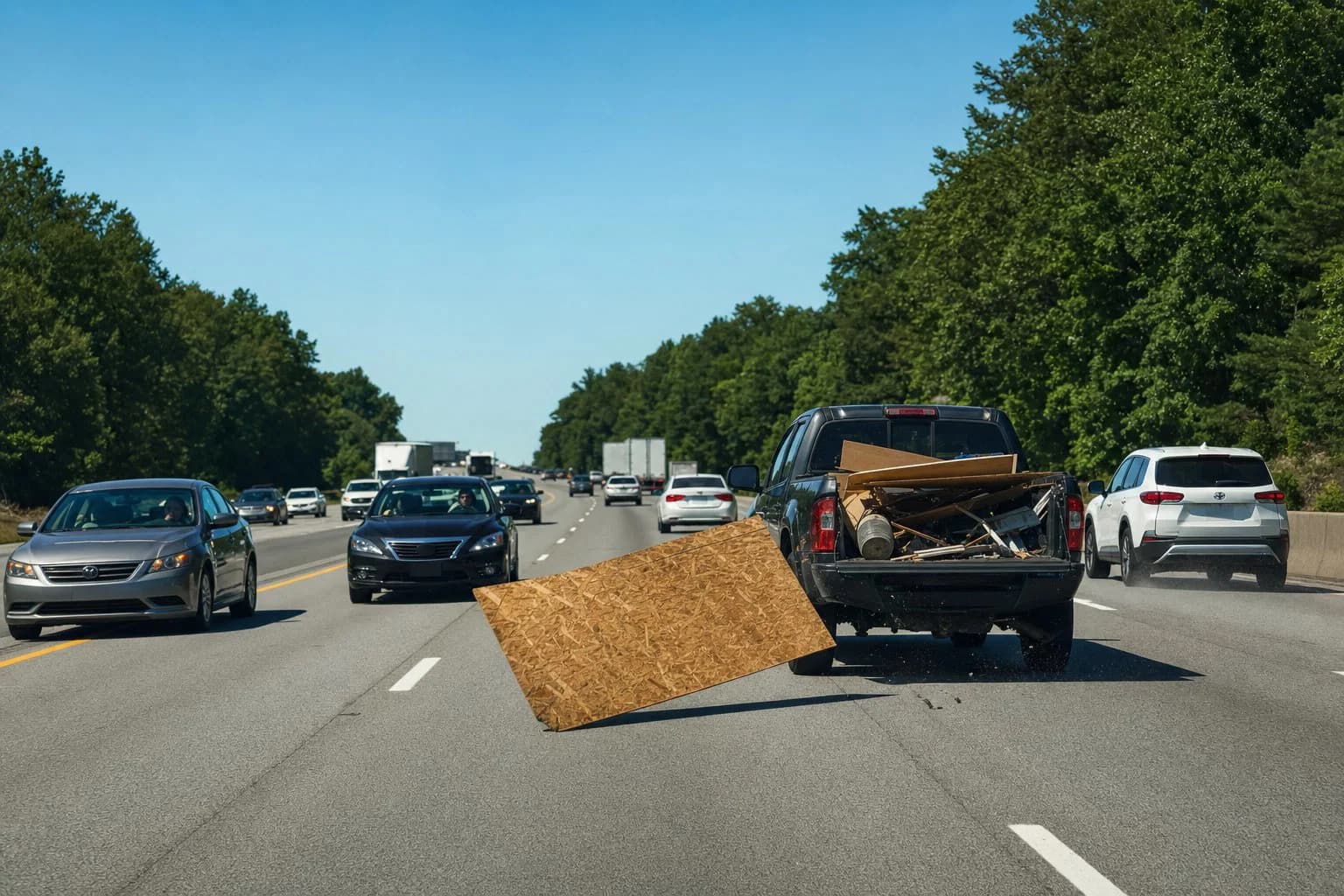
Picture this: You are cruising down the interstate on a perfectly clear, sunny Tuesday afternoon. The radio is playing, the commute is routine, and traffic is flowing smoothly at 70 miles per hour. A few car lengths ahead of you is a pickup truck, its bed loaded with supplies for a weekend home improvement project. Suddenly, without warning, a large sheet of particle board catches a gust of wind, snaps its inadequate bungee cord, and launches into the air like a rigid sail. In a fraction of a second, that routine commute transforms into a high-stakes, life-or-death crisis.
This terrifying scenario is not an anomaly; it is a daily occurrence on our roadways. The sudden appearance of a mattress, a ladder, a wheelbarrow, or a shredded tire tread in the middle of a high-speed corridor represents one of the largest, yet most entirely preventable, categories of vehicular crashes on modern roadways. We talk endlessly about the dangers of distracted driving, driving under the influence, and speeding. Yet, road debris and unsecured loads—a category responsible for staggering financial loss, environmental devastation, and human tragedy—remain vastly under-discussed in mainstream traffic safety discourse.
As a community safety advocate and automotive journalist, I have seen firsthand the aftermath of these preventable disasters. The question that drives this exhaustive analysis is clear: Why are road debris and unsecured loads such a major, persistent cause of crashes, and what concrete steps can communities, technology platforms, and individual drivers take to eliminate this hazard?
To answer this, we must look beyond the surface. We must explore the statistical reality of road debris, the cognitive psychology of human reaction times, the unforgiving physics of cargo securement, the stringent legal frameworks designed to protect us, the staggering economic toll of highway litter, and the emergence of modern driver-to-driver safety technologies designed to mitigate these exact hazards in real-time.

The Statistical Reality: A Silent Crisis on the Asphalt
When analyzing traffic fatalities, intoxicated and distracted driving typically dominate the conversation. However, rigorous research conducted by organizations like the AAA Foundation for Traffic Safety reveals that road debris is an equally dangerous, ubiquitous culprit. The sheer volume of debris-related incidents highlights a systemic, nationwide failure in cargo securement and routine vehicle maintenance.
The Scope of the Danger
The scale of the problem is difficult to comprehend until you look at the raw data. According to a recent and comprehensive analysis by the AAA Foundation covering the period between 2018 and 2023, road debris contributed to an estimated 319,724 motor vehicle crashes across the United States.
When broken down on an annual basis, this traffic hazard produces the following devastating metrics:
53,000 crashes every single year.
5,500 injuries annually.
72 deaths per year directly attributed to road debris in the AAA analysis.
However, broader data sets from the National Highway Traffic Safety Administration (NHTSA) paint an even more severe picture. When accounting for all objects in the roadway—which includes a wider array of debris—NHTSA indicates that approximately 850 people are killed and nearly 19,000 are injured annually in crashes involving road objects. Furthermore, most of the vehicles involved in these specific crashes (73%) are standard passenger vehicles, highlighting that everyday commuters bear the brunt of this hazard.
A report issued by the Government Accountability Office (GAO) specifically analyzed the lethality of unsecured loads, noting that 400 people are killed and 10,000 are injured annually in accidents caused by debris falling specifically from non-commercial vehicles. This directly counters the common misconception that massive commercial semi-trucks are the primary culprits; everyday citizens hauling personal items are heavily responsible. In 2022 alone, the Fatality Analysis Reporting System (FARS) recorded 895 deaths, 17,203 injuries, and 98,502 property damage crashes caused by unsecured loads and road debris.
The Anatomy of a Debris Crash: Time, Location, and Origins
The data reveals highly specific, almost predictable patterns regarding when and where these crashes occur. Debris-related crashes are not evenly distributed across all roads; they are approximately four times as likely to occur on Interstate highways compared to local municipal roads. The reason is rooted in aerodynamics. Driving at high speeds significantly increases the aerodynamic lift and drag on objects, making it much more likely for rusted vehicle parts to detach or poorly secured cargo to achieve liftoff and escape a truck bed.
Surprisingly, these accidents are not predominantly creatures of the night. They are most common during broad daylight. More than one in three crashes involving road debris occurs between 10:00 a.m. and 3:59 p.m. This time frame perfectly aligns with peak hours for residential and commercial hauling. This is the window when everyday drivers are most likely to transport heavy items like furniture, mattresses, or construction equipment purchased from local hardware stores. They are least likely to occur during the early morning commute between 6:00 a.m. and 9:59 a.m.
According to the reports, approximately two-thirds of all debris-related crashes are "vehicular in origin," meaning the hazard did not blow onto the road from a nearby field, but fell directly off a moving vehicle. The AAA Foundation identified the most common types of vehicular debris:
Vehicle parts: Tires, wheel treads, mufflers, and bumpers detaching due to improper maintenance, rust, or underinflation. For a deeper dive into how tire failures turn into deadly debris, see this guide to tire safety and blowout prevention.
Unsecured cargo: Furniture, mattresses, appliances, tools, and building materials escaping from truck beds and trailers.
Separated trailers: Tow trailers becoming physically detached from the hitch and striking other vehicles or landing in the roadway.
| Metric | AAA Foundation Data (2018–2023 Avg.) | NHTSA & FARS Data (General Objects/Loads) |
|---|---|---|
| Annual Crashes | ~53,000 | 98,502 (property damage alone, 2022) |
| Annual Injuries | ~5,500 | ~17,200 - 19,000 |
| Annual Fatalities | ~72 | ~850 - 895 |
| Primary Crash Location | Interstates (4x higher risk) | High-speed corridors |
| Peak Time of Occurrence | 10:00 a.m. to 3:59 p.m. | Daylight hauling hours |
| Gender Demographic | Men 20% more likely to be involved | N/A |
The Human Factor: The Psychology of Avoidance and PRT
Understanding why road debris is so exceptionally lethal requires a deep dive into human cognitive psychology, biomechanics, and human factors engineering. It is a startling truth that the debris itself is often not the direct cause of the highest rate of fatalities. The true danger lies in the human reaction to the debris.
The Lethality of Swerving and Overcorrection
Crash data explicitly shows that collisions following an attempt to avoid debris tend to be far more severe than crashes in which a vehicle simply strikes the debris head-on. Evasive maneuvers—such as sudden, violent swerving—account for about a quarter of all injuries and nearly half (or at least 37%) of all deaths in road debris incidents.
When a driver spots a sofa tumbling across the asphalt at 70 miles per hour, the instinctual, panicked response is to violently jerk the steering wheel to avoid the obstacle. This overcorrecting at highway speeds frequently results in a catastrophic loss of vehicle control, leading to rollover events, median crossovers, or head-on collisions with adjacent high-speed traffic. A situation that might have resulted in severe front-end cosmetic damage, a deployed airbag, and a broken radiator instead transforms into a multi-fatality rollover simply because of the human instinct to swerve. This phenomenon illustrates that human behavior is an intuitive, often unconscious process heavily influenced by the immediate environment.
Demystifying Perception-Reaction Time (PRT)
In accident reconstruction and traffic engineering, experts rigorously evaluate a driver's Perception-Reaction Time (PRT)—the interval between a hazard appearing and the driver initiating a physical response, such as pressing the brake pedal or turning the steering wheel.
For decades, the industry and legal courts have often relied on a "canned" baseline PRT of 1.5 seconds, or 1.1 to 1.6 seconds based on the commonly cited "Olson" data (Olson & Sivak, 1986). However, modern human factors research indicates that this one-size-fits-all number is fundamentally flawed. Reaction times are highly variable, psychologically complex, and deeply context-dependent. A driver's response must be scrutinized across several distinct phases: perception, identification, decision, and reaction.
1. The Perception and Identification Phase (Response Speed) Drivers must first visually detect the hazard and identify it as a threat. The Massachusetts Institute of Technology (MIT) conducted a study indicating that humans need about 390 to 600 milliseconds merely to detect and react to road hazards given a single glance at the road. In this study, participants were shown a white noise mask followed by a brief video snippet of a hazard, measuring their raw detection speed. The research revealed a stark age divide: younger drivers (20 to 25 years old) needed only 220 milliseconds to detect a hazard, while older drivers (55 to 69 years old) required 403 milliseconds.
2. The Decision Phase (Response Choice) Once the hazard is identified, the driver must decide what to do. The complexity of the hazard severely complicates the decision-making process. If the vehicle ahead simply applies its red brake lights, the choice is clear and the response is fast: brake as well. However, if an unsecured ladder bounces randomly into the lane, the driver must instantly choose between swerving left, swerving right, braking hard, or bracing for impact. This "choice reaction time" is inherently longer than a "simple reaction time," consuming precious milliseconds as the brain processes variables. Accident reconstructionists warn against "hindsight bias," where drivers are unfairly criticized in court for swerving left instead of right, failing to account for the split-second panic of a complex hazard.
3. The Reaction Phase (Response Magnitude) Even in dire emergency situations, drivers are notoriously hesitant to apply maximum, anti-lock braking force. Studies on test tracks using child-sized dummies show that 86% of drivers exhibit a "two-stage braking response." That is, drivers quickly apply light pressure to the brakes, pause to assess the situation further, and only then push the pedal to the floor. Drivers who exhibited this two-stage braking were 17% more likely to impact the dummies. Because drivers rarely take advantage of their vehicle's full braking capabilities immediately, stopping distances are drastically increased.
Speed compresses this entire timeline. At 100 km/h (approx. 62 mph), a vehicle travels about 27 meters per second. A 2-second reaction time means the car travels 54 meters (nearly 180 feet) before the brakes are even applied. Add to this the cognitive load of modern distractions, fatigue, and stress, and the reaction time stretches even further.
The inescapable conclusion of human factors engineering is that human beings are simply not equipped to reliably avoid high-speed, unpredictable road debris. Therefore, the only effective way to survive a road debris crash is to prevent the debris from entering the roadway in the first place through rigorous cargo securement.
The Physics and Engineering of Cargo Securement
The prevailing cause of unsecured loads is a fundamental, widespread misunderstanding of the physical forces acting on a vehicle in motion. Drivers routinely assume that the sheer weight of an object will keep it grounded. Weight is not a form of securement, nor is the "cram technique" of wedging objects tightly together in a truck bed. A mattress may weigh 100 pounds, but at 65 miles per hour, aerodynamic drag and lift forces can easily generate hundreds of pounds of upward force, turning the mattress into a massive, unpredictable sail.

Understanding the Working Load Limit (WLL)
Safe cargo securement is not a matter of guesswork; it relies on precise mathematical standards established by the Federal Motor Carrier Safety Administration (FMCSA) and the Department of Transportation (DOT). The most critical metric for any securing device is the Working Load Limit (WLL).
The WLL represents the maximum load that a tie-down can safely handle under normal, sustained operating conditions. This is vastly different from "Break Strength," which is the point of absolute failure under laboratory test conditions. WLL is typically one-third of the strap's breaking strength (a 3:1 safety ratio). In the eyes of DOT inspectors, WLL is the only number that matters.
Under FMCSA rules, the aggregate (combined) WLL of all tie-downs used to secure a load against movement must equal at least one-half the total weight of the cargo being transported. Furthermore, FMCSA rules require that cargo securement systems be capable of withstanding extreme gravitational forces without failing:
0.8 g deceleration in the forward direction (simulating heavy, emergency braking).
0.5 g acceleration in the rearward direction (simulating rapid acceleration or shifting).
0.5 g acceleration in a lateral direction (simulating sharp turning or swerving).
The Math of Securement: If you are hauling a 40,000-pound machine, the minimum aggregate WLL required is 20,000 pounds. If you are using standard 4-inch ratchet straps, each with a WLL of 5,400 pounds, you would divide the 20,000-pound requirement by 5,400. The math dictates 3.7 straps, meaning a minimum of four straps is legally and physically required to prevent the load from breaking loose.
If using direct tie-downs (attaching directly from the machine to the truck frame, rather than looping over the load), only half of the strap's capacity is counted, requiring even more chains or straps. Furthermore, length rules dictate that cargo shorter than 5 feet and under 1,100 lbs requires one tie-down, cargo longer than 5 feet requires two, and an additional tie-down is required for every additional 10 feet of length. Heavy equipment over 10,000 pounds strictly requires a minimum of four tie-downs attached to independent corners.
The Fastener Fallacy: Bungee Cords vs. Ratchet Straps
A major contributor to roadway debris among passenger vehicles is the incorrect selection of securement hardware by everyday consumers.
Bungee Cords: Bungee cords are constructed of elastic material specifically designed to stretch. While they are highly useful for organizing light garage gear, holding down the edge of a tarp, or bundling small, soft items at a campsite, they are entirely inappropriate and incredibly dangerous for securing heavy cargo against highway wind speeds and braking forces. Because bungee cords lack a rated Working Load Limit and stretch by design, they cannot prevent cargo from shifting, settling, or escaping. State and provincial commercial vehicle inspectors do not consider rubber bungee cords to be valid tie-downs because they carry no load ratings and provide no mechanical tension.
Ratchet Straps: Ratchet straps are the gold standard for heavy loads. They utilize a ratcheting mechanical mechanism to apply immense, locking tension to high-strength synthetic webbing. These straps possess visible WLL ratings, do not stretch under aerodynamic loads, and physically lock the cargo to the structural anchor points of the vehicle. If a strap lacks a visible, legible WLL tag, DOT inspectors consider it to have zero capacity.
Cam Buckle Straps: Cam buckle straps operate similarly to ratchets but use a pull-through friction lock rather than a mechanical crank. They are gentler and ideal for items like kayaks, fiberglass, or bicycles that could easily be crushed by the extreme mechanical advantage of a heavy-duty ratchet strap.
| Securement Type | Best Used For | Primary Limitation | WLL Rated? |
|---|---|---|---|
| Bungee Cords | Light tarp edges, garage organization, temporary containment. | Stretches under force; snaps back; allows cargo shifting. | No |
| Cam Buckle Straps | Bicycles, kayaks, lighter recreational cargo. | Less mechanical tension than ratchets; relies on hand-pull strength. | Yes |
| Ratchet Straps | Heavy appliances, furniture, trailers, high-tension jobs. | Can overtighten and crush delicate cargo if the user is careless. | Yes |
To properly secure a load, safety authorities consistently recommend the following protocol:
Tie items down securely with rated rope, netting, or ratchet straps.
Attach heavy objects directly to the vehicle's structural anchor points, not just to other pieces of cargo.
Cover loose, aggregate (dirt, sand, gravel), or light loads completely with a sturdy tarp or netting.
Place lighter items at the bottom of the load and heavier items on top to anchor them in place.
Never overload the vehicle beyond its gross vehicle weight rating.
Inspect the load within the first 50 miles, and every 150 miles or 3 hours thereafter, as loads can settle and straps can loosen.
The Legal Framework: Mandates and Liability
The failure to secure cargo transcends individual safety; it imposes a massive burden on the public. Because of this, all 50 U.S. states and the District of Columbia have enacted strict laws regarding unsecured loads for both commercial and passenger vehicles.
The Letter of the Law: California Vehicle Code as a Case Study
California provides a stark example of how stringently these laws are written. Vehicle-related road debris causes about 400 crashes and dumps twelve million pounds of litter on California roads each year. Under California Vehicle Code Section 23114, no vehicle may be driven or moved on any highway unless it is so constructed, covered, or loaded as to prevent any of its contents from dropping, sifting, leaking, blowing, spilling, or otherwise escaping from the vehicle. Clear water and feathers from live birds are the only bizarre exceptions to this rule.
The law specifically dictates that aggregate materials (like rock fragments, pebbles, dirt, sand, and gravel) must be entirely covered, and the cargo area must not contain any holes or cracks. Vehicles transporting these materials must be equipped with splash flaps behind every tire, center flaps behind bottom dump release gates, and properly functioning seals on release gates. Aggregate loads are only exempt from covers if the load sits six inches below the upper edge of the container, or if they are driving less than 200 yards from an egress point to safely cover it. Furthermore, Vehicle Code 23115 mandates that rubbish vehicles must be totally covered to prevent spilling.
Penalties and Corporate Liability
The penalties for non-compliance are severe. A violation can result in steep fines ranging up to $5,000. If an unsecured item falls from a vehicle and causes bodily harm, the driver faces gross misdemeanor charges, severe financial penalties, and potentially up to a year in prison.
Crucially, placing a hand-painted "Not Responsible for Broken Windshields" sign on the back of a dump truck holds absolutely no legal weight. The California Highway Patrol (CHP) and other agencies actively enforce that posting signs claiming no liability does not remove a driver's statutory responsibility to secure their load safely.
Under the legal doctrine of respondeat superior (Section 2338 of the California Civil Code), trucking and freight companies can be held entirely liable for the damages caused by their drivers' unsecured loads, as employers are responsible for actions performed during the course of work. If a company has a pattern of sending out overloaded or improperly secured trucks, victims can pursue punitive damages designed to punish willful recklessness.
Grassroots Advocacy: Maria’s Law
Much of the push for stricter enforcement has been driven by grassroots advocacy, born from tragedy. A prominent example is the work of Robin Abel, a Washington State native who founded the Secure Your Load campaign. In 2004, her daughter, Maria, was catastrophically injured and nearly killed by an unsecured piece of particle board that flew out of a trailer and shattered her windshield.
Abel's relentless advocacy led to the passage of "Maria's Law" in Washington State, which criminalizes the failure to secure a load if it results in significant property damage, injury, or death. The law also enables victims of unsecured loads to apply for Crime Victim's Assistance. Her efforts resulted in the GAO study on unsecured loads, the inclusion of load securement in the 2021 Infrastructure Investment and Jobs Act, and the establishment of June 6th as National Secure Your Load Day, recognized by states nationwide to raise awareness.
The Economic and Environmental Toll of Highway Litter
When cargo escapes a vehicle and doesn't immediately cause a multi-car pileup, it becomes something else: litter. Road debris is a primary contributor to systemic highway and environmental pollution, carrying an astronomical economic cost.
The $11.5 Billion Cleanup Bill
In the United States, an estimated $11.5 billion is spent annually to remediate trash and clean up litter across roadways, waterways, and public lands. Picking up trash is inherently the most expensive way to deal with waste. The burden of this cost is distributed heavily among commercial entities and taxpayers:
Businesses pay the lion's share, spending approximately $9.1 billion annually to keep their properties clean, costs that are ultimately passed down to consumers in the form of higher prices.
States, cities, and counties expend over $1.3 billion in taxpayer funds for litter abatement and roadside cleanup. In Texas alone, taxpayers spend $50 million annually just to pick up litter from roadsides. A Duke Environmental Law and Policy Clinic report found that in 2023, North Carolinians spent $56.3 million cleaning up 14.6 million pounds of litter.
Educational institutions spend around $241 million annually.
NGOs spend approximately $769 million.
The scale of the physical waste is staggering. A 2020 study by Keep America Beautiful found nearly 52 billion pieces of litter along U.S. roadways and waterways. That equates to roughly 6,729 pieces of litter per roadway mile, or 152 pieces of litter for every single U.S. resident. Much of this is plastic packaging, which accounts for 46% of litter larger than four inches. Because a littered plastic water bottle takes 450 years to decompose, and an aluminum can takes 200 years, this debris remains in the ecosystem for generations.
Real Estate, Tourism, and Environmental Devastation
Beyond direct cleanup costs, the presence of road debris actively destroys community wealth and infrastructure. Debris clogs drainage systems, causing flooding and road erosion, diverting public funds away from community improvement.
Surveys reveal that 93% of homeowners believe a littered neighborhood decreases their assessment of a home's value, and real estate appraisers frequently reduce the valuation of homes in heavily littered areas by 7% to 9%. Furthermore, areas plagued by roadside debris see marked declines in potential tourism revenues. In a state like Texas, where tourism generates $193.8 billion, a study indicated that 85% of beach tourists would avoid a heavily littered beach, potentially affecting tourism spending by 38.1%.
The environmental toll is equally devastating. An estimated 10 to 12 million metric tons of plastic waste enters the ocean each year, killing one million marine animals annually. The direct and indirect costs of marine plastic litter cost the global economy an estimated $2.5 trillion per year. Microplastics degrading from roadway litter infiltrate water sources, and pathogens in contaminated water are responsible for 40% of hospitalizations and 50% of deaths related to waterborne diseases in the U.S. All of this underscores a vital point: an unsecured load is not just a traffic hazard; it is a profound environmental and economic threat.
The Modern Solution: Fostering Community Safety Through Technology
While stricter laws, rigorous enforcement of Working Load Limits, and defensive driving techniques are essential countermeasures, they are fundamentally reactive. By the time a mattress flies off a roof, the hazard has already been introduced to the roadway, and the $11.5 billion economic damage clock has started ticking.
Addressing this critical gap requires a proactive approach to driver-to-driver communication—a space where modern technology and community safety platforms are proving revolutionary.
Bridging the Isolation Gap on the Highway
Historically, motorists have been isolated in metal boxes, completely unable to communicate with the driver in the lane next to them. If an observant driver notices that a pickup truck's cargo straps are violently vibrating loose, or that a trailer's safety chains are dragging and sparking on the asphalt, the only available methods of communication are archaic: honking the horn, flashing high beams, or waving frantically out the window.
These aggressive gestures are frequently misinterpreted as road rage. Instead of pulling over to check their load, the offending driver is likely to speed up, act defensively, or engage in hostile behavior. Calling 911 for an unsecured load is an option for extreme, active emergencies, but traditional dispatch systems face a severe limitation: response times. A highway patrol unit can rarely intercept a vehicle traveling 70 mph before a poorly secured object breaks free. Systems like FEMA’s Integrated Public Alert & Warning System (IPAWS) are excellent for broad weather emergencies, but they are not designed for hyper-local, vehicle-to-vehicle intervention.
The Carszy Ecosystem: Proactive Roadway Accountability
This communication void is precisely what platforms like Carszy are engineered to solve. As a privacy-focused, driver-to-driver communication and community safety platform, Carszy utilizes vehicle license plates as unique, secure identifiers to connect people on the road, turning passive observers into active protectors.
The application of this technology directly mitigates the hazards of unsecured loads and road debris through several proprietary features:
1. License Plate Messaging for Immediate Intervention If a motorist observes a loose tarp, a failing ratchet strap, or an unlatched tailgate, they no longer have to rely on aggressive honking. Using the Carszy platform, the observer can securely text or call the other driver using just their license plate number. This allows for clear, non-confrontational alerts (e.g., "Your rear strap on the lumber just snapped, you need to pull over immediately before you lose it."). This early, frictionless intervention stops debris crashes before they happen, saving lives and preventing property damage.
2. VOIS™ (Vehicle of Interest Search) When an unsecured load does result in a crash, it is common for the responsible driver to continue driving—either unaware of the damage they caused or fleeing liability. In these debris-related hit-and-runs, the community can mobilize. VOIS™ serves as a community-driven alert system, pinging nearby users to help locate vehicles involved in critical incidents. This drastically reduces the time it takes to hold negligent drivers accountable, transforming the local commuting base into a highly effective neighborhood watch.
3. Human Media™: Shifting from Vanity to Utility Carszy champions a shift from traditional, often toxic "Social Media" toward "Human Media™"—technology engineered for real-world, tangible impact. By empowering communities to report dangerous driving, failing cargo securement, and road rage safely and anonymously, the platform fosters a culture of deep accountability. Relying on US-based servers to ensure strict user privacy, these geolocation safety features seamlessly integrate via iOS and Android apps, allowing users to participate without compromising their personal data.
By decentralizing traffic safety, modern technology transforms every observant driver into an active participant in preventing the 53,000 annual crashes caused by highway debris. For example, a parent using Carszy to report a loose ladder today is using the same kind of connected-safety mindset that protects teens in their first vehicles; you can build that broader family strategy with this framework for keeping teen drivers safe in their first car.
Conclusion: Securing Our Future
Road debris and unsecured loads represent an $11.5 billion economic drain, an environmental catastrophe, and a lethal physical threat that claims hundreds of lives and causes tens of thousands of injuries each year. The data unequivocally proves that relying on human perception-reaction times to swerve around a flying object at highway speeds is a deadly gamble. The true solution lies in absolute prevention at the source: utilizing proper Working Load Limit-rated equipment like ratchet straps, covering aggregate loads with secure tarps, and abandoning the dangerous reliance on elastic bungee cords for heavy transport.
Beyond mastering the physics of securement and respecting the legal liability imposed by the state, solving this crisis requires breaking down the barriers of isolation on the road. When motorists can easily and safely communicate hazards to one another in real time, the roads become infinitely safer for everyone. Accountability, education, and community watchfulness are the most powerful countermeasures against the silent killer of road debris.
Motorists are encouraged to check their tie-downs, respect the laws of physics, and leverage modern safety networks. Take the next step toward a safer commute—download the Carszy app today to stay connected, protect your neighborhood, and keep our roads clear of preventable hazards.
Frequently Asked Question
What should I do if I spot a vehicle with a dangerous, unsecured load on the highway?
First and foremost, immediately increase your following distance. Do not tailgate a vehicle carrying loose cargo, and avoid driving directly parallel to it in adjacent "blind spot" lanes. If it is safe to do so without distracted driving, note the vehicle's make, model, and license plate number. If the load is actively falling and poses an imminent, life-threatening danger to traffic, pull over when safe and dial 911 to report the hazard to highway patrol. To proactively warn the driver before an accident occurs—without engaging in dangerous honking or distracting gestures—observant motorists can use platforms like Carszy to securely message the driver via their license plate, alerting them to the failing straps or loose cargo so they can pull over safely. The same defensive mindset that helps you manage roadside breakdowns and move over safely is outlined in this roadside survival playbook, which pairs well with unsecured-load awareness.
Further Reading and Safety Resources
For more detailed information regarding roadway safety, the physics of load securement, and the statistical impact of road debris, explore the following resources:
- The Safety Impact of Road Debris: Updated Prevalences of Crashes, Injuries, and Deaths in the United States
- Drive Safe: Secure Your Load Official Guide
- Cargo Securement Rules and Working Load Limits
- To understand how poor dashboard warning light maintenance can lead to tire, brake, and equipment failures that become road debris, review this guide to modern warning symbols.
- If your cargo trip involves mountain passes or steep grades, read these mountain driving and brake safety tips so a sudden stop doesn’t turn your load into flying debris.
- Drivers transporting bikes, scooters, or e-motos should also factor in how falling micromobility devices endanger people on foot and on wheels; this analysis of micromobility collisions and sidewalk safety explains the bigger picture.
- If you’re choosing a new vehicle and want it to support safer hauling, this 2026 guide to leasing, buying, or financing walks through safety tech and features that help prevent debris incidents.
- Families coaching new motorists on hauling gear, moving to college, or driving work trucks should pair this article with calm, structured teen driver training so “secure your load” becomes second nature from day one.