On the morning of November 8, 2026, home security cameras in East Northport, New York, recorded suspects in dark clothing and ski masks working through one neighborhood for about an hour. They stole a Dodge Durango, a Honda Acura and a Mercedes-Benz from separate streets and broke into several other vehicles along the way.
That is a residential street in November, before the holiday rush has peaked. The out-of-sight rule stops the casual thief. Thieves with a Bluetooth scanner and a pry tool are a different problem, and so is an insurance system that treats your gifts and your broken window as two separate claims.
Why Holiday Shopping Draws Break-Ins
The National Retail Federation (NRF), working with Oxford Economics, published its holiday forecast on October 15, 2026. It expects retail sales to grow 4.2% over last year, to about $1.013 trillion for November 1 through December 31. The NRF's count leaves out auto dealers, gas stations and restaurants, so that figure is shopping for goods, not driving costs.
Last year's season grew 3.1% to $972 billion, and the 2026 projection would be the fastest holiday growth since 2021, when sales rose 12.6%. Retailers expect to hire 325,000 to 375,000 seasonal workers. Those are forecasts, not results.
In our view, that much buying means more bags carried to more cars. The NRF forecast says nothing about crime, so this link is our reasoning and not a measured one. The National Insurance Crime Bureau (NICB) describes the thief's side: offenders blend into crowded parking areas and scan vehicles for visible belongings or key fobs left inside. Once they pick a car, a smash-and-grab takes only five to ten seconds.
A Falling National Number Does Not Describe Your Parking Lot
National vehicle theft is falling. The NICB reported on September 30, 2026 that thefts dropped 21% in the first half of the year compared with the first half of 2025, to 268,415 thefts, or 77.81 per 100,000 people. All 50 states recorded decreases.
Those figures count stolen vehicles, not break-ins. They still show how little a national average says about one place. In the same NICB analysis, Bakersfield-Delano, California, had the highest rate in the country at 223.28 thefts per 100,000 people, and Chicago-Naperville-Elgin was the only top-10 metro area where thefts rose, by 2%.
Montgomery County, Maryland, is a sharper example. For the year ending July 28, 2026, the county recorded 1,569 vehicle thefts, up 22% from the previous 12 months, while Maryland and neighboring jurisdictions fell 8%. Silver Spring led with 444 thefts, followed by Gaithersburg (324) and Wheaton (322). Police had arrested 136 people in connection with stolen vehicles by that date, 90 of them minors.
When and Where Thieves Strike
The cases below do not point to one hour of the day. They point to places where cars sit unattended and to moments when the owner is away or visibly loading valuables.
| Place | Date | What happened |
| Public parking garages, Silver Spring, MD | Reported June 1, 2026 | Organized crews harvested airbags and catalytic converters. One crew in the Four Corners area compromised over 25 vehicles for airbags, and a 17-year-old was arrested for allegedly breaking into more than 15 cars in one night at a downtown garage. |
| East Northport, NY | Morning of November 8, 2026 | Three vehicles stolen from separate streets and several others broken into over about an hour. |
| Skokie, Wilmette and Oak Park, IL | December 12 to 26, 2025 | Vehicles stolen in Skokie (December 12) and Wilmette (December 20), a vehicle burglarized in Skokie (December 13), and a wallet taken from a vehicle in Wilmette (December 14 to 15). |
| Oak Park, IL | December 22, 2025 | A Kia Optima was damaged when offenders used a pry tool to break the window and destroy the ignition switch in an attempted theft. |
Time of year matters too. The NRF counts the season from November 1 to December 31. The police logs above that mention gifts-season incidents run from mid to late December, and the California Highway Patrol (CHP) ran its single-day "Operation Holiday Watch" blitz on December 20, 2024 with 10 local agencies and 56 retail partners.
That operation produced 117 arrests for offenses from petty theft to organized retail crime and auto theft. Officers recovered 767 stolen items worth over $38,000, seized two illegal firearms and recovered three stolen vehicles. Police plan for this season, and so should you.
The Two Moments That Matter Most
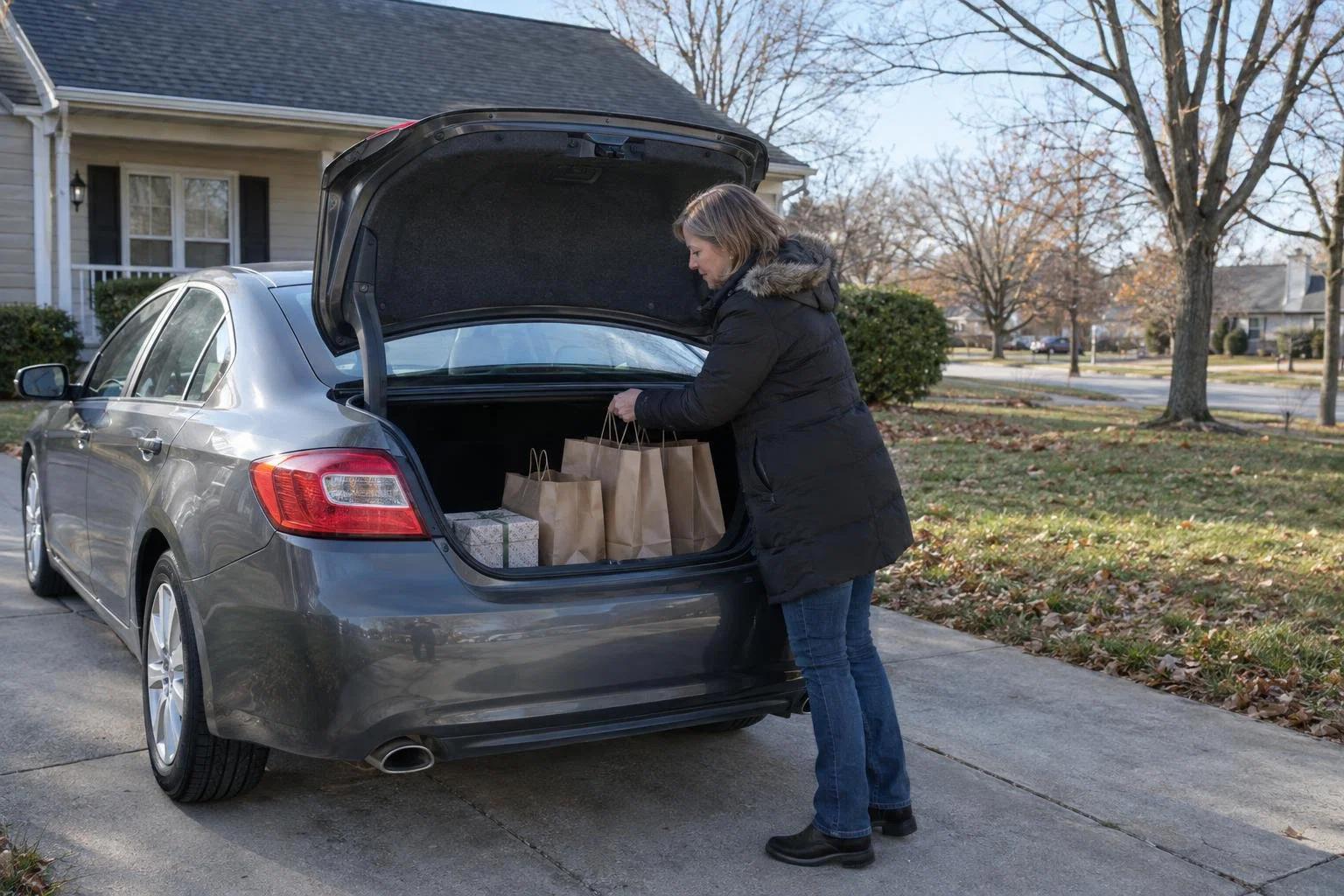
The first is the minute after you park. The NICB and police guidance warn that thieves watch parking lots and see shoppers moving valuables into the trunk after they park. If you do that, the thief now knows exactly which car holds the gifts.
The second is the quick stop with the engine running. Police in Howard County, Maryland, and James City County, Virginia, report "jump-in" thefts, where an opportunist gets into a car left running and unattended at a gas station, convenience store or residential driveway. A brief errand does not justify leaving the car on and the door open to the next person who walks by.
The Out-of-Sight Rule, Done Properly
Insurers and police give the same basic advice. Never leave valuables, shopping bags or personal identification in plain view inside the cabin. The NICB's holiday guidance also flags key fobs left inside the car as something thieves look for.
Doing the rule properly takes more than hiding things when you leave. Three habits make it work.
- Load the trunk before you arrive. Put the items already in the car away at home or at the previous stop, not in the lot where you are being watched.
- Clear the small stuff. A charging cable sticking out of a center console is one of the cues thieves use to confirm that a car holds electronics. Take cables and mounts out of view with the bags.
- Take the keys and the fob with you. A car left running or with keys inside is a jump-in theft waiting to happen. Insurers also treat keys left in the ignition as a breach of reasonable care, which we cover below.
If you have already parked and must move packages, our advice is to drive to a different space or lot first, so the people who watched you park do not see where the bags went. The sources do not rank that step, so it is our suggestion and not a measured one. Also remember that the rule assumes a closed trunk. A vehicle without one needs another way to keep items out of view.
Where the Rule Falls Short
Detective Jesse Harmon of James City County, Virginia, described a change in method when police reported a county-wide rise in vehicle vandalism and theft in March 2026. Thieves used to check for unlocked door handles, he said, and now they aggressively break car windows to steal belongings. A locked car is no longer a deterrent by itself, and a hidden item only helps if the thief cannot tell it is there.
Scanners Can Find Electronics You Cannot See

Thieves now use Bluetooth Low Energy, Wi-Fi and radio frequency scanning apps to detect electronics inside a car. Laptops, tablets and wireless headphones constantly emit short-range signals so they can pair with other devices. Inexpensive hardware or a smartphone app can pick those signals up from outside the car, which lets a thief pinpoint which vehicles hold valuable gear even when it is hidden in the trunk.
The method is often layered. A thief may use a Bluetooth scanner to find a general target, a thermal imaging camera to spot recent heat (a warm battery or recent driving), and then a human look to confirm, such as that charging cable.
The scanners have limits that you can use. They cannot detect electronics that are fully powered down or have Bluetooth explicitly disabled. They also produce false positives from the devices of passing pedestrians or nearby home networks. We would not describe a hit as proof that valuables are there, but a thief who gets a hit has a reason to try.
What to Do About It
The cheapest fix is to power gifts that have batteries all the way off, not asleep, before you put them in the trunk, and to disable Bluetooth on your own devices. The more certain fix is to take laptops and tablets with you or to store them in a Faraday enclosure. These pouches use electromagnetic shielding to block Wi-Fi, cellular, RFID, NFC and Bluetooth signals, and larger ones can stop a scanner from discovering a laptop or tablet in a parking lot.
Faraday pouches also have a second use. In a relay attack, thieves capture the signal of a key fob inside a house with one device and relay it to a second device near the car, which tricks the car into unlocking and starting. An Offgrid guide calls Faraday bags a high-return purchase for owners of push-to-start vehicles, with a warning that low-quality options may not block signals reliably. If you buy one, test it by putting the fob inside and trying to unlock the car from next to it. That test is our suggestion, not a step from the guide.
An Empty Car Is Still a Target
Some crews are not after your gifts. The Silver Spring crews harvested airbags and catalytic converters, and one group hit over 25 vehicles in the Four Corners area just for airbags. Nothing in the cabin would have changed that.
This is where insurance matters. Comprehensive coverage pays for components permanently built into or affixed to the vehicle, such as a factory-installed catalytic converter, stereo system or bike rack. Parts thieves are a reason to keep that coverage in place, not a reason to hide more things.
Aftermarket Remote Systems Are a Separate Risk
Researchers from UC San Diego presented a peer-reviewed paper on August 14, 2026, during the 35th USENIX Security Symposium (August 12–14, 2026) in Baltimore, Maryland. It covers aftermarket Bluetooth-based remote control systems, which let owners unlock doors and start engines from a smartphone app and are often installed by car dealerships or by owners.
The team found six such systems in use and critical vulnerabilities in three of them, two of which are installed by car dealers. Unlike factory systems, these often skip Bluetooth's built-in authentication and encryption and rely on flawed proprietary security. Because the systems broadcast Bluetooth advertisements, attackers can find targets by driving around or by querying public databases such as WiGLE, where these systems have been logged. The researchers estimate that these flaws expose 1.4 million vehicles to remote unlocking and unauthorized engine starts.
The paper does not name which products are affected in the material we have, so the practical step is to find out whether your car has an aftermarket remote and who installed it. If it does, ask the installer or the vendor whether it is one of the systems in that research.
Window Film and Trackers: What They Cost and Do
Two purchases come up in holiday advice. Neither is the first thing we would buy.
Window Film
Privacy tint reduces how much a thief can see into the cabin, and security-grade film makes glass harder to shatter in a smash-and-grab. Cost depends on film tier, vehicle class, glass complexity and local labor rates. A dataset of 27 certified-installer quotes from 2026 in markets including Atlanta, Dallas, Miami and Phoenix finds the film tier is the largest pricing variable.
| Film tier | 2026 full-car price range (estimated) | Trade-off |
| Dyed | $100 to $300 | Cheapest; fades over time; limited heat rejection. |
| Metalized | $200 to $400 | Interferes with cellular, GPS and toll signals. |
| Carbon | $200 to $500 | No signal interference; strong longevity. |
| Ceramic or nano-ceramic | $300 to $800 | Highest heat rejection and durability; no signal interference. |
Those are tint-tier prices. Ask any installer to quote security-grade film separately, because the tint ranges do not tell you what it costs.
Installers warn that a full-car "ceramic" quote under $250 is a red flag for dyed film sold as ceramic, since genuine ceramic material for a standard sedan costs $80 to $120 before labor. Brand moves the price: for the same compact class, the median quote for SunTek CXP was $340, against $675 for 3M Crystalline. SUVs and trucks cost 25% to 40% more than sedans. Check your state's visible light transmission limits first, because non-compliant tint can bring fines or forced removal.
Bluetooth Trackers
A tracker in a gift bag or a laptop sleeve can help find the item after a theft. These trackers rely on crowdsourced networks: when one moves out of range of the owner's phone, passing smartphones in the same ecosystem detect its Bluetooth signal, encrypt the location and send it to a cloud server without the passerby knowing.
There is a catch. Since the Detecting Unwanted Location Trackers standard that Apple and Google put in place in May 2024, iOS 17.5 and later and Android 6.0 and later alert users when an unknown tracker is traveling with them. That feature exists to stop stalking, but it also tells a thief who has stolen a tracked item that the tracker is there. Tile added an "Anti-Theft Mode" that hides the device from standard detection scans, and turning it on requires ID verification with biometric scanning.
We would treat a tracker as a bonus that may help recovery, not as protection, and never as a reason to leave an item in view.
What We Would Do First, and What We Would Skip
Our order puts free steps ahead of purchases, because they address the most common way cars get hit. The same mindset applies to seasonal driving, where simple habits in this fall driving safety guide matter more than gadgets.
- Load the trunk before you arrive and take your keys. This costs nothing and handles the visible-valuables problem the NICB describes.
- Power off electronics and disable Bluetooth, or carry them with you. It deals with the scanning risk at no cost.
- Read your insurance before the shopping starts. Know whether you carry comprehensive coverage, what your home or renters policy covers off-premises, and what each deductible is. We explain why below.
- Photograph gift cards. Record the number and PIN before gifting or storing them, because recovery depends on those details.
- Consider a Faraday pouch if you have a push-to-start car, and test it.
What would we skip for now? We would not buy window film in November just for this season. Film is a year-round purchase with a price range from $100 to $800 for a full car, and no source here gives a figure for how much it reduces break-ins. We also would not rely on a tracker in place of the first three steps.
The First Hour After a Break-In

If you come back to broken glass, safety comes first. If you suspect the thief is still nearby, move to a secure area and call the authorities. Do not move the vehicle until police arrive, so evidence stays intact.
Then document everything. Photograph all the damage, such as shattered glass, pried locks or a damaged ignition column, and write an itemized list of what is missing. Do not wait on the list, because your memory of what was in the trunk is best right now.
File a police report right away. Insurers require it before they process a claim, and officers will ask for your driver's license, vehicle registration and proof of insurance. Get the crime reference or case number, since insurers need it to proceed.
Two Policies, Two Deductibles
The most common misunderstanding is that one auto policy pays for everything. Damage to the car and loss of the items inside go through two separate policies, each with its own deductible.
| Loss | Comprehensive auto | Homeowners or renters |
| Shattered window or damaged lock | Yes | No |
| Factory audio system or catalytic converter | Yes | No |
| Holiday gifts, packages, groceries | No | Yes |
| Laptop, smartphone, briefcase | No | Yes |
The Car
Standard liability-only coverage does not pay for theft or break-in damage. You need optional comprehensive coverage, sometimes called "other than collision". It pays for structural repairs such as windows, locks or a ruined ignition column. If the whole car is stolen and not recovered, it typically pays actual cash value at the time of theft minus the deductible. Auto policies exclude personal items stolen from the car.
The Belongings
Gifts, laptops, phones, sports gear and luggage fall under homeowners, renters or condo insurance, through the off-premises clause that covers belongings stolen away from home, up to the policy's limits. An Advora guide says standard ISO property policies generally pay for theft without proof of forced entry, so items taken from an unlocked car can still be eligible.
Check the special limits. On the standard ISO renters form, stolen cash is capped at $200, jewelry, watches and furs combined at about $1,500, and electronic apparatus designed to run on the vehicle's power at $1,500. A watch or a gift of cash does not get reimbursed at replacement cost.
When Filing Does Not Pay
The deductible is what you pay before coverage starts. With a $1,000 deductible and $1,500 of stolen goods, the insurer reimburses $500. If the loss is lower than the deductible, a claim returns nothing and may raise future premiums. Run the numbers for the window and the gifts separately before you call anyone.
Bundling can help. In some bundled policies you pay only one deductible, usually the higher of the two, for a single break-in. Items that belong to someone else, such as a friend's camera left in your car, fall under that friend's homeowners policy and not yours.
Reasonable Care: How Claims Get Reduced or Denied
Motor and property policies carry a reasonable-care clause that requires you to take sensible steps to protect the vehicle and its contents. If an insurer finds that you breached it, it may reduce the payout or deny the claim. Policy wording varies, so read yours. These are the situations that guides on the subject describe:
- Keys left in the car. A theft after keys were left in the ignition, or hidden in a magnetic box on the chassis, is routinely treated as a breach of reasonable care.
- An unlocked car or open windows. Renters insurance generally pays for items stolen from an unlocked car, but leaving it unlocked or leaving windows or sunroofs open can hurt the auto claim. Some comprehensive policies exclude coverage if the car was left unsecured.
- Valuables in plain sight. A Quashed guide says an insurer may argue that visible high-value items attracted the break-in, which can complicate a comprehensive claim for the window and lock damage. This is the out-of-sight rule showing up on the insurance side.
- Ignoring written security requirements. Some policies require a specific alarm, immobilizer or tracker, or require a locked garage overnight, and not meeting those terms leads to denial.
Be accurate in what you report. The Insurance and Financial Services Ombudsman in New Zealand upheld a case in which an insurer declined a claim and voided a couple's motor policy entirely after an investigation found they had misrepresented the timing and nature of damage to their vehicle. Tell the insurer what happened, even if it is less flattering.
Gift Cards: A Separate Recovery Problem
Gift cards are liquid and need no ID, so thieves target them. Police in Howard County, Maryland, note that criminals often use stolen credit cards to buy gift cards in bulk right after a break-in. That makes your credit cards the first thing to freeze, along with any cards in the stolen items.
Recovery is possible, but it depends on speed and paperwork. The first step is to contact the issuing retailer. You will need the card number, the PIN and the original receipt showing the date, time and amount. Without them retailers often cannot find the funds.
If the thief has not used the card, the retailer can usually freeze the balance, cancel the card and issue a replacement, sometimes for a fee. If the card has been emptied, replacement is highly unlikely. To prepare, photograph the front and back of a card (after scratching off the PIN cover) before storing it, or enter the details in a mobile wallet, and register the card on the issuer's website if it offers that, so you have a history and proof of ownership.
| Issuer | Phone | What to expect |
| Apple | 1-800-275-2273 | A representative checks whether money remains and can freeze it. |
| Target | 1-800-544-2943 | Have the original receipt and card details ready. |
| Walmart | 1-888-537-5503 | Have the original receipt and card details ready. |
| Visa | 1-800-847-2911 | Prepaid cards work like bank cards, so report theft immediately to block transactions. |
| Vanilla | 1-833-322-6760 | Same as Visa. |
Amazon works differently. According to a Quora answer describing its policy, a redeemed gift card cannot be unredeemed or refunded for cash, and customer service moves a balance to another account only when the rightful owner applied it to the wrong profile by mistake, not when a stolen card was applied to a thief's account. If an issuer refuses to help, or if you were pressured into handing cards to a scammer, the Federal Trade Commission recommends reporting the fraud at ReportFraud.ftc.gov. Our advice is to photograph cards first, so you never reach that point.
Conclusion: Do the Free Things This Week
Start with the steps that cost nothing: load the trunk before you park, take your keys, power off electronics and clear cables from view. Then spend ten minutes on your insurance, because most people find out about the second deductible and the $200 cash limit only after a claim. If you want to buy something, a tested Faraday pouch for a push-to-start fob has the clearest case, and window film can wait until it makes sense for the whole year.
If you want to talk through how to protect a vehicle during the holidays, get in touch with Carszy.
FAQ
Does my car insurance cover holiday gifts stolen from the trunk?
No. Auto policies exclude personal items stolen from the vehicle. Gifts, laptops and phones fall under homeowners, renters or condo insurance through the off-premises clause, up to your limits. The car damage, such as a broken window or lock, goes to your comprehensive auto coverage, which carries its own deductible.
Is locking gifts in the trunk enough?
It stops the thief who is scanning for visible items, and it is the baseline advice from the NICB and police. It does not stop a thief who watched you load the trunk, and it does not hide powered-on electronics from Bluetooth, Wi-Fi and radio scanners. Load the trunk before you arrive, and turn off electronics or take them with you.
Can thieves really find a laptop hidden in my trunk?
A scanner can detect a laptop that is powered on and discoverable, even if it is hidden, because it emits short-range signals. The scanners cannot detect devices that are fully powered down or have Bluetooth disabled, and they sometimes pick up passing pedestrians' devices or nearby home networks by mistake. A Faraday enclosure blocks the signals.
How long does a smash-and-grab take?
The NICB says five to ten seconds once a target is selected. That is too short for most alarms to bring anyone, which is why prevention carries more weight than response.
What should I do first if my car is broken into?
If the thief may still be near, move somewhere secure and call the authorities. Leave the car where it is until police arrive. Photograph the damage, list the missing items and file a police report, then get the case number your insurer will need. Bring your license, registration and proof of insurance when you file.
Should I file a claim if the loss is less than my deductible?
The insurer pays nothing below the deductible, and a claim may raise your future premiums. With a $1,000 deductible and $1,500 of stolen goods, you would get $500. Compare the glass repair and the stolen items against their own deductibles, since two policies are involved.
Could leaving valuables in view hurt my claim?
It can. A Quashed guide says an insurer may argue that visible valuables attracted the break-in and failed the reasonable-care standard, which can weaken a comprehensive claim for window and lock damage. Leaving keys in the car or the car unlocked can also cause trouble with the auto claim. Check your own policy's wording.
What if a gift card was in the stolen bag?
Call the issuer right away with the card number, PIN and receipt. If the balance is intact, the retailer can usually freeze it and issue a replacement, sometimes for a fee. If the thief has already spent it, the funds are probably gone. Freeze your credit cards too, since thieves may use stolen ones to buy gift cards in bulk.
Does the national drop in car theft mean my area is safe?
No. The NICB reported a 21% national decline in vehicle thefts for the first half of 2026, but Montgomery County, Maryland, saw a 22% increase in the year ending July 28, 2026, and Chicago-Naperville-Elgin was the only top-10 metro area where thefts rose. Those figures count stolen vehicles and not break-ins, but they show that local conditions can differ sharply from the national trend.
Supporting Links
- NRF forecast for 2026 holiday sales growth
- NICB advice on keeping your vehicle from being an easy holiday target
- prnewswire.com
- James City County police on rising car thefts and vandalism
- How thieves detect hidden electronics in cars with scanners
- USENIX Security paper on aftermarket Bluetooth car remote systems
- Whether home insurance covers holiday gifts stolen in a break-in